Attorney-Verified  Motor Vehicle Bill of Sale Document for Hawaii

Attorney-Verified Motor Vehicle Bill of Sale Document for Hawaii

The Hawaii Motor Vehicle Bill of Sale form is an important document that records the transfer of ownership for a vehicle in Hawaii. This form provides essential details about the vehicle and the buyer and seller, ensuring a smooth transaction. To get started, fill out the form by clicking the button below.

Article Guide

When buying or selling a vehicle in Hawaii, the Motor Vehicle Bill of Sale form serves as an essential document that facilitates the transfer of ownership. This form captures vital information such as the names and addresses of both the buyer and seller, vehicle identification details, and the sale price. It also includes fields for the date of the transaction and any relevant odometer readings, ensuring transparency and accountability in the sale process. By providing a clear record of the transaction, the Bill of Sale helps protect both parties by outlining the terms of the sale. Furthermore, it can be instrumental in resolving any disputes that may arise after the sale is completed. Understanding the importance of this document can streamline the buying and selling process, making it a crucial step for anyone involved in a vehicle transaction in the Aloha State.

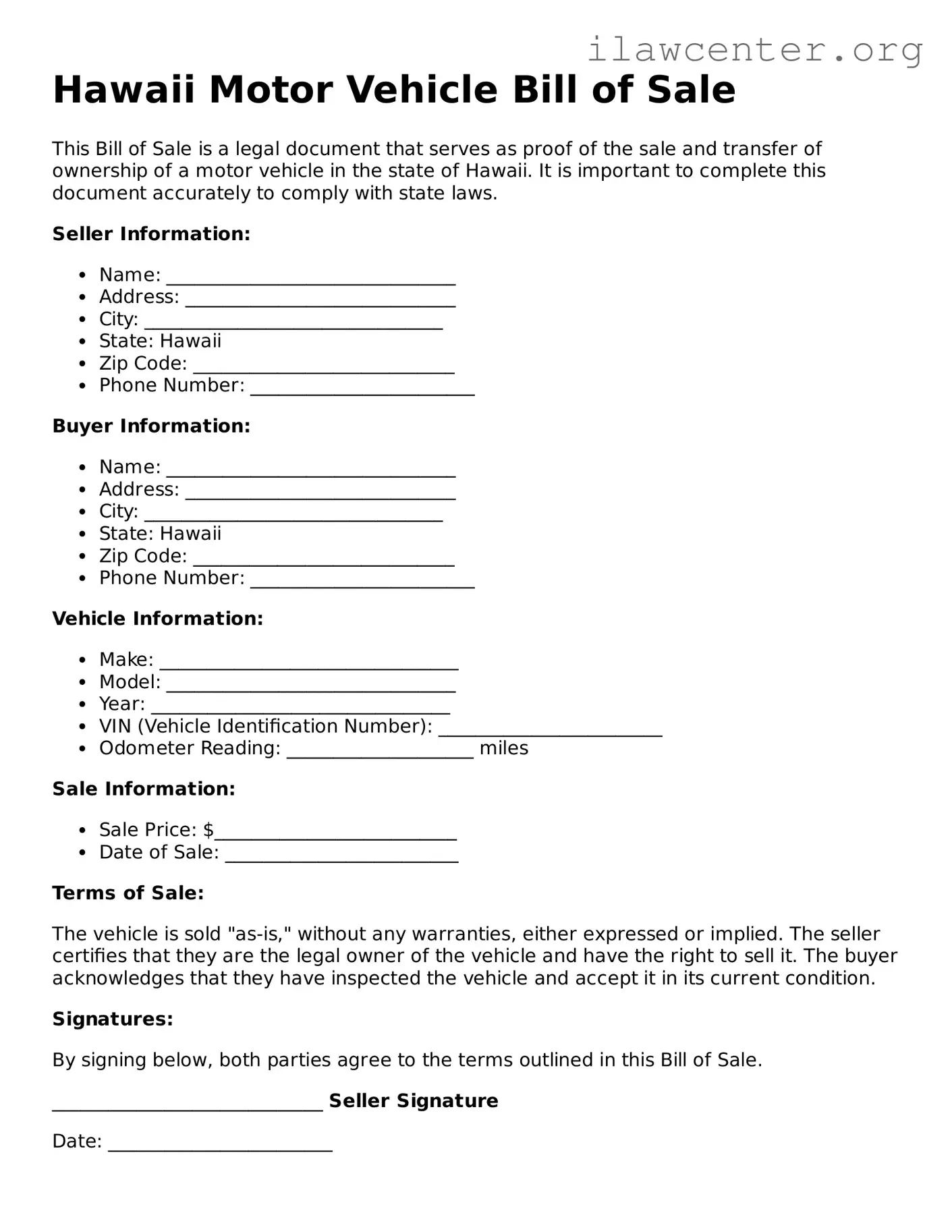
Hawaii Motor Vehicle Bill of Sale Preview

Hawaii Motor Vehicle Bill of Sale

This Bill of Sale is a legal document that serves as proof of the sale and transfer of ownership of a motor vehicle in the state of Hawaii. It is important to complete this document accurately to comply with state laws.

Seller Information:

  • Name: _______________________________
  • Address: _____________________________
  • City: ________________________________
  • State: Hawaii
  • Zip Code: ____________________________
  • Phone Number: ________________________

Buyer Information:

  • Name: _______________________________
  • Address: _____________________________
  • City: ________________________________
  • State: Hawaii
  • Zip Code: ____________________________
  • Phone Number: ________________________

Vehicle Information:

  • Make: ________________________________
  • Model: _______________________________
  • Year: ________________________________
  • VIN (Vehicle Identification Number): ________________________
  • Odometer Reading: ____________________ miles

Sale Information:

  • Sale Price: $__________________________
  • Date of Sale: _________________________

Terms of Sale:

The vehicle is sold "as-is," without any warranties, either expressed or implied. The seller certifies that they are the legal owner of the vehicle and have the right to sell it. The buyer acknowledges that they have inspected the vehicle and accept it in its current condition.

Signatures:

By signing below, both parties agree to the terms outlined in this Bill of Sale.

_____________________________ Seller Signature

Date: ________________________

_____________________________ Buyer Signature

Date: ________________________

This Bill of Sale is governed by the laws of the state of Hawaii.

PDF Form Characteristics

Fact Name Details
Purpose The Hawaii Motor Vehicle Bill of Sale form is used to document the sale of a motor vehicle between a buyer and a seller.
Governing Law This form is governed by the Hawaii Revised Statutes, specifically under Chapter 286, which pertains to motor vehicles.
Required Information The form requires details such as the vehicle identification number (VIN), make, model, year, and the sale price.
Signatures Both the seller and buyer must sign the form to validate the transaction and transfer ownership of the vehicle.

Instructions on Utilizing Hawaii Motor Vehicle Bill of Sale

After obtaining the Hawaii Motor Vehicle Bill of Sale form, it is essential to fill it out accurately to ensure a smooth transaction. This document will serve as proof of sale for both the buyer and the seller. Follow the steps below to complete the form correctly.

  1. Begin by entering the date of the sale at the top of the form.
  2. Provide the name and address of the seller in the designated section.
  3. Fill in the name and address of the buyer next.
  4. Include the vehicle identification number (VIN) to uniquely identify the vehicle.
  5. List the make, model, and year of the vehicle.
  6. Indicate the odometer reading at the time of sale.
  7. Specify the purchase price of the vehicle.
  8. Both the buyer and seller must sign and date the form to validate the transaction.

Once completed, ensure that both parties retain a copy for their records. This will help in case any issues arise in the future regarding the sale.

Important Facts about Hawaii Motor Vehicle Bill of Sale

What is a Hawaii Motor Vehicle Bill of Sale?

The Hawaii Motor Vehicle Bill of Sale is a legal document used to transfer ownership of a vehicle from one party to another. This form serves as proof of the transaction and includes important details such as the vehicle's make, model, year, and Vehicle Identification Number (VIN). It also records the names and addresses of both the buyer and seller, along with the sale price and date of the transaction.

Is a Bill of Sale required in Hawaii?

While a Bill of Sale is not legally required in Hawaii for the transfer of a vehicle, it is highly recommended. This document provides a clear record of the sale, which can be useful for both the buyer and seller. It can help protect against future disputes regarding ownership or the terms of the sale, and it may be required by some financial institutions or insurance companies when registering the vehicle.

What information should be included in the Bill of Sale?

A comprehensive Bill of Sale should include several key pieces of information. First, the full names and addresses of both the buyer and seller must be included. Second, details about the vehicle, such as its make, model, year, and VIN, should be clearly stated. Additionally, the sale price and the date of the transaction are essential. It’s also advisable to include any warranties or conditions of the sale, if applicable.

How do I complete the Bill of Sale?

To complete the Bill of Sale, both the buyer and seller should carefully fill out the form with the required information. It is important to ensure that all details are accurate and legible. After filling out the form, both parties should sign and date it. Each party should keep a copy for their records. This documentation will help facilitate a smooth registration process with the Hawaii Department of Transportation.

Can I create my own Bill of Sale, or do I need a specific form?

You can create your own Bill of Sale as long as it includes all necessary information. However, using a specific form designed for Hawaii can simplify the process. Official forms may be available through the Hawaii Department of Transportation or other authorized entities. Utilizing a standard form can also help ensure that you do not miss any critical details that could lead to complications later on.

What should I do after completing the Bill of Sale?

Once the Bill of Sale is completed and signed by both parties, the next step is to register the vehicle with the Hawaii Department of Transportation. The buyer will need to provide the completed Bill of Sale, along with other required documents, such as the vehicle title and proof of insurance. Timely registration is important to avoid any penalties or issues with the vehicle's legal status.
Common mistakes

Filling out the Hawaii Motor Vehicle Bill of Sale form can be straightforward, but mistakes happen. One common error is not providing the correct vehicle identification number (VIN). The VIN is crucial for identifying the vehicle and ensuring that all details match. Double-check this number before submitting the form.

Another frequent mistake is omitting the purchase price. It's important to include this information, as it reflects the transaction's value. Leaving it blank can lead to complications down the line, especially when it comes to tax assessments.

People often forget to sign the form. A signature is essential for validating the sale. Without it, the document may not hold up if disputes arise. Make sure both the seller and buyer sign the form to avoid future issues.

Not including the date of sale is another oversight. The date helps establish the timeline of the transaction and is necessary for record-keeping. Always fill in this section to keep everything clear and official.

Many individuals also neglect to provide their contact information. This can create problems if either party needs to follow up regarding the sale. Including phone numbers or email addresses ensures that communication remains open.

Another mistake involves using incorrect or outdated forms. Always check that you have the most recent version of the Bill of Sale. Using an outdated form can lead to confusion and potential legal issues.

Some people fail to include a description of the vehicle. Details such as make, model, and year are essential for accurately identifying the vehicle. Providing a thorough description can prevent misunderstandings later on.

Not keeping a copy of the completed form is a mistake many make. Having a record of the transaction can be beneficial for both parties. It's wise to retain a copy for your files in case questions arise in the future.

Finally, failing to understand the implications of the Bill of Sale can lead to problems. This document serves as proof of ownership transfer and may have legal consequences. Make sure you fully understand what you are signing.

Documents used along the form

When completing a transaction involving the sale or transfer of a vehicle in Hawaii, several additional documents may be required to ensure a smooth process. Below is a list of common forms and documents that are often used alongside the Hawaii Motor Vehicle Bill of Sale form.

  • Certificate of Title: This document proves ownership of the vehicle. It must be signed over to the new owner at the time of sale.
  • Vehicle Registration Application: This form is necessary for registering the vehicle in the new owner's name. It includes details about the vehicle and the new owner.
  • Odometer Disclosure Statement: Required by federal law, this statement discloses the vehicle's mileage at the time of sale. It helps prevent odometer fraud.
  • Safety Inspection Certificate: In Hawaii, vehicles must pass a safety inspection before being registered. This certificate proves the vehicle meets safety standards.
  • Proof of Insurance: The new owner must provide proof of insurance coverage for the vehicle before it can be registered.
  • Power of Attorney: If someone is handling the transaction on behalf of the owner, this document grants them the authority to act in the owner's stead.

Having these documents prepared and organized can facilitate a hassle-free vehicle transaction. Ensure that all parties involved understand their responsibilities and have the necessary paperwork ready to go.

Similar forms

  • Boat Bill of Sale: This document transfers ownership of a boat from one party to another. Like the Motor Vehicle Bill of Sale, it includes details about the seller, buyer, and the boat itself.
  • Motorcycle Bill of Sale: Similar to the Motor Vehicle Bill of Sale, this form is used to document the sale of a motorcycle. It captures essential information about both the buyer and seller, along with motorcycle specifics.
  • ATV Bill of Sale: This document serves to transfer ownership of an all-terrain vehicle. It shares similarities with the Motor Vehicle Bill of Sale in terms of the information required for both parties involved.
  • Trailer Bill of Sale: Used for the sale of a trailer, this form includes details about the seller, buyer, and the trailer. It functions similarly to the Motor Vehicle Bill of Sale.
  • Mobile Home Bill of Sale: This document is used when selling a mobile home. It contains buyer and seller information and details about the mobile home, much like the Motor Vehicle Bill of Sale.
  • Aircraft Bill of Sale: This document facilitates the transfer of ownership of an aircraft. It requires similar information to that found in the Motor Vehicle Bill of Sale, including identification of both parties and the aircraft.
  • Personal Property Bill of Sale: This form is used for the sale of personal items, such as furniture or electronics. It documents the transaction and includes buyer and seller information, paralleling the Motor Vehicle Bill of Sale.

Dos and Don'ts

When filling out the Hawaii Motor Vehicle Bill of Sale form, there are important steps to follow. Below is a list of dos and don'ts to ensure the process goes smoothly.

  • Do provide accurate information about the vehicle, including make, model, year, and VIN.
  • Do include the purchase price clearly to avoid any misunderstandings.
  • Do sign and date the form to validate the sale.
  • Do ensure both the buyer and seller retain a copy of the completed form for their records.
  • Don't leave any fields blank; incomplete forms can cause issues later.
  • Don't forge signatures or provide false information; this can lead to legal problems.
  • Don't forget to check for any outstanding liens on the vehicle before completing the sale.
  • Don't assume that verbal agreements are sufficient; always document the sale in writing.

Misconceptions

Understanding the Hawaii Motor Vehicle Bill of Sale form is essential for anyone involved in buying or selling a vehicle in the state. However, several misconceptions can lead to confusion. Here are eight common misunderstandings:

  • It is not a legally binding document. Some people think that a bill of sale is just a casual agreement. In reality, it serves as a legal record of the transaction, providing proof of ownership transfer.
  • Only the seller needs to sign it. A common belief is that only the seller's signature is necessary. Both the buyer and seller should sign the document to validate the transaction.
  • It is not required in Hawaii. Many assume that a bill of sale is optional. However, it is highly recommended and often required for registering the vehicle with the state.
  • It must be notarized. Some people think notarization is mandatory. While it can add an extra layer of security, notarization is not a requirement for the bill of sale in Hawaii.
  • It can be handwritten. Many believe that any format will suffice. While a handwritten bill of sale is acceptable, using a standardized form can help ensure all necessary information is included.
  • It is only for used vehicles. Some think that a bill of sale is only needed for second-hand transactions. New vehicle purchases also require a bill of sale for registration purposes.
  • It doesn't need to include vehicle details. A misconception exists that basic information is sufficient. The bill of sale should include specific details about the vehicle, such as the VIN, make, model, and year.
  • Once signed, it cannot be changed. Some believe that the document is final and cannot be altered. If both parties agree, changes can be made before the vehicle is registered.

By clarifying these misconceptions, individuals can better navigate the process of buying or selling a vehicle in Hawaii, ensuring a smoother transaction.

Key takeaways

When it comes to buying or selling a vehicle in Hawaii, understanding the Motor Vehicle Bill of Sale form is essential. This document serves as a record of the transaction and provides important information for both parties involved. Here are some key takeaways:

  • Accurate Information is Crucial: Ensure that all details, including the vehicle identification number (VIN), make, model, year, and odometer reading, are filled out accurately. This information is vital for registration and title transfer.
  • Signatures Matter: Both the buyer and seller must sign the form. This signature confirms that both parties agree to the terms of the sale and acknowledges the transfer of ownership.
  • Keep a Copy: After completing the Bill of Sale, both the buyer and seller should retain a copy for their records. This document can serve as proof of the transaction in case of any future disputes.
  • Check Local Requirements: While the Bill of Sale is a standard document, always verify if there are additional requirements specific to your county or city in Hawaii. Local regulations may dictate additional information or documentation needed for the sale.