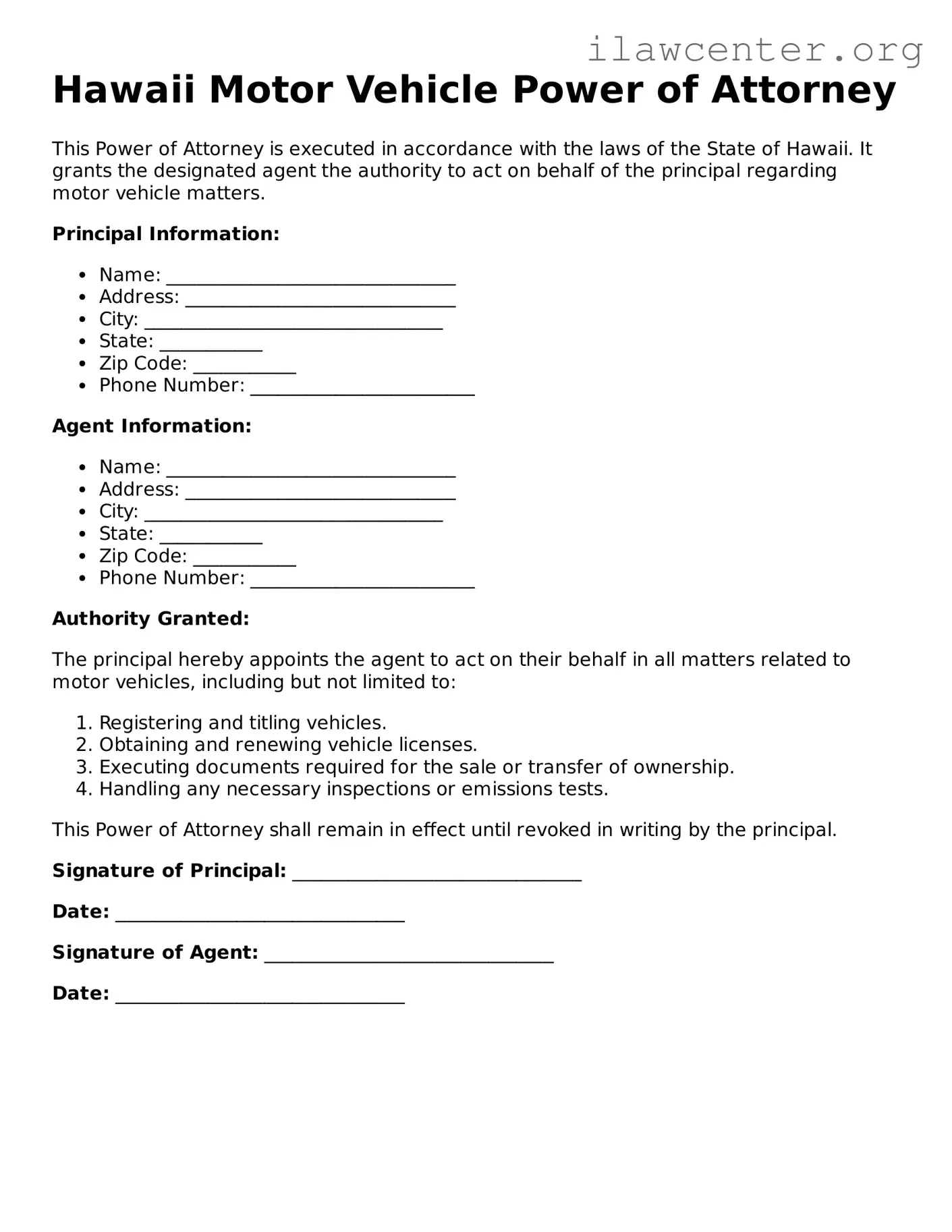
What is a Hawaii Motor Vehicle Power of Attorney form?
The Hawaii Motor Vehicle Power of Attorney form is a legal document that allows an individual, known as the principal, to appoint another person, called the agent, to act on their behalf regarding motor vehicle transactions. This can include tasks such as registering a vehicle, transferring ownership, or obtaining title documents. Essentially, it grants the agent the authority to handle specific vehicle-related matters that the principal may not be able to manage personally.
Who can be appointed as an agent in the Motor Vehicle Power of Attorney?
Any competent adult can be appointed as an agent in the Motor Vehicle Power of Attorney. This means that the person you choose should be at least 18 years old and capable of understanding the responsibilities they will undertake. Many people select trusted friends, family members, or professionals, such as attorneys, to ensure their interests are well-represented.
Is the Motor Vehicle Power of Attorney form specific to Hawaii?
Yes, the Motor Vehicle Power of Attorney form is specific to Hawaii. Each state has its own requirements and regulations regarding power of attorney documents. Therefore, if you are dealing with motor vehicle transactions in Hawaii, it is essential to use the appropriate form that complies with state laws to ensure its validity.
Do I need to have the Motor Vehicle Power of Attorney notarized?
In Hawaii, notarization is not a strict requirement for the Motor Vehicle Power of Attorney form. However, having the document notarized can provide an additional layer of authenticity and may be required by certain institutions or agencies when the agent presents the form. It is always a good practice to check with the specific entity involved to confirm their requirements.
Can I revoke the Motor Vehicle Power of Attorney once it is signed?
Yes, you can revoke the Motor Vehicle Power of Attorney at any time, as long as you are competent to do so. To revoke the document, you should create a written notice of revocation and communicate this to your agent and any relevant parties, such as the Department of Motor Vehicles. This ensures that everyone is aware that the agent no longer has the authority to act on your behalf.
What happens if the principal becomes incapacitated?
If the principal becomes incapacitated, the Motor Vehicle Power of Attorney typically remains in effect unless it is specifically stated to terminate upon incapacitation. This means that the agent can continue to act on behalf of the principal. However, if the principal wants to ensure that the power of attorney ends if they become incapacitated, they should include such a provision in the document when it is created.
Are there any limitations to what the agent can do?
Yes, the principal can specify limitations in the Motor Vehicle Power of Attorney. For instance, the principal may allow the agent to handle only certain transactions, like selling a specific vehicle, or they may restrict the agent from taking any action without prior approval. It is crucial to clearly outline these limitations in the document to avoid any misunderstandings later on.
How long is the Motor Vehicle Power of Attorney valid?
The validity of the Motor Vehicle Power of Attorney can vary based on the terms set forth in the document. Generally, it remains effective until the principal revokes it, the principal passes away, or a specified expiration date is reached. If the principal wants the power of attorney to be valid for a specific period, this should be explicitly stated in the document.
What should I do if my agent abuses their power?
If you suspect that your agent is abusing their power or acting against your interests, it is important to act quickly. You can revoke the Motor Vehicle Power of Attorney immediately by providing written notice to the agent and any relevant parties. Additionally, you may want to consult with a legal professional to discuss your options for addressing the situation and protecting your interests.