Attorney-Verified  Non-compete Agreement Document for Hawaii

Attorney-Verified Non-compete Agreement Document for Hawaii

A Hawaii Non-compete Agreement is a legal document designed to restrict an employee from competing with their employer for a specified period after leaving the company. This agreement aims to protect the employer's business interests and confidential information. To get started on your Non-compete Agreement, fill out the form by clicking the button below.

Article Guide

In the vibrant business landscape of Hawaii, the Non-compete Agreement form serves as a crucial tool for employers and employees alike. This legal document outlines the terms under which an employee agrees not to engage in competitive activities within a specified geographical area and time frame after leaving a job. It aims to protect a company’s proprietary information, trade secrets, and client relationships from being exploited by former employees. The form typically includes essential details such as the duration of the non-compete clause, the geographic limits of the restriction, and the specific activities that are prohibited. While these agreements can help safeguard business interests, they must also comply with Hawaii's unique legal standards to be enforceable. Understanding the nuances of this form is vital for anyone involved in employment contracts in the state, as it can significantly impact future career opportunities and business operations.

Hawaii Non-compete Agreement Preview

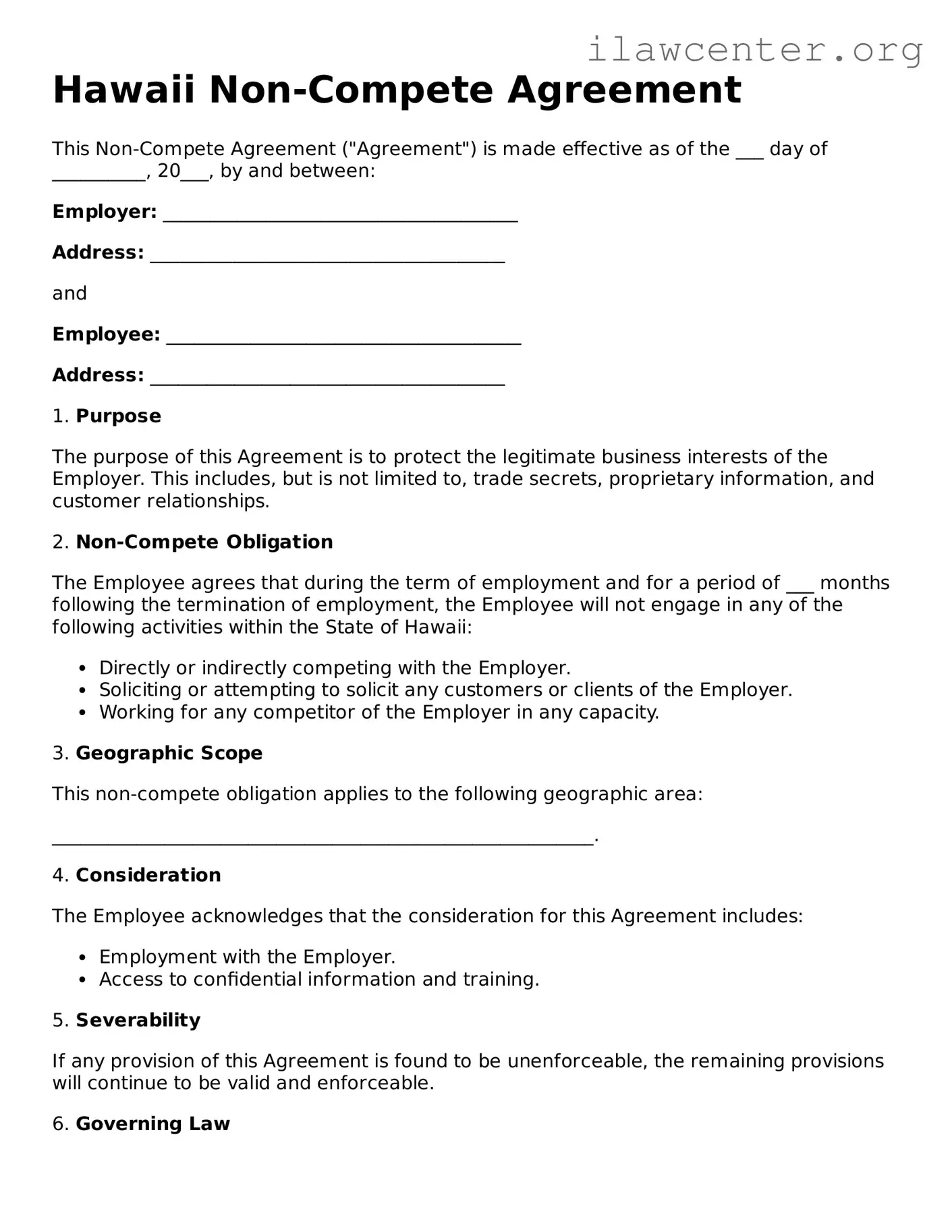
Hawaii Non-Compete Agreement

This Non-Compete Agreement ("Agreement") is made effective as of the ___ day of __________, 20___, by and between:

Employer: ______________________________________

Address: ______________________________________

and

Employee: ______________________________________

Address: ______________________________________

1. Purpose

The purpose of this Agreement is to protect the legitimate business interests of the Employer. This includes, but is not limited to, trade secrets, proprietary information, and customer relationships.

2. Non-Compete Obligation

The Employee agrees that during the term of employment and for a period of ___ months following the termination of employment, the Employee will not engage in any of the following activities within the State of Hawaii:

  • Directly or indirectly competing with the Employer.
  • Soliciting or attempting to solicit any customers or clients of the Employer.
  • Working for any competitor of the Employer in any capacity.

3. Geographic Scope

This non-compete obligation applies to the following geographic area:

__________________________________________________________.

4. Consideration

The Employee acknowledges that the consideration for this Agreement includes:

  • Employment with the Employer.
  • Access to confidential information and training.

5. Severability

If any provision of this Agreement is found to be unenforceable, the remaining provisions will continue to be valid and enforceable.

6. Governing Law

This Agreement shall be governed by and construed in accordance with the laws of the State of Hawaii.

7. Entire Agreement

This Agreement constitutes the entire understanding between the parties and supersedes all prior discussions and agreements.

IN WITNESS WHEREOF, the parties have executed this Non-Compete Agreement as of the date first above written.

Employer Signature: ___________________________

Date: ______________________________________

Employee Signature: ___________________________

Date: ______________________________________

PDF Form Characteristics

Fact Name Details
Governing Law Hawaii Revised Statutes § 480-4
Enforceability Non-compete agreements in Hawaii are generally enforceable if reasonable in scope and duration.
Duration Limit Agreements should typically not exceed two years in duration to be considered reasonable.
Geographic Scope The geographic area covered by the agreement must be clearly defined and reasonable.
Consideration A valid non-compete must provide consideration, such as employment or training.
Exceptions Non-compete agreements cannot restrict an employee from engaging in lawful employment after leaving a job.
Judicial Review Courts may modify or invalidate overly broad non-compete agreements to ensure fairness.

Instructions on Utilizing Hawaii Non-compete Agreement

Filling out the Hawaii Non-compete Agreement form is an important step in establishing the terms of your professional relationship. After completing the form, it will need to be reviewed and signed by all parties involved to ensure mutual understanding and compliance with the terms outlined.

  1. Begin by downloading the Hawaii Non-compete Agreement form from a reliable source.
  2. Read through the entire form carefully to understand its content and implications.
  3. Fill in your full name and contact information in the designated fields.
  4. Provide the name and contact information of the other party or parties involved.
  5. Clearly state the duration of the non-compete agreement in the specified section.
  6. Define the geographic area where the non-compete will apply.
  7. Outline the specific activities or businesses that are restricted under this agreement.
  8. Include any additional terms or conditions that may be relevant to your situation.
  9. Review the completed form to ensure all information is accurate and complete.
  10. Have all parties sign and date the form in the appropriate sections.

Once the form is filled out and signed, keep a copy for your records and provide copies to the other parties involved. It’s advisable to consult with a professional if you have any questions or concerns about the agreement.

Important Facts about Hawaii Non-compete Agreement

What is a Hawaii Non-compete Agreement?

A Hawaii Non-compete Agreement is a legal document that restricts an employee from engaging in certain activities that could compete with their employer after leaving the company. These agreements are designed to protect business interests, trade secrets, and confidential information. In Hawaii, such agreements must be reasonable in scope, duration, and geographic area to be enforceable.

Are Non-compete Agreements enforceable in Hawaii?

Yes, Non-compete Agreements can be enforceable in Hawaii, but they are subject to specific limitations. The state law requires that the terms of the agreement be reasonable and not overly restrictive. Courts will evaluate the necessity of the agreement in protecting legitimate business interests while balancing the employee's right to work. If an agreement is deemed too broad or unfair, it may be invalidated.

What factors determine the enforceability of a Non-compete Agreement in Hawaii?

Several factors influence the enforceability of a Non-compete Agreement in Hawaii. These include the duration of the restriction, the geographic area covered, and the nature of the business. Additionally, the court will consider whether the agreement protects a legitimate business interest, such as trade secrets or customer relationships, and whether it imposes an undue hardship on the employee.

How long can a Non-compete Agreement last in Hawaii?

The duration of a Non-compete Agreement in Hawaii should be reasonable. While there is no specific time frame mandated by law, agreements typically range from six months to two years. Courts will assess the reasonableness of the time period based on the nature of the industry and the specific circumstances surrounding the employment.

Can an employee negotiate the terms of a Non-compete Agreement?

Yes, employees can negotiate the terms of a Non-compete Agreement before signing it. It's important for employees to understand their rights and the implications of the agreement. Open communication with employers about concerns regarding specific terms can lead to a more balanced agreement that protects both parties' interests.

What should an employee do if they believe their Non-compete Agreement is unfair?

If an employee feels that their Non-compete Agreement is unfair or overly restrictive, they should seek legal advice. Consulting with an attorney who specializes in employment law can provide clarity on their rights and options. An attorney can help assess the agreement's enforceability and advise on possible next steps, which may include negotiation or legal action.

Common mistakes

When filling out the Hawaii Non-compete Agreement form, individuals often overlook several critical aspects that can lead to misunderstandings or legal issues. One common mistake is failing to clearly define the scope of the non-compete clause. It is essential to specify the geographical area and the duration for which the agreement will be in effect. Without this clarity, the agreement may be deemed overly broad or unenforceable.

Another frequent error is neglecting to consider the reasonableness of the restrictions imposed. Non-compete agreements must be reasonable in terms of time and geographic limitations. If the restrictions are too extensive, they may not hold up in court. A well-crafted agreement should balance the interests of both the employer and the employee.

Many individuals also forget to include consideration in the agreement. Consideration refers to something of value exchanged between the parties involved. In the context of a non-compete agreement, this could be employment itself, a promotion, or additional compensation. Without adequate consideration, the agreement may not be enforceable.

Additionally, some people make the mistake of not reviewing the agreement with legal counsel. Legal language can be complex, and having an expert review the document ensures that it complies with Hawaii's laws and regulations. This step can prevent future disputes and misunderstandings.

Another common oversight is failing to update the agreement when circumstances change. If an employee's role evolves or if the business expands into new markets, the original agreement may no longer be applicable. Regularly reviewing and updating the agreement is crucial to ensure its relevance and enforceability.

Lastly, individuals sometimes underestimate the importance of mutual agreement. Both parties should fully understand and agree to the terms outlined in the non-compete agreement. A lack of mutual consent can lead to disputes and potential legal challenges down the road. Open communication about the terms can foster a better understanding and cooperation between both parties.

Documents used along the form

When drafting a Hawaii Non-compete Agreement, it is essential to consider additional documents that may complement or support the agreement. Each of these forms serves a specific purpose and can help clarify the terms of the non-compete arrangement. Below is a list of commonly used forms that you may need to prepare alongside the Non-compete Agreement.

  • Employment Agreement: This document outlines the terms of employment between the employer and employee. It typically includes job responsibilities, compensation, and other essential details that may relate to the non-compete terms.
  • Confidentiality Agreement: Also known as a Non-disclosure Agreement (NDA), this form protects sensitive information shared between parties during the course of employment. It ensures that proprietary information remains confidential, which often ties into non-compete clauses.
  • Severance Agreement: This agreement is used when an employee is leaving the company. It may include terms regarding the non-compete obligations and any compensation or benefits the employee will receive upon termination.
  • Independent Contractor Agreement: If a business hires independent contractors, this document outlines the terms of the working relationship. It may include non-compete clauses relevant to the contractor's work and the protection of the business's interests.
  • Intellectual Property Assignment Agreement: This document ensures that any intellectual property created by an employee during their tenure belongs to the employer. This can be crucial in a non-compete context, as it protects the company's innovations and ideas.
  • Non-solicitation Agreement: This agreement prevents an employee from soliciting clients or employees of the company after leaving. It is often used in conjunction with a non-compete agreement to provide broader protection for the business.

By preparing these documents, you can create a comprehensive legal framework that supports the objectives of the Hawaii Non-compete Agreement. Ensuring all relevant forms are in place can help protect your interests and clarify the obligations of all parties involved.

Similar forms

  • Non-disclosure Agreement (NDA): This document prevents individuals from sharing confidential information. Like a non-compete agreement, it aims to protect a company's sensitive information and trade secrets.
  • Employment Agreement: This document outlines the terms of employment, including duties, compensation, and duration. Both agreements establish clear expectations between the employer and employee, ensuring mutual understanding.
  • Non-solicitation Agreement: This agreement restricts an employee from soliciting clients or employees after leaving a company. Similar to a non-compete, it protects business relationships and reduces the risk of unfair competition.
  • Confidentiality Agreement: This document ensures that parties involved do not disclose proprietary information. It shares the same goal as a non-compete by safeguarding a company's intellectual property and maintaining a competitive edge.
  • Partnership Agreement: This outlines the terms of a partnership, including roles, responsibilities, and profit-sharing. Like a non-compete agreement, it aims to clarify expectations and protect each partner's interests in the business.

Dos and Don'ts

When filling out the Hawaii Non-compete Agreement form, it's essential to approach the task with care. Here are ten important do's and don'ts to consider:

  • Do read the entire agreement carefully before signing.
  • Don't leave any sections blank; complete all required fields.
  • Do consult with a legal professional if you have questions about the terms.
  • Don't rush through the form; take your time to ensure accuracy.
  • Do provide accurate and truthful information throughout the document.
  • Don't include any information that is irrelevant to the agreement.
  • Do keep a copy of the completed form for your records.
  • Don't sign the form until you fully understand its implications.
  • Do ensure that all parties involved have signed the agreement.
  • Don't overlook any deadlines for submitting the agreement.

Misconceptions

Non-compete agreements can be a source of confusion, especially in a unique legal landscape like Hawaii. Here are five common misconceptions about the Hawaii Non-compete Agreement form, along with clarifications to help you better understand this important document.

  • All non-compete agreements are enforceable in Hawaii. Many people believe that once a non-compete agreement is signed, it is automatically valid. However, Hawaii law imposes specific requirements for enforceability, including reasonableness in time, geographic scope, and the interests being protected.
  • Non-compete agreements are only for high-level employees. Some assume that only executives or high-ranking employees need to worry about non-compete clauses. In reality, any employee, regardless of their position, could be subject to a non-compete agreement if it is deemed necessary to protect a legitimate business interest.
  • Signing a non-compete means you can't work in your field again. While non-compete agreements can limit where and how you work, they do not necessarily prohibit all employment in your field. The restrictions should be reasonable and tailored to protect the employer's interests without completely barring the employee from earning a living.
  • Non-compete agreements can last indefinitely. There is a common belief that these agreements can bind employees forever. In Hawaii, non-compete agreements must have a reasonable duration. Courts will often strike down agreements that impose overly long restrictions.
  • All non-compete agreements are the same. Many people think that non-compete agreements are uniform across the board. In truth, each agreement can vary significantly based on the specific circumstances, the nature of the business, and the individual employee's role. It is crucial to read and understand the terms of your specific agreement.

Understanding these misconceptions can help individuals navigate the complexities of non-compete agreements in Hawaii. Always consider seeking legal advice to clarify any doubts or questions regarding your specific situation.

Key takeaways

When filling out and using the Hawaii Non-compete Agreement form, it is essential to understand several key aspects to ensure that the agreement is enforceable and effective. Here are the main takeaways:

  • Understand the Purpose: A non-compete agreement is designed to protect a business's interests by restricting an employee's ability to work for competitors after leaving the company.
  • Know the Legal Requirements: In Hawaii, non-compete agreements must be reasonable in scope, duration, and geographic area to be enforceable.
  • Define Key Terms: Clearly outline what constitutes "confidential information" and "competition" within the agreement to avoid ambiguity.
  • Consider Duration: The length of time the non-compete will be in effect should be reasonable. Typically, durations of six months to two years are considered acceptable.
  • Geographic Limitations: Specify the geographic area where the non-compete applies. A broader area may be harder to enforce.
  • Review with Legal Counsel: It is advisable to have the agreement reviewed by a legal professional to ensure compliance with Hawaii laws and regulations.
  • Document Delivery: Ensure that the agreement is provided to the employee prior to the start of employment or at the time of a promotion to ensure they understand its terms.