Attorney-Verified  Non-disclosure Agreement Document for Hawaii

Attorney-Verified Non-disclosure Agreement Document for Hawaii

A Hawaii Non-disclosure Agreement (NDA) is a legally binding contract that protects confidential information shared between parties. This form ensures that sensitive data remains private and outlines the obligations of each party regarding that information. To safeguard your interests, consider filling out the form by clicking the button below.

Article Guide

In the vibrant and diverse business landscape of Hawaii, protecting sensitive information is crucial for maintaining competitive advantage and fostering trust between parties. The Hawaii Non-disclosure Agreement (NDA) serves as a vital tool for individuals and organizations looking to safeguard proprietary information from unauthorized disclosure. This legally binding document outlines the obligations of the parties involved, detailing what constitutes confidential information and the specific terms under which it can be shared. It also clarifies the duration of the confidentiality obligation, ensuring that sensitive data remains protected even after the business relationship ends. By establishing clear guidelines for handling confidential information, the NDA not only mitigates risks but also promotes transparency and cooperation among stakeholders. Whether you are a startup seeking to protect your innovative ideas or an established business looking to secure trade secrets, understanding the nuances of the Hawaii Non-disclosure Agreement is essential for effective information management.

Hawaii Non-disclosure Agreement Preview

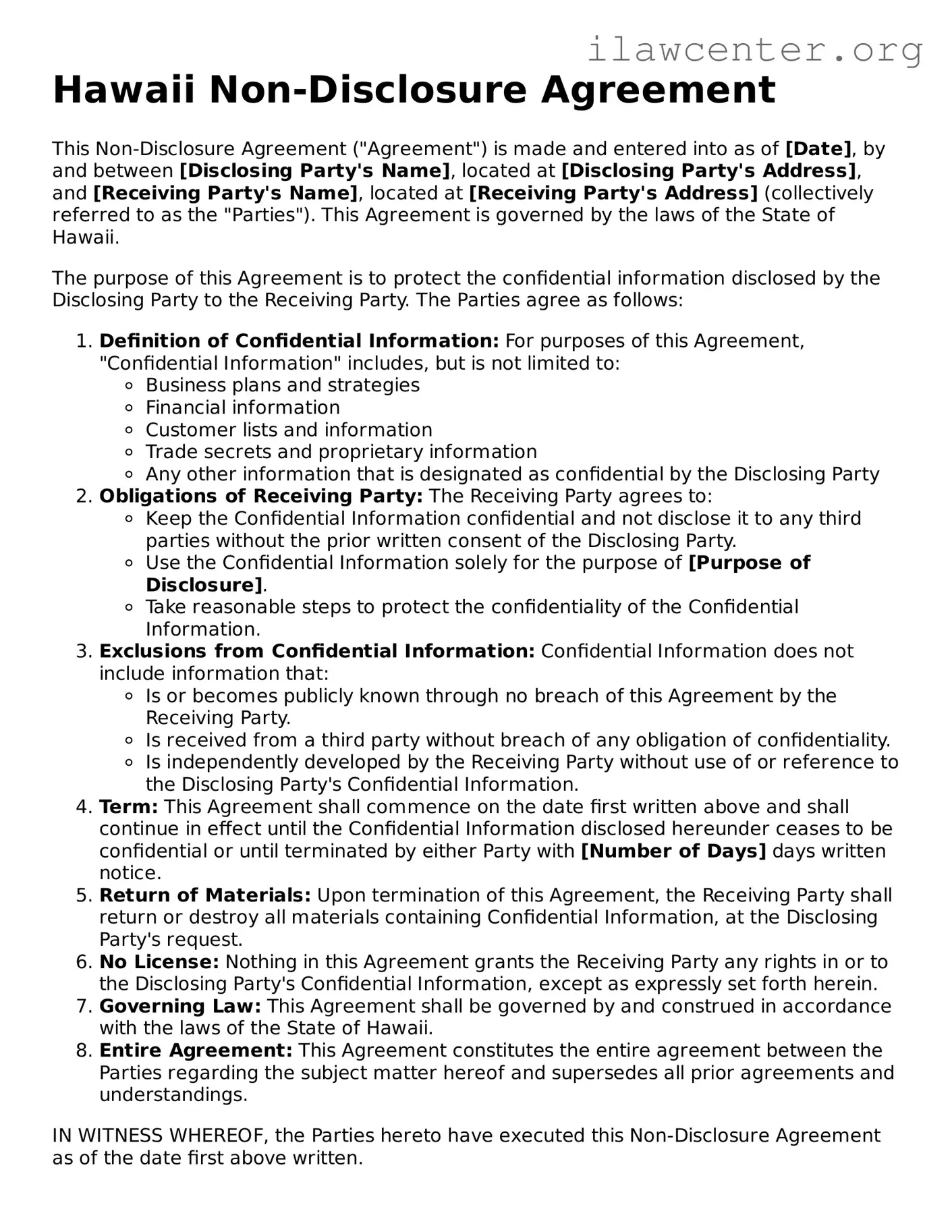
Hawaii Non-Disclosure Agreement

This Non-Disclosure Agreement ("Agreement") is made and entered into as of [Date], by and between [Disclosing Party's Name], located at [Disclosing Party's Address], and [Receiving Party's Name], located at [Receiving Party's Address] (collectively referred to as the "Parties"). This Agreement is governed by the laws of the State of Hawaii.

The purpose of this Agreement is to protect the confidential information disclosed by the Disclosing Party to the Receiving Party. The Parties agree as follows:

  1. Definition of Confidential Information: For purposes of this Agreement, "Confidential Information" includes, but is not limited to:
    • Business plans and strategies
    • Financial information
    • Customer lists and information
    • Trade secrets and proprietary information
    • Any other information that is designated as confidential by the Disclosing Party
  2. Obligations of Receiving Party: The Receiving Party agrees to:
    • Keep the Confidential Information confidential and not disclose it to any third parties without the prior written consent of the Disclosing Party.
    • Use the Confidential Information solely for the purpose of [Purpose of Disclosure].
    • Take reasonable steps to protect the confidentiality of the Confidential Information.
  3. Exclusions from Confidential Information: Confidential Information does not include information that:
    • Is or becomes publicly known through no breach of this Agreement by the Receiving Party.
    • Is received from a third party without breach of any obligation of confidentiality.
    • Is independently developed by the Receiving Party without use of or reference to the Disclosing Party's Confidential Information.
  4. Term: This Agreement shall commence on the date first written above and shall continue in effect until the Confidential Information disclosed hereunder ceases to be confidential or until terminated by either Party with [Number of Days] days written notice.
  5. Return of Materials: Upon termination of this Agreement, the Receiving Party shall return or destroy all materials containing Confidential Information, at the Disclosing Party's request.
  6. No License: Nothing in this Agreement grants the Receiving Party any rights in or to the Disclosing Party's Confidential Information, except as expressly set forth herein.
  7. Governing Law: This Agreement shall be governed by and construed in accordance with the laws of the State of Hawaii.
  8. Entire Agreement: This Agreement constitutes the entire agreement between the Parties regarding the subject matter hereof and supersedes all prior agreements and understandings.

IN WITNESS WHEREOF, the Parties hereto have executed this Non-Disclosure Agreement as of the date first above written.

Disclosing Party:

Signature: _______________________________

Name: [Name]

Title: [Title]

Receiving Party:

Signature: _______________________________

Name: [Name]

Title: [Title]

PDF Form Characteristics

Fact Name Description
Purpose A Hawaii Non-disclosure Agreement (NDA) protects confidential information shared between parties.
Governing Law The NDA is governed by the laws of the State of Hawaii.
Parties Involved The agreement typically involves at least two parties: the disclosing party and the receiving party.
Duration NDAs in Hawaii can specify a duration for confidentiality, often ranging from one to five years.
Enforceability For an NDA to be enforceable, it must be clear, reasonable, and not overly broad in scope.
Exceptions There are certain exceptions to confidentiality, such as information that is publicly available or already known to the receiving party.
Remedies If a breach occurs, the injured party may seek legal remedies, including damages or injunctive relief.

Instructions on Utilizing Hawaii Non-disclosure Agreement

Once you have the Hawaii Non-disclosure Agreement form, you can begin the process of filling it out. Completing this form accurately is essential for ensuring that all parties understand their obligations. Follow these steps carefully to ensure that you fill out the form correctly.

  1. Start by entering the date at the top of the form. This is usually found in the designated area labeled "Date."
  2. Next, provide the names of all parties involved in the agreement. This includes both the disclosing party and the receiving party. Make sure to spell names correctly.
  3. Fill in the addresses of all parties. This information should be complete and current to avoid any confusion later.
  4. Clearly state the purpose of the agreement. This section outlines why the confidential information is being shared.
  5. Identify the specific information that will be considered confidential. Be as detailed as possible to avoid ambiguity.
  6. Include any exclusions to the confidentiality obligations. This may include information that is already public or independently developed.
  7. Specify the duration of the confidentiality obligations. Indicate how long the information should remain confidential.
  8. Have all parties sign and date the form. Each signature should be accompanied by the printed name of the signatory.
  9. Finally, make copies of the signed agreement for all parties involved. This ensures that everyone has a record of the agreement.

Important Facts about Hawaii Non-disclosure Agreement

What is a Hawaii Non-disclosure Agreement (NDA)?

A Hawaii Non-disclosure Agreement is a legal document designed to protect confidential information shared between parties. It establishes a mutual understanding regarding the non-disclosure of sensitive information, ensuring that the parties involved do not share or misuse the information for any unauthorized purposes. This agreement is commonly used in business settings, where trade secrets, proprietary data, or other confidential information may be disclosed during discussions or negotiations.

Who typically uses a Non-disclosure Agreement in Hawaii?

Various individuals and organizations utilize NDAs in Hawaii. Businesses often require employees, contractors, and partners to sign NDAs to safeguard their proprietary information. Startups may also use these agreements when seeking investors or collaborators to protect their innovative ideas. Additionally, professionals in fields such as technology, healthcare, and finance frequently rely on NDAs to maintain confidentiality regarding sensitive information.

What are the key components of a Hawaii Non-disclosure Agreement?

A typical Hawaii Non-disclosure Agreement includes several essential components. First, it identifies the parties involved in the agreement. Next, it defines what constitutes confidential information, outlining the scope of the information that must be protected. The agreement also specifies the duration of confidentiality, indicating how long the parties must maintain the secrecy of the information. Finally, it may include clauses addressing the consequences of breach, governing law, and dispute resolution procedures.

How long does the confidentiality obligation last under a Hawaii NDA?

The duration of confidentiality obligations in a Hawaii Non-disclosure Agreement can vary based on the specific terms outlined in the document. Generally, the agreement will specify a time frame during which the parties are required to maintain confidentiality. This period can range from a few years to an indefinite term, depending on the nature of the information and the preferences of the parties involved. It is essential for both parties to clearly understand and agree upon the duration before signing the NDA.

What are the consequences of breaching a Non-disclosure Agreement in Hawaii?

Breaching a Non-disclosure Agreement in Hawaii can lead to significant legal consequences. The party that discloses confidential information without authorization may be subject to civil lawsuits, resulting in financial damages. Additionally, the injured party may seek injunctive relief to prevent further disclosure or misuse of the information. It is crucial for all parties to adhere to the terms of the NDA to avoid potential legal repercussions and protect their interests.

Common mistakes

When filling out the Hawaii Non-disclosure Agreement form, individuals often overlook key details that can lead to complications later. One common mistake is failing to clearly identify all parties involved. It is essential to list both the disclosing party and the receiving party accurately. If either party is not properly identified, it may create confusion about who is bound by the agreement.

Another frequent error is neglecting to specify the confidential information. A vague description can lead to misunderstandings about what information is protected under the agreement. It's important to be precise about what constitutes confidential information to ensure that both parties have a clear understanding of their obligations.

People also sometimes forget to include the duration of the confidentiality obligations. Without specifying how long the information must remain confidential, the agreement may lack enforceability. Clearly stating the duration helps both parties understand their responsibilities and the timeframe for which the agreement applies.

In addition, individuals may fail to consider the governing law. The Hawaii Non-disclosure Agreement should indicate which state's laws will govern the agreement. This is crucial, as it can affect how the agreement is interpreted and enforced. Not addressing this aspect can lead to legal complications down the line.

Another mistake is not including a clause for dispute resolution. Many people overlook the importance of having a clear process for resolving conflicts that may arise from the agreement. Including a dispute resolution clause can help avoid lengthy and costly legal battles in the future.

Lastly, some individuals neglect to have the agreement reviewed by a legal professional. While it may seem like an unnecessary step, having an expert review the document can catch potential issues before they become problematic. A legal professional can provide valuable insights and ensure that the agreement meets all necessary requirements.

Documents used along the form

A Hawaii Non-disclosure Agreement (NDA) is a crucial document for protecting sensitive information shared between parties. However, several other forms and documents are often utilized in conjunction with an NDA to ensure comprehensive protection and clarity in business relationships. Below is a list of these documents, each serving a specific purpose.

  • Confidentiality Agreement: Similar to an NDA, this document specifically outlines the obligations of the parties to keep certain information confidential. It may be used when discussing sensitive business matters that do not require the formal structure of a full NDA.
  • Memorandum of Understanding (MOU): An MOU is a non-binding agreement that establishes a mutual understanding between parties regarding their intentions and commitments. It can set the stage for future agreements, including NDAs.
  • Non-compete Agreement: This document restricts one party from engaging in business activities that compete with another party for a specified period and within a certain geographic area. It is often used alongside NDAs to protect business interests.
  • Non-solicitation Agreement: This agreement prevents one party from soliciting the clients or employees of another party for a specific duration. It complements NDAs by protecting relationships that could be jeopardized by the sharing of sensitive information.
  • Service Agreement: A service agreement outlines the terms under which services will be provided between parties. It often includes confidentiality clauses to protect sensitive information exchanged during the service provision.
  • Intellectual Property Assignment Agreement: This document transfers ownership of intellectual property from one party to another. It is important to have alongside an NDA to clarify ownership rights over any ideas or inventions discussed during the relationship.

Utilizing these documents in conjunction with a Hawaii Non-disclosure Agreement can enhance the protection of sensitive information and clarify the expectations between parties. Each document serves a unique purpose, contributing to a well-rounded approach to confidentiality and business relationships.

Similar forms

A Non-disclosure Agreement (NDA) is an essential document for protecting sensitive information. Several other documents serve similar purposes in various contexts. Here’s a list of seven documents that share similarities with an NDA:

  • Confidentiality Agreement: Like an NDA, a confidentiality agreement ensures that parties involved do not disclose private information. It often covers similar terms and conditions regarding the handling of confidential data.
  • Mutual Non-disclosure Agreement: This document is a two-way agreement where both parties agree to protect each other's confidential information. It is particularly useful in business partnerships where information flows in both directions.
  • Employment Agreement: An employment agreement often includes confidentiality clauses to protect the employer's proprietary information. Employees are bound to keep sensitive information private during and after their employment.
  • Partnership Agreement: In a partnership agreement, confidentiality provisions are typically included to safeguard business secrets shared among partners. This ensures that all partners maintain trust and protect the business’s interests.
  • License Agreement: A license agreement may contain confidentiality terms to protect proprietary information shared between the licensor and licensee. This is crucial when sensitive technology or processes are involved.
  • Service Agreement: Service agreements often include confidentiality clauses to ensure that service providers do not disclose any confidential information they may access while performing their duties.
  • Settlement Agreement: In legal disputes, a settlement agreement may require confidentiality regarding the terms of the settlement. This protects the parties involved from public scrutiny and maintains privacy.

Understanding these documents can help individuals and businesses navigate the complexities of protecting sensitive information effectively.

Dos and Don'ts

When filling out the Hawaii Non-disclosure Agreement (NDA) form, attention to detail is crucial. Here’s a guide to help you navigate the process smoothly. Consider the following dos and don’ts:

  • Do read the entire agreement carefully before signing.
  • Do ensure all parties involved are clearly identified.
  • Do specify the information that is considered confidential.
  • Do include the duration of the confidentiality obligation.
  • Do consult a legal professional if you have questions about the terms.
  • Don't rush through the form; take your time to understand each section.
  • Don't leave any sections blank unless instructed to do so.
  • Don't sign the agreement without ensuring all parties have agreed to the terms.
  • Don't overlook the importance of including a dispute resolution clause.
  • Don't forget to keep a copy of the signed agreement for your records.

By following these guidelines, you can help protect your confidential information effectively. A well-prepared NDA fosters trust and clarity between parties, ensuring that sensitive information remains secure.

Misconceptions

Many people have misunderstandings about the Hawaii Non-disclosure Agreement (NDA). Clearing up these misconceptions can help individuals and businesses better protect their confidential information. Here are eight common misconceptions:

  • All NDAs are the same. Each NDA is unique and tailored to the specific needs of the parties involved. The terms and conditions can vary significantly based on the situation.
  • NDAs are only for large companies. Small businesses and individuals can also benefit from NDAs. Protecting sensitive information is important for any size entity.
  • Signing an NDA means you can’t talk to anyone. NDAs typically allow for certain disclosures, such as to employees or contractors, as long as they are also bound by confidentiality.
  • NDAs are only about money. While financial information is often protected, NDAs can cover a wide range of confidential information, including trade secrets, business strategies, and customer lists.
  • Once signed, an NDA is forever. Many NDAs have a specific duration for how long the information must remain confidential. Once that period ends, the obligation may no longer apply.
  • All NDAs are enforceable. An NDA must meet certain legal requirements to be enforceable. If it’s overly broad or vague, a court may not uphold it.
  • Only written NDAs are valid. While written agreements are preferred for clarity, verbal NDAs can also be enforceable in some situations, depending on the circumstances.
  • NDAs prevent all legal action. While an NDA restricts disclosure of information, it does not prevent a party from taking legal action if the agreement is breached.

Understanding these misconceptions can empower individuals and businesses to use NDAs effectively. By doing so, they can safeguard their valuable information while fostering trust in their professional relationships.

Key takeaways

When filling out and using the Hawaii Non-disclosure Agreement (NDA) form, consider the following key takeaways:

  • Ensure that all parties involved are clearly identified. This includes full names and addresses.
  • Specify the confidential information that is being protected. Be as detailed as possible.
  • Define the purpose of the NDA. This helps clarify why the information is being shared.
  • Include the duration of confidentiality. State how long the information must remain confidential.
  • Outline the obligations of each party. Clearly state what is expected from everyone involved.
  • Consider including exceptions to confidentiality. This can include situations where disclosure is required by law.
  • Make sure to sign and date the agreement. All parties must provide their signatures for the NDA to be valid.

Following these guidelines will help ensure that the NDA is effective and legally binding.