Attorney-Verified  Notary Acknowledgement Document for Hawaii

Attorney-Verified Notary Acknowledgement Document for Hawaii

The Hawaii Notary Acknowledgement form is a legal document used to verify the identity of a signer and confirm that they willingly signed a document in front of a notary public. This form is essential for ensuring the authenticity of various legal transactions in Hawaii. To get started, fill out the form by clicking the button below.

Article Guide

When dealing with legal documents in Hawaii, understanding the Notary Acknowledgment form is essential. This form serves as a vital tool in verifying the identity of the signer and ensuring that they are signing willingly and with full understanding of the document’s implications. Typically, it includes spaces for the notary's signature, seal, and the date of the acknowledgment. The signer must present valid identification to the notary, who then confirms their identity before proceeding. This process not only adds a layer of protection against fraud but also enhances the credibility of the document itself. In Hawaii, the Notary Acknowledgment form is often required for various legal transactions, including property transfers and financial agreements, making it a crucial element in maintaining the integrity of legal processes across the state.

Hawaii Notary Acknowledgement Preview

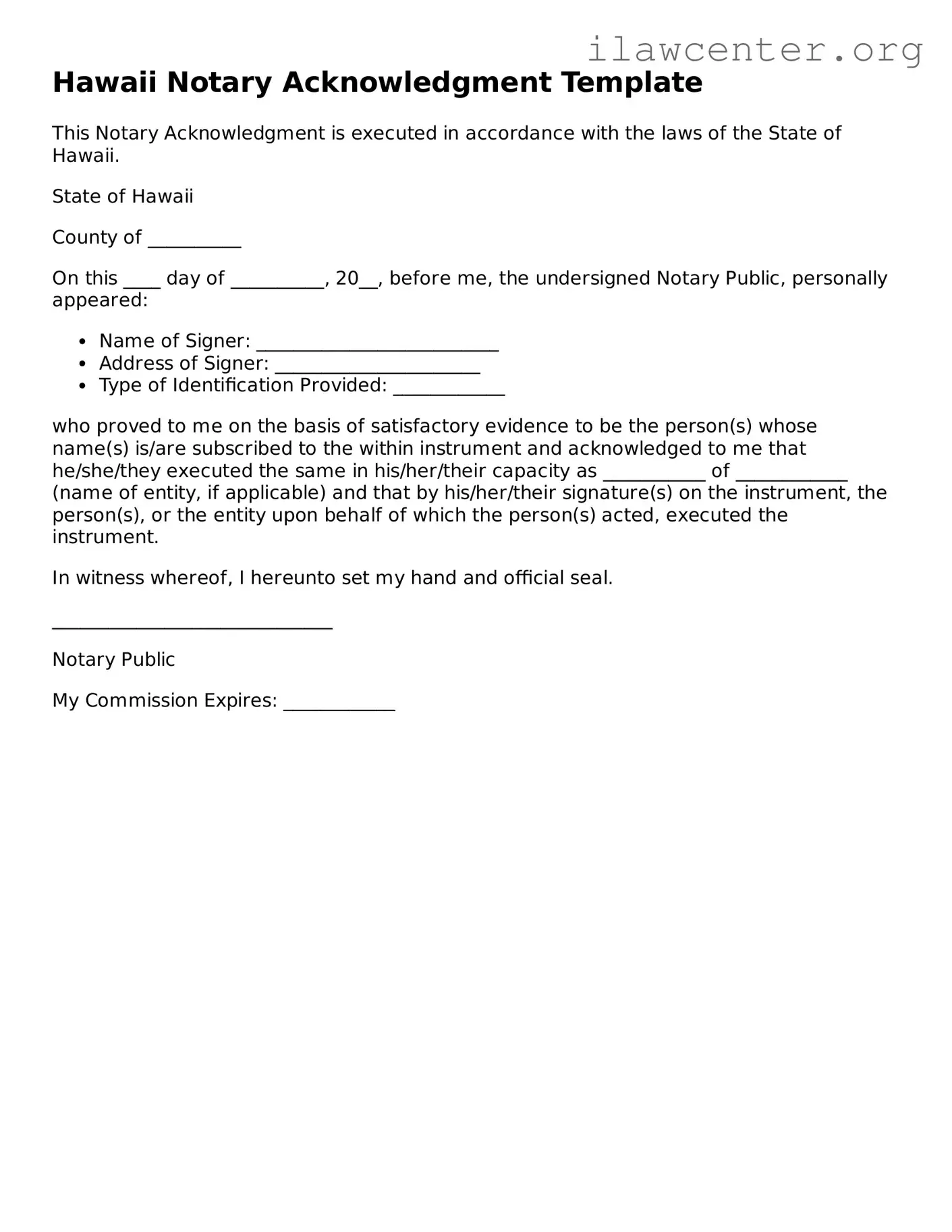
Hawaii Notary Acknowledgment Template

This Notary Acknowledgment is executed in accordance with the laws of the State of Hawaii.

State of Hawaii

County of __________

On this ____ day of __________, 20__, before me, the undersigned Notary Public, personally appeared:

  • Name of Signer: __________________________
  • Address of Signer: ______________________
  • Type of Identification Provided: ____________

who proved to me on the basis of satisfactory evidence to be the person(s) whose name(s) is/are subscribed to the within instrument and acknowledged to me that he/she/they executed the same in his/her/their capacity as ___________ of ____________ (name of entity, if applicable) and that by his/her/their signature(s) on the instrument, the person(s), or the entity upon behalf of which the person(s) acted, executed the instrument.

In witness whereof, I hereunto set my hand and official seal.

______________________________

Notary Public

My Commission Expires: ____________

PDF Form Characteristics

Fact Name Description
Purpose The Hawaii Notary Acknowledgement form is used to verify the identity of individuals signing documents and to confirm that they did so voluntarily.
Governing Law The use of this form is governed by Hawaii Revised Statutes, Chapter 456, which outlines the powers and duties of notaries public in the state.
Signature Requirement For the acknowledgment to be valid, the signer must personally appear before the notary and provide a valid form of identification.
Record Keeping Notaries are required to keep a record of each acknowledgment performed, including details such as the date, type of document, and the identity of the signer.

Instructions on Utilizing Hawaii Notary Acknowledgement

Once you have the Hawaii Notary Acknowledgement form ready, you will need to complete it accurately. This ensures that the document serves its intended purpose. Follow these steps to fill out the form correctly.

  1. Begin by entering the date on which the acknowledgment is being made.
  2. Fill in the name of the person whose signature is being acknowledged. Ensure that the name is spelled correctly.
  3. Provide the address of the individual. This should include the street address, city, state, and ZIP code.
  4. In the next section, indicate the title of the document being acknowledged. This could be a deed, contract, or any other relevant document.
  5. Have the individual sign the form in the designated area. The signature should match the name provided earlier.
  6. Next, the notary will need to complete their section. This includes signing the form and affixing their official seal or stamp.
  7. Finally, review the entire form for any errors or omissions before submitting it.

Important Facts about Hawaii Notary Acknowledgement

What is a Hawaii Notary Acknowledgement form?

The Hawaii Notary Acknowledgement form is a legal document used to verify the identity of individuals signing a document. It confirms that the signer appeared before a notary public and acknowledged that they signed the document willingly. This form is commonly used in various transactions, such as real estate deals, contracts, and legal documents.

Who can serve as a notary public in Hawaii?

In Hawaii, a notary public must be a resident of the state and at least 18 years old. They are appointed by the Governor and must complete a training course. Notaries are responsible for verifying the identity of signers and ensuring that all signatures are made voluntarily and without coercion.

How do I complete a Notary Acknowledgement form?

To complete the form, the signer must appear in person before the notary. The notary will ask for identification and confirm that the signer understands the document they are signing. After verifying the identity, the notary will complete the form by filling in their details, including their signature and seal. Make sure to provide accurate information to avoid any issues later.

Is a Notary Acknowledgement required for all documents?

No, a Notary Acknowledgement is not required for every document. However, it is often necessary for legal documents that need to be filed with government agencies or presented in court. Always check the specific requirements for your document to determine if notarization is needed.

What should I do if I encounter issues with a Notary Acknowledgement?

If you face any issues with a Notary Acknowledgement, first try to resolve the matter directly with the notary. If that does not work, you can contact the Notary Public Office in Hawaii for guidance. They can provide assistance and information on how to proceed if there are concerns about the notary's actions or the validity of the acknowledgment.

Common mistakes

Filling out the Hawaii Notary Acknowledgment form can be straightforward, but several common mistakes often occur. One frequent error is not providing the correct date. The date must match the day the notary performs the acknowledgment. If the date is incorrect, it can cause delays or complications.

Another mistake involves incomplete information. People sometimes forget to include all necessary details, such as the name of the signer or the title of the document. This omission can lead to the form being rejected. Ensure that all fields are filled out completely to avoid this issue.

Some individuals do not sign the document in front of the notary. The signer must be present when the notary acknowledges the signature. If the notary is not witnessing the signing, the acknowledgment may not be valid.

Additionally, using the wrong type of identification can be problematic. Notaries require specific forms of ID to verify a signer's identity. If the wrong identification is presented, the notary may refuse to complete the acknowledgment.

People also often overlook the notary's signature and seal. The acknowledgment must include the notary's signature and official seal for it to be valid. If either is missing, the document may not be accepted.

Another common error is failing to check the notary's commission expiration date. Notaries must be commissioned and active to perform acknowledgments. If the notary's commission has expired, the acknowledgment will not hold up.

Some individuals make the mistake of not following the specific instructions for the form. Each state may have different requirements, and it is essential to review the instructions carefully to ensure compliance.

Lastly, neglecting to keep a copy of the acknowledged document can lead to issues later. It is a good practice to retain a copy for personal records. This can help clarify any disputes or questions that may arise in the future.

Documents used along the form

When engaging in various legal and financial transactions in Hawaii, the Notary Acknowledgement form is often used. This document serves as a verification that a signature was made in the presence of a notary public. However, it is typically accompanied by other important forms and documents. Here are five commonly used documents that often go hand-in-hand with the Hawaii Notary Acknowledgement form:

  • Power of Attorney: This document grants someone the authority to act on behalf of another person in legal or financial matters. It often requires notarization to ensure that the person granting the authority is doing so willingly and understands the implications.
  • Real Estate Deeds: When transferring property ownership, a deed must be executed. Notarization is essential to validate the transaction and protect against fraud, ensuring that the signatures on the deed are authentic.
  • Affidavits: An affidavit is a written statement confirmed by oath or affirmation. It is often used in court proceedings and requires notarization to verify the identity of the person making the statement and the truthfulness of the contents.
  • Contracts: Many contracts, particularly those involving significant obligations or financial transactions, may require notarization. This adds an extra layer of security, ensuring that all parties understand and agree to the terms.
  • Wills: In some cases, a will may need to be notarized to ensure its validity. Notarization helps confirm that the testator (the person making the will) was of sound mind and not under duress when signing the document.

Understanding these documents and their relationship with the Hawaii Notary Acknowledgement form is essential for anyone navigating legal processes. Properly executed documents can save time and prevent disputes in the future. Always consult with a legal professional if you have questions about these forms or their requirements.

Similar forms

  • Affidavit: Similar to a notary acknowledgment, an affidavit is a written statement confirmed by oath or affirmation, often used to provide evidence in legal proceedings.
  • Power of Attorney: This document grants one person the authority to act on behalf of another. Like a notary acknowledgment, it often requires notarization to verify the identities of the parties involved.
  • Deed: A deed transfers ownership of property. Notarization is typically required to ensure the authenticity of the signatures, similar to the notary acknowledgment process.
  • Will: A will outlines how a person’s assets will be distributed after death. Notarization can add an extra layer of validation, akin to a notary acknowledgment.
  • Loan Documents: These documents detail the terms of a loan. They often require notarization to confirm the identities of the signers, much like a notary acknowledgment.
  • Contract: A contract is an agreement between parties. While not always required, notarization can enhance the enforceability of a contract, similar to a notary acknowledgment.
  • Certificate of Authorship: This document certifies that a person is the author of a specific work. Notarization may be used to confirm the author's identity, paralleling the notary acknowledgment.
  • Release of Liability: This document releases one party from liability. Notarization can help verify the signer's intent, similar to the notary acknowledgment process.
  • Marriage License Application: This application often requires notarization to confirm the identities of the applicants, similar to how a notary acknowledgment verifies signatures.
  • Business License Application: This document may require notarization to confirm the identity of the applicant, much like a notary acknowledgment verifies the signing parties.

Dos and Don'ts

When filling out the Hawaii Notary Acknowledgment form, it is essential to approach the task with care. Here are some important dos and don'ts to keep in mind:

  • Do ensure that all information is accurate and complete. Double-check names, dates, and signatures.
  • Do use blue or black ink for clarity. This helps maintain the form’s professionalism.
  • Do sign the form in the presence of the notary public. This step is crucial for the acknowledgment to be valid.
  • Do bring valid identification. A government-issued ID is typically required to verify your identity.
  • Don't leave any sections blank. Incomplete forms can lead to delays or rejection.
  • Don't sign the form before meeting with the notary. Doing so can invalidate the acknowledgment process.

By following these guidelines, you can ensure that your Notary Acknowledgment form is filled out correctly and efficiently.

Misconceptions

When it comes to the Hawaii Notary Acknowledgement form, there are several misconceptions that can lead to confusion. Let’s clarify these misunderstandings to ensure you have the right information.

  1. Notaries can draft legal documents.

    Many people think that notaries can create or alter legal documents. In reality, notaries are only authorized to witness signatures and verify identities.

  2. All notaries are attorneys.

    This is a common myth. While some notaries may be lawyers, not all notaries have legal training or expertise.

  3. A notary can refuse to notarize any document.

    Notaries have the right to refuse if they suspect fraud or if the signer is not present. However, they cannot refuse based on personal biases.

  4. Notarization guarantees the legality of a document.

    Notarization simply confirms that a signature is genuine. It does not validate the content or legality of the document itself.

  5. Once a document is notarized, it cannot be changed.

    While the notarization process confirms the signature, it doesn’t prevent the document from being amended afterward.

  6. All notaries can perform any type of notarization.

    Notaries may have limitations based on their state laws. Some may not be authorized to handle certain types of documents.

  7. Notarization is only needed for legal documents.

    Notarization can also be useful for personal documents, such as consent forms or affidavits, to add an extra layer of authenticity.

  8. You must be in the same room as the notary.

    While traditionally, signers and notaries meet in person, some states allow remote notarization, making it possible to notarize documents online.

  9. Notaries charge the same fee everywhere.

    Fees for notarization can vary widely depending on the state and the type of service. Always check local regulations for accurate information.

  10. Notaries can provide legal advice.

    This is a major misconception. Notaries are not permitted to give legal advice or interpret the law. Their role is strictly to witness signatures.

Understanding these misconceptions can help you navigate the notarization process with confidence. Always seek clarity and ask questions if you're unsure about any aspect of the process!

Key takeaways

When filling out and using the Hawaii Notary Acknowledgement form, it is essential to understand its purpose and the proper procedure. Here are some key takeaways to keep in mind:

  • Purpose of the Form: The Hawaii Notary Acknowledgement form serves to verify the identity of the signer and confirm that they willingly signed the document.
  • Completeness: Ensure that all required fields are filled out accurately. Missing information can invalidate the notarization.
  • Identification: The signer must provide valid identification to the notary. This step is crucial for establishing the signer's identity.
  • Signature: The signer should sign the document in the presence of the notary. This act is a fundamental requirement for the acknowledgment process.
  • Notary's Role: The notary public is responsible for completing the acknowledgment section of the form, which includes their signature, seal, and date.
  • Retention: It is advisable to keep a copy of the notarized document for personal records. This can be helpful for future reference or legal purposes.

Understanding these aspects can help ensure that the notarization process is smooth and legally valid. Proper use of the Hawaii Notary Acknowledgement form can provide peace of mind in various legal matters.