Attorney-Verified  Notice to Quit Document for Hawaii

Attorney-Verified Notice to Quit Document for Hawaii

The Hawaii Notice to Quit form is a legal document used by landlords to formally notify tenants of their intention to terminate a lease agreement. This notice provides essential information regarding the reasons for termination and the timeframe in which the tenant must vacate the property. Understanding this form is crucial for both landlords and tenants to ensure compliance with state laws.

To fill out the form, click the button below.

Article Guide

In the vibrant landscape of Hawaii's rental market, landlords and tenants must navigate a variety of legal requirements to ensure smooth interactions. One crucial document in this process is the Hawaii Notice to Quit form, which serves as a formal communication tool for landlords seeking to terminate a tenancy. This form outlines the reasons for eviction, whether it be non-payment of rent, lease violations, or other justifiable causes. It specifies the notice period, allowing tenants a designated time to remedy the situation or vacate the premises. Understanding the nuances of this form is essential for both parties, as it helps clarify rights and responsibilities. Additionally, the Notice to Quit must be delivered in accordance with state regulations to be legally binding. With the right knowledge, both landlords and tenants can approach this aspect of rental agreements with confidence and clarity.

Hawaii Notice to Quit Preview

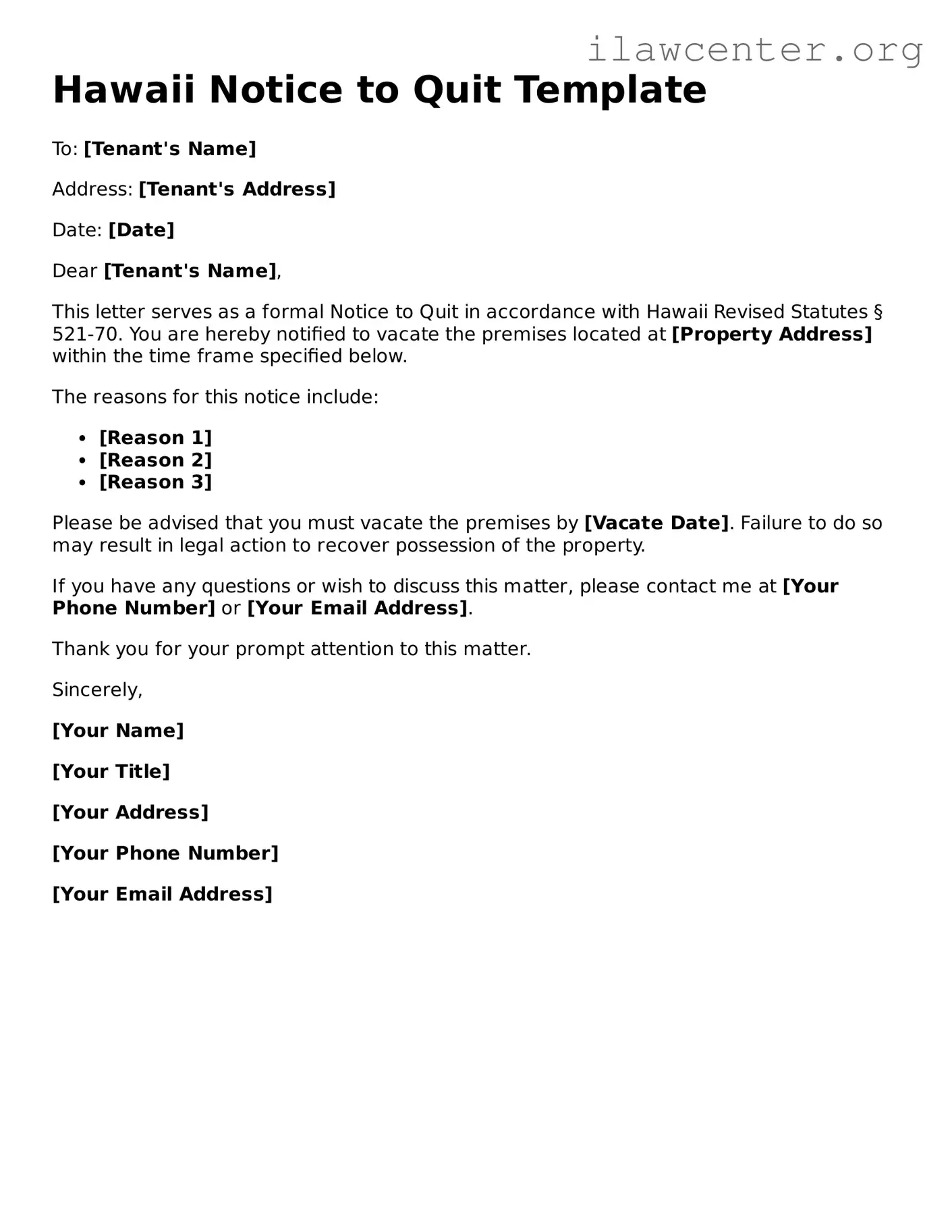
Hawaii Notice to Quit Template

To: [Tenant's Name]

Address: [Tenant's Address]

Date: [Date]

Dear [Tenant's Name],

This letter serves as a formal Notice to Quit in accordance with Hawaii Revised Statutes § 521-70. You are hereby notified to vacate the premises located at [Property Address] within the time frame specified below.

The reasons for this notice include:

  • [Reason 1]
  • [Reason 2]
  • [Reason 3]

Please be advised that you must vacate the premises by [Vacate Date]. Failure to do so may result in legal action to recover possession of the property.

If you have any questions or wish to discuss this matter, please contact me at [Your Phone Number] or [Your Email Address].

Thank you for your prompt attention to this matter.

Sincerely,

[Your Name]

[Your Title]

[Your Address]

[Your Phone Number]

[Your Email Address]

PDF Form Characteristics

Fact Name Details
Purpose The Hawaii Notice to Quit form is used to inform a tenant that they must vacate the rental property.
Governing Law This form is governed by Hawaii Revised Statutes, Chapter 521.
Types of Notices There are different types of notices depending on the reason for eviction, including non-payment of rent and lease violations.
Notice Period The notice period can vary; typically, it is 5 days for non-payment of rent and 10 days for other lease violations.
Delivery Methods The notice can be delivered in person, by mail, or posted on the property.
Tenant Response The tenant has the right to respond to the notice and may contest the eviction in court.
Form Requirements The form must include specific information such as the tenant's name, address, and the reason for the notice.
Landlord's Signature The landlord or their authorized agent must sign the notice for it to be valid.
Legal Consequences Failure to comply with the notice may result in legal action for eviction.

Instructions on Utilizing Hawaii Notice to Quit

When you're ready to address a tenancy issue in Hawaii, filling out the Notice to Quit form is an essential step. This form serves as a formal way to communicate your intent and provides the necessary details for both parties involved. After completing the form, it’s important to deliver it properly to ensure that it is legally recognized.

  1. Begin by downloading the Hawaii Notice to Quit form from a reliable source or obtain a physical copy.
  2. At the top of the form, fill in the date you are completing the notice.
  3. Next, enter your name and address as the landlord or property owner.
  4. In the designated section, write the tenant's name and address accurately.
  5. Specify the reason for the notice. Be clear and concise in your explanation.
  6. Indicate the date by which the tenant must vacate the property. This should align with the legal requirements for your situation.
  7. Sign the form in the appropriate area, confirming that you are the landlord or authorized representative.
  8. Make a copy of the completed form for your records.
  9. Deliver the Notice to Quit to the tenant, either by personal delivery or through certified mail, ensuring you have proof of delivery.

After you have filled out and delivered the Notice to Quit, keep track of any responses from the tenant. This will help you determine your next steps, whether it involves further communication or legal action.

Important Facts about Hawaii Notice to Quit

What is a Hawaii Notice to Quit form?

The Hawaii Notice to Quit form is a legal document used by landlords to inform tenants that they must vacate the rental property. This notice is typically issued when a tenant has violated the lease agreement or failed to pay rent. It serves as a formal request to leave the premises by a specified date.

When should a landlord use a Notice to Quit?

A landlord should use a Notice to Quit when a tenant has breached the rental agreement, such as not paying rent, causing damage, or violating other terms. It can also be used for month-to-month leases when the landlord wants to terminate the tenancy for any reason, provided they give proper notice.

How much notice must be given in a Notice to Quit?

The required notice period varies based on the reason for the eviction. Generally, for non-payment of rent, a landlord must provide a 15-day notice. For other lease violations, a 5-day notice is often sufficient. However, if a landlord is terminating a month-to-month lease without cause, a 45-day notice is required.

Can a tenant contest a Notice to Quit?

Yes, a tenant can contest a Notice to Quit. If a tenant believes the notice is unjust or that they have rectified the issue, they can respond to the landlord and potentially seek legal advice. It’s important for tenants to understand their rights and the specific grounds for eviction.

What happens if a tenant does not comply with the Notice to Quit?

If a tenant does not comply with the Notice to Quit, the landlord may proceed with eviction proceedings. This typically involves filing a lawsuit in the local court. The court will then determine whether the eviction is justified and may issue an order for the tenant to vacate the property.

Is a Notice to Quit the same as an eviction notice?

While a Notice to Quit is a type of eviction notice, it is not the final step in the eviction process. It is the initial notice that informs the tenant of the need to vacate. If the tenant does not leave by the specified date, the landlord may then file for formal eviction in court.

Does the Notice to Quit need to be delivered in person?

No, the Notice to Quit does not have to be delivered in person. Landlords can deliver the notice via mail, or by posting it on the rental property if the tenant is not available. However, it is advisable to keep a record of how and when the notice was delivered.

Can a tenant request a longer notice period?

A tenant can request a longer notice period, but the landlord is not obligated to comply. However, open communication between the landlord and tenant can sometimes lead to an agreement that benefits both parties. If a tenant needs more time, discussing the situation may lead to a mutually acceptable solution.

Common mistakes

Filling out the Hawaii Notice to Quit form can be a straightforward process, but many individuals make common mistakes that can complicate matters. One frequent error is failing to provide accurate tenant information. It is crucial to include the full name of the tenant as it appears in the lease agreement. Omitting or misspelling this information can lead to delays and potential legal issues.

Another common mistake involves neglecting to specify the reason for the notice. The form requires a clear statement regarding why the notice is being issued. Whether it's for non-payment of rent or lease violations, clarity is key. Without a specific reason, the notice may be deemed insufficient, and the eviction process could be stalled.

Many individuals also overlook the importance of including the correct date. The date of the notice must reflect when the tenant is expected to vacate the premises. If this date is incorrect or unrealistic, it can undermine the effectiveness of the notice. Additionally, ensuring that the notice is served within the appropriate time frame is essential to avoid complications.

Another mistake is failing to sign the form. A signature adds legitimacy to the notice and confirms that the landlord is taking formal action. Without a signature, the notice may be considered invalid, leaving the landlord without legal recourse. It is a simple step that should not be overlooked.

Finally, many people forget to keep a copy of the completed form. Documenting the notice is vital for future reference. Should disputes arise, having a record of the notice can be invaluable. It serves as proof that the landlord followed the necessary legal steps in the eviction process.

Documents used along the form

When dealing with rental agreements and tenant issues in Hawaii, several important documents often accompany the Hawaii Notice to Quit form. Understanding these documents can help ensure a smooth process and protect the rights of both landlords and tenants. Below is a list of commonly used forms that you may encounter.

  • Lease Agreement: This is a legally binding contract between a landlord and tenant outlining the terms of the rental arrangement, including rent amount, duration, and responsibilities of both parties.
  • Eviction Notice: Also known as a Notice to Vacate, this document formally informs the tenant of the landlord's intention to terminate the lease and outlines the reasons for eviction.
  • Rent Payment Receipt: This is a record provided by the landlord to the tenant, confirming that rent has been paid for a specific period. It serves as proof of payment and can be important in disputes.
  • Security Deposit Agreement: This document details the terms regarding the security deposit, including the amount collected, conditions for its return, and any deductions that may be made.
  • Inspection Report: This report documents the condition of the rental property before and after a tenant's occupancy, helping to establish accountability for any damages or necessary repairs.
  • Tenant's Response to Eviction: If a tenant wishes to contest an eviction, they may submit a formal response outlining their reasons for disputing the eviction notice.

Familiarizing yourself with these documents can significantly aid in navigating rental agreements and potential disputes. Each form plays a crucial role in ensuring clarity and fairness in the landlord-tenant relationship.

Similar forms

  • Eviction Notice: Similar to a Notice to Quit, an eviction notice formally informs a tenant that they must vacate the property. It typically includes the reason for eviction, such as non-payment of rent or lease violations, and specifies a deadline for the tenant to leave.

  • Lease Termination Letter: This document serves as a notification to a tenant that their lease will not be renewed or has been terminated. It outlines the end date of the lease and any obligations the tenant has before moving out.

  • Notice of Rent Increase: While it focuses on changes to rent rather than termination, this notice communicates important information to tenants. It informs them of upcoming rent adjustments and may lead to a tenant deciding to vacate the premises.

  • Notice of Non-Renewal: This document is used when a landlord chooses not to renew a tenant's lease. It provides a clear timeframe for the tenant to find alternative housing, similar to a Notice to Quit.

  • Demand for Possession: Often used in eviction proceedings, this document demands that a tenant vacate the property. It is a formal request that can precede legal action, paralleling the intent of a Notice to Quit.

  • Notice of Breach of Lease: This notice informs a tenant that they have violated terms of their lease agreement. It typically outlines the breach and provides an opportunity for the tenant to remedy the situation, similar to a Notice to Quit in its potential to lead to termination of tenancy.

Dos and Don'ts

When filling out the Hawaii Notice to Quit form, attention to detail is crucial. Here are some important do's and don'ts to keep in mind:

  • Do ensure that all information is accurate and complete. Double-check names, addresses, and dates.
  • Do clearly state the reason for the notice. This helps provide context and clarity.
  • Do keep a copy of the completed form for your records. Documentation is key in any legal matter.
  • Don't use vague language. Be specific about the issue at hand to avoid confusion.
  • Don't forget to sign and date the form. An unsigned notice may not be considered valid.

Following these guidelines can help ensure that the process goes smoothly and legally. Proper preparation can prevent misunderstandings and potential disputes down the line.

Misconceptions

Understanding the Hawaii Notice to Quit form is essential for both landlords and tenants. However, several misconceptions can lead to confusion. Here are ten common misconceptions about this form:

  1. The Notice to Quit is the same as an eviction notice.

    This is incorrect. A Notice to Quit is a formal request for a tenant to vacate the property, while an eviction notice is a legal action that follows if the tenant does not comply.

  2. Landlords can issue a Notice to Quit for any reason.

    This is not true. There are specific legal grounds under which a landlord can issue this notice, such as non-payment of rent or lease violations.

  3. A Notice to Quit must be delivered in person.

    Delivery methods can vary. The notice can be sent via mail or posted on the property, depending on local regulations.

  4. Tenants have no rights after receiving a Notice to Quit.

    This is a misconception. Tenants have the right to contest the notice and may have legal defenses available to them.

  5. A Notice to Quit is a final decision.

    This is misleading. The notice is merely a request for the tenant to leave, and it does not conclude the legal process.

  6. The Notice to Quit can be ignored.

    Ignoring the notice can lead to legal consequences. It is important for tenants to respond appropriately to avoid further action.

  7. There is no time limit for issuing a Notice to Quit.

    Landlords must adhere to specific time frames set by law when issuing the notice based on the reason for termination.

  8. All Notices to Quit are the same.

    This is incorrect. The content and requirements of the notice can vary based on the situation and local laws.

  9. A Notice to Quit guarantees eviction.

    This is not accurate. The notice is a step in the process, but eviction requires further legal proceedings.

  10. Only landlords can issue a Notice to Quit.

    While landlords typically issue these notices, tenants may also have grounds to terminate a lease under certain circumstances.

Clarifying these misconceptions can help both landlords and tenants navigate the process more effectively.

Key takeaways

  • Understand the purpose of the Hawaii Notice to Quit form. This document is used by landlords to formally notify tenants to vacate the rental property.

  • Ensure the form is filled out correctly. Include all required information, such as the tenant's name, address, and the reason for the notice.

  • Be aware of the notice period. Depending on the reason for eviction, the notice period can vary, typically ranging from 5 to 45 days.

  • Deliver the notice properly. The form must be served to the tenant in person or sent via certified mail to ensure legal compliance.

  • Keep a copy of the Notice to Quit. Documenting the notice is crucial for future legal proceedings, if necessary.

  • Know your rights and responsibilities. Familiarize yourself with Hawaii's landlord-tenant laws to avoid potential legal issues.