Attorney-Verified  Power of Attorney for a Child Document for Hawaii

Attorney-Verified Power of Attorney for a Child Document for Hawaii

The Hawaii Power of Attorney for a Child form is a legal document that allows a parent or guardian to designate another adult to make decisions on behalf of their child. This form is particularly useful for temporary situations, such as when a parent is traveling or unable to care for their child. If you’re ready to ensure your child's well-being while you're away, consider filling out the form by clicking the button below.

Article Guide

In the beautiful state of Hawaii, the Power of Attorney for a Child form serves as a crucial legal tool for parents and guardians who wish to delegate specific parental responsibilities to another trusted adult. This form is particularly valuable when parents are temporarily unavailable due to travel, work commitments, or other circumstances that may prevent them from being present for their child. By completing this document, parents can grant authority for various decisions, including medical care, educational needs, and day-to-day activities, ensuring that their child’s welfare is safeguarded in their absence. The form not only outlines the extent of the powers being granted but also specifies the duration of this authority, which can be tailored to meet the unique needs of each family situation. Understanding the implications and requirements of this form is essential, as it helps to establish clear guidelines that protect both the child and the appointed agent, fostering a sense of security and continuity during times of transition.

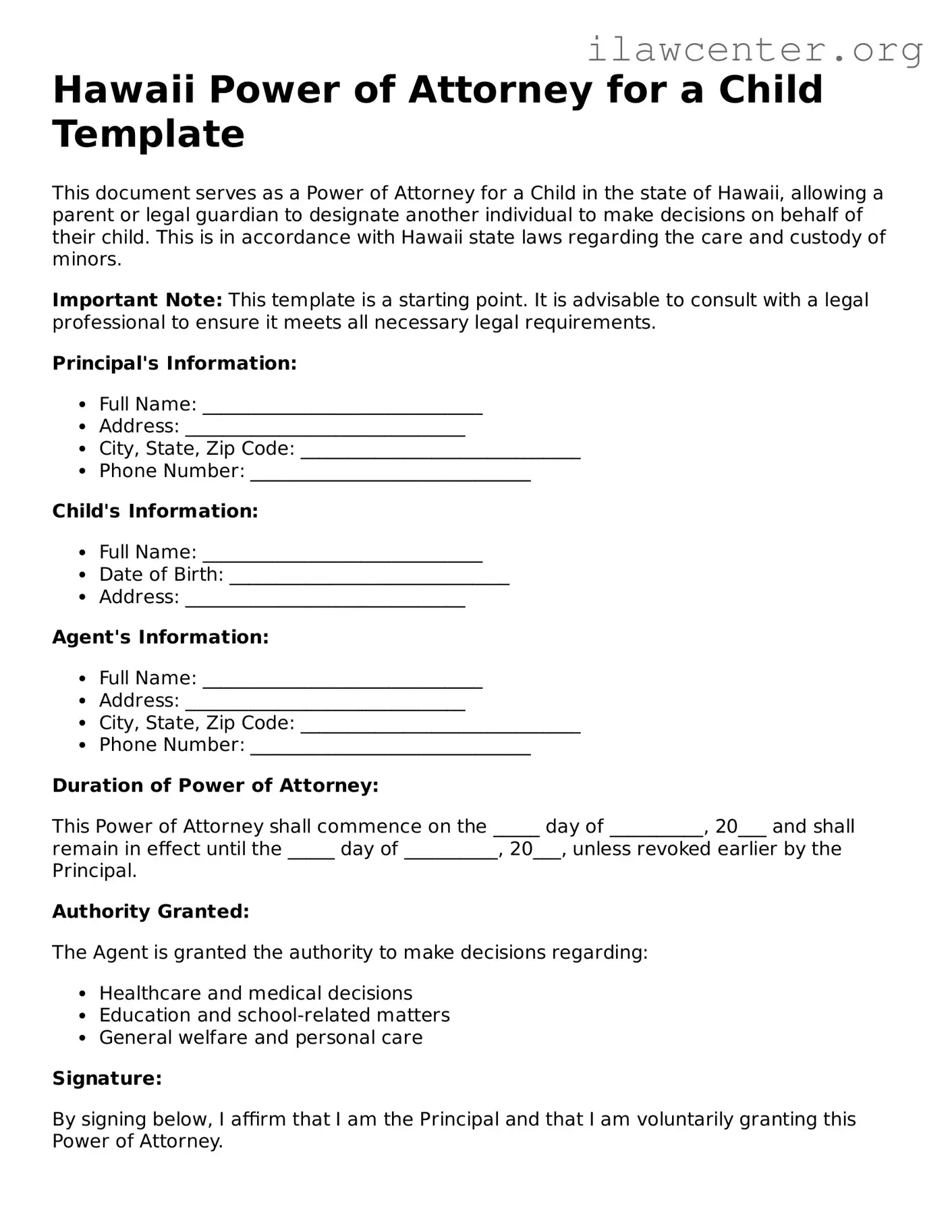
Hawaii Power of Attorney for a Child Preview

Hawaii Power of Attorney for a Child Template

This document serves as a Power of Attorney for a Child in the state of Hawaii, allowing a parent or legal guardian to designate another individual to make decisions on behalf of their child. This is in accordance with Hawaii state laws regarding the care and custody of minors.

Important Note: This template is a starting point. It is advisable to consult with a legal professional to ensure it meets all necessary legal requirements.

Principal's Information:

  • Full Name: ______________________________
  • Address: ______________________________
  • City, State, Zip Code: ______________________________
  • Phone Number: ______________________________

Child's Information:

  • Full Name: ______________________________
  • Date of Birth: ______________________________
  • Address: ______________________________

Agent's Information:

  • Full Name: ______________________________
  • Address: ______________________________
  • City, State, Zip Code: ______________________________
  • Phone Number: ______________________________

Duration of Power of Attorney:

This Power of Attorney shall commence on the _____ day of __________, 20___ and shall remain in effect until the _____ day of __________, 20___, unless revoked earlier by the Principal.

Authority Granted:

The Agent is granted the authority to make decisions regarding:

  • Healthcare and medical decisions
  • Education and school-related matters
  • General welfare and personal care

Signature:

By signing below, I affirm that I am the Principal and that I am voluntarily granting this Power of Attorney.

______________________________
Signature of Principal

______________________________
Date

Witness Information:

Two witnesses are required to sign this document. They must be at least 18 years old and cannot be the Agent.

______________________________
Signature of Witness 1

______________________________
Date

______________________________
Signature of Witness 2

______________________________
Date

Notary Acknowledgment:

State of Hawaii
County of _______________

On this _____ day of __________, 20___, before me, a Notary Public, personally appeared ______________________, known to me to be the person whose name is subscribed to this instrument and acknowledged that they executed the same.

______________________________
Notary Public Signature

______________________________
Notary Public Name
My Commission Expires: ____________

PDF Form Characteristics

Fact Name Description
Purpose The Hawaii Power of Attorney for a Child form allows a parent or legal guardian to designate another adult to make decisions on behalf of their child.
Governing Law This form is governed by Hawaii Revised Statutes § 551-1.6, which outlines the legal framework for powers of attorney concerning minors.
Duration The authority granted through this form can be temporary or indefinite, depending on the preferences of the parent or guardian.
Eligibility Any adult can be appointed as an agent, but the parent or guardian must be competent and able to make informed decisions.
Revocation The Power of Attorney can be revoked at any time by the parent or guardian, as long as they are competent to do so.
Signatures Required The form must be signed by the parent or guardian and may require notarization for it to be legally binding.
Limitations The agent’s authority is limited to the specific powers granted in the form, which can include medical, educational, and financial decisions.
Notification It is advisable to inform the child’s school and healthcare providers about the Power of Attorney to ensure smooth communication.

Instructions on Utilizing Hawaii Power of Attorney for a Child

Filling out the Hawaii Power of Attorney for a Child form is a straightforward process. This form allows a parent or legal guardian to designate another adult to make decisions on behalf of their child in specific situations. After completing the form, ensure that it is signed and dated in accordance with state requirements, and provide copies to all relevant parties.

  1. Obtain the Hawaii Power of Attorney for a Child form. You can find it online or at local government offices.
  2. Read through the entire form carefully to understand the requirements and sections.
  3. Fill in your child's full name, date of birth, and any other identifying information requested.
  4. Provide your name and contact information as the parent or legal guardian.
  5. Designate the adult who will act as the attorney-in-fact. Include their full name, address, and contact information.
  6. Specify the powers you are granting to the attorney-in-fact. Clearly outline any limitations or specific decisions they can make.
  7. Set the duration for which the Power of Attorney is effective. You may choose a specific time frame or indicate that it is effective until revoked.
  8. Sign and date the form in the designated areas. Ensure your signature matches the name provided in the form.
  9. Have the form notarized if required. Check local requirements to confirm if notarization is necessary.
  10. Distribute copies of the completed form to the attorney-in-fact and any other relevant parties, such as schools or healthcare providers.

Important Facts about Hawaii Power of Attorney for a Child

What is a Power of Attorney for a Child in Hawaii?

A Power of Attorney for a Child in Hawaii is a legal document that allows a parent or guardian to grant another individual the authority to make decisions on behalf of their child. This can include decisions related to medical care, education, and other important matters. The appointed individual, often referred to as an agent or attorney-in-fact, can act in the best interest of the child while the parent or guardian is unavailable or unable to do so. This document is particularly useful for situations such as travel, temporary relocations, or when parents are away for extended periods.

How do I complete the Power of Attorney for a Child form?

To complete the Power of Attorney for a Child form, you must provide specific information about both the child and the designated agent. This includes the child's name, date of birth, and the name and contact information of the person you are appointing. The form must be signed by the parent or guardian in the presence of a notary public to ensure its validity. It is essential to clearly outline the powers being granted to the agent, as well as any limitations. Once completed, the document should be kept in a safe place, and copies should be provided to the agent and relevant parties.

Is there a specific duration for the Power of Attorney for a Child in Hawaii?

Yes, the Power of Attorney for a Child in Hawaii can be set for a specific duration or can remain in effect until revoked. If a specific time frame is desired, it should be clearly stated in the document. For example, it can be valid for a few months or until a particular event occurs. If no duration is specified, the power may continue until the child reaches the age of majority or the document is revoked by the parent or guardian. Regularly reviewing the document is advisable to ensure it meets current needs.

Can the Power of Attorney for a Child be revoked?

Yes, a Power of Attorney for a Child can be revoked at any time by the parent or guardian who created it. To revoke the document, a written notice of revocation should be prepared and signed. It is recommended to notify the appointed agent and any relevant parties about the revocation to avoid any confusion. Keeping a record of the revocation is also advisable for future reference. The parent or guardian retains the right to make changes or terminate the authority granted as long as they are legally able to do so.

Common mistakes

Filling out the Hawaii Power of Attorney for a Child form can be a straightforward process, but many people make common mistakes that can lead to complications. One significant error is failing to provide complete information. Each section of the form requires specific details about the child and the agent. Omitting even a small piece of information can render the document invalid.

Another frequent mistake is not signing the form in the appropriate places. Both the parent and the agent must sign the document for it to be legally binding. If either party neglects to sign, the Power of Attorney will not take effect, leaving the child without the intended legal representation.

People often overlook the need for witnesses or notarization. In Hawaii, the form must be signed in the presence of a notary public or two witnesses. Failing to meet this requirement can invalidate the document, so it is crucial to understand the signing requirements before submitting the form.

Some individuals mistakenly select an agent who may not be available or willing to fulfill the role. It is essential to choose someone trustworthy and reliable. The agent should be informed about their responsibilities and prepared to act in the child's best interests.

Another common error is misunderstanding the scope of authority granted. The Power of Attorney can be limited or broad, depending on the parent's wishes. Not clearly defining the powers given to the agent can lead to confusion and potential conflicts later on.

People sometimes forget to update the Power of Attorney when circumstances change. Life events such as divorce, relocation, or changes in the child's needs can necessitate a revision of the document. Regularly reviewing and updating the form ensures it remains relevant and effective.

Additionally, individuals may fail to communicate with the child about the arrangement. Children should be aware of who will be responsible for them in the absence of their parents. This discussion can help ease any anxiety and foster a sense of security.

Some parents mistakenly assume that the Power of Attorney for a Child is a permanent arrangement. In reality, this document can be revoked at any time. Understanding the revocation process is important for parents who may want to change their arrangements in the future.

Moreover, individuals often neglect to keep copies of the completed form. Having multiple copies is essential for all parties involved, including the agent, the parents, and any relevant institutions, such as schools or healthcare providers. This practice ensures that everyone is aware of the arrangement and can act accordingly.

Finally, many people do not seek legal advice when filling out the Power of Attorney for a Child form. Consulting with a legal professional can provide clarity on the process and help avoid mistakes. Taking this step can lead to a more effective and legally sound document.

Documents used along the form

When establishing a Power of Attorney for a Child in Hawaii, it is often beneficial to consider additional forms and documents that can support the overall legal framework. These documents can help clarify responsibilities, outline specific powers, and ensure that all parties are aware of their rights and obligations. Below is a list of commonly used forms that may accompany a Power of Attorney for a Child.

  • Child Custody Agreement: This document outlines the terms of custody and visitation between parents or guardians, ensuring clarity about where the child will live and how often they will see each parent.
  • Medical Authorization Form: This form grants permission for a designated individual to make medical decisions on behalf of the child, ensuring that they can receive necessary medical care in emergencies.
  • Emergency Contact Information: A simple document listing emergency contacts, including names and phone numbers, can be invaluable for caregivers in urgent situations.
  • School Authorization Form: This form allows the designated caregiver to enroll the child in school, attend parent-teacher conferences, and access educational records.
  • Travel Consent Form: If the child will be traveling with someone other than their parents, this document provides consent for travel, specifying destinations and duration.
  • Health Care Proxy: Similar to a medical authorization form, this document specifically designates someone to make health care decisions if the child is unable to do so.
  • Financial Power of Attorney: This form allows a designated person to manage financial matters on behalf of the child, such as handling bank accounts or applying for government benefits.
  • Affidavit of Guardianship: This legal document can be used to affirm the guardian's authority and responsibilities, providing a clear statement of their role in the child's life.
  • Consent to Treat Minor Form: This form allows a caregiver to consent to medical treatment for the child, ensuring that healthcare providers can proceed without delay.
  • Letter of Intent: While not a legal document, this letter can provide guidance about the child's needs, preferences, and any special considerations for the caregiver.

Each of these documents serves a unique purpose and can significantly enhance the effectiveness of a Power of Attorney for a Child. By preparing these forms, parents and guardians can ensure that the child's best interests are prioritized and that caregivers are equipped to handle various situations that may arise.

Similar forms

The Power of Attorney for a Child form is an important document that allows a parent or guardian to designate another individual to make decisions on behalf of their child. This form is similar to several other legal documents that serve specific purposes in the realm of parental authority and guardianship. Here are seven documents that share similarities with the Power of Attorney for a Child form:

  • General Power of Attorney: Like the Power of Attorney for a Child, this document grants authority to another person to make decisions on behalf of the principal. However, it is broader and can cover various aspects of the principal's life, not just related to a child.
  • Medical Power of Attorney: This document allows someone to make medical decisions for another person if they become incapacitated. Similar to the Power of Attorney for a Child, it designates a trusted individual to act in the best interest of someone who cannot make decisions themselves.
  • Guardianship Agreement: This legal arrangement appoints an individual to care for a child when the parents are unable to do so. Both documents aim to ensure that the child’s needs are met by a responsible adult.
  • Temporary Custody Agreement: This document allows a designated person to care for a child temporarily. Similar to the Power of Attorney for a Child, it provides authority for someone to make decisions regarding the child’s welfare during a specified period.
  • Consent for Medical Treatment: This form permits a designated individual to consent to medical treatments for a child. It shares the same purpose of ensuring that someone can make critical decisions regarding a child’s health in the absence of a parent.
  • Child Care Authorization: This document allows a parent to authorize another person to care for their child. It is similar in that it grants specific authority to another adult regarding the child’s daily care and supervision.
  • Educational Power of Attorney: This form allows someone to make educational decisions for a child, such as enrolling them in school or signing permission slips. Like the Power of Attorney for a Child, it focuses on specific aspects of a child’s life, ensuring their educational needs are met.

Dos and Don'ts

Filling out the Power of Attorney for a Child form in Hawaii can seem daunting, but it’s essential to ensure that you do it correctly. Here are four important do's and don'ts to keep in mind:

  • Do clearly identify the child and the agent. Make sure to include full names and any relevant identification details.
  • Do specify the powers you are granting. Be clear about what decisions the agent can make on behalf of the child.
  • Don't leave any sections blank. Incomplete forms can lead to confusion or delays in the authority being granted.
  • Don't forget to sign and date the form. Without your signature, the document will not be valid.

By following these guidelines, you can ensure that your Power of Attorney for a Child form is filled out correctly and effectively. This important document can provide peace of mind, knowing that your child's needs will be taken care of in your absence.

Misconceptions

Understanding the Power of Attorney for a Child in Hawaii is crucial for parents and guardians. However, several misconceptions often cloud the true nature of this legal document. Here’s a list of ten common misunderstandings:

  1. It is the same as a guardianship.

    A Power of Attorney for a Child does not grant permanent custody. Instead, it allows a designated person to make decisions for the child temporarily.

  2. Only parents can create a Power of Attorney.

    While parents typically initiate this document, legal guardians or other authorized individuals can also establish it under certain circumstances.

  3. It must be filed with the court.

    This document does not require court approval or filing. It is effective once signed by the parent and the agent.

  4. It is permanent.

    The Power of Attorney is temporary and can be revoked at any time by the parent or guardian who created it.

  5. It covers all decisions.

    The form can specify which powers are granted. It does not automatically include all decision-making authority.

  6. It is only for emergencies.

    While it can be useful in emergencies, it is also helpful for planned situations, such as travel or extended absences.

  7. It can be used in any state.

    The Power of Attorney for a Child is specific to Hawaii and may not be recognized in other states without proper documentation.

  8. It doesn’t need to be notarized.

    In Hawaii, the document should be notarized to ensure its validity and to provide legal assurance for the agent.

  9. It is the same as a medical power of attorney.

    A Power of Attorney for a Child is not the same as a medical power of attorney, which specifically pertains to health care decisions.

  10. Once signed, it cannot be changed.

    Parents can modify or revoke the Power of Attorney at any time, provided they follow the proper procedures.

Being informed about these misconceptions can help parents and guardians navigate the complexities of child care arrangements more effectively.

Key takeaways

When filling out and using the Hawaii Power of Attorney for a Child form, consider the following key takeaways:

  • Understand the Purpose: This form allows a parent or legal guardian to grant authority to another adult to make decisions on behalf of their child.
  • Choose the Right Person: Select someone trustworthy and responsible, as they will have significant authority over the child's welfare.
  • Specify the Duration: Clearly indicate how long the power of attorney will remain in effect. This can be for a specific period or until revoked.
  • Complete All Required Information: Ensure that all sections of the form are filled out accurately to avoid any legal complications.
  • Keep Copies: After the form is signed, make copies for all parties involved, including the child’s school or healthcare providers if necessary.