Attorney-Verified  Quitclaim Deed Document for Hawaii

Attorney-Verified Quitclaim Deed Document for Hawaii

A Hawaii Quitclaim Deed is a legal document that allows a property owner to transfer their interest in a property to another party without making any guarantees about the title. This form is often used in situations where the transfer is between family members or in divorce settlements. If you're ready to fill out the form, click the button below.

Article Guide

The Hawaii Quitclaim Deed form serves as a crucial legal document in the realm of real estate transactions, particularly when it comes to the transfer of property rights. This form allows an individual, known as the grantor, to relinquish any claim they may have to a property, thereby transferring whatever interest they hold to another party, referred to as the grantee. Unlike other types of deeds, a quitclaim deed does not guarantee that the grantor holds clear title to the property; instead, it simply conveys whatever interest the grantor may possess at the time of the transfer. This makes it a popular choice for transferring property among family members, resolving title issues, or during divorce settlements. Importantly, the form must be properly executed, which includes signatures from both the grantor and the grantee, and it often requires notarization to ensure its validity. Additionally, once completed, the deed must be filed with the appropriate county office to make the transfer official and to provide public notice of the change in ownership.

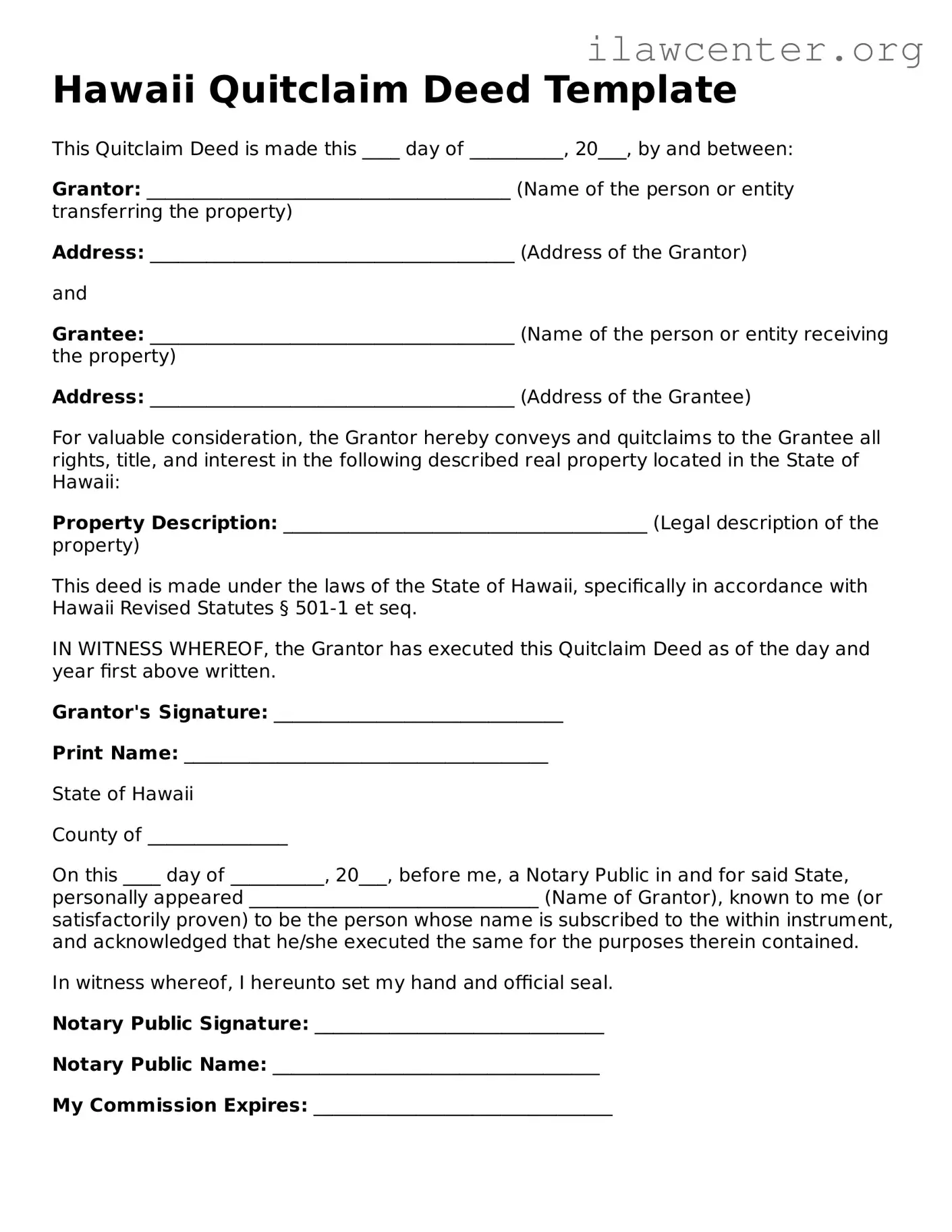
Hawaii Quitclaim Deed Preview

Hawaii Quitclaim Deed Template

This Quitclaim Deed is made this ____ day of __________, 20___, by and between:

Grantor: _______________________________________ (Name of the person or entity transferring the property)

Address: _______________________________________ (Address of the Grantor)

and

Grantee: _______________________________________ (Name of the person or entity receiving the property)

Address: _______________________________________ (Address of the Grantee)

For valuable consideration, the Grantor hereby conveys and quitclaims to the Grantee all rights, title, and interest in the following described real property located in the State of Hawaii:

Property Description: _______________________________________ (Legal description of the property)

This deed is made under the laws of the State of Hawaii, specifically in accordance with Hawaii Revised Statutes § 501-1 et seq.

IN WITNESS WHEREOF, the Grantor has executed this Quitclaim Deed as of the day and year first above written.

Grantor's Signature: _______________________________

Print Name: _______________________________________

State of Hawaii

County of _______________

On this ____ day of __________, 20___, before me, a Notary Public in and for said State, personally appeared _______________________________ (Name of Grantor), known to me (or satisfactorily proven) to be the person whose name is subscribed to the within instrument, and acknowledged that he/she executed the same for the purposes therein contained.

In witness whereof, I hereunto set my hand and official seal.

Notary Public Signature: _______________________________

Notary Public Name: ___________________________________

My Commission Expires: ________________________________

PDF Form Characteristics

Fact Name Details
Definition A quitclaim deed is a legal document used to transfer ownership of real property without any warranties.
Governing Law The Hawaii Quitclaim Deed is governed by Hawaii Revised Statutes, Chapter 501.
Usage This form is commonly used among family members or in situations where the parties know each other.
Consideration While a quitclaim deed can be executed for no monetary consideration, it is often recommended to include a nominal amount.
Recording To ensure the transfer is legally recognized, the quitclaim deed must be recorded with the local county recorder's office.

Instructions on Utilizing Hawaii Quitclaim Deed

Once you have your Hawaii Quitclaim Deed form ready, you will need to carefully fill it out to ensure that all necessary information is accurately provided. This document is essential for transferring property ownership, and it is important to follow each step closely to avoid any issues.

  1. Obtain the Form: Start by downloading the Hawaii Quitclaim Deed form from a reliable source or obtain a physical copy from a local office.
  2. Fill in the Grantor's Information: In the designated section, enter the full name and address of the person or entity transferring the property.
  3. Fill in the Grantee's Information: Next, provide the full name and address of the person or entity receiving the property.
  4. Describe the Property: Include a legal description of the property being transferred. This may involve referencing the property's tax map key number or including a detailed description.
  5. Include the Date: Write the date on which the deed is being executed.
  6. Sign the Document: The grantor must sign the deed in the presence of a notary public. The notary will then acknowledge the signature.
  7. Record the Deed: Finally, take the completed and notarized deed to the appropriate county office to record it officially. This step is crucial for the transfer to be legally recognized.

After completing these steps, you will have successfully filled out the Hawaii Quitclaim Deed form. The next important task is to ensure that the deed is recorded with the county, as this will finalize the property transfer and provide public notice of the change in ownership.

Important Facts about Hawaii Quitclaim Deed

What is a Quitclaim Deed?

A Quitclaim Deed is a legal document used to transfer ownership of real estate from one person to another. Unlike a warranty deed, a quitclaim deed does not guarantee that the person transferring the property has clear title. Instead, it simply conveys whatever interest the grantor has in the property, if any.

Why would someone use a Quitclaim Deed in Hawaii?

People often use Quitclaim Deeds in situations such as transferring property between family members, adding or removing a spouse from a title after marriage or divorce, or clearing up title issues. It’s a straightforward way to handle property transfers without the complexities of a sale.

How do I fill out a Quitclaim Deed form in Hawaii?

To fill out a Quitclaim Deed in Hawaii, you need to provide the names of the grantor (the person giving up the interest) and the grantee (the person receiving the interest), a legal description of the property, and the date of the transfer. It’s essential to ensure all information is accurate and complete to avoid issues later.

Do I need a notary for a Quitclaim Deed in Hawaii?

Yes, in Hawaii, a Quitclaim Deed must be notarized. This means that the grantor must sign the document in the presence of a notary public, who will then validate the signature. This step is crucial for the deed to be legally recognized.

Is there a filing fee for a Quitclaim Deed in Hawaii?

Yes, there is typically a fee associated with filing a Quitclaim Deed in Hawaii. The exact amount can vary by county, so it’s best to check with the local county clerk’s office for the current fees and any additional requirements.

What happens after I file a Quitclaim Deed?

After filing a Quitclaim Deed, it becomes part of the public record. This means that anyone can access it to see the property’s ownership history. The grantee should also receive a copy of the deed for their records. It’s important to keep this document safe, as it proves ownership.

Can I revoke a Quitclaim Deed in Hawaii?

Revoking a Quitclaim Deed can be complicated. Generally, once a Quitclaim Deed is executed and recorded, it cannot be undone without the consent of the grantee. If you want to change the ownership back, you would typically need to execute another deed transferring the property back to the original owner.

Are there any tax implications when using a Quitclaim Deed in Hawaii?

Yes, there can be tax implications. While transferring property via a Quitclaim Deed may not incur a transfer tax in some cases, it’s essential to consult with a tax professional or attorney to understand any potential tax consequences, especially if the property is sold later.

Can I use a Quitclaim Deed for commercial property in Hawaii?

Yes, a Quitclaim Deed can be used for both residential and commercial properties in Hawaii. However, due to the complexities often involved with commercial transactions, it may be wise to consult with a legal professional to ensure all aspects are handled properly.

Where can I obtain a Quitclaim Deed form in Hawaii?

Quitclaim Deed forms can often be found online through legal websites, or you may obtain them from the county clerk’s office. Some local offices may also provide assistance in completing the form, ensuring that you have all necessary information included.
Common mistakes

When filling out the Hawaii Quitclaim Deed form, many people overlook important details that can lead to complications. One common mistake is not providing accurate information about the property. The legal description of the property must be precise. If it’s vague or incomplete, it may cause issues during the transfer process.

Another frequent error involves the names of the parties involved. It’s crucial to ensure that the names of the grantor (the person transferring the property) and the grantee (the person receiving the property) are spelled correctly and match their legal identification. Any discrepancies can result in delays or even invalidate the deed.

People often forget to sign the Quitclaim Deed. Both the grantor and any witnesses, if required, must sign the document for it to be legally binding. Neglecting this step can lead to the deed being rejected by the county recorder’s office.

Additionally, many individuals fail to have the deed notarized. In Hawaii, notarization is typically necessary for the deed to be accepted. Without a notary’s signature, the document may not hold up in court or during property transactions.

Finally, individuals sometimes overlook the importance of filing the Quitclaim Deed with the appropriate county office. Simply completing the form is not enough. To ensure the transfer is recognized legally, the deed must be recorded in the local land records. Failing to do so can leave the property transfer unprotected.

Documents used along the form

When dealing with property transfers in Hawaii, the Quitclaim Deed form is often accompanied by several other important documents. Each of these documents serves a specific purpose and helps ensure a smooth and legally compliant transaction. Understanding these forms can provide clarity and peace of mind during the process.

  • Title Search Report: This document provides a detailed history of the property’s ownership. It reveals any liens, encumbrances, or claims against the property, ensuring that the seller has the right to transfer ownership.
  • Affidavit of Value: Required by the state, this affidavit states the value of the property being transferred. It helps in assessing property taxes and ensures that the transaction is recorded accurately.
  • Property Transfer Tax Declaration: This form is necessary for reporting the transfer of property to the local tax authority. It includes information about the sale price and any exemptions that may apply.
  • Escrow Instructions: If an escrow service is used, these instructions outline the responsibilities of all parties involved. They ensure that funds and documents are handled properly during the transfer process.
  • Power of Attorney: In some cases, a seller may not be able to sign the Quitclaim Deed in person. A Power of Attorney allows another person to act on their behalf, ensuring the transaction can proceed without delay.

Each of these documents plays a vital role in the property transfer process. Familiarity with them can help individuals navigate the complexities of real estate transactions more confidently. Always consider consulting a professional if you have questions or need assistance with these forms.

Similar forms

A Quitclaim Deed is a legal document used to transfer ownership of real estate from one party to another without any warranties. While it serves a specific purpose, several other documents share similarities in function or intent. Here are nine such documents:

  • Warranty Deed: This document provides a guarantee that the grantor has clear title to the property and the right to sell it. Unlike a Quitclaim Deed, it offers more protection to the buyer.
  • Grant Deed: A Grant Deed transfers ownership and includes implied warranties that the property has not been sold to anyone else. It is more secure than a Quitclaim Deed but less so than a Warranty Deed.
  • Deed of Trust: This document secures a loan by placing a lien on the property. While it does not transfer ownership outright, it is similar in that it involves real estate interests.
  • Lease Agreement: A Lease Agreement allows one party to use another's property for a specified time in exchange for rent. Though it does not transfer ownership, it conveys rights to use the property, akin to a Quitclaim Deed.
  • Life Estate Deed: This deed grants ownership of a property to one person for their lifetime, after which it transfers to another party. It shares the characteristic of transferring interests in property.
  • Bill of Sale: While primarily used for personal property, a Bill of Sale can transfer ownership of items. It is similar to a Quitclaim Deed in that it conveys ownership without warranties.
  • Power of Attorney: This document allows one person to act on behalf of another in legal matters, including property transactions. It is similar in that it can facilitate the transfer of property rights.
  • Affidavit of Heirship: This document establishes the heirs of a deceased person and their rights to inherit property. It is similar to a Quitclaim Deed as it also pertains to the transfer of property ownership.
  • Partition Deed: When co-owners of a property wish to divide their interests, a Partition Deed formalizes that division. It serves a similar purpose of clarifying ownership interests like a Quitclaim Deed.

Dos and Don'ts

When filling out the Hawaii Quitclaim Deed form, it's important to be mindful of certain practices to ensure the process goes smoothly. Below is a list of things you should and shouldn't do.

  • Do double-check all names and addresses for accuracy.
  • Do include a legal description of the property being transferred.
  • Do sign the form in the presence of a notary public.
  • Do ensure that the form is filed with the appropriate county office after completion.
  • Don't leave any required fields blank.
  • Don't use white-out or any correction fluid on the form.

By following these guidelines, you can help avoid common pitfalls and ensure that your Quitclaim Deed is processed correctly.

Misconceptions

When it comes to the Hawaii Quitclaim Deed, several misconceptions can lead to confusion. Understanding these misconceptions is essential for anyone considering using this form for property transfer. Here are seven common misunderstandings:

  1. It transfers ownership without any warranty. Many believe that a quitclaim deed guarantees clear title to the property. In reality, it simply transfers whatever interest the grantor has, without any promises about the quality of that title.
  2. It is only used for transferring property between family members. While quitclaim deeds are often used among relatives, they can also be employed in various situations, such as divorce settlements or transferring property into a trust.
  3. Quitclaim deeds are only valid in Hawaii. This misconception overlooks the fact that quitclaim deeds are recognized in many states across the U.S., each with its own rules and regulations.
  4. Using a quitclaim deed is the same as selling property. A quitclaim deed does not involve a sale or exchange of money. It merely conveys any interest the grantor may have, which may be nothing at all.
  5. Once a quitclaim deed is signed, it cannot be revoked. While it is true that a quitclaim deed is generally irrevocable once executed, there are circumstances under which it can be challenged or set aside, such as fraud or duress.
  6. All quitclaim deeds must be notarized. Although notarization is highly recommended for legal validity and to prevent future disputes, it is not a strict requirement in every situation.
  7. Quitclaim deeds are only for real estate transactions. While they are primarily used for real estate, quitclaim deeds can also be utilized to transfer other types of property interests, such as vehicles or personal property, depending on state laws.

Being aware of these misconceptions can help individuals make informed decisions regarding property transfers in Hawaii. Always consider consulting with a legal professional for guidance tailored to your specific situation.

Key takeaways

When dealing with a Hawaii Quitclaim Deed form, it is essential to understand its purpose and how to fill it out correctly. Here are some key takeaways:

  • The Quitclaim Deed is used to transfer ownership of property without guaranteeing that the title is clear. This means the new owner may inherit any existing liens or claims against the property.
  • Both the grantor (the person transferring the property) and the grantee (the person receiving the property) must be clearly identified on the form. This includes full names and addresses.
  • The property description must be accurate and detailed. This typically includes the parcel number and legal description to ensure proper identification of the property being transferred.
  • Signatures are required from the grantor, and the deed must be notarized to be legally binding. This adds a layer of authenticity to the document.
  • After completing the form, it must be filed with the Bureau of Conveyances in Hawaii. There may be a filing fee, so it’s important to check the current rates.
  • Consider consulting with a real estate attorney if there are any uncertainties about the deed or the implications of transferring property through a Quitclaim Deed.

Understanding these key points can help ensure a smoother process when using the Hawaii Quitclaim Deed form.