Attorney-Verified  Small Estate Affidavit Document for Hawaii

Attorney-Verified Small Estate Affidavit Document for Hawaii

The Hawaii Small Estate Affidavit is a legal document that allows individuals to claim the assets of a deceased person without going through a lengthy probate process, provided the estate meets certain criteria. This form simplifies the transfer of property and helps heirs access their inheritance more quickly. To learn more and fill out the form, please click the button below.

Article Guide

In Hawaii, when a loved one passes away and leaves behind a small estate, the process of settling their affairs can often feel overwhelming. However, the Hawaii Small Estate Affidavit form provides a streamlined option for heirs to claim property without going through the lengthy probate process. This form is designed for estates valued at $100,000 or less, excluding real property, making it an accessible solution for many families. By completing the Small Estate Affidavit, heirs can assert their rights to the deceased's assets, which may include bank accounts, personal belongings, and other possessions. The affidavit must be signed under oath and typically requires the signature of at least one disinterested witness. Additionally, it’s important to note that this form can only be used when there are no pending claims against the estate, ensuring that the process remains straightforward and efficient. Understanding the requirements and implications of this form can help individuals navigate a difficult time with greater ease and clarity.

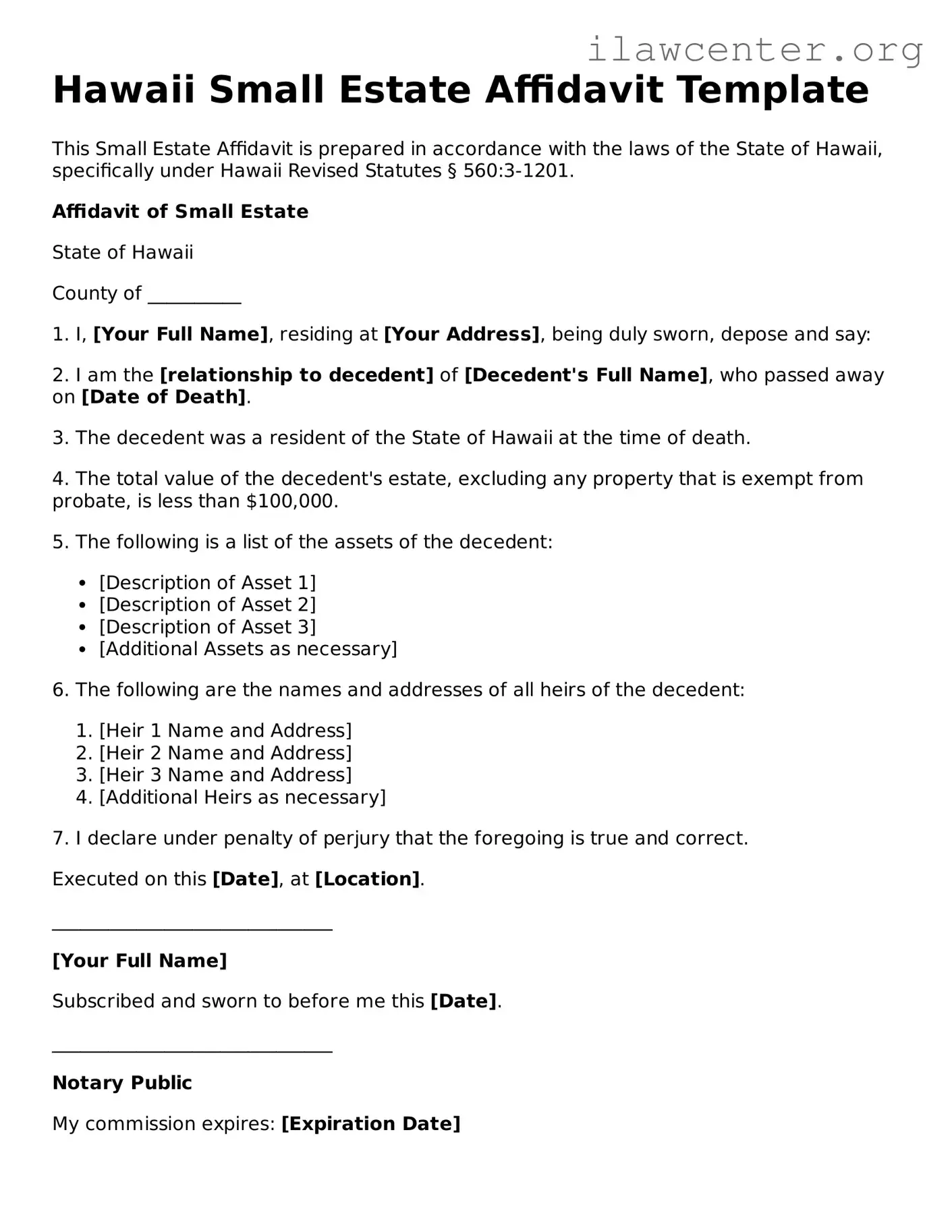
Hawaii Small Estate Affidavit Preview

Hawaii Small Estate Affidavit Template

This Small Estate Affidavit is prepared in accordance with the laws of the State of Hawaii, specifically under Hawaii Revised Statutes § 560:3-1201.

Affidavit of Small Estate

State of Hawaii

County of __________

1. I, [Your Full Name], residing at [Your Address], being duly sworn, depose and say:

2. I am the [relationship to decedent] of [Decedent's Full Name], who passed away on [Date of Death].

3. The decedent was a resident of the State of Hawaii at the time of death.

4. The total value of the decedent's estate, excluding any property that is exempt from probate, is less than $100,000.

5. The following is a list of the assets of the decedent:

  • [Description of Asset 1]
  • [Description of Asset 2]
  • [Description of Asset 3]
  • [Additional Assets as necessary]

6. The following are the names and addresses of all heirs of the decedent:

  1. [Heir 1 Name and Address]
  2. [Heir 2 Name and Address]
  3. [Heir 3 Name and Address]
  4. [Additional Heirs as necessary]

7. I declare under penalty of perjury that the foregoing is true and correct.

Executed on this [Date], at [Location].

______________________________

[Your Full Name]

Subscribed and sworn to before me this [Date].

______________________________

Notary Public

My commission expires: [Expiration Date]

PDF Form Characteristics

Fact Name Description
Purpose The Hawaii Small Estate Affidavit allows individuals to claim property of a deceased person without going through probate, provided the estate meets certain criteria.
Eligibility The form can be used if the total value of the estate is $100,000 or less, excluding real property.
Governing Law The use of the Small Estate Affidavit is governed by Hawaii Revised Statutes § 560:3-1201.
Filing Process The affidavit must be filed with the appropriate financial institutions or other entities holding the deceased's assets to transfer ownership.

Instructions on Utilizing Hawaii Small Estate Affidavit

After gathering the necessary information and documentation, you are ready to begin filling out the Hawaii Small Estate Affidavit form. This process will require careful attention to detail to ensure that all information is accurate and complete. Follow these steps to fill out the form correctly.

  1. Obtain the form: Download the Hawaii Small Estate Affidavit form from the official Hawaii State Judiciary website or visit your local courthouse to pick up a physical copy.
  2. Read the instructions: Before filling out the form, read any accompanying instructions carefully to understand the requirements and information needed.
  3. Provide the decedent's information: Fill in the full name, address, and date of death of the deceased individual.
  4. List the heirs: Identify all heirs entitled to the estate. Include their names, addresses, and relationship to the decedent.
  5. Detail the estate's assets: Clearly list all assets that are part of the estate. This includes bank accounts, real estate, vehicles, and personal property.
  6. Include liabilities: If applicable, note any debts or liabilities that the estate owes at the time of the decedent's passing.
  7. Sign the affidavit: The affidavit must be signed by the person filing it, affirming that the information provided is true and accurate to the best of their knowledge.
  8. Notarize the document: After signing, the affidavit needs to be notarized. Find a notary public who can witness your signature and provide their seal.
  9. Submit the affidavit: File the completed and notarized affidavit with the appropriate court in Hawaii. Be prepared to pay any required filing fees.

Important Facts about Hawaii Small Estate Affidavit

What is a Hawaii Small Estate Affidavit?

The Hawaii Small Estate Affidavit is a legal document that allows individuals to settle the estate of a deceased person without going through the formal probate process. This form is particularly useful for estates that fall below a certain value threshold, which, as of 2023, is $100,000 for personal property and $25,000 for real property. By using this affidavit, heirs can claim assets more quickly and with less expense than a full probate proceeding would require.

Who is eligible to use the Small Estate Affidavit?

Generally, any individual who is a beneficiary or heir of the deceased person can use the Small Estate Affidavit. This includes family members such as spouses, children, or siblings. However, eligibility also depends on the total value of the deceased's assets. If the estate exceeds the specified limits, the formal probate process must be initiated instead.

What assets can be claimed using the Small Estate Affidavit?

The Small Estate Affidavit can be used to claim various types of personal property, such as bank accounts, vehicles, and personal belongings. Real property, like a house or land, can also be claimed, but only if its value does not exceed $25,000. It is important to note that certain assets, such as life insurance policies and retirement accounts with designated beneficiaries, do not fall under the jurisdiction of the Small Estate Affidavit.

How do I complete the Small Estate Affidavit?

To complete the Small Estate Affidavit, you must fill out the form with accurate information regarding the deceased, the heirs, and the assets involved. The form typically requires details such as the date of death, the total value of the estate, and a list of the assets. Once completed, the affidavit must be signed in front of a notary public to validate it. Ensure that all information is correct to avoid delays in the process.

Is there a deadline for filing the Small Estate Affidavit?

While there is no strict deadline for filing the Small Estate Affidavit, it is advisable to do so promptly after the death of the individual. Delays can complicate matters, especially if creditors or other interested parties become involved. Taking timely action helps ensure that the estate can be settled efficiently and that heirs receive their rightful inheritance without unnecessary complications.

What if there are disputes among heirs regarding the Small Estate Affidavit?

Disputes among heirs can complicate the use of the Small Estate Affidavit. If disagreements arise, it may be necessary to seek mediation or legal counsel to resolve the issues. In some cases, if the heirs cannot reach an agreement, it may be advisable to proceed with formal probate to ensure that the estate is settled according to the law. Open communication among heirs can often prevent misunderstandings and facilitate a smoother process.

Can I use the Small Estate Affidavit if the deceased had a will?

Yes, you can use the Small Estate Affidavit even if the deceased had a will. However, the will must not designate an executor or require formal probate proceedings. If the will is straightforward and the estate qualifies under the small estate limits, the affidavit can be an effective way to settle the estate without going through the full probate process.

Where do I submit the Small Estate Affidavit?

The completed Small Estate Affidavit should be submitted to the institutions that hold the deceased's assets, such as banks or property title offices. Each institution may have its own requirements for accepting the affidavit, so it is wise to contact them directly for guidance. In some cases, you may also need to file the affidavit with the local court, particularly if there are real property claims involved.
Common mistakes

Filling out the Hawaii Small Estate Affidavit form can be straightforward, but many people make common mistakes that can delay the process. One frequent error is not providing all necessary information. Each section of the form requires specific details about the deceased and their estate. Omitting even a small piece of information can lead to complications.

Another mistake is failing to sign the affidavit. It may seem simple, but many individuals forget to include their signature. Without it, the affidavit is not valid. Always double-check to ensure that every required signature is present before submitting the form.

Many people also miscalculate the value of the estate. The Small Estate Affidavit is only applicable for estates valued under a certain threshold. If the value exceeds this limit, the affidavit cannot be used. It's essential to assess the total value of assets accurately.

Some individuals mistakenly assume that the affidavit can be used for all types of property. This form is specifically for personal property and does not cover real estate. If real property is involved, a different process must be followed. Understanding the limitations of the affidavit is crucial.

Providing incorrect information about the deceased is another common pitfall. This includes errors in the name, date of death, or other personal details. Such inaccuracies can lead to delays or even rejection of the affidavit. Always verify that the information is correct and matches official documents.

People often forget to include all heirs or beneficiaries in the affidavit. It is important to list everyone who has a claim to the estate. Failing to do so can result in legal issues down the line. Make sure to identify all parties involved to avoid complications.

Lastly, individuals may neglect to attach supporting documents. The affidavit often requires additional paperwork, such as a death certificate or proof of identity. Without these documents, the affidavit may not be processed. Gather all necessary paperwork before submission to ensure a smooth process.

Documents used along the form

When dealing with the estate of a deceased person in Hawaii, particularly when the estate is small, several forms and documents may be necessary alongside the Hawaii Small Estate Affidavit. Understanding these documents can help streamline the process and ensure that all legal requirements are met. Below is a list of commonly used forms and documents in conjunction with the Small Estate Affidavit.

  • Death Certificate: This official document confirms the death of the individual and is often required to initiate the estate settlement process.
  • Will: If the deceased left a will, it must be presented during the estate settlement. The will outlines the deceased's wishes regarding asset distribution.
  • List of Assets: A comprehensive inventory of the deceased's assets helps clarify what is included in the small estate. This can include bank accounts, real estate, and personal property.
  • Affidavit of Heirship: This document may be used to establish who the legal heirs are, particularly when there is no will or when the will is contested.
  • Notice to Creditors: This notice informs potential creditors of the deceased's passing and provides them an opportunity to make claims against the estate.
  • Tax Returns: Recent tax returns may be needed to ensure that any outstanding tax obligations are addressed as part of the estate settlement.
  • Court Order (if applicable): In some cases, a court order may be required to validate the Small Estate Affidavit or to resolve disputes among heirs.

Gathering these documents can facilitate a smoother process when settling a small estate in Hawaii. Each document plays a crucial role in ensuring that the estate is handled according to the law and the deceased's wishes. Familiarity with these forms can empower heirs and personal representatives to navigate the estate settlement process more effectively.

Similar forms

The Small Estate Affidavit is a legal document that allows individuals to settle the estate of a deceased person without going through the full probate process. Several other documents serve similar purposes in estate management and can be compared to the Small Estate Affidavit. Here are five such documents:

  • Last Will and Testament: This document outlines how a person's assets should be distributed after their death. Like the Small Estate Affidavit, it provides a legal framework for asset distribution, but it typically requires probate to be validated.
  • Probate Petition: A Probate Petition initiates the formal probate process in court. While the Small Estate Affidavit allows for a simplified process, a Probate Petition is necessary for larger estates or when disputes arise.
  • Letters Testamentary: Issued by the court, these letters grant an executor the authority to manage the estate of a deceased person. Similar to the Small Estate Affidavit, they provide legal recognition of a person's role in settling an estate, but they are part of the formal probate process.
  • Trust Document: A Trust Document establishes a trust to manage a person's assets during their lifetime and after their death. It serves a similar function in asset distribution, often avoiding probate altogether, like the Small Estate Affidavit.
  • Affidavit of Heirship: This document is used to establish the heirs of a deceased person when there is no will. Like the Small Estate Affidavit, it can simplify the transfer of property but is typically used in cases where the estate is not large enough to warrant probate.

Dos and Don'ts

When filling out the Hawaii Small Estate Affidavit form, it is important to follow specific guidelines to ensure accuracy and compliance. Here are five things to do and five things to avoid:

  • Do ensure that you meet the eligibility requirements for using the Small Estate Affidavit.
  • Do provide accurate and complete information about the deceased's assets and debts.
  • Do sign the affidavit in front of a notary public to validate your claim.
  • Do include all necessary documentation to support your affidavit.
  • Do file the affidavit with the appropriate court in Hawaii.
  • Don't omit any required details, as this may delay the process.
  • Don't use the form if the estate exceeds the value limit set by Hawaii law.
  • Don't forget to check for any changes in state laws that may affect the affidavit.
  • Don't submit the form without reviewing it for errors.
  • Don't rely solely on verbal instructions; always refer to the official guidelines.

Misconceptions

When it comes to the Hawaii Small Estate Affidavit, there are several misconceptions that can lead to confusion. Here are eight common misunderstandings:

  1. Only wealthy individuals can use the Small Estate Affidavit.

    This is not true. The Small Estate Affidavit is available for estates that meet specific value limits, regardless of the overall wealth of the deceased.

  2. The Small Estate Affidavit is the same as a will.

    While both are related to estate management, a Small Estate Affidavit is a legal document used to transfer assets without going through probate, while a will outlines how a person wishes their assets to be distributed after death.

  3. It can be used for any type of asset.

    Not all assets qualify. The Small Estate Affidavit typically covers only certain types of assets, such as bank accounts or personal property, and not real estate.

  4. You must hire a lawyer to file a Small Estate Affidavit.

    While legal advice can be helpful, it is not required. Many people successfully complete the process on their own.

  5. The Small Estate Affidavit process is quick and easy.

    Although it is designed to simplify the transfer of assets, the process can still take time. Gathering necessary documents and waiting for responses from institutions can lead to delays.

  6. Only immediate family can use the Small Estate Affidavit.

    In fact, anyone who has a rightful claim to the estate can file the affidavit, not just immediate family members.

  7. You cannot use the Small Estate Affidavit if there is a will.

    This is a misconception. A Small Estate Affidavit can still be used even if a will exists, as long as the estate meets the requirements.

  8. The Small Estate Affidavit is only for residents of Hawaii.

    While the process is governed by Hawaii law, individuals with assets in Hawaii, regardless of their residency, may utilize the Small Estate Affidavit.

Understanding these misconceptions can help navigate the Small Estate Affidavit process more effectively.

Key takeaways

The Hawaii Small Estate Affidavit is a useful tool for simplifying the probate process for small estates. Below are key takeaways regarding its use and completion:

  • The affidavit is designed for estates valued at $100,000 or less, excluding real property.
  • It allows heirs to collect assets without going through formal probate, which can be time-consuming and costly.
  • To use the affidavit, the individual must be an heir or a person entitled to the property under Hawaii law.
  • All debts and taxes of the deceased must be settled before distributing assets.
  • The form requires a declaration that the estate qualifies as a small estate and includes a list of assets.
  • Filing the affidavit with the appropriate financial institutions or asset holders is necessary to access the deceased's assets.
  • After assets are distributed, the heirs should keep a copy of the affidavit and any supporting documents for their records.