Attorney-Verified  Transfer-on-Death Deed Document for Hawaii

Attorney-Verified Transfer-on-Death Deed Document for Hawaii

The Hawaii Transfer-on-Death Deed is a legal document that allows property owners to transfer their real estate to designated beneficiaries upon their death, bypassing the probate process. This form provides a straightforward way to ensure that your property is passed on according to your wishes. To get started with the Transfer-on-Death Deed, click the button below to fill out the form.

Article Guide

The Hawaii Transfer-on-Death Deed (TOD) form serves as a vital estate planning tool, allowing individuals to transfer real property directly to designated beneficiaries upon their death. This process eliminates the need for probate, simplifying the transition of property ownership and ensuring that loved ones receive their inheritance without unnecessary delays or complications. The form requires clear identification of the property and the beneficiaries, along with the signature of the property owner. Importantly, the TOD deed must be recorded with the appropriate county office to be legally effective. This method not only provides peace of mind for property owners but also empowers beneficiaries by allowing them to inherit property seamlessly, preserving family assets for future generations. Understanding the intricacies of the Hawaii TOD deed can help individuals make informed decisions about their estate planning needs.

Hawaii Transfer-on-Death Deed Preview

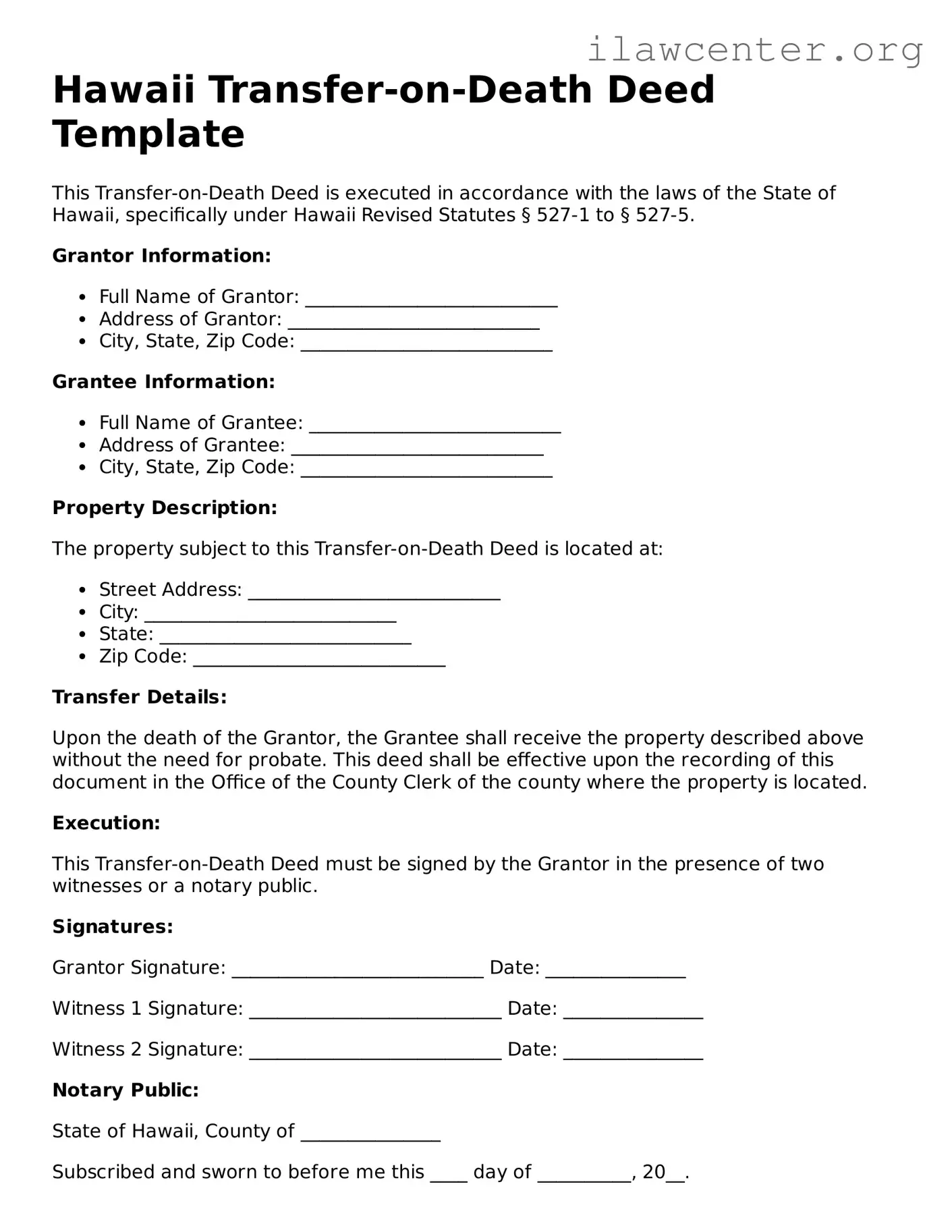
Hawaii Transfer-on-Death Deed Template

This Transfer-on-Death Deed is executed in accordance with the laws of the State of Hawaii, specifically under Hawaii Revised Statutes § 527-1 to § 527-5.

Grantor Information:

  • Full Name of Grantor: ___________________________
  • Address of Grantor: ___________________________
  • City, State, Zip Code: ___________________________

Grantee Information:

  • Full Name of Grantee: ___________________________
  • Address of Grantee: ___________________________
  • City, State, Zip Code: ___________________________

Property Description:

The property subject to this Transfer-on-Death Deed is located at:

  • Street Address: ___________________________
  • City: ___________________________
  • State: ___________________________
  • Zip Code: ___________________________

Transfer Details:

Upon the death of the Grantor, the Grantee shall receive the property described above without the need for probate. This deed shall be effective upon the recording of this document in the Office of the County Clerk of the county where the property is located.

Execution:

This Transfer-on-Death Deed must be signed by the Grantor in the presence of two witnesses or a notary public.

Signatures:

Grantor Signature: ___________________________ Date: _______________

Witness 1 Signature: ___________________________ Date: _______________

Witness 2 Signature: ___________________________ Date: _______________

Notary Public:

State of Hawaii, County of _______________

Subscribed and sworn to before me this ____ day of __________, 20__.

Notary Public Signature: ___________________________

My Commission Expires: _______________

PDF Form Characteristics

Fact Name Description
Purpose The Hawaii Transfer-on-Death Deed allows property owners to transfer real estate to designated beneficiaries upon their death without going through probate.
Governing Law This deed is governed by Hawaii Revised Statutes § 525-1 to § 525-10.
Execution Requirements The deed must be signed by the property owner and witnessed by two individuals or notarized to be valid.
Revocation Property owners can revoke the Transfer-on-Death Deed at any time before their death by executing a new deed or a revocation form.
Beneficiary Rights Beneficiaries do not have any rights to the property until the owner passes away, ensuring the owner retains full control during their lifetime.

Instructions on Utilizing Hawaii Transfer-on-Death Deed

After obtaining the Hawaii Transfer-on-Death Deed form, it's essential to fill it out accurately to ensure your intentions are clearly documented. Once completed, the form must be signed and recorded with the appropriate county office to take effect.

  1. Begin by entering your full name as the transferor at the top of the form.
  2. Provide your current address, including city, state, and ZIP code.
  3. Identify the property you wish to transfer by including its legal description. This may involve referencing the property tax map key number or the lot number.
  4. Designate the beneficiary or beneficiaries who will receive the property upon your passing. Include their full names and addresses.
  5. Specify whether the transfer is to be made to one beneficiary or multiple beneficiaries.
  6. Sign the form in the presence of a notary public to ensure it is legally binding.
  7. Have the notary public complete their section, which includes their signature and seal.
  8. Make copies of the completed and notarized form for your records.
  9. Submit the original form to the appropriate county office for recording.

Important Facts about Hawaii Transfer-on-Death Deed

What is a Transfer-on-Death Deed in Hawaii?

A Transfer-on-Death Deed (TODD) in Hawaii is a legal document that allows property owners to transfer their real estate to designated beneficiaries upon their death. This deed enables the property to bypass the probate process, which can be lengthy and costly. The owner retains full control of the property during their lifetime and can sell or modify it without any restrictions. The deed only takes effect after the owner's death, making it a flexible estate planning tool.

Who can use a Transfer-on-Death Deed?

Any individual who owns real estate in Hawaii can use a Transfer-on-Death Deed. This includes homeowners, co-owners, and even those who hold property in a trust. However, it’s important to note that the deed must be executed according to Hawaii law to be valid. Additionally, the beneficiaries named in the deed must be individuals or entities that can legally inherit property.

How do I create a Transfer-on-Death Deed?

Creating a Transfer-on-Death Deed involves several steps. First, you need to obtain the appropriate form, which can usually be found online or through legal resources. Next, fill out the form with the necessary information, including your name, the property details, and the names of your chosen beneficiaries. After completing the form, you must sign it in front of a notary public. Finally, to make the deed effective, you must record it with the appropriate county office in Hawaii. It’s advisable to consult with an attorney to ensure everything is done correctly.

Can I change or revoke a Transfer-on-Death Deed?

Yes, you can change or revoke a Transfer-on-Death Deed at any time while you are alive. To do so, you would need to create a new deed that either updates the beneficiaries or completely revokes the previous deed. This new deed must also be signed and recorded with the county. It’s important to keep your estate planning documents up to date to reflect your current wishes.

What happens if a beneficiary predeceases me?

If a beneficiary named in your Transfer-on-Death Deed passes away before you do, the property will typically not go to that beneficiary’s heirs unless you specify otherwise in the deed. Instead, the property will be distributed according to the terms of the deed. You may want to consider naming alternate beneficiaries to ensure your property goes to the intended individuals, even if the primary beneficiaries are no longer alive.
Common mistakes

Filling out the Hawaii Transfer-on-Death Deed form can be a straightforward process, but many people make common mistakes that can lead to complications down the line. One frequent error is not including all required information. The form requires specific details about the property and the beneficiaries. Omitting even a small piece of information can result in delays or even the rejection of the deed.

Another common mistake is failing to sign the form correctly. In Hawaii, the deed must be signed by the owner in the presence of a notary public. If the signature is missing or not notarized properly, the deed may not be considered valid. It's essential to ensure that all signatures are present and that the notarization is completed as required.

Many individuals also overlook the importance of properly identifying beneficiaries. This includes providing full legal names and, if applicable, their relationship to the property owner. Mistakes in names or relationships can create confusion and may lead to disputes among heirs in the future.

Another mistake people often make is not understanding the implications of the deed. A Transfer-on-Death Deed allows property to pass directly to the named beneficiaries without going through probate. However, if someone is unaware of this and believes they still need to go through probate, it can lead to unnecessary complications and stress for the family.

Some individuals may also forget to record the deed with the county clerk's office. For the Transfer-on-Death Deed to be effective, it must be recorded before the property owner's death. If this step is skipped, the deed may not hold up legally, and the property could end up in probate.

Lastly, people sometimes fail to review the deed after completing it. Changes in circumstances, such as the death of a beneficiary or a change in marital status, can affect the validity of the deed. Regularly reviewing and updating the deed ensures that it reflects the current wishes of the property owner and prevents future issues.

Documents used along the form

The Hawaii Transfer-on-Death Deed is a useful tool for transferring property upon death without going through probate. However, several other forms and documents often accompany it to ensure a smooth process. Here are some key documents that may be used alongside the Transfer-on-Death Deed.

  • Will: A legal document that outlines how a person's assets should be distributed after their death. It can specify guardianship for minor children and appoint an executor to manage the estate.
  • Affidavit of Death: This document serves as proof of a person's death. It is often required to facilitate the transfer of property or assets, confirming the passing of the individual named in the deed.
  • Property Deed: The official document that proves ownership of real estate. It includes details about the property and the current owner, which may need to be updated when transferring ownership.
  • Beneficiary Designation Forms: These forms are used to designate beneficiaries for certain assets, such as bank accounts or retirement plans. They can help ensure that assets pass directly to named individuals upon death.
  • Trust Documents: If a trust is established, these documents outline the terms and conditions of the trust. They specify how assets should be managed and distributed, potentially working alongside the Transfer-on-Death Deed.
  • Notice of Transfer: This document may be filed to inform interested parties of the property transfer. It can help clarify ownership and reduce potential disputes among heirs or beneficiaries.

Using these documents in conjunction with the Hawaii Transfer-on-Death Deed can simplify the process of asset transfer. Each document plays a specific role in ensuring that the wishes of the deceased are honored and that the transfer of property is carried out smoothly.

Similar forms

  • Will: A will outlines how a person's assets will be distributed after their death. Like a Transfer-on-Death Deed, it allows individuals to designate beneficiaries for their property. However, a will typically goes through probate, whereas a Transfer-on-Death Deed avoids this process.
  • Living Trust: A living trust is a legal arrangement where assets are held for the benefit of the trust's beneficiaries. Similar to a Transfer-on-Death Deed, it allows for the direct transfer of assets upon death, bypassing probate.
  • Beneficiary Designation: Certain financial accounts, like life insurance policies and retirement accounts, allow individuals to name beneficiaries. This is akin to a Transfer-on-Death Deed, as both methods ensure that assets transfer directly to chosen individuals without going through probate.
  • Joint Tenancy with Right of Survivorship: This property ownership arrangement allows two or more people to own property together. Upon the death of one owner, the property automatically passes to the surviving owner, similar to how a Transfer-on-Death Deed functions.
  • Payable-on-Death Accounts: These bank accounts allow individuals to designate beneficiaries who will receive the funds upon their death. Like a Transfer-on-Death Deed, this method ensures a smooth transfer of assets without the need for probate.
  • Transfer-on-Death Registration for Vehicles: Some states allow vehicle owners to register their vehicles in a way that designates a beneficiary to receive the vehicle upon the owner’s death. This process mirrors the intent and function of a Transfer-on-Death Deed.
  • Life Estate Deed: This deed allows a person to retain the right to use and benefit from a property during their lifetime, with the property passing to a designated beneficiary upon their death. It shares the goal of asset transfer without probate.
  • Community Property with Right of Survivorship: In some states, married couples can hold property as community property with a right of survivorship. Upon the death of one spouse, the property automatically passes to the surviving spouse, similar to the Transfer-on-Death Deed.
  • Declaration of Trust: This document outlines the terms of a trust and names beneficiaries. It serves a similar purpose to a Transfer-on-Death Deed in that it facilitates the transfer of assets upon death without the need for probate.
  • Transfer-on-Death Securities Registration: This allows individuals to register securities in a way that designates a beneficiary. Like a Transfer-on-Death Deed, it ensures that the securities pass directly to the beneficiary without going through probate.

Dos and Don'ts

When filling out the Hawaii Transfer-on-Death Deed form, it is essential to approach the task with care and attention to detail. This deed allows property owners to designate beneficiaries who will inherit their property upon their death, without going through the probate process. Here are six important dos and don'ts to consider:

  • Do ensure you are eligible to use the form. Only property owners can complete this deed.
  • Do provide accurate property descriptions. Clearly identify the property you wish to transfer to avoid confusion.
  • Do include the full names of beneficiaries. Make sure to list the beneficiaries’ legal names to prevent any issues later.
  • Do sign the deed in the presence of a notary. This step is crucial for the deed's validity.
  • Don't forget to record the deed. After signing, submit the deed to the appropriate county office to make it effective.
  • Don't use vague language. Be specific about the terms of the transfer to avoid misunderstandings.

By following these guidelines, you can help ensure that your Transfer-on-Death Deed is completed correctly and serves its intended purpose efficiently.

Misconceptions

The Hawaii Transfer-on-Death Deed (TOD) form is a useful tool for estate planning, but several misconceptions surround it. Understanding these misconceptions can help individuals make informed decisions about their property and beneficiaries. Here are five common misunderstandings:

  • 1. The TOD Deed is the same as a will. Many people think that a TOD deed functions like a will, but it actually operates differently. A TOD deed allows property to pass directly to a beneficiary upon the owner’s death, avoiding probate, while a will requires probate to transfer assets.
  • 2. A TOD Deed is irrevocable. Some believe that once a TOD deed is created, it cannot be changed. In reality, the owner can revoke or modify the deed at any time before their death, as long as they follow the proper procedures.
  • 3. All types of property can be transferred using a TOD Deed. It is a common myth that any property can be transferred through a TOD deed. However, only certain types of property, like real estate, qualify for this transfer method. Personal property and bank accounts typically do not.
  • 4. The beneficiary has rights to the property while the owner is alive. Some individuals mistakenly think that naming a beneficiary on a TOD deed gives them rights to the property during the owner’s lifetime. This is not true; the owner retains full control of the property until their death.
  • 5. A TOD Deed eliminates all estate taxes. Many believe that using a TOD deed means there will be no estate taxes. While it can help avoid probate, it does not eliminate tax obligations. Estate taxes may still apply based on the total value of the estate.

Understanding these misconceptions can clarify how the Hawaii Transfer-on-Death Deed works and its role in effective estate planning.

Key takeaways

When considering the Hawaii Transfer-on-Death Deed form, there are several important points to keep in mind. This legal tool allows property owners to pass their real estate directly to their beneficiaries upon their death, avoiding probate. Here are some key takeaways:

  1. Eligibility: Only individuals who own real property in Hawaii can utilize this deed. It is essential to ensure that the property is solely owned or owned as a joint tenant with rights of survivorship.
  2. Form Requirements: The Transfer-on-Death Deed must be completed accurately and signed in the presence of a notary public. This step is crucial to ensure the deed is valid and enforceable.
  3. Beneficiary Designation: When filling out the form, you must clearly designate your beneficiary or beneficiaries. You can name one or multiple individuals, and it’s wise to consider alternative beneficiaries in case the primary ones are unable to inherit.
  4. Revocation: The deed can be revoked at any time before the property owner’s death. To do this, a new deed must be executed and recorded, or the original deed must be formally revoked.
  5. Recording the Deed: Once completed and notarized, the deed must be recorded with the Bureau of Conveyances in Hawaii. This step ensures that the transfer is legally recognized and binding.

Understanding these key aspects can help ensure a smoother process when using the Transfer-on-Death Deed in Hawaii. Proper planning can provide peace of mind for both property owners and their loved ones.