
Hazmat Employee Training Record PDF Template

Hazmat Employee Training Record PDF Template

The Hazmat Employee Training Record form is a crucial document that tracks the training and certification of employees handling hazardous materials. It ensures compliance with federal regulations by maintaining a detailed record of training sessions, completion dates, and the qualifications of trainers. Properly filling out this form is essential for both employers and employees to uphold safety standards in hazardous material transportation.

Ready to complete your Hazmat Employee Training Record? Click the button below to get started!

Article Guide

The Hazmat Employee Training Record form is a crucial document designed to ensure compliance with federal regulations governing hazardous materials transportation. This form captures essential information about hazmat employees, including their name, employer details, and job description. It serves as a comprehensive record of the training that these employees have undergone, detailing their most recent training completion date and the materials used during their training. The form also requires the name and address of the training provider, along with a certification confirming that the employee has been adequately trained and tested as mandated by the regulations. Employers must maintain this record for as long as the employee is in their role and for an additional 90 days after their departure. Additionally, the form addresses the specific training requirements laid out in sections 172.704 and 177.816, which cover various training areas, ensuring that hazmat employees are well-prepared for their responsibilities. By completing this form accurately, employers can demonstrate their commitment to safety and regulatory compliance in the handling of hazardous materials.

Hazmat Employee Training Record Preview

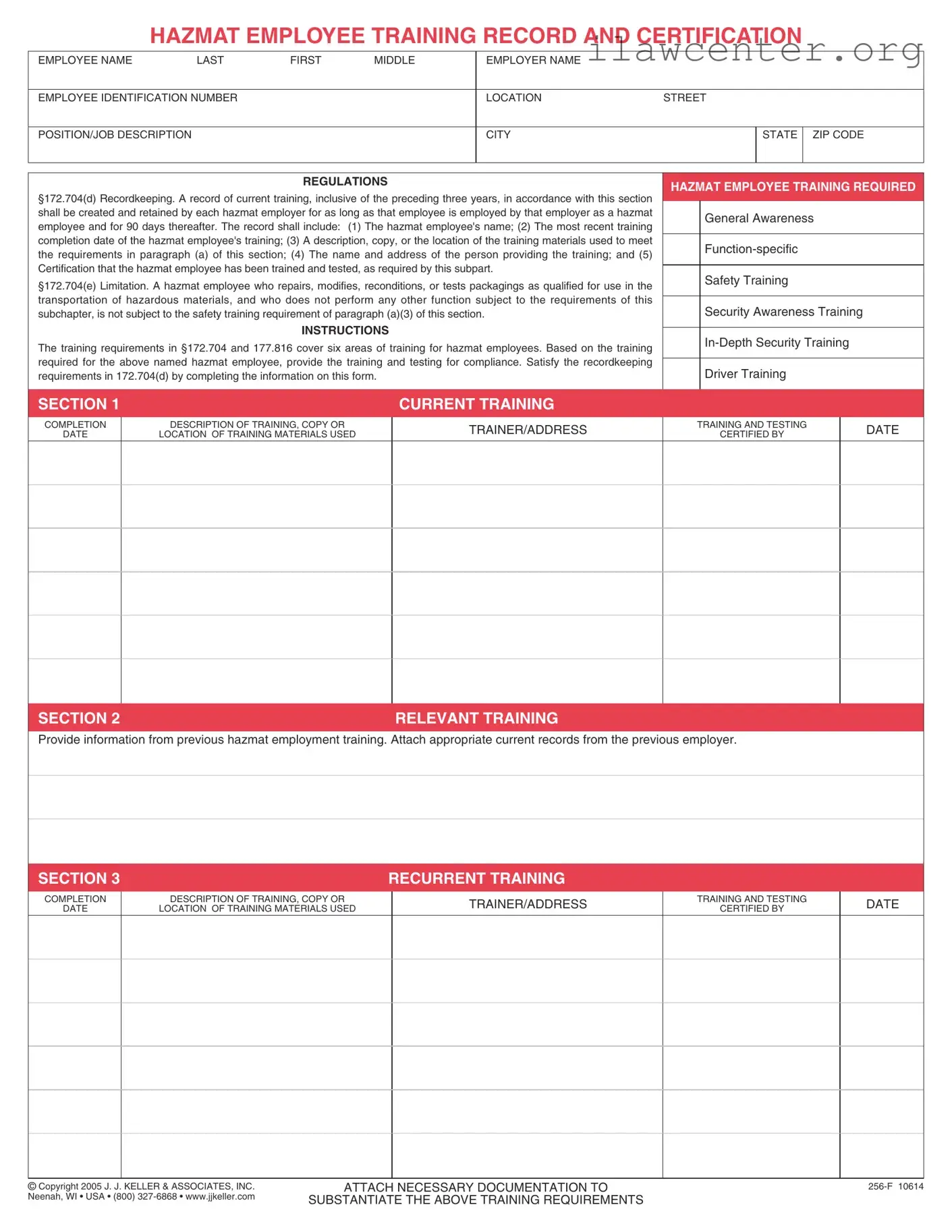
HAZMAT EMPLOYEE TRAINING RECORD AND CERTIFICATION
EMPLOYEE NAME LAST FIRST MIDDLE EMPLOYER NAME
EMPLOYEE IDENTIFICATION NUMBER LOCATION STREET
POSITION/JOB DESCRIPTION CITY STATE ZIP CODE
ATTACH NECESSARY DOCUMENTATION TO
SUBSTANTIATE THE ABOVE TRAINING REQUIREMENTS
©
Copyright 2005 J. J. KELLER & ASSOCIATES, INC. 256-F 10614
Neenah, WI • USA • (800) 327-6868 • www.jjkeller.com
HAZMAT EMPLOYEE TRAINING REQUIRED
General Awareness
Function-specific
Safety Training
Security Awareness Training
In-Depth Security Training
Driver Training
REGULATIONS
§172.704(d) Recordkeeping. A record of current training, inclusive of the preceding three years, in accordance with this section
shall be created and retained by each hazmat employer for as long as that employee is employed by that employer as a hazmat
employee and for 90 days thereafter. The record shall include: (1) The hazmat employee's name; (2) The most recent training
completion date of the hazmat employee's training; (3) A description, copy, or the location of the training materials used to meet
the requirements in paragraph (a) of this section; (4) The name and address of the person providing the training; and (5)
Certification that the hazmat employee has been trained and tested, as required by this subpart.
§172.704(e) Limitation. A hazmat employee who repairs, modifies, reconditions, or tests packagings as qualified for use in the
transportation of hazardous materials, and who does not perform any other function subject to the requirements of this
subchapter, is not subject to the safety training requirement of paragraph (a)(3) of this section.
INSTRUCTIONS
The training requirements in §172.704 and 177.816 cover six areas of training for hazmat employees. Based on the training
required for the above named hazmat employee, provide the training and testing for compliance. Satisfy the recordkeeping
requirements in 172.704(d) by completing the information on this form.
SECTION 1 CURRENT TRAINING
COMPLETION DESCRIPTION OF TRAINING, COPY OR TRAINING AND TESTING
DATE LOCATION OF TRAINING MATERIALS USED
TRAINER/ADDRESS
CERTIFIED BY
DATE
SECTION 2 RELEVANT TRAINING
Provide information from previous hazmat employment training. Attach appropriate current records from the previous employer.
SECTION 3 RECURRENT TRAINING
COMPLETION DESCRIPTION OF TRAINING, COPY OR TRAINING AND TESTING
DATE LOCATION OF TRAINING MATERIALS USED
TRAINER/ADDRESS
CERTIFIED BY
DATE

File Properties

Fact Name Description
Employee Identification The form requires the employee's full name, identification number, and position/job description for accurate recordkeeping.
Employer Responsibilities Employers must maintain training records for each hazmat employee for the duration of their employment and for 90 days after termination.
Training Duration Records must include training completion dates and descriptions for training received within the last three years.
Training Content Training records should detail the training materials used, ensuring compliance with the required training standards.
Certification Requirement Employers must certify that each hazmat employee has been trained and tested according to the regulations.
Exemptions Employees who only repair or test packagings may be exempt from certain safety training requirements.
State-Specific Regulations State laws may vary; for example, California's regulations under Title 49 of the California Code of Regulations govern additional training requirements.

Instructions on Utilizing Hazmat Employee Training Record

Completing the Hazmat Employee Training Record form is essential for maintaining accurate training documentation for hazmat employees. This record ensures compliance with federal regulations and helps employers keep track of their employees' training history. Follow the steps below to accurately fill out the form.

  1. Begin with Section 1. Enter the employee's name in the appropriate fields: last name, first name, and middle initial.
  2. Next, provide the employer's name in the designated area.
  3. Fill in the employee identification number assigned by the employer.
  4. Complete the location section by entering the street address, city, state, and ZIP code.
  5. In the position/job description field, write the employee's current job title.
  6. For the training completion details, input the most recent training completion date and the description of training in the respective spaces.
  7. Document the location of training materials used and the name and address of the trainer.
  8. Certify the training by including a statement that confirms the employee has been trained and tested, then sign in the certified by section.
  9. Move to Section 2 to provide information from any previous hazmat employment training. Attach relevant records from the prior employer.
  10. Proceed to Section 3. Repeat the steps for recurrent training completion by entering the training completion date, description of training, location of training materials used, and trainer's name and address.
  11. Finally, ensure that all necessary documentation is attached to substantiate the training requirements.

Important Facts about Hazmat Employee Training Record

What is the purpose of the Hazmat Employee Training Record form?

The Hazmat Employee Training Record form serves to document the training of employees who handle hazardous materials. It ensures compliance with federal regulations that require employers to maintain accurate records of training completion, which is essential for safety and legal accountability.

Who is required to fill out this form?

This form must be completed by hazmat employers for each hazmat employee. This includes anyone involved in the transportation, handling, or management of hazardous materials. The form helps ensure that all employees receive the necessary training and that their training records are properly maintained.

What information is needed on the form?

Essential information includes the employee's name, employer's name, employee identification number, job description, and training completion dates. Additionally, details about the training materials, the trainer’s name and address, and certification of training must be included. This comprehensive documentation is crucial for compliance.

How long must training records be kept?

According to regulations, employers must retain training records for the duration of the employee's employment as a hazmat employee, plus an additional 90 days after their employment ends. This ensures that there is a clear history of the employee’s training and compliance during their tenure.

What types of training must be documented?

The form must document various types of training, including general awareness, function-specific, safety, and security awareness training. Each type of training is essential for ensuring that employees are adequately prepared to handle hazardous materials safely and in compliance with regulations.

Can previous training from other employers be included?

Yes, the form allows for the inclusion of relevant training from previous hazmat employment. Employers should attach appropriate records from prior employers to substantiate the training history. This can help in establishing a comprehensive training background for the employee.

What happens if an employee does not receive proper training?

If an employee does not receive the required training, the employer may face significant legal and financial consequences. This can include fines from regulatory agencies, increased liability in case of accidents, and potential harm to employees and the public. Proper training is not just a regulatory requirement; it is essential for safety.

Is recurrent training necessary?

Yes, recurrent training is necessary to ensure that hazmat employees remain up-to-date with the latest safety practices and regulations. The form includes a section for documenting recurrent training, which is vital for maintaining compliance and ensuring ongoing employee competency.

How can employers ensure they are compliant with training requirements?

Employers can ensure compliance by regularly reviewing training requirements, maintaining accurate records, and conducting training sessions as needed. Using the Hazmat Employee Training Record form effectively will help keep all necessary documentation organized and accessible, facilitating compliance with federal regulations.

Common mistakes

Filling out the Hazmat Employee Training Record form is a critical task that ensures compliance with federal regulations. However, many individuals make common mistakes that can lead to complications. One frequent error is failing to include the employee's full name. The form requires the last, first, and middle names, and omitting any part can result in confusion or invalid records.

Another common mistake is neglecting to provide the most recent training completion date. This date is essential for tracking the employee's training history and ensuring that it is up to date. Without this information, employers may struggle to demonstrate compliance during audits.

Inaccuracies in the description of training can also lead to issues. It is crucial to provide a clear and concise description of the training received. Vague or incomplete descriptions can raise questions about whether the training met the necessary standards.

Many individuals also forget to include the location of training materials. This detail is vital for verifying that the training content aligns with regulatory requirements. If the materials are not properly documented, it could result in non-compliance findings.

Providing incorrect information about the trainer is another mistake that can undermine the validity of the training record. The form requires the name and address of the trainer, and inaccuracies here can lead to complications in verifying the training's legitimacy.

Additionally, individuals often overlook the certification section. It is essential to include a certification statement that confirms the employee has been trained and tested. Failing to do so can lead to questions about the employee's qualifications and readiness to handle hazardous materials.

In Section 2, some employees fail to attach current records from previous employers. This documentation is crucial for providing a complete training history. Without it, the record may be considered incomplete, which can have serious implications for compliance.

Finally, not substantiating the training requirements can lead to significant issues. Employers must ensure that all necessary documentation is attached to the form. Incomplete submissions can result in delays or rejections, ultimately hindering compliance efforts.

Documents used along the form

The Hazmat Employee Training Record form is a crucial document for ensuring compliance with federal regulations regarding hazardous materials training. However, it is often accompanied by several other forms and documents that further support the training and certification process. Understanding these additional documents can help streamline compliance and enhance safety in the workplace.

  • Training Curriculum Outline: This document provides a detailed overview of the training program, including objectives, topics covered, and the duration of each session. It serves as a roadmap for the training process and ensures that all necessary areas are addressed.
  • Training Attendance Sheet: This form records the names of participants who attended the training sessions. It helps verify that all required employees have completed their training and can be used for audit purposes.
  • Trainer Qualification Records: These documents contain the credentials and qualifications of the trainers conducting the hazmat training. They ensure that the trainers have the necessary expertise and experience to provide effective instruction.
  • Assessment and Evaluation Forms: After training, these forms are used to assess the knowledge and skills acquired by the employees. They can include quizzes, practical evaluations, or feedback surveys to measure the effectiveness of the training.
  • Previous Employment Training Records: If an employee has prior hazmat training, these records must be attached to the current training documentation. They provide evidence of the employee's previous experience and can help fulfill training requirements.
  • Recurrent Training Documentation: This includes records of any refresher training sessions that employees have completed. Regular updates are essential for maintaining compliance and ensuring that employees stay informed about the latest safety practices.

Collectively, these documents support the Hazmat Employee Training Record form and reinforce the commitment to safety and regulatory compliance. Properly maintaining and organizing these records is essential for any organization handling hazardous materials.

Similar forms

The Hazmat Employee Training Record form shares similarities with several other important documents related to employee training and safety compliance. Below is a list of these documents and their similarities.

  • Employee Training Certificate: This document certifies that an employee has completed specific training programs, similar to how the Hazmat Employee Training Record confirms training for hazardous materials handling.
  • Safety Data Sheet (SDS): An SDS provides detailed information about hazardous substances, ensuring employees understand the risks, akin to the training record which outlines safety training received by the employee.
  • Training Needs Assessment: This document identifies the training requirements for employees based on their job roles, paralleling the Hazmat form's focus on specific training needed for hazmat employees.
  • Incident Report Form: This form documents any incidents involving hazardous materials, similar to how the Hazmat Employee Training Record tracks training to prevent such incidents.
  • Job Safety Analysis (JSA): A JSA outlines potential hazards associated with job tasks, much like the Hazmat form details training that addresses these hazards.
  • Compliance Audit Report: This report assesses adherence to safety regulations, akin to the Hazmat Employee Training Record's role in documenting compliance with training requirements.
  • Training Attendance Record: This record tracks employee participation in training sessions, similar to how the Hazmat form keeps a record of training completion dates and descriptions.

Dos and Don'ts

When filling out the Hazmat Employee Training Record form, it’s crucial to ensure accuracy and completeness. Here are some important dos and don’ts to keep in mind:

  • Do include the full name of the employee, including first, middle, and last names.
  • Do provide the employer's name clearly to avoid any confusion.
  • Do enter the employee identification number to ensure proper tracking.
  • Do list the most recent training completion date accurately.
  • Don’t leave out any sections of the form; every part is important.
  • Don’t forget to attach any necessary documentation from previous employers.
  • Don’t use vague descriptions for training materials; be specific.
  • Don’t neglect to include the name and address of the trainer.

Completing this form correctly is not just a formality; it ensures compliance with regulations and helps maintain safety standards in hazardous materials handling. Take these steps seriously.

Misconceptions

Misconceptions about the Hazmat Employee Training Record form can lead to confusion and compliance issues. Here are seven common misunderstandings:

  • It is optional to keep training records. Some employers believe that maintaining training records is not mandatory. In reality, the records must be kept for as long as the employee is employed and for 90 days after.
  • Only initial training records are required. Many think that only initial training documentation is necessary. However, records must include ongoing training and testing for compliance.
  • Any training program suffices. Some assume that any training program can be used. The training must meet specific regulatory requirements to be valid.
  • Only the employer needs to keep records. Employees often believe that only the employer is responsible for recordkeeping. In fact, employees should also retain copies of their training records for personal reference.
  • Training records can be discarded after a year. There is a misconception that records can be discarded after one year. They must be maintained for three years as per regulations.
  • Training does not need to be documented. Some individuals think that verbal confirmation of training is sufficient. Documentation is essential to prove compliance with training requirements.
  • Previous training records are not relevant. Many believe that past training does not need to be documented. However, relevant training from previous employment must be included to ensure comprehensive compliance.

Understanding these misconceptions can help ensure that hazmat employers and employees maintain proper compliance with training requirements.

Key takeaways

Filling out and using the Hazmat Employee Training Record form is crucial for compliance and safety in the transportation of hazardous materials. Here are key takeaways to consider:

  • Employee Identification: Clearly fill out the employee's name, identification number, and job description to ensure accurate recordkeeping.
  • Employer Responsibilities: Employers must maintain training records for each hazmat employee as long as they are employed and for 90 days thereafter.
  • Training Documentation: Include the most recent training completion date and a description or copy of the training materials used.
  • Trainer Information: Provide the name and address of the individual or organization that conducted the training.
  • Certification Requirement: Ensure that the form includes a certification stating that the employee has been trained and tested according to regulations.
  • Previous Employment Records: If applicable, attach records from prior hazmat training to substantiate the employee's qualifications.
  • Recurrent Training: Document any recurrent training completed, including dates and descriptions, to maintain compliance.
  • Security Awareness Training: Understand that specific training is required for employees involved in the transportation of hazardous materials, including security awareness training.
  • Record Retention: Keep these records organized and accessible, as they may be requested during inspections or audits.

Taking these steps will help ensure that both employers and employees are compliant with federal regulations and contribute to a safer working environment.