Hcfa 487 PDF Template

Hcfa 487 PDF Template

The HCFA 487 form is an important document used in the healthcare system, specifically as an addendum to the plan of treatment for medical updates. It includes essential information such as the patient’s claim number, provider details, and certification periods. For those needing to complete this form, please click the button below to get started.

Article Guide

The HCFA 487 form serves as an essential document in the healthcare system, specifically designed for medical updates related to patient treatment plans. This form is utilized by healthcare providers to communicate important information about a patient's ongoing care. Key elements include the patient's health insurance claim number, the date of service certification, and the certification period. Additionally, the form requires details such as the patient's name, medical record number, and provider information. The physician's signature is a crucial component, affirming the accuracy of the information provided. There is also an option for a nurse or therapist to include their name and signature, further validating the update. This structured format ensures that all necessary details are captured efficiently, facilitating clear communication among healthcare professionals and ensuring that patient care remains coordinated and effective.

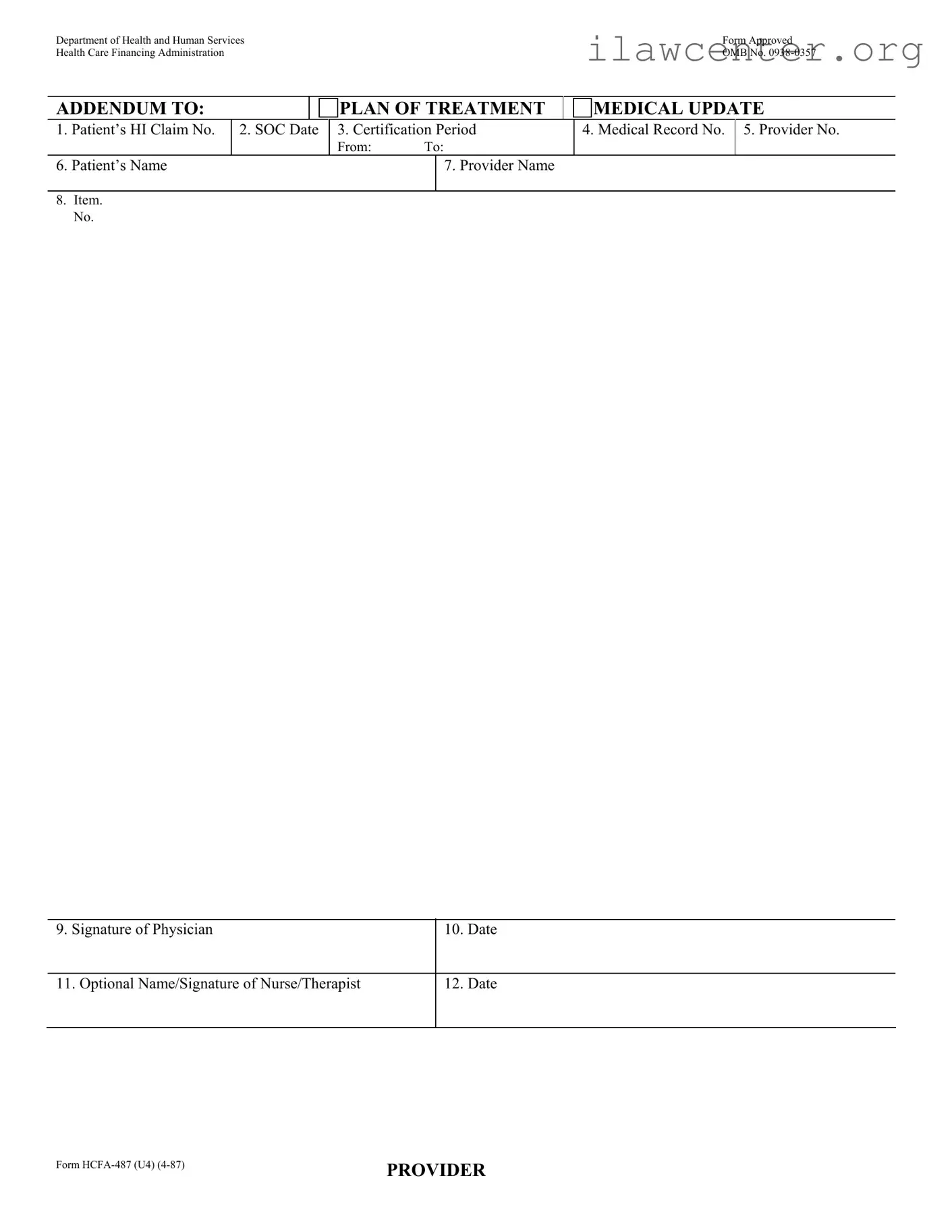
Hcfa 487 Preview

Department of Health and Human Services Form Approved
Health Care Financing Administration OMB No. 0938-0357
Form HCFA-487 (U4) (4-87)
PROVIDER
ADDENDUM TO:
PLAN OF TREATMENT MEDICAL UPDATE
1. Patient’s HI Claim No.
2. SOC Date
3. Certification Period
From: To:
4. Medical Record No.
5. Provider No.
6. Patient’s Name
7. Provider Name
8. Item.
No.
9. Signature of Physician
10. Date
11. Optional Name/Signature of Nurse/Therapist
12. Date

File Properties

Fact Name Description
Form Purpose The HCFA 487 form serves as an addendum to the plan of treatment, providing necessary medical updates.
Governing Body This form is approved by the Department of Health and Human Services and the Health Care Financing Administration.
OMB Approval The form is assigned OMB No. 0938-0357, indicating it has been reviewed and approved for use in healthcare settings.
Patient Information Essential patient details such as HI Claim No., SOC Date, and Medical Record No. are required on the form.
Provider Details Information regarding the provider, including their name and provider number, must be included for accountability.
Certification Period The form specifies the certification period, indicating the time frame during which the treatment is validated.
Signature Requirements A physician's signature is mandatory, along with an optional signature from a nurse or therapist for additional validation.
Date Fields Both the physician and optional nurse/therapist must provide the date of their signatures, ensuring a clear timeline.
State-Specific Forms Some states may have additional requirements or variations of the HCFA 487 form, governed by state healthcare laws.

Instructions on Utilizing Hcfa 487

After completing the HCFA 487 form, you will need to submit it to the appropriate health care financing administration or provider. Ensure that all information is accurate and complete to avoid delays in processing.

  1. Locate the HCFA 487 form. Ensure you have the most recent version.
  2. In the first section, enter the Patient’s HI Claim No..
  3. Fill in the SOC Date (Start of Care Date).
  4. Indicate the Certification Period by writing the start and end dates.
  5. Provide the Medical Record No. for the patient.
  6. Enter the Provider No. along with the date range (From: To:).
  7. Write the Patient’s Name clearly.
  8. Fill in the Provider Name.
  9. Input the Item No. as required.
  10. Have the physician sign in the Signature of Physician section.
  11. Record the Date of the physician's signature.
  12. If applicable, include the Optional Name/Signature of Nurse/Therapist.
  13. Provide the Date for the nurse/therapist's signature if included.

Important Facts about Hcfa 487

What is the HCFA 487 form used for?

The HCFA 487 form, also known as the Addendum to Plan of Treatment Medical Update, is primarily used in the healthcare industry to provide updates regarding a patient's treatment plan. This form is essential for documenting changes in a patient's medical condition or treatment strategy, ensuring that all healthcare providers involved in a patient's care are on the same page. By maintaining accurate and up-to-date information, the HCFA 487 helps facilitate effective communication among medical professionals and supports optimal patient care.

Who is required to fill out the HCFA 487 form?

Typically, the HCFA 487 form is completed by healthcare providers, including physicians, nurses, and therapists. The form requires the signature of the physician to validate the medical updates being reported. In some cases, a nurse or therapist may also provide their name and signature, indicating their involvement in the patient's care. This collaborative approach ensures that all relevant parties contribute to the patient's treatment documentation.

What information is included on the HCFA 487 form?

The HCFA 487 form includes several key pieces of information. It captures the patient's health insurance claim number, the date of service certification, and the certification period. Additionally, it requires the patient's name, medical record number, and provider information. The form also has designated areas for the physician's signature, the date of signing, and an optional section for the nurse or therapist's name and signature. This comprehensive data collection is crucial for maintaining accurate records and ensuring continuity of care.

How does the HCFA 487 form impact patient care?

By providing a structured way to document updates to a patient's treatment plan, the HCFA 487 form plays a vital role in enhancing patient care. It ensures that all healthcare providers are informed of any changes in the patient's condition or treatment approach. This can lead to more coordinated and effective care, reducing the risk of miscommunication or oversight. Ultimately, the timely completion and submission of the HCFA 487 form can significantly contribute to better health outcomes for patients.

Common mistakes

Filling out the HCFA 487 form can be a straightforward process, but many people make common mistakes that can lead to delays or complications in claims processing. One frequent error is leaving out the patient’s HI Claim Number. This number is crucial for identifying the patient’s records and ensuring that the claim is processed correctly. Without it, the form may be returned or delayed.

Another mistake often seen is incorrect dates. The SOC Date and Certification Period need to be accurate. If these dates are wrong, it can create confusion about the timeline of care, potentially impacting reimbursement. Always double-check these entries to avoid unnecessary setbacks.

In addition, many individuals overlook the importance of the Medical Record Number. This number links the claim to the patient’s medical history. Forgetting to include it can lead to issues in verifying the treatment provided. Make sure this field is filled out completely.

Another common oversight is not providing the Provider Name or the Provider Number. This information is essential for the claims process, as it identifies who provided the care. If this information is missing or incorrect, it can lead to payment denials.

Signatures are also a frequent source of error. The Signature of Physician is required, and it must be the actual signature, not a stamp or printed name. Additionally, if a nurse or therapist has provided care, their optional signature should also be included, along with the date. Omitting these signatures can lead to a rejection of the claim.

Sometimes, individuals fail to complete all required fields. Each item on the form serves a purpose, and leaving any blank can cause delays. Take the time to review the entire form to ensure all necessary information is included.

Another mistake is not keeping a copy of the completed form. It’s essential to retain a copy for your records. This can be helpful if there are any questions or issues later on. Having a reference can make the follow-up process much smoother.

Lastly, many people forget to check for updates to the form. Regulations and requirements can change, so it’s wise to ensure you are using the most current version. Using an outdated form can lead to complications that could have been easily avoided.

By being mindful of these common mistakes, you can improve the accuracy of your HCFA 487 form submissions and help ensure a smoother claims process.

Documents used along the form

The HCFA 487 form is essential for updating a patient's medical treatment plan. However, it often accompanies other important documents to ensure comprehensive care and proper billing. Below is a list of forms frequently used alongside the HCFA 487.

  • HCFA 1500 Form: This form is used for submitting medical claims for reimbursement from Medicare and other insurers. It details the services provided and the associated costs.
  • Plan of Treatment: This document outlines the specific medical care and services a patient will receive. It serves as a roadmap for healthcare providers and ensures that everyone is on the same page regarding the patient's care.
  • Medical Records Release Form: Patients use this form to authorize the release of their medical records to healthcare providers or insurance companies. It protects patient privacy while allowing necessary information to be shared.
  • Physician's Orders: This document contains specific instructions from a physician regarding a patient's care, including medications, therapies, and any necessary follow-up actions.
  • Progress Notes: Healthcare providers use progress notes to document a patient's ongoing treatment and response to care. These notes are vital for tracking a patient's health over time.
  • Patient Consent Form: This form ensures that patients understand and agree to the proposed treatment plan. It is crucial for legal protection and patient autonomy.
  • Insurance Verification Form: This document confirms a patient's insurance coverage and benefits. It helps healthcare providers ensure that services rendered will be reimbursed by the insurance company.

Each of these forms plays a critical role in the healthcare process, facilitating communication between patients, providers, and insurers. Using them in conjunction with the HCFA 487 form can streamline patient care and billing, ensuring a smoother experience for everyone involved.

Similar forms

The HCFA 487 form is an important document used in the healthcare field, particularly for documenting medical updates and treatment plans. Several other forms serve similar purposes, each with its own specific context and requirements. Below are seven documents that are similar to the HCFA 487 form, along with an explanation of how they are alike:

  • CMS-1500 Form: This form is used for billing outpatient medical services. Like the HCFA 487, it requires patient information, provider details, and a summary of services rendered.
  • UB-04 Form: This document is primarily used by hospitals to bill for inpatient and outpatient services. Similar to the HCFA 487, it collects comprehensive patient and provider information.
  • HCFA 1500 Form: This form is utilized for reporting healthcare services provided to patients. It shares similarities with the HCFA 487 in that both require detailed patient identification and provider information.
  • Plan of Care (POC): This document outlines the treatment plan for a patient. Like the HCFA 487, it is essential for tracking a patient’s progress and requires signatures from healthcare providers.
  • Patient Progress Notes: These notes document a patient’s ongoing treatment and response to care. Similar to the HCFA 487, they provide updates that are critical for maintaining accurate medical records.
  • Authorization for Release of Medical Information: This form allows healthcare providers to share patient information. It is similar to the HCFA 487 in that both involve important patient data and require signatures for compliance.
  • Referral Form: This document is used when a patient is referred to a specialist. Like the HCFA 487, it includes patient details and provider information to ensure continuity of care.

Dos and Don'ts

When filling out the HCFA 487 form, it is crucial to follow certain guidelines to ensure accuracy and compliance. Here’s a list of what you should and shouldn’t do:

  • Do provide accurate patient information.
  • Do double-check the certification period dates.
  • Do ensure the physician’s signature is present.
  • Do include the medical record number.
  • Do clearly print the provider’s name.
  • Don’t leave any required fields blank.
  • Don’t use abbreviations that may confuse the reviewer.
  • Don’t forget to include the optional nurse/therapist signature if applicable.
  • Don’t submit the form without a thorough review.
  • Don’t ignore submission deadlines.

Following these guidelines can help prevent delays in processing and ensure that the information provided is complete and accurate.

Misconceptions

Understanding the HCFA 487 form is crucial for healthcare providers and patients alike. However, several misconceptions can lead to confusion. Here are seven common misconceptions clarified:

  • Misconception 1: The HCFA 487 form is only for Medicare patients.
  • This form is not limited to Medicare patients. It can be used for various healthcare plans that require a plan of treatment update.

  • Misconception 2: The form is only necessary for initial treatments.
  • In reality, the HCFA 487 is an addendum that can be used throughout the entire treatment process, not just at the beginning.

  • Misconception 3: Completing the form is optional.
  • In many cases, submitting the HCFA 487 is mandatory to ensure proper documentation and reimbursement for services provided.

  • Misconception 4: Only physicians can sign the HCFA 487 form.
  • While a physician's signature is required, nurses and therapists can also provide their signatures to validate the treatment updates.

  • Misconception 5: The form is only relevant for inpatient care.
  • The HCFA 487 is applicable to both inpatient and outpatient settings, making it versatile for various healthcare scenarios.

  • Misconception 6: The form is outdated and no longer in use.
  • Despite its age, the HCFA 487 remains a relevant document in healthcare administration for updates in treatment plans.

  • Misconception 7: The HCFA 487 does not affect reimbursement rates.
  • Proper completion and submission of the form can significantly impact reimbursement processes, ensuring that providers receive appropriate payment for services rendered.

Key takeaways

Filling out the HCFA 487 form is an important step in documenting a patient's plan of treatment and medical updates. Here are some key takeaways to keep in mind:

  • Understand the Purpose: The HCFA 487 form is used to provide updates to a patient's plan of treatment, ensuring that all medical information is current and accurate.
  • Accurate Patient Information: Make sure to include the patient's HI Claim Number, SOC Date, and Certification Period. This information is crucial for proper record-keeping.
  • Provider Details: Clearly list the provider's name and number. This helps identify who is responsible for the patient's care.
  • Signature Requirements: The form must be signed by the physician. An optional signature from a nurse or therapist can also be included for additional validation.
  • Keep Dates in Mind: Include the date of the physician's signature and, if applicable, the date of the nurse/therapist's signature. This establishes a timeline for the updates.
  • Item Number Importance: Fill in the Item Number accurately. This helps in tracking specific treatments or procedures associated with the patient.
  • Review Before Submission: Always double-check the completed form for any errors or missing information. This can prevent delays in processing and ensure timely care for the patient.

By following these guidelines, you can effectively utilize the HCFA 487 form to enhance patient care and maintain comprehensive medical records.