

High School Transcript PDF Template

High School Transcript PDF Template

The High School Transcript form is an official document that provides a comprehensive record of a student's academic achievements throughout their high school years. It typically includes courses taken, grades received, and graduation status, serving as a crucial component for college applications and job opportunities. To get started on obtaining your transcript, click the button below.

Article Guide

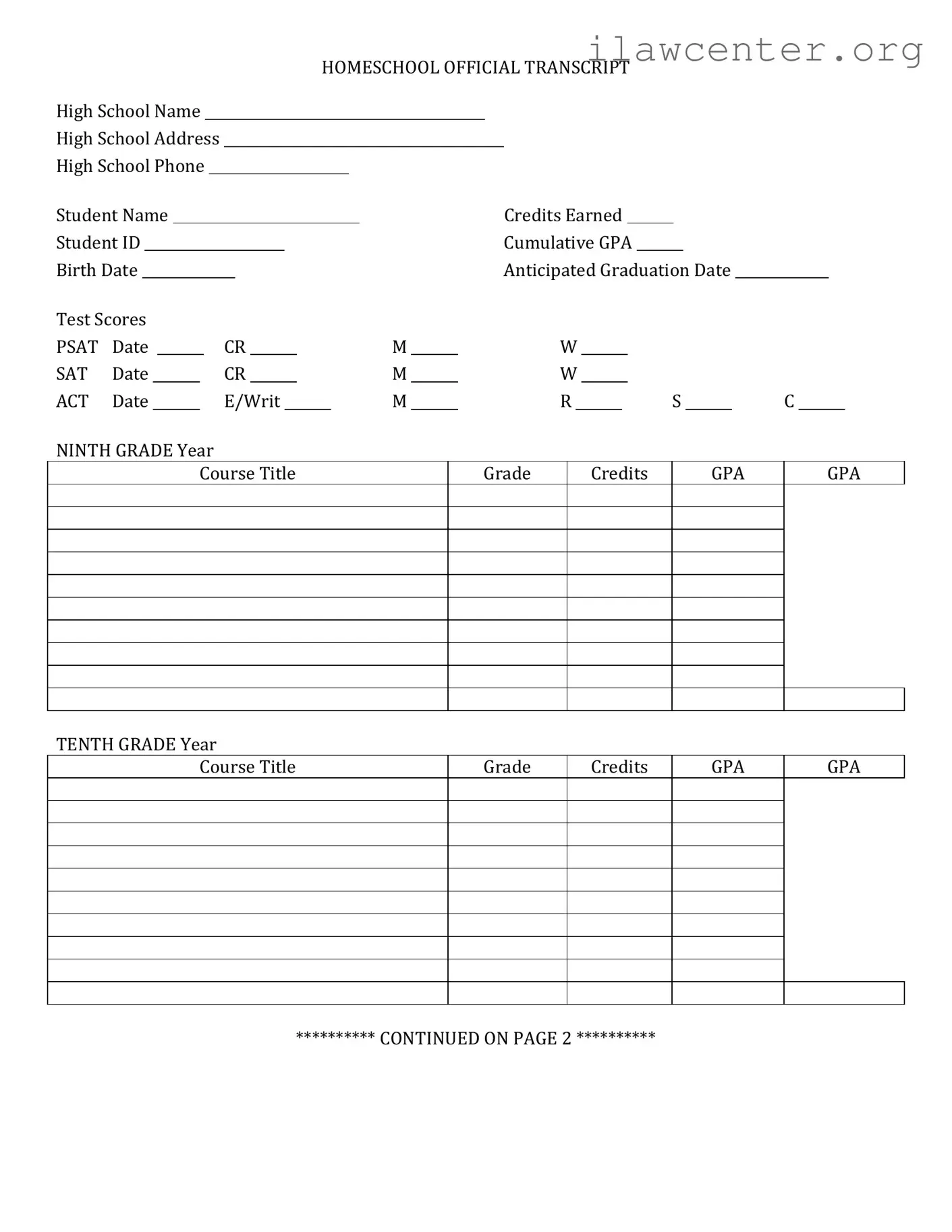
The High School Transcript form serves as a vital document in a student’s academic journey, encapsulating their educational achievements and providing a comprehensive overview of their high school performance. This form typically includes essential information such as the student’s name, date of birth, and the dates of attendance, which help to establish their identity and academic timeline. Additionally, it outlines the courses taken, grades earned, and credits obtained, offering a clear picture of the student’s academic strengths and areas for improvement. Many transcripts also feature standardized test scores, honors, and any extracurricular activities, painting a fuller portrait of the student’s high school experience. For students planning to pursue higher education or enter the workforce, the High School Transcript form is not just a record; it is a key that unlocks future opportunities. Understanding its components and significance can empower students and parents alike to navigate the next steps in education or career paths with confidence.

High School Transcript Preview




 
 
 
   
   
     






















HOMESCHOOLOFFICIALTRANSCRIPT
High School Name
High School Address
High School Phone
Student Name
Student ID
Birth Date
Credits Earned
Cumulative GPA
Anticipated Graduation Date
TestScores
PSAT Date CR M W
SAT Date CR M W
ACT Date E/Writ M R S C
NINTH GRADE Year
CourseTitle Grade Credits GPA GPA
GPA GPA
TENTH GRADE Year
CourseTitle Grade Credits
**********CONTINUEDONPAGE2**********


























PAGE 2
ELEVENTH GRADE Year
CourseTitle Grade Credits GPA GPA
*indicatescommunitycollegecoursesforcollegecredit–seecollegetranscript
**********ENDOFACADEMICTRANSCRIPT**********
Date Issued
Thistranscriptisprovidedinaccordancewith theStateofNorthCarolinaDepartmentofEducation
regulationsforgraduation.Idoherebyacknowledgethatallinformationprovidedhereinisaccurate.
Signature of the Administrator of High School
Date
TWELVTH GRADE Year

File Properties

Fact Name Description
Definition A high school transcript is an official record of a student's academic performance during their high school years.
Contents Typically includes courses taken, grades received, and credits earned, along with personal information like the student's name and date of birth.
Purpose Used for college admissions, job applications, and scholarship opportunities.
Request Process Students usually must request their transcripts through their high school’s guidance office or registrar.
State-Specific Forms Many states have specific forms for transcripts. For example, California requires compliance with the California Education Code § 49061.
Official vs. Unofficial Official transcripts are sealed and signed by the school, while unofficial transcripts may be printed by the student.
Importance of Accuracy It is crucial that transcripts are accurate, as errors can impact college admissions and job opportunities.

Instructions on Utilizing High School Transcript

Completing the High School Transcript form is an important step in preparing for your next educational or career opportunity. After filling out the form, you will typically submit it to your school or the relevant institution for processing. Follow these steps to ensure you fill it out correctly.

  1. Start by gathering your personal information, including your full name, date of birth, and contact details.
  2. Enter the name of your high school and its address. Make sure to include the city, state, and zip code.
  3. Provide your graduation date or the expected graduation date if you are still in school.
  4. List all courses you have completed, along with the grades received. Ensure accuracy in your entries.
  5. If applicable, include any honors or advanced placement courses you have taken.
  6. Check for any additional sections that may require your attention, such as extracurricular activities or standardized test scores.
  7. Review the entire form for any errors or missing information.
  8. Sign and date the form to certify that the information provided is true and complete.
  9. Submit the completed form according to your school’s instructions, whether that’s online, by mail, or in person.

Important Facts about High School Transcript

What is a High School Transcript?

A high school transcript is an official document that provides a detailed record of a student's academic achievements during their time in high school. It typically includes information such as the courses taken, grades received, and credits earned. Transcripts may also list standardized test scores and any honors or awards received. Colleges, universities, and employers often require transcripts as part of their application or hiring processes to assess an individual's educational background.

How can I request my High School Transcript?

To request a high school transcript, students or alumni should contact their high school’s administration office. Many schools have specific procedures in place for transcript requests, which may include filling out a form or submitting a written request. Some schools allow requests to be made online, while others may require in-person or mail submissions. It’s important to check if there are any fees associated with the request and to provide necessary identification to verify your identity.

How long does it take to receive my High School Transcript?

The time it takes to receive a high school transcript can vary depending on the school’s policies and the method of request. Generally, it may take anywhere from a few days to several weeks. If the request is made during busy times, such as the end of the school year or during college application seasons, processing may take longer. To ensure a timely receipt, it’s advisable to submit requests well in advance of any deadlines.

What should I do if there are errors on my High School Transcript?

If you notice any errors on your high school transcript, it is important to address them promptly. Start by contacting the school’s administration office to report the inaccuracies. You may need to provide documentation or evidence to support your claim. Schools typically have a process for correcting errors, which may involve reviewing your records and issuing a corrected transcript. It’s beneficial to keep a copy of all correspondence related to the correction for your records.

Common mistakes

Filling out a High School Transcript form can feel overwhelming, but avoiding common mistakes can make the process smoother. One frequent error is providing incorrect personal information. Ensure that your name, date of birth, and contact details are accurate. A small typo can lead to significant delays in processing.

Another common mistake is not including all relevant courses. Students sometimes forget to list classes taken during summer sessions or dual enrollment courses. Every class matters, as it reflects your academic journey. Double-check your course list to ensure completeness.

Some individuals neglect to verify their grades. It’s crucial to ensure that the grades reported on the transcript match those received. Discrepancies can raise red flags and may lead to complications with college admissions. Always cross-reference your records before submission.

Inconsistent formatting is also a pitfall. Different schools may have varying formats for transcripts. If you’re using a template, make sure it aligns with your school’s standards. Consistency in presentation helps maintain professionalism and clarity.

Another mistake is overlooking the signature requirement. Many forms require a signature from a parent or guardian. Failing to include this can result in the form being rejected. Don’t forget to check for any necessary approvals before sending it off.

Lastly, people often miss deadlines. High school transcripts are often needed for college applications, and missing a deadline can jeopardize your chances. Keep track of important dates and submit your form well in advance to avoid last-minute stress.

Documents used along the form

When applying for colleges, scholarships, or jobs, the High School Transcript form is often accompanied by several other important documents. Each of these documents serves a unique purpose and helps provide a comprehensive view of a student’s qualifications and achievements. Here are some commonly used forms and documents:

  • Letter of Recommendation: This is a written endorsement from a teacher, counselor, or other authority figure who can speak to the student’s character, work ethic, and academic abilities. It provides insight into the student’s strengths and contributions in a school setting.
  • Personal Statement or Essay: Many applications require a personal statement that allows students to express their individuality, aspirations, and motivations. This essay can highlight personal experiences and goals, helping to paint a fuller picture of the applicant.
  • Standardized Test Scores: Documents such as SAT or ACT scores are often requested by colleges. These scores can provide a benchmark of a student’s academic abilities and readiness for college-level work.
  • Resume: A resume outlines a student’s extracurricular activities, volunteer work, and any relevant job experience. It serves as a snapshot of the student’s involvement and skills beyond academics.
  • Application Form: This is the official document that collects essential information about the applicant, including personal details, academic history, and intended major. It is a crucial part of the college application process.
  • Financial Aid Forms: For those seeking financial assistance, forms such as the FAFSA (Free Application for Federal Student Aid) are necessary. They help determine eligibility for grants, loans, and scholarships.

Understanding these documents and their purposes can greatly enhance a student’s application process. By preparing each component thoughtfully, students can present themselves in the best possible light to colleges and employers alike.

Similar forms

The High School Transcript form shares similarities with several other important documents. Here are four documents that have comparable features:

  • College Transcript: Like a high school transcript, a college transcript provides a record of academic performance. It includes courses taken, grades received, and credits earned, serving as an official document for future educational pursuits.
  • Report Card: A report card summarizes a student’s performance over a specific period. Similar to a transcript, it lists subjects and corresponding grades, but it typically covers a shorter timeframe, such as a semester or quarter.
  • Diploma: A diploma certifies that a student has completed their high school education. While it is not a detailed record like a transcript, it signifies academic achievement and is often required for college admissions and job applications.
  • Certificate of Completion: This document indicates that a student has fulfilled the requirements of a particular program or course of study. Similar to a transcript, it serves as proof of educational attainment, though it may not provide a comprehensive overview of all academic work.

Dos and Don'ts

Filling out a High School Transcript form can feel overwhelming, but with a little guidance, you can make the process smoother. Here’s a list of things to do and avoid when completing this important document.

  • Do double-check all personal information for accuracy.
  • Do ensure that you include all relevant courses and grades.
  • Do use clear, legible handwriting or type your responses.
  • Do keep a copy of the completed form for your records.
  • Don't leave any sections blank; fill in all required fields.
  • Don't rush through the form; take your time to avoid mistakes.

By following these tips, you can submit a well-prepared transcript form that accurately reflects your academic achievements.

Misconceptions

Many people have misunderstandings about the High School Transcript form. Here are seven common misconceptions and the truths behind them:

  1. All transcripts are the same.

    Transcripts can vary by school. Each institution has its own format, grading scale, and information included.

  2. Transcripts only include grades.

    In addition to grades, transcripts may also show attendance records, standardized test scores, and extracurricular activities.

  3. Once a transcript is issued, it cannot be changed.

    If there is an error, schools can correct it. It’s important to contact the school to resolve any discrepancies.

  4. Transcripts are only needed for college applications.

    Transcripts are often required for job applications, scholarships, and other educational opportunities.

  5. All colleges require the same type of transcript.

    Different colleges may have specific requirements regarding what needs to be included on the transcript.

  6. High school transcripts are only for current students.

    Alumni can request their transcripts as well. Many schools maintain records for years after graduation.

  7. Transcripts can be delivered instantly.

    Processing times can vary. It may take several days to prepare and send a transcript, depending on the school’s policies.

Key takeaways

When filling out and using the High School Transcript form, keep these key takeaways in mind:

  • Ensure all personal information is accurate. This includes your full name, date of birth, and contact details.
  • List all the courses you have taken, including grades and credits earned. This helps provide a complete academic picture.
  • Double-check the formatting. A clear and organized transcript is easier to read and understand.
  • Include any honors or advanced placement courses. Highlighting these can enhance your academic profile.
  • Be aware of the submission requirements. Different colleges or institutions may have specific guidelines.
  • Keep a copy for your records. Having your own version can be helpful for future applications.
  • Request your transcript well in advance. Processing times can vary, so allow enough time for delivery.