Honda Odometer Statement PDF Template

Honda Odometer Statement PDF Template

The Honda Odometer Statement form is a crucial document that ensures transparency in vehicle ownership transfers. Under federal and state laws, it is mandatory for the lessee to accurately disclose the mileage of the vehicle to the lessor. Failing to complete this form correctly can lead to serious legal consequences, including fines or imprisonment.

Ready to fill out your Honda Odometer Statement? Click the button below to get started!

Article Guide

The Honda Odometer Statement form is an essential document that plays a crucial role in the transfer of vehicle ownership, particularly in lease agreements. This form serves to disclose the current mileage of the vehicle, ensuring compliance with federal and state laws. It is imperative for the lessee to accurately report the odometer reading at the time of transfer. Not only does this safeguard against potential legal repercussions, such as fines or imprisonment for false statements, but it also protects both parties involved in the transaction. The form includes a section for the lessee to affirm that the reported mileage is correct, with options to indicate if the odometer reading exceeds mechanical limits or does not reflect actual mileage. Key details such as the vehicle's year, make, model, and identification number must also be provided. Additionally, personal information for both the lessee and lessor is required, ensuring that all parties are clearly identified. Completing this form accurately is vital for a smooth transfer process and helps maintain transparency in vehicle ownership transactions.

Honda Odometer Statement Preview

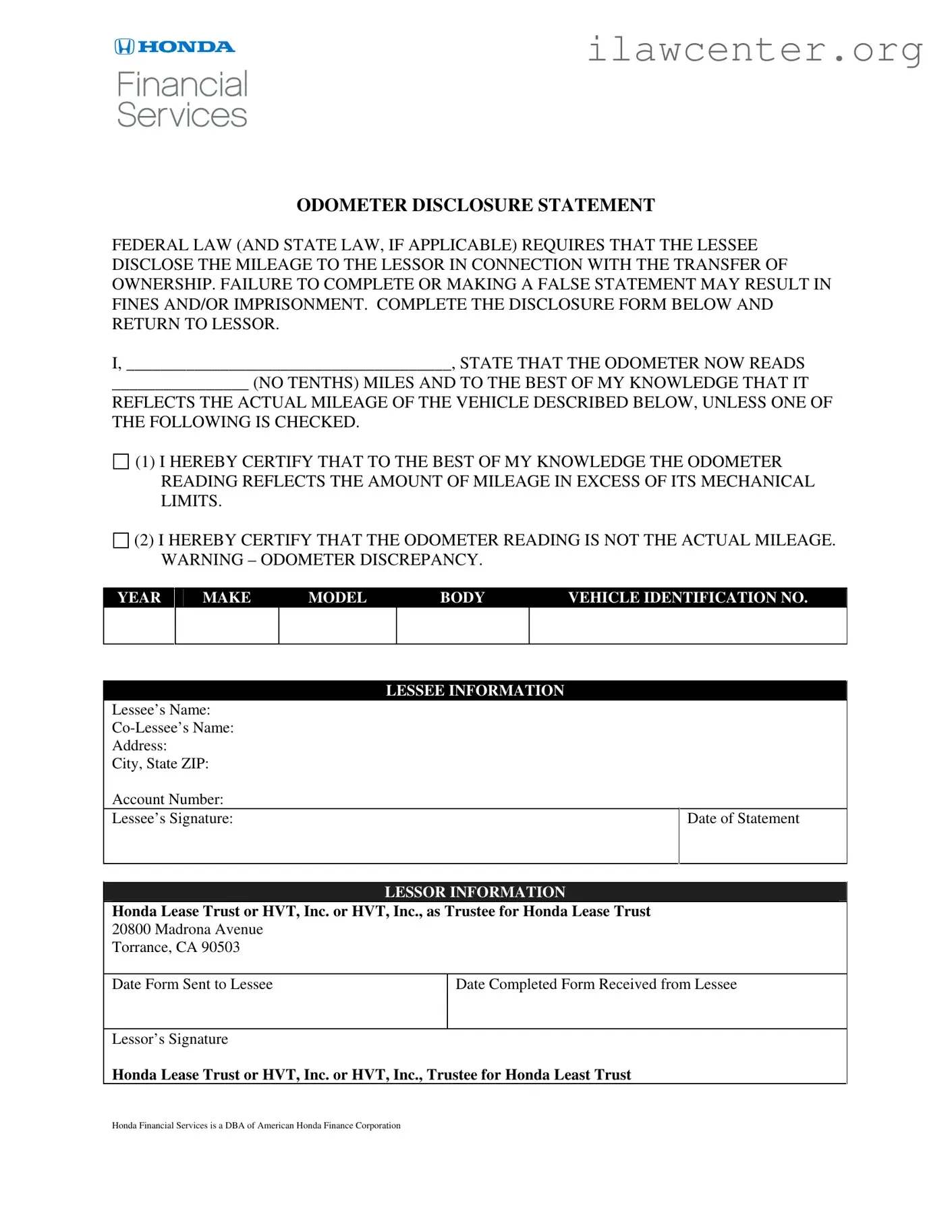
ODOMETER DISCLOSURE STATEMENT
FEDERAL LAW (AND STATE LAW, IF APPLICABLE) REQUIRES THAT THE LESSEE
DISCLOSE THE MILEAGE TO THE LESSOR IN CONNECTION WITH THE TRANSFER OF
OWNERSHIP. FAILURE TO COMPLETE OR MAKING A FALSE STATEMENT MAY RESULT IN
FINES AND/OR IMPRISONMENT. COMPLETE THE DISCLOSURE FORM BELOW AND
RETURN TO LESSOR.
I, ______________________________________, STATE THAT THE ODOMETER NOW READS
________________ (NO TENTHS) MILES AND TO THE BEST OF MY KNOWLEDGE THAT IT
REFLECTS THE ACTUAL MILEAGE OF THE VEHICLE DESCRIBED BELOW, UNLESS ONE OF
THE FOLLOWING IS CHECKED.
(1) I HEREBY CERTIFY THAT TO THE BEST OF MY KNOWLEDGE THE ODOMETER
READING REFLECTS THE AMOUNT OF MILEAGE IN EXCESS OF ITS MECHANICAL
LIMITS.
(2) I HEREBY CERTIFY THAT THE ODOMETER READING IS NOT THE ACTUAL MILEAGE.
WARNING – ODOMETER DISCREPANCY.
YEAR MAKE MODEL BODY VEHICLE IDENTIFICATION NO.
LESSEE INFORMATION
Lessee’s Name:
Co-Lessee’s Name:
Address:
City, State ZIP:
Account Number:
Lessee’s Signature:
Date of Statement
LESSOR INFORMATION
Honda Lease Trust or HVT, Inc. or HVT, Inc., as Trustee for Honda Lease Trust
20800 Madrona Avenue
Torrance, CA 90503
Date Form Sent to Lessee
Date Completed Form Received from Lessee
Lessor’s Signature
Honda Lease Trust or HVT, Inc. or HVT, Inc., Trustee for Honda Least Trust
Honda Financial Services is a DBA of American Honda Finance Corporation

File Properties

Fact Name Details
Purpose of the Form The Honda Odometer Statement form is used to disclose the mileage of a vehicle during the transfer of ownership.
Legal Requirement Federal law mandates that the lessee must disclose the odometer reading to the lessor to ensure accurate mileage reporting.
Consequences of Non-Compliance Failure to complete the form or providing false information may lead to fines and/or imprisonment.
Mileage Disclosure The form requires the lessee to state the current odometer reading without tenths of a mile.
Certification Options Lessee must certify whether the odometer reading reflects actual mileage, exceeds mechanical limits, or is not accurate.
State-Specific Laws Each state may have additional laws governing odometer disclosures. Check local regulations for specific requirements.
Submission Process After completing the form, the lessee must return it to the lessor for processing.

Instructions on Utilizing Honda Odometer Statement

Completing the Honda Odometer Statement form is essential for accurately documenting the mileage of a vehicle during ownership transfer. After filling out the form, it should be returned to the lessor to ensure compliance with federal and state laws regarding odometer disclosure.

  1. Begin by writing your name in the space provided at the top of the form.
  2. Enter the current odometer reading in the designated area. Do not include tenths of a mile.
  3. Indicate whether the odometer reading reflects the actual mileage of the vehicle. If applicable, check one of the boxes to certify if the reading exceeds mechanical limits or is not actual mileage.
  4. Fill in the details of the vehicle, including the year, make, model, and Vehicle Identification Number (VIN).
  5. Provide your address, including city, state, and ZIP code.
  6. If there is a co-lessee, enter their name in the appropriate space.
  7. Write your account number in the specified area.
  8. Sign the form where indicated to confirm the information provided is accurate.
  9. Date the statement in the space provided.
  10. Leave the lessor information section blank, as this will be completed by the lessor.

Important Facts about Honda Odometer Statement

What is the purpose of the Honda Odometer Statement form?

The Honda Odometer Statement form is required by federal law, and in some cases state law, to disclose the mileage of a vehicle during the transfer of ownership. This ensures that both the lessee and lessor are aware of the vehicle's mileage, helping to prevent fraud and misrepresentation.

Who needs to complete the Odometer Statement?

The lessee, or the person leasing the vehicle, must complete the Odometer Statement. This form is essential when transferring ownership to the lessor, ensuring that the mileage is accurately reported.

What information is required on the form?

The form requires the lessee's name, address, vehicle details (such as year, make, model, and vehicle identification number), and the current odometer reading. Additionally, the lessee must provide their signature and the date of the statement.

What happens if the form is not completed correctly?

Failure to complete the form accurately can lead to serious consequences, including fines and potential imprisonment. It is crucial to provide truthful and precise information to avoid legal issues.

What should I do if the odometer reading is not accurate?

If the odometer reading does not reflect the actual mileage, the lessee must check the box indicating that the odometer reading is not accurate. This ensures transparency and helps avoid future complications regarding the vehicle's mileage.

What are the consequences of providing false information on the form?

Providing false information on the Odometer Statement can result in significant penalties. Legal repercussions may include fines and imprisonment, as it is considered a serious offense to misrepresent vehicle mileage.

Where should the completed form be sent?

The completed Odometer Statement form should be returned to the lessor, which is typically Honda Lease Trust or HVT, Inc. It is important to ensure that the form is sent to the correct address provided in the document.

How can I contact Honda Financial Services for questions about the form?

For any questions regarding the Honda Odometer Statement form, you can contact Honda Financial Services, which operates under American Honda Finance Corporation. They can provide assistance and clarify any uncertainties you may have.

Common mistakes

Filling out the Honda Odometer Statement form can seem straightforward, but many people make common mistakes that can lead to complications. One significant error is not providing the correct odometer reading. It is crucial to enter the mileage accurately, as this number reflects the vehicle's actual usage. Leaving out the mileage, or even entering it incorrectly, can cause issues later on.

Another frequent mistake involves ignoring the warning about odometer discrepancies. If the odometer reading does not reflect the actual mileage, the lessee must check the appropriate box on the form. Failing to do so can result in legal consequences, including fines. It is essential to be honest and transparent when completing this section.

Many individuals also overlook the requirement to sign and date the form. A signature is necessary to validate the statement. Without it, the document may not be considered complete, leading to delays in processing or potential disputes. Additionally, the date is important for record-keeping purposes.

Providing incomplete information about the vehicle can also create problems. The form requires specific details such as the year, make, model, and vehicle identification number (VIN). Omitting any of these details can result in confusion or complications down the line. Ensuring that all vehicle information is accurate and complete is vital.

Some people mistakenly think that the form is only necessary for the lessee's records. In reality, it is a legal document that must be returned to the lessor. Not sending the completed form back can lead to misunderstandings about the vehicle's mileage and ownership status.

Another common issue is not reviewing the entire form before submission. Taking a moment to double-check the information can prevent mistakes. Many people rush through the process, which can lead to overlooked errors or missing signatures.

People often forget to include their contact information. Providing a phone number or email address can be helpful if the lessor needs to reach out for any clarifications. This small detail can make communication smoother and more efficient.

Some lessees fail to keep a copy of the completed form for their records. Retaining a copy can be beneficial if any disputes arise in the future. Documentation serves as proof of what was reported and can protect against potential issues.

Lastly, misunderstanding the legal implications of the form can lead to significant consequences. The form warns that false statements may result in fines or imprisonment. It is essential to comprehend the seriousness of the information being provided and to take the completion of the form seriously.

Documents used along the form

The Honda Odometer Statement form is a crucial document in the vehicle leasing process, ensuring transparency regarding the mileage of the vehicle being transferred. However, it is often accompanied by other important forms and documents that facilitate the leasing or purchasing process. Below is a list of related documents that may be required.

  • Vehicle Title Transfer Form: This form is essential for transferring ownership of a vehicle from one party to another. It includes information about the seller, buyer, and vehicle identification number (VIN).
  • Bill of Sale: A bill of sale serves as a receipt for the transaction, detailing the sale price and confirming the transfer of ownership. It protects both the buyer and seller by providing proof of the sale.
  • Lease Agreement: This document outlines the terms and conditions of the lease, including payment amounts, duration, and responsibilities of both the lessor and lessee. It is a binding contract that governs the leasing relationship.
  • Vehicle Registration Application: After acquiring a vehicle, the new owner must complete a registration application to obtain license plates and legally register the vehicle with the state.
  • Insurance Declaration Page: This document provides proof of insurance coverage for the vehicle. It is often required by lessors to ensure that the vehicle is adequately insured during the lease period.
  • Odometer Disclosure Statement (for Buyers): Similar to the Honda Odometer Statement, this form is used when selling a vehicle. It confirms the odometer reading at the time of sale and helps prevent fraud.
  • Power of Attorney: In some cases, a power of attorney may be needed to authorize one party to act on behalf of another in the transfer of vehicle ownership or signing of related documents.
  • Loan Application: If financing the vehicle, a loan application will be required. This document provides lenders with information about the borrower’s financial situation and creditworthiness.
  • Credit Report Authorization: This form allows a lender to access a borrower’s credit report, which is a crucial step in the loan approval process.

Each of these documents plays a significant role in ensuring a smooth transaction and protecting the interests of all parties involved. Understanding the purpose and requirements of these forms can help facilitate a more efficient leasing or purchasing experience.

Similar forms

The Honda Odometer Statement form serves a specific purpose in documenting the mileage of a vehicle during a transfer of ownership. Several other documents share similar functions, particularly in ensuring transparency and compliance in vehicle transactions. Here are ten documents that are comparable to the Honda Odometer Statement form:

  • Vehicle Title Transfer Form: This document is essential when ownership of a vehicle changes hands. It requires the seller to provide accurate information about the vehicle, including its mileage, similar to the odometer statement.
  • Bill of Sale: A bill of sale acts as a receipt for the transaction. It often includes details about the vehicle's mileage at the time of sale, ensuring that both parties are aware of the vehicle's condition.
  • Odometer Disclosure Statement (State-Specific): Many states have their own versions of the odometer disclosure statement, which serves the same purpose as the Honda form but may include state-specific requirements.
  • Lease Agreement: When leasing a vehicle, the lease agreement often contains clauses regarding mileage limits and odometer readings, ensuring that lessees understand their obligations regarding vehicle use.
  • Vehicle History Report: This report provides a comprehensive history of a vehicle, including previous mileage records. It helps buyers verify the accuracy of the odometer reading provided by the seller.
  • Service Records: Documentation of a vehicle's service history can include mileage readings at various service intervals. This information can help validate the current odometer reading.
  • Insurance Policy Application: When applying for auto insurance, applicants often need to disclose the vehicle's mileage. This ensures that the insurance company has accurate information for underwriting purposes.
  • Vehicle Registration Application: When registering a vehicle, the application typically requires the current odometer reading. This helps maintain accurate records with the state department of motor vehicles.
  • Rebuilt Title Application: If a vehicle has been rebuilt after being declared a total loss, the application process often includes an odometer disclosure to confirm the vehicle's mileage post-repair.
  • Trade-In Appraisal Form: When trading in a vehicle, dealerships usually assess the car's value based on its mileage. This form captures the odometer reading to ensure fair evaluation.

Each of these documents plays a crucial role in ensuring that all parties involved in a vehicle transaction have accurate and transparent information. This helps to prevent disputes and promotes trust in the buying and selling process.

Dos and Don'ts

When filling out the Honda Odometer Statement form, it's important to be thorough and accurate. Here are some things you should and shouldn't do:

  • Do ensure that you fill in your name and the odometer reading clearly.
  • Do double-check the mileage to confirm it reflects the actual amount.
  • Do sign and date the form before returning it to the lessor.
  • Do read the instructions carefully to avoid mistakes.
  • Do keep a copy of the completed form for your records.
  • Don't leave any fields blank; all sections must be completed.
  • Don't provide an odometer reading with tenths; it should be a whole number.
  • Don't make false statements; this could lead to legal consequences.
  • Don't forget to check the appropriate box if the mileage is not accurate.
  • Don't submit the form without reviewing it for errors.

Misconceptions

When it comes to the Honda Odometer Statement form, several misconceptions can lead to confusion. Here’s a clear breakdown of some common misunderstandings.

  1. The form is optional. Many believe that filling out the Odometer Statement is optional. In reality, federal and state laws require this disclosure when transferring ownership of a vehicle.
  2. Only the seller needs to sign. Some think only the seller is responsible for signing the form. However, both the lessee and the lessor must complete and sign the document to ensure its validity.
  3. Odometer readings can be estimated. A common misconception is that it’s acceptable to estimate the odometer reading. The form specifically requires the exact mileage, without tenths.
  4. It’s only for used vehicles. Many assume the Odometer Statement is only necessary for used cars. This form is required for any transfer of ownership, including leases and new vehicles.
  5. Incorrect information has no consequences. Some people believe that inaccuracies on the form won’t matter. Providing false information can lead to serious penalties, including fines or imprisonment.
  6. Checking the wrong box is harmless. Some think that checking the wrong certification box is not a big deal. In fact, doing so can lead to legal complications and may invalidate the entire transaction.
  7. Only the mileage matters. While the odometer reading is crucial, the form also requires detailed vehicle information, including make, model, and VIN, which must be accurately filled out.
  8. The form is only for private sales. Many believe this form is only necessary for private transactions. In truth, it’s required for any change in vehicle ownership, including dealership sales and leases.
  9. Once submitted, the form cannot be changed. Some think that after submitting the form, no changes can be made. If there’s an error, it’s important to communicate with the lessor to correct it as soon as possible.

Understanding these misconceptions can help ensure a smoother process when dealing with the Honda Odometer Statement form. Always take the time to read and complete the document accurately to avoid any potential issues.

Key takeaways

Filling out the Honda Odometer Statement form is an important step in the vehicle transfer process. Here are some key takeaways to consider:

  • Accurate Mileage Reporting: Always provide the correct odometer reading. This ensures transparency and compliance with federal and state laws.
  • Disclosure Requirement: Federal law mandates that the lessee disclose the mileage to the lessor during the transfer of ownership.
  • Consequences of Inaccuracy: Failing to complete the form accurately or making false statements can lead to fines or imprisonment.
  • Certification Options: If applicable, check the appropriate box to indicate if the odometer reading reflects mileage exceeding mechanical limits or if it is not the actual mileage.
  • Complete All Information: Ensure that all required fields, including vehicle details and lessee information, are filled out completely before submitting the form.