Fillable Horse Bill of Sale Document

Fillable Horse Bill of Sale Document

A Horse Bill of Sale form is a legal document that records the sale and transfer of ownership of a horse from one party to another. This form serves to protect both the buyer and seller by detailing important information about the horse, including its identification, health status, and the terms of the sale. To ensure a smooth transaction, consider filling out the form by clicking the button below.

Article Guide

When engaging in the sale or purchase of a horse, a Horse Bill of Sale form serves as a crucial document that protects the interests of both the buyer and the seller. This form typically outlines essential details such as the horse's identification, including breed, age, and registration number, ensuring that both parties have a clear understanding of the animal being transferred. Additionally, the form includes the sale price and payment terms, which are vital for establishing the financial aspects of the transaction. It may also address any warranties or guarantees regarding the horse's health and soundness, providing peace of mind to the buyer. Furthermore, the Horse Bill of Sale often requires signatures from both parties, validating the agreement and making it legally binding. By clearly documenting these details, the form helps prevent disputes and misunderstandings, making it an indispensable tool in equine transactions.

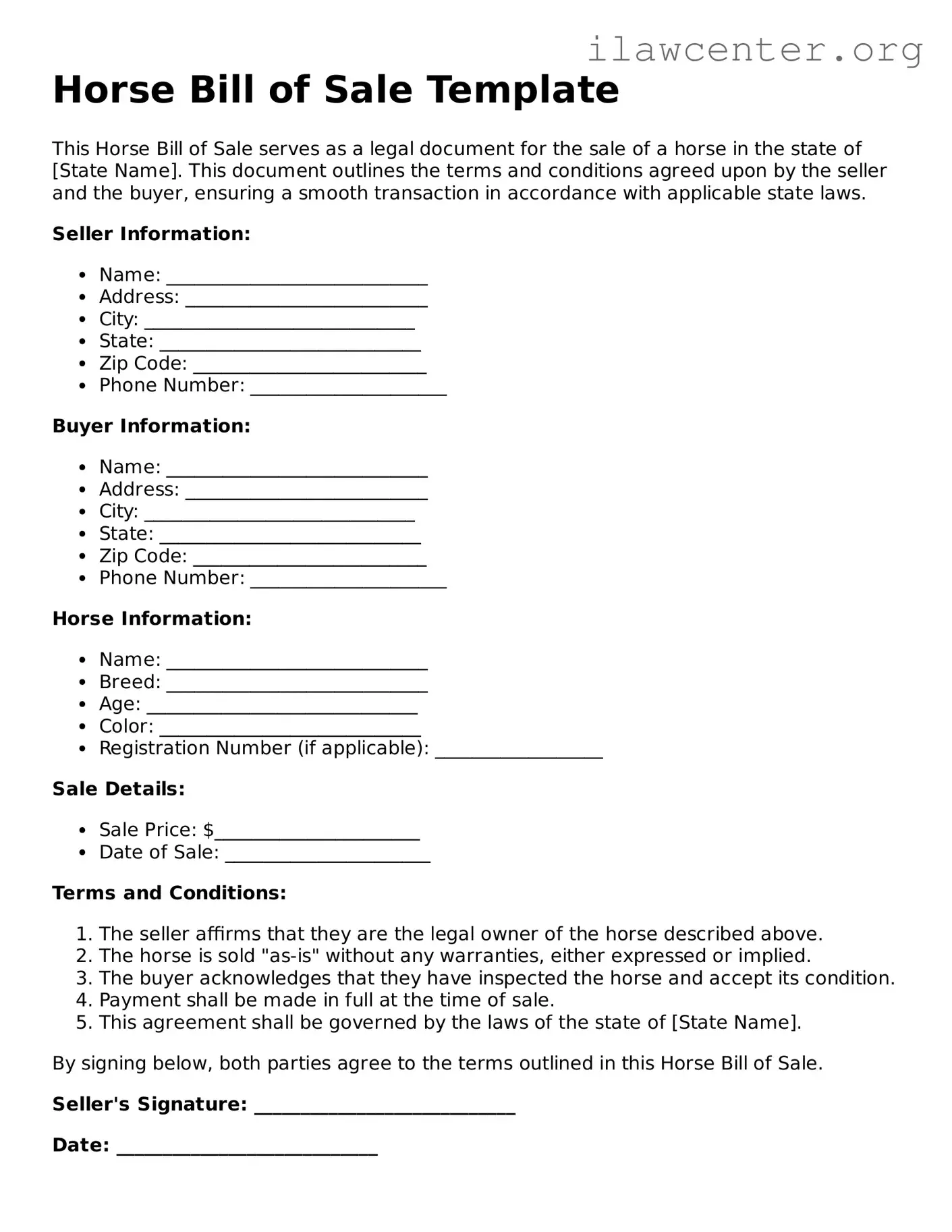
Horse Bill of Sale Preview

Horse Bill of Sale Template

This Horse Bill of Sale serves as a legal document for the sale of a horse in the state of [State Name]. This document outlines the terms and conditions agreed upon by the seller and the buyer, ensuring a smooth transaction in accordance with applicable state laws.

Seller Information:

  • Name: ____________________________
  • Address: __________________________
  • City: _____________________________
  • State: ____________________________
  • Zip Code: _________________________
  • Phone Number: _____________________

Buyer Information:

  • Name: ____________________________
  • Address: __________________________
  • City: _____________________________
  • State: ____________________________
  • Zip Code: _________________________
  • Phone Number: _____________________

Horse Information:

  • Name: ____________________________
  • Breed: ____________________________
  • Age: _____________________________
  • Color: ____________________________
  • Registration Number (if applicable): __________________

Sale Details:

  • Sale Price: $______________________
  • Date of Sale: ______________________

Terms and Conditions:

  1. The seller affirms that they are the legal owner of the horse described above.
  2. The horse is sold "as-is" without any warranties, either expressed or implied.
  3. The buyer acknowledges that they have inspected the horse and accept its condition.
  4. Payment shall be made in full at the time of sale.
  5. This agreement shall be governed by the laws of the state of [State Name].

By signing below, both parties agree to the terms outlined in this Horse Bill of Sale.

Seller's Signature: ____________________________

Date: ____________________________

Buyer's Signature: ____________________________

Date: ____________________________

PDF Form Characteristics

Fact Name Description
Definition A Horse Bill of Sale form is a legal document that transfers ownership of a horse from one party to another.
Purpose This form serves as proof of the transaction and outlines the terms agreed upon by both the seller and buyer.
Essential Information The form typically includes details such as the horse's name, breed, age, and registration number, as well as the sale price.
State-Specific Forms Different states may have specific requirements or forms. For example, in Texas, the governing law is found in the Texas Business and Commerce Code.
Notarization Some states require the Horse Bill of Sale to be notarized to be legally binding.
Liability Disclaimer The form often includes a clause stating that the seller is not liable for any future issues related to the horse after the sale.
Record Keeping It is advisable for both parties to keep a copy of the completed form for their records, as it may be needed for future reference.

Instructions on Utilizing Horse Bill of Sale

Filling out a Horse Bill of Sale form is an essential step in transferring ownership of a horse. This document serves as a legal record of the transaction and includes important details that protect both the buyer and seller. Once the form is completed, both parties should keep a copy for their records.

  1. Obtain the form: Start by acquiring the Horse Bill of Sale form. This can typically be found online or through local equestrian organizations.
  2. Fill in the date: Write the date of the transaction at the top of the form. This establishes when the sale occurred.
  3. Provide seller information: Enter the full name and contact information of the seller. This includes their address, phone number, and email address.
  4. Provide buyer information: Next, fill in the buyer's details, including their name, address, phone number, and email address.
  5. Describe the horse: Include specific details about the horse being sold. This should encompass the horse's name, breed, age, color, and any identifying marks.
  6. State the sale price: Clearly indicate the agreed-upon sale price for the horse. This amount should be written in both numeric and written form to avoid confusion.
  7. Include payment terms: Specify the payment method and any terms related to the payment, such as whether a deposit is required.
  8. Signatures: Both the seller and buyer must sign the form to validate the sale. Ensure that the signatures are dated as well.
  9. Make copies: After completing the form, make copies for both the seller and the buyer. This ensures that both parties have a record of the transaction.

Important Facts about Horse Bill of Sale

What is a Horse Bill of Sale?

A Horse Bill of Sale is a legal document that records the sale of a horse from one party to another. It serves as proof of the transaction and outlines the terms of the sale, including the purchase price, description of the horse, and any warranties or guarantees provided by the seller.

Why is a Horse Bill of Sale important?

This document is essential for both the buyer and the seller. For the buyer, it provides evidence of ownership and can be useful for registration purposes or insurance claims. For the seller, it protects against future disputes regarding the sale and confirms that the horse has been transferred to the new owner.

What information should be included in a Horse Bill of Sale?

A comprehensive Horse Bill of Sale should include the following details: the names and addresses of both the buyer and seller, a detailed description of the horse (including breed, age, color, and any identifying marks), the sale price, payment terms, and any conditions or warranties related to the horse's health or behavior.

Is a Horse Bill of Sale required by law?

While a Horse Bill of Sale is not universally required by law, it is highly recommended. Many states do not mandate a bill of sale for livestock transactions, but having one can prevent misunderstandings and provide legal protection. Always check local laws to ensure compliance.

Can a Horse Bill of Sale be modified after signing?

Once a Horse Bill of Sale is signed by both parties, it generally becomes a binding contract. Modifications can be made, but both the buyer and seller must agree to the changes and sign an amended document to ensure clarity and legality.

What if the horse has health issues?

If the horse has known health issues, it is crucial to disclose this information in the bill of sale. Sellers may include a warranty that states the horse is sold "as is" or provide guarantees regarding its health. Transparency helps protect both parties and minimizes potential disputes.

How can I ensure the Horse Bill of Sale is valid?

To ensure the validity of a Horse Bill of Sale, both parties should sign the document and keep copies for their records. It is also advisable to have the transaction witnessed or notarized, which can add an extra layer of authenticity and legal standing.

What happens if there is a dispute after the sale?

In the event of a dispute, the Horse Bill of Sale serves as a key piece of evidence. The document can clarify the terms of the sale and the responsibilities of each party. If necessary, parties may seek mediation or legal action to resolve the issue based on the terms outlined in the bill of sale.

Can I use a Horse Bill of Sale for other livestock?

While a Horse Bill of Sale is specifically designed for the sale of horses, similar forms can be adapted for other types of livestock. However, it is essential to ensure that the document reflects the specific details and legal requirements pertinent to the type of animal being sold.

Common mistakes

When filling out a Horse Bill of Sale form, individuals often overlook critical details that can lead to complications later. One common mistake is failing to include accurate identification of the horse being sold. This includes not only the horse's name but also its breed, age, color, and any unique identifying marks. Without this information, disputes may arise regarding the horse's identity.

Another frequent error is neglecting to provide complete seller and buyer information. The names, addresses, and contact details of both parties should be clearly stated. Incomplete information can hinder communication and lead to misunderstandings about the transaction.

People sometimes forget to include the sale price. This detail is essential for establishing the terms of the sale. Leaving it blank may create confusion about the agreed-upon amount, which can lead to disputes after the sale is finalized.

Additionally, some individuals fail to indicate whether the sale is "as is" or if any warranties are included. Clearly stating the condition of the horse and any guarantees can prevent future disagreements. Buyers should know what they are getting, and sellers must protect themselves from potential claims.

Another mistake is not having both parties sign the document. A Horse Bill of Sale is not legally binding without the signatures of both the seller and the buyer. Ensuring that both parties sign the form confirms their agreement to the terms laid out in the document.

People often overlook the importance of including the date of the transaction. This date serves as a reference point for both parties and is crucial for record-keeping. Without it, tracking the sale can become complicated.

Many individuals forget to retain a copy of the completed form. Keeping a copy for personal records is essential. This document serves as proof of the sale and can be important for future reference or if any issues arise.

Some sellers may also neglect to verify the buyer's ability to complete the transaction. Ensuring that the buyer has the means to pay and is serious about the purchase can save time and prevent potential financial loss.

Lastly, failing to consult local laws regarding horse sales can lead to unintentional violations. Each state may have specific requirements for such transactions. Understanding these regulations is crucial to ensure that the sale is compliant and protects both parties.

Documents used along the form

When buying or selling a horse, several documents can accompany the Horse Bill of Sale form to ensure a smooth transaction. Each document serves a specific purpose, providing clarity and protection for both parties involved.

  • Health Certificate: This document verifies that the horse has been examined by a veterinarian and is free from contagious diseases. It is often required for interstate travel and assures the buyer of the horse's health status.
  • Registration Papers: If the horse is registered with a breed association, these papers prove its lineage and eligibility for competitions. They are important for buyers interested in showing or breeding the horse.
  • Transfer of Ownership Form: This form is necessary to officially transfer the horse’s ownership from the seller to the buyer. It is often required by breed registries and can help prevent future disputes over ownership.
  • Pre-Purchase Exam Report: This report is generated after a veterinarian evaluates the horse. It provides insights into the horse's condition and can highlight any potential issues that might affect the buyer's decision.

Having these documents in hand can facilitate a more transparent and secure transaction. Always consider consulting with a professional to ensure all necessary paperwork is complete and accurate.

Similar forms

The Horse Bill of Sale form is an important document for transferring ownership of a horse. However, it shares similarities with several other documents used in various transactions. Here are five documents that are similar to the Horse Bill of Sale:

  • Vehicle Bill of Sale: This document serves to transfer ownership of a vehicle from one party to another. Like the Horse Bill of Sale, it includes details about the buyer, seller, and the vehicle itself, ensuring both parties have a clear understanding of the transaction.
  • Pet Bill of Sale: Similar to the Horse Bill of Sale, this document is used when selling or transferring ownership of a pet. It outlines the details of the pet, the seller, and the buyer, ensuring a legal record of the transaction.
  • Real Estate Purchase Agreement: This document outlines the terms of a real estate transaction. Just like the Horse Bill of Sale, it includes information about the parties involved and the property being sold, providing a legal framework for the transfer of ownership.
  • Equipment Bill of Sale: This document is used for the sale of equipment, such as machinery or tools. It includes essential details about the equipment and the parties involved, similar to the Horse Bill of Sale, ensuring a smooth transfer of ownership.
  • Business Bill of Sale: When a business is sold, this document outlines the terms of the sale. It includes information about the business assets being transferred and the parties involved, much like the Horse Bill of Sale, facilitating a clear and legal transfer of ownership.

Dos and Don'ts

When completing a Horse Bill of Sale form, attention to detail is essential. Here’s a list of things to do and avoid for a smooth transaction.

  • Do ensure all information is accurate, including the horse's name, breed, age, and registration number.
  • Do include the seller's and buyer's full names and contact information.
  • Do specify the sale price clearly to avoid any misunderstandings.
  • Do sign and date the document in the appropriate sections.
  • Do keep a copy of the signed bill of sale for your records.
  • Don't leave any sections blank; fill in all required fields.
  • Don't use vague language; be specific about the horse's condition and any included equipment.
  • Don't forget to check for any local laws regarding horse sales that may apply.
  • Don't rush the process; take your time to review the document thoroughly.

Misconceptions

The Horse Bill of Sale form is an important document in equine transactions. However, several misconceptions surround its use and purpose. Below are nine common misconceptions regarding this form.

  1. The Horse Bill of Sale is only necessary for expensive horses.

    This is not true. Regardless of the horse's value, a bill of sale is essential for any transaction to provide proof of ownership and protect both the buyer and seller.

  2. A verbal agreement is sufficient.

    While verbal agreements can be legally binding, they are difficult to enforce. A written bill of sale provides clear documentation of the terms agreed upon.

  3. The form is only required in certain states.

    In fact, a bill of sale is advisable in all states, as it serves as a legal record of the transaction, regardless of local laws.

  4. Only the seller needs to sign the document.

    Both parties should sign the bill of sale. This ensures that both the buyer and seller acknowledge the terms of the sale.

  5. The Horse Bill of Sale does not need to be notarized.

    While notarization is not always required, having the document notarized can add an extra layer of security and authenticity to the transaction.

  6. The form does not need to include specific details about the horse.

    On the contrary, it is crucial to include specific details such as the horse's name, breed, age, and any identifying marks to avoid future disputes.

  7. A Horse Bill of Sale protects only the seller.

    This is a misconception. The bill of sale protects both parties by documenting the transaction and outlining any warranties or guarantees.

  8. The form is not necessary if the horse is a gift.

    Even if the horse is given as a gift, a bill of sale is beneficial. It provides a record of the transfer of ownership, which can be useful for future reference.

  9. Once the bill of sale is signed, the transaction is complete.

    While signing the bill of sale is a significant step, it is also essential to ensure that all agreed-upon conditions, such as payment and delivery, are fulfilled.

Key takeaways

When filling out and using the Horse Bill of Sale form, it is essential to keep several key points in mind. These takeaways will help ensure a smooth transaction and protect both the buyer and seller.

  • Complete Information: Provide accurate details about the horse, including breed, age, color, and any identifying marks. This information helps prevent disputes later.
  • Seller's Disclosure: The seller should disclose any known health issues or behavioral problems. Transparency fosters trust and can prevent future legal complications.
  • Purchase Price: Clearly state the agreed-upon purchase price. This amount should be reflected in both the bill of sale and any payment methods used.
  • Signatures Required: Both the buyer and seller must sign the document. This step is crucial, as it indicates mutual agreement on the terms outlined in the bill of sale.
  • Consider Notarization: While not always required, having the bill of sale notarized can add an extra layer of legitimacy and protection for both parties.
  • Keep Copies: After the transaction is complete, both parties should retain a copy of the signed bill of sale for their records. This document serves as proof of ownership transfer.