
Horse Riding PDF Template

Horse Riding PDF Template

The Horse Riding form is a legal document that outlines the risks associated with horseback riding and the responsibilities of participants. By signing this form, individuals acknowledge the inherent dangers of riding and agree to waive certain legal rights, including the right to sue for injuries or damages. It is important to read the form carefully before signing, as it serves to protect both the rider and the stable.

To participate, please fill out the form by clicking the button below.

Article Guide

Horse riding is a thrilling and rewarding activity that attracts many enthusiasts, but it comes with inherent risks that riders must understand. Before engaging in this sport, participants often encounter a Release and Waiver of Liability document. This agreement outlines the potential dangers associated with horseback riding, such as unpredictable horse behavior and equipment failures. Riders acknowledge that these risks can lead to serious injury or even death. By signing this document, individuals are not only accepting these risks but also agreeing to release the stable and its staff from liability for any accidents that may occur. This includes a commitment to not sue for damages resulting from negligence or other issues related to the riding experience. Additionally, the agreement emphasizes the importance of safety measures, including the recommendation to wear a protective helmet. Understanding these aspects is crucial for anyone considering horseback riding, as it ensures that they are well-informed and prepared for the adventure ahead.

Horse Riding Preview

______________ _____________________________________
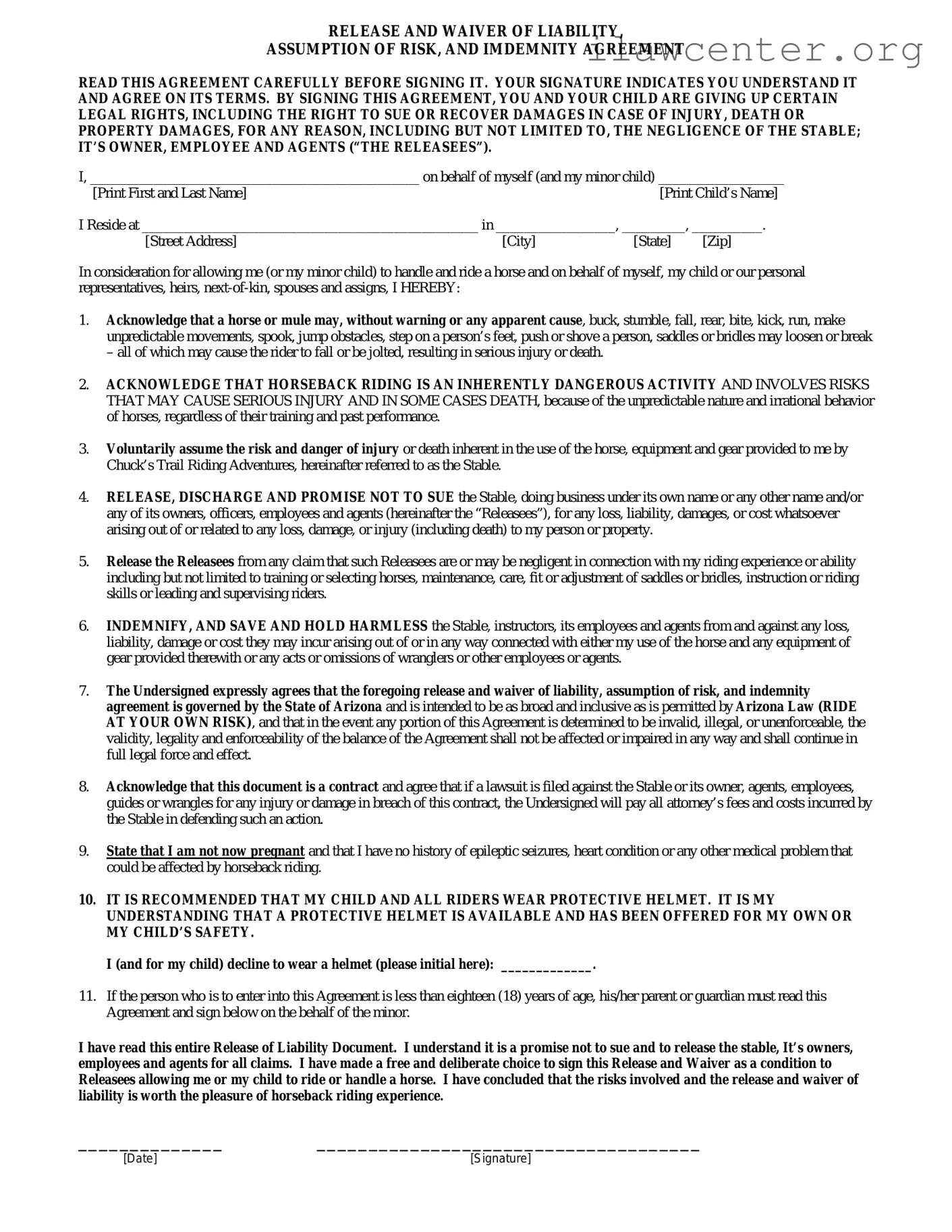
RELEASE AND WAIVER OF LIABILITY,
ASSUMPTION OF RISK, AND IMDEMNITY AGREEMENT
READ THIS AGREEMENT CAREFULLY BEFORE SIGNING IT. YOUR SIGNATURE INDICATES YOU UNDERSTAND IT
AND AGREE ON ITS TERMS. BY SIGNING THIS AGREEMENT, YOU AND YOUR CHILD ARE GIVING UP CERTAIN
LEGAL RIGHTS, INCLUDING THE RIGHT TO SUE OR RECOVER DAMAGES IN CASE OF INJURY, DEATH OR
PROPERTY DAMAGES, FOR ANY REASON, INCLUDING BUT NOT LIMITED TO, THE NEGLIGENCE OF THE STABLE;
IT’S OWNER, EMPLOYEE AND AGENTS (“THE RELEASEES”).
I, _______________________________________________ on behalf of myself (and my minor child) __________________
[Print First and Last Name] [Print Child’s Name]
I Reside at ________________________________________________ in _________________, _________, __________.
[Street Address] [City] [State] [Zip]
In consideration for allowing me (or my minor child) to handle and ride a horse and on behalf of myself, my child or our personal
representatives, heirs, next-of-kin, spouses and assigns, I HEREBY:
1. Acknowledge that a horse or mule may, without warning or any apparent cause, buck, stumble, fall, rear, bite, kick, run, make
unpredictable movements, spook, jump obstacles, step on a person’s feet, push or shove a person, saddles or bridles may loosen or break
all of which may cause the rider to fall or be jolted, resulting in serious injury or death.
2. ACKNOWLEDGE THAT HORSEBACK RIDING IS AN INHERENTLY DANGEROUS ACTIVITY AND INVOLVES RISKS
THAT MAY CAUSE SERIOUS INJURY AND IN SOME CASES DEATH, because of the unpredictable nature and irrational behavior
of horses, regardless of their training and past performance.
3. Voluntarily assume the risk and danger of injury or death inherent in the use of the horse, equipment and gear provided to me by
Chuck’s Trail Riding Adventures, hereinafter referred to as the Stable.
4. RELEASE, DISCHARGE AND PROMISE NOT TO SUE the Stable, doing business under its own name or any other name and/or
any of its owners, officers, employees and agents (hereinafter the “Releasees”), for any loss, liability, damages, or cost whatsoever
arising out of or related to any loss, damage, or injury (including death) to my person or property.
5. Release the Releasees from any claim that such Releasees are or may be negligent in connection with my riding experience or ability
including but not limited to training or selecting horses, maintenance, care, fit or adjustment of saddles or bridles, instruction or riding
skills or leading and supervising riders.
6. INDEMNIFY, AND SAVE AND HOLD HARMLESS the Stable, instructors, its employees and agents from and against any loss,
liability, damage or cost they may incur arising out of or in any way connected with either my use of the horse and any equipment of
gear provided therewith or any acts or omissions of wranglers or other employees or agents.
7. The Undersigned expressly agrees that the foregoing release and waiver of liability, assumption of risk, and indemnity
agreement is governed by the State of Arizona and is intended to be as broad and inclusive as is permitted by Arizona Law (RIDE
AT YOUR OWN RISK), and that in the event any portion of this Agreement is determined to be invalid, illegal, or unenforceable, the
validity, legality and enforceability of the balance of the Agreement shall not be affected or impaired in any way and shall continue in
full legal force and effect.
8. Acknowledge that this document is a contract and agree that if a lawsuit is filed against the Stable or its owner, agents, employees,
guides or wrangles for any injury or damage in breach of this contract, the Undersigned will pay all attorney’s fees and costs incurred by
the Stable in defending such an action.
9. State that I am not now pregnant
and that I have no history of epileptic seizures, heart condition or any other medical problem that
could be affected by horseback riding.
10. IT IS RECOMMENDED THAT MY CHILD AND ALL RIDERS WEAR PROTECTIVE HELMET. IT IS MY
UNDERSTANDING THAT A PROTECTIVE HELMET IS AVAILABLE AND HAS BEEN OFFERED FOR MY OWN OR
MY CHILD’S SAFETY.
I (and for my child) decline to wear a helmet (please initial here): _____________.
11. If the person who is to enter into this Agreement is less than eighteen (18) years of age, his/her parent or guardian must read this
Agreement and sign below on the behalf of the minor.
I have read this entire Release of Liability Document. I understand it is a promise not to sue and to release the stable, It’s owners,
employees and agents for all claims. I have made a free and deliberate choice to sign this Release and Waiver as a condition to
Releasees allowing me or my child to ride or handle a horse. I have concluded that the risks involved and the release and waiver of
liability is worth the pleasure of horseback riding experience.
[Date] [Signature]
File Properties

Fact Name Description
Document Purpose This form is a Release and Waiver of Liability, Assumption of Risk, and Indemnity Agreement for horseback riding activities.
Legal Rights By signing, participants give up certain legal rights, including the right to sue for injuries or damages.
Inherent Risks Horseback riding is acknowledged as an inherently dangerous activity that may lead to serious injury or death.
Assumption of Risk Participants voluntarily assume the risks associated with riding and handling horses.
Release of Liability The form releases the stable and its agents from any claims related to injuries or damages incurred during riding.
Indemnification Participants agree to indemnify the stable and its employees against any claims arising from their riding experience.
Governing Law This agreement is governed by the laws of the State of Arizona.
Contractual Nature The document is a legally binding contract, and participants are responsible for attorney fees if a lawsuit arises.
Medical Disclosure Participants must confirm they are not pregnant and have no medical conditions that could be affected by riding.
Helmet Recommendation It is recommended that all riders wear a protective helmet, which is available for use.

Instructions on Utilizing Horse Riding

Completing the Horse Riding form is a straightforward process that requires careful attention to detail. This document outlines important agreements and acknowledgments regarding horseback riding activities. Follow the steps below to ensure that all necessary information is accurately provided.

  1. Begin by filling in your full name in the designated space: _______________________________________________.
  2. Next, print your child's name in the space provided: __________________.
  3. Enter your complete residential address, including street, city, state, and zip code: ________________________________________________.
  4. Read through the entire form carefully to understand the terms and conditions outlined.
  5. Initial next to the statement indicating your choice regarding helmet use: __________.
  6. If you are signing on behalf of a minor, ensure that you read the agreement aloud to them and sign below, including the date: ____________________ (Date) and ____________________________________ (Signature).
  7. Review all filled information for accuracy before submitting the form.

Important Facts about Horse Riding

What is the purpose of the Horse Riding form?

The Horse Riding form serves as a Release and Waiver of Liability, Assumption of Risk, and Indemnity Agreement. It is designed to inform participants about the inherent risks associated with horseback riding and to protect the stable and its employees from potential legal claims. By signing this form, individuals acknowledge these risks and agree not to hold the stable liable for any injuries or damages that may occur during their riding experience.

What risks are associated with horseback riding?

Horseback riding is inherently dangerous and involves various risks. Horses can behave unpredictably, which may lead to serious injuries or even death. Common risks include falling from the horse, being kicked or bitten, and equipment failure, such as saddles or bridles breaking. Participants must understand these risks before engaging in the activity.

Who needs to sign the form?

All participants, including minors, must have the form signed. If the rider is under the age of eighteen, a parent or guardian must read the agreement and sign on their behalf. This ensures that the adult understands the risks involved and agrees to the terms of the waiver for the minor's participation.

What does it mean to assume the risk?

Assuming the risk means that participants acknowledge the dangers involved in horseback riding and accept responsibility for any injuries that may occur. By signing the form, individuals voluntarily agree to engage in the activity despite these risks, indicating their understanding that accidents can happen.

Can I still sue if I sign this form?

By signing the form, participants agree not to sue the stable or its employees for any injuries or damages that may arise from horseback riding. This waiver limits the legal rights of the signer and their heirs, meaning that pursuing legal action after signing the agreement would likely be unsuccessful.

What happens if any part of the agreement is found invalid?

The agreement includes a clause stating that if any portion is deemed invalid, illegal, or unenforceable, the remaining parts will still remain in effect. This means that the overall intent of the waiver is preserved, and the stable continues to be protected from liability as much as permitted by law.

Is it mandatory to wear a helmet while riding?

While it is strongly recommended that all riders wear a protective helmet for safety reasons, it is ultimately a personal choice. The form provides the option to decline wearing a helmet, but participants should carefully consider the risks before making this decision. A helmet is available for those who choose to wear one.

What should I do if I have medical conditions?

Participants are required to disclose any medical conditions that could affect their ability to ride safely, such as pregnancy, epilepsy, or heart conditions. If you have any concerns about your health or safety while riding, it is advisable to consult a medical professional before participating in horseback riding activities.

Common mistakes

Completing the Horse Riding form requires careful attention to detail, yet many individuals overlook critical elements that can lead to misunderstandings or complications. One common mistake is failing to provide complete and accurate personal information. This includes not only the rider's name but also the child's name, if applicable, and the full residential address. Omitting any part of this information can result in delays or issues with the registration process, potentially jeopardizing the riding experience.

Another frequent error occurs when individuals neglect to read the agreement thoroughly before signing. The form contains important information regarding the inherent risks associated with horseback riding, as well as the legal implications of signing the waiver. By not fully understanding these terms, riders may inadvertently give up rights they did not intend to relinquish. It is essential to grasp the meaning of the agreement to ensure informed consent.

Some individuals also make the mistake of not addressing health-related questions accurately. The form specifically asks about medical conditions that could be affected by horseback riding. Failing to disclose relevant health issues, such as pregnancy or a history of seizures, can pose serious risks to the rider's safety and well-being. Transparency in this section is crucial for both the rider's safety and the stable's ability to provide appropriate care.

Lastly, riders often overlook the recommendation regarding protective gear, particularly helmets. While the form states that a helmet is available, some may decline to wear one without fully understanding the implications. Initialing the decline section without considering the safety benefits can lead to regrettable consequences. Ensuring that riders, especially minors, wear appropriate protective equipment is a key aspect of a safe riding experience.

Documents used along the form

When engaging in horseback riding, it's essential to have the right documentation to ensure safety and understanding of the associated risks. Along with the Horse Riding form, several other forms and documents may be required or recommended. Each of these documents plays a crucial role in protecting both the rider and the stable. Below is a list of additional forms that are often used in conjunction with the Horse Riding form.

  • Medical Release Form: This document provides information about the rider's medical history and any pre-existing conditions. It allows the stable to understand any potential health risks and ensure appropriate care in case of an emergency.
  • Parental Consent Form: Required for riders under the age of 18, this form must be signed by a parent or guardian. It confirms that the adult understands the risks involved in horseback riding and grants permission for the minor to participate.
  • Emergency Contact Form: This form lists individuals to be contacted in case of an emergency. It ensures that the stable has immediate access to relevant contact information should an incident occur.
  • Equipment Waiver: This document states that the rider accepts responsibility for the equipment provided, such as saddles and helmets. It clarifies that the rider will take care of the equipment and acknowledges any risks associated with its use.
  • Insurance Information Form: This form collects details about the rider's insurance coverage. It helps the stable understand how to proceed with medical care if an injury occurs and ensures that financial responsibilities are clear.

Having these forms in place not only enhances safety but also fosters a better understanding between riders and the stable. By being informed and prepared, everyone can enjoy a more secure and enjoyable horseback riding experience.

Similar forms

  • Release of Liability Form: Similar to the Horse Riding form, this document protects an organization from legal claims by participants. It outlines the risks involved in an activity and requires participants to acknowledge these risks before engaging.
  • Assumption of Risk Agreement: This document explicitly states that participants accept the inherent risks associated with an activity, just as the Horse Riding form does. It emphasizes that participants understand the potential dangers involved.
  • Informed Consent Form: Like the Horse Riding form, this document ensures that participants are fully aware of the risks and consequences associated with an activity. It requires participants to acknowledge their understanding before proceeding.
  • Medical Release Form: This document allows organizations to obtain necessary medical information from participants, similar to the Horse Riding form’s request for medical history. Both forms prioritize safety and informed decision-making.
  • Parental Consent Form: This document is essential when minors are involved, mirroring the Horse Riding form's requirement for a guardian's signature. It ensures that parents are aware of the risks their children may face.
  • Waiver of Subrogation Agreement: This document prevents insurance companies from pursuing claims against a party that has been released from liability. It shares similarities with the Horse Riding form's intention to limit legal claims against the stable.
  • Participant Agreement: This document outlines the terms and conditions of participation in an event, much like the Horse Riding form. It ensures that participants agree to abide by specific rules and acknowledge risks.
  • Release and Indemnity Agreement: This form combines elements of release and indemnity, similar to the Horse Riding form. It protects the organization from financial liability due to participants' actions while participating in the activity.

Dos and Don'ts

When filling out the Horse Riding form, it is essential to be thorough and accurate. Below is a list of things you should and shouldn't do:

  • Do read the entire agreement carefully before signing.
  • Do provide your full name and your child's name clearly.
  • Do ensure that your address is complete and accurate.
  • Do acknowledge the inherent risks of horseback riding as stated in the form.
  • Do indicate any medical conditions that could affect your riding experience.
  • Do consider wearing a protective helmet for safety.
  • Don't rush through the form; take your time to understand each section.
  • Don't leave any required fields blank; all information is important.
  • Don't ignore the legal implications of the waiver; understand what you are agreeing to.
  • Don't sign the form if you do not fully agree with its terms.

Misconceptions

Here are six common misconceptions about the Horse Riding form:

  1. Signing the form means I can’t sue under any circumstances.

    This is not entirely true. While the form does release the stable from certain liabilities, you may still have the right to sue in cases of gross negligence or misconduct. Always consult with a legal professional if you have concerns.

  2. The form is only for children.

    Many believe that the waiver only applies to minors. In reality, it applies to all riders, regardless of age. Everyone must understand and agree to the terms before riding.

  3. Wearing a helmet is optional and not important.

    While the form states that helmets are recommended, wearing one is crucial for safety. Helmets can significantly reduce the risk of head injuries in case of falls.

  4. Signing means I am responsible for my own injuries only.

    This misconception overlooks the fact that the waiver also protects the stable and its employees from claims related to their actions. Riders should be aware of the full scope of the agreement.

  5. The waiver is the same everywhere.

    Not all waivers are created equal. Each stable may have different terms based on local laws and regulations. It's essential to read and understand each waiver you encounter.

  6. Once signed, I cannot change my mind.

    While the waiver is a binding agreement, you can always choose not to ride if you feel uncomfortable with the risks involved. It's important to prioritize your safety and well-being.

Key takeaways

When filling out and using the Horse Riding form, there are several important points to keep in mind. Understanding these can help ensure a smooth experience and clarify your responsibilities.

  • Read Carefully: Before signing, take the time to read the entire agreement. It outlines your rights and the risks involved in horseback riding.
  • Understand the Risks: Horseback riding is inherently dangerous. Acknowledge that horses can behave unpredictably, which may lead to serious injuries or even death.
  • Assumption of Risk: By signing the form, you are voluntarily assuming all risks associated with riding and handling horses.
  • Release of Liability: You agree not to hold the stable or its employees responsible for any injuries or damages that may occur during your riding experience.
  • Indemnification: You will protect the stable and its staff from any claims or legal actions that arise from your use of their horses and equipment.
  • Legal Jurisdiction: The agreement is governed by the laws of Arizona, and any disputes will be handled according to these laws.
  • Medical History: You must confirm that you do not have any medical conditions that could be aggravated by horseback riding, such as pregnancy or heart issues.
  • Helmet Recommendation: Wearing a protective helmet is highly recommended for safety. You may decline this option, but be aware of the risks involved.

By keeping these key takeaways in mind, you can ensure that you and your child are well-prepared for a safe and enjoyable horseback riding experience.