Hurt Feelings Report PDF Template

Hurt Feelings Report PDF Template

The Hurt Feelings Report form is designed for individuals to document their emotional distress and seek support from law enforcement. This form allows individuals to express their feelings and receive the attention they may need. If you find yourself in need of assistance, please consider filling out the form by clicking the button below.

Article Guide

The Hurt Feelings Report form is designed to provide individuals with a way to express and document their emotional distress in a light-hearted yet structured manner. It requires the completion of various sections, including personal information about the individual filing the report, such as name, age, and the specific incident that caused their feelings to be hurt. The form prompts the user to detail the circumstances surrounding the incident, including the date, time, and location of the hurtful comments, as well as any witnesses who may have been present. Additionally, it includes a section to assess the severity of the emotional injury, asking questions about the nature of the comments and any physical reactions, such as the need for tissues. The report also allows individuals to express their reasons for filing, which range from feeling overly sensitive to simply wanting sympathy. Lastly, it emphasizes that the department takes these feelings seriously and offers support in a humorous way, ensuring that individuals know help is available if they need it. While the form is intended to be lighthearted, it highlights the importance of acknowledging and addressing emotional well-being.

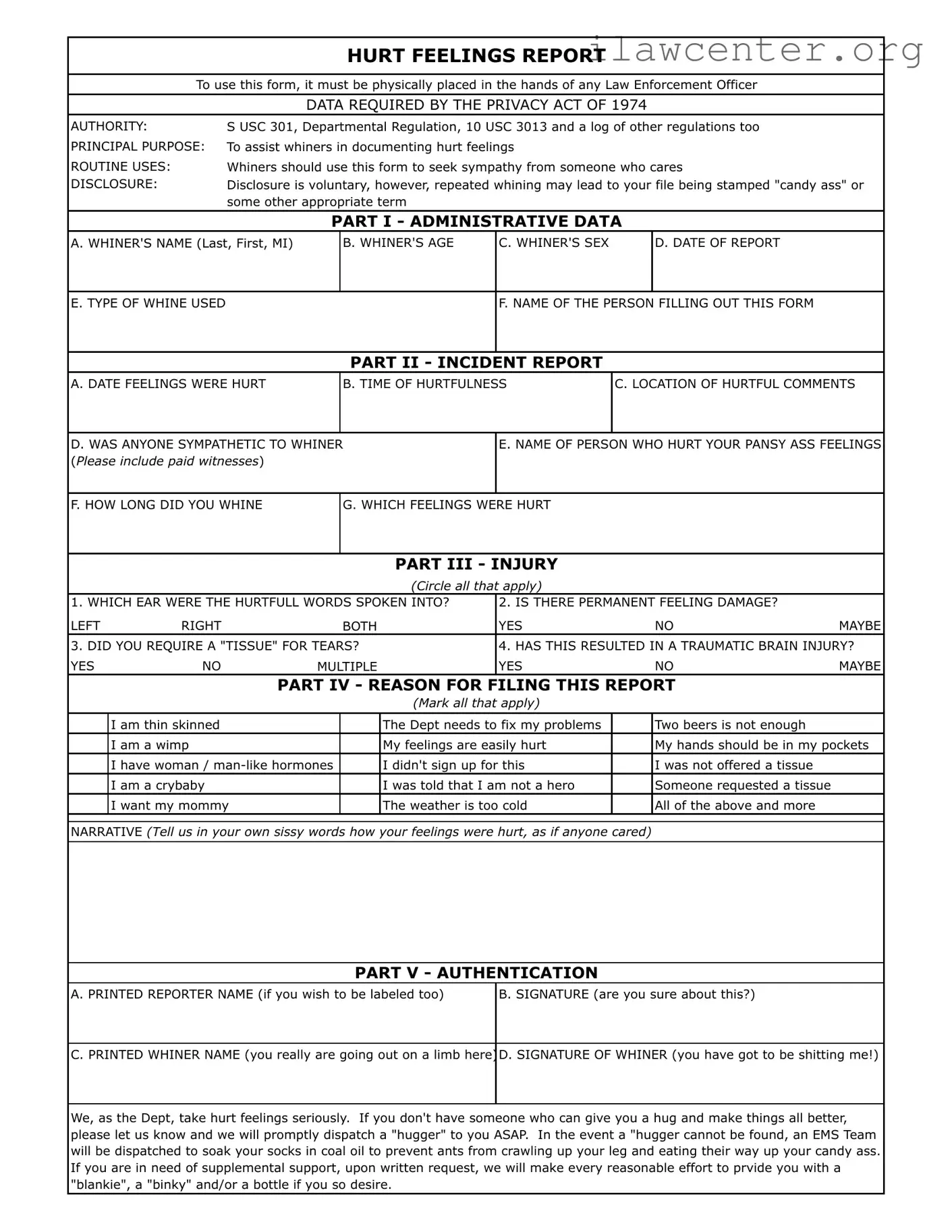
Hurt Feelings Report Preview

AUTHORITY:
PRINCIPAL PURPOSE:
ROUTINE USES:
DISCLOSURE:
B. WHINER'S AGE C. WHINER'S SEX D. DATE OF REPORT
E. TYPE OF WHINE USED F. NAME OF THE PERSON FILLING OUT THIS FORM
A. DATE FEELINGS WERE HURT B. TIME OF HURTFULNESS C. LOCATION OF HURTFUL COMMENTS
D. WAS ANYONE SYMPATHETIC TO WHINER E. NAME OF PERSON WHO HURT YOUR PANSY ASS FEELINGS
(Please include paid witnesses)
F. HOW LONG DID YOU WHINE G. WHICH FEELINGS WERE HURT
2. IS THERE PERMANENT FEELING DAMAGE?
LEFT RIGHT YES NO MAYBE
3. DID YOU REQUIRE A "TISSUE" FOR TEARS? 4. HAS THIS RESULTED IN A TRAUMATIC BRAIN INJURY?
YES NO YES NO MAYBE
I am thin skinned The Dept needs to fix my problems Two beers is not enough
I am a wimp My feelings are easily hurt My hands should be in my pockets
I have woman / man-like hormones I didn't sign up for this I was not offered a tissue
I am a crybaby I was told that I am not a hero Someone requested a tissue
I want my mommy The weather is too cold All of the above and more
A. PRINTED REPORTER NAME (if you wish to be labeled too) B. SIGNATURE (are you sure about this?)
C. PRINTED WHINER NAME (you really are going out on a limb here)
D. SIGNATURE OF WHINER (you have got to be shitting me!)
Disclosure is voluntary, however, repeated whining may lead to your file being stamped "candy ass" or
some other appropriate term
NARRATIVE (Tell us in your own sissy words how your feelings were hurt, as if anyone cared)
PART V - AUTHENTICATION
We, as the Dept, take hurt feelings seriously. If you don't have someone who can give you a hug and make things all better,
please let us know and we will promptly dispatch a "hugger" to you ASAP. In the event a "hugger cannot be found, an EMS Team
will be dispatched to soak your socks in coal oil to prevent ants from crawling up your leg and eating their way up your candy ass.
If you are in need of supplemental support, upon written request, we will make every reasonable effort to prvide you with a
"blankie", a "binky" and/or a bottle if you so desire.
(Mark all that apply)
BOTH
MULTIPLE
1. WHICH EAR WERE THE HURTFULL WORDS SPOKEN INTO?
PART I - ADMINISTRATIVE DATA
PART II - INCIDENT REPORT
PART III - INJURY
(Circle all that apply)
PART IV - REASON FOR FILING THIS REPORT
A. WHINER'S NAME (Last, First, MI)
HURT FEELINGS REPORT
To use this form, it must be physically placed in the hands of any Law Enforcement Officer
DATA REQUIRED BY THE PRIVACY ACT OF 1974
S USC 301, Departmental Regulation, 10 USC 3013 and a log of other regulations too
To assist whiners in documenting hurt feelings
Whiners should use this form to seek sympathy from someone who cares

File Properties

Fact Name Description
Purpose of the Form This form is designed to help individuals document their hurt feelings and seek sympathy.
Governing Law The form is governed by the Privacy Act of 1974 and various sections of U.S. Code, including 5 USC 301 and 10 USC 3013.
Submission Requirement The completed form must be physically handed to a Law Enforcement Officer for it to be considered valid.
Voluntary Disclosure While disclosing information is voluntary, repeated complaints may lead to informal labeling.
Administrative Data Part I requires personal information such as name, age, sex, and date of the report.
Incident Reporting Part II focuses on the details of the incident, including date, time, and location of the hurtful comments.
Injury Assessment Part III allows the whiner to assess the impact of the hurtful words, including potential permanent damage.
Reason for Filing Part IV lists various reasons individuals might feel the need to file a report, from being "thin-skinned" to wanting a "hug."
Authentication Part V requires signatures from both the reporter and the whiner, confirming the authenticity of the report.
Support Offered The department expresses a commitment to addressing hurt feelings, offering additional support like "huggers" or "blankies."

Instructions on Utilizing Hurt Feelings Report

After completing the Hurt Feelings Report form, it must be physically submitted to a Law Enforcement Officer. This process ensures that your report is received and documented appropriately.

  1. Fill out Part I - Administrative Data:
    • Enter your name (Last, First, MI).
    • Provide your age.
    • Indicate your sex.
    • Record the date of the report.
    • Specify the type of whine used.
    • Write the name of the person filling out the form.
  2. Complete Part II - Incident Report:
    • State the date your feelings were hurt.
    • Indicate the time of the hurtful comments.
    • Specify the location where the comments were made.
    • Note if anyone was sympathetic to you, including paid witnesses.
    • Provide the name of the person who hurt your feelings.
    • Indicate how long you whined.
    • List which feelings were hurt.
  3. Fill out Part III - Injury:
    • Circle which ear the hurtful words were spoken into (Left, Right, Both).
    • Indicate if there is permanent feeling damage (Yes, No, Maybe).
    • State if you required a tissue for tears.
    • Indicate if this resulted in a traumatic brain injury (Yes, No, Multiple, Maybe).
  4. Complete Part IV - Reason for Filing This Report:
    • Mark all applicable reasons for filing.
  5. Provide a Narrative:
    • Describe in your own words how your feelings were hurt.
  6. Authenticate the Report:
    • Print your name (if you wish to be labeled).
    • Sign the form.
    • Print the whiner's name.
    • Sign the whiner's signature.

Important Facts about Hurt Feelings Report

What is the purpose of the Hurt Feelings Report form?

The Hurt Feelings Report form is designed to help individuals document their feelings when they feel hurt by someone else's words or actions. It provides a way for them to express their emotions and seek sympathy from others who may care about their situation.

Who should fill out the form?

This form is intended for anyone who feels that their feelings have been hurt and wishes to document the incident. It can be filled out by the person who experienced the hurt feelings, referred to as the "whiner," or by someone else on their behalf.

What information is required on the form?

The form asks for various pieces of information, including the whiner's name, age, sex, and details about the incident that caused the hurt feelings. Specific sections require information about the time, location, and nature of the comments that led to the feelings of hurt.

Is it mandatory to submit this form?

Submitting the Hurt Feelings Report form is voluntary. However, if someone chooses to file a report, it is essential to provide accurate and complete information to ensure the situation is understood.

What happens after the form is submitted?

Once the form is submitted to a law enforcement officer, it will be reviewed. The department takes hurt feelings seriously and may offer support, such as sending a "hugger" to provide comfort. If necessary, additional assistance may be provided based on the details shared in the report.

Can I include witnesses in my report?

Yes, the form allows for the inclusion of witnesses who may have been sympathetic to the whiner. This can include anyone who observed the incident or offered support during the situation. Providing this information can help clarify the context of the hurt feelings.

What should I do if I need additional support?

If someone requires further assistance beyond what is offered in the report, they can make a written request for supplemental support. The department will make reasonable efforts to provide items like a "blankie," a "binky," or even a bottle if that would help the individual feel better.

Are there any consequences for filing this report?

While filing the report is a way to express hurt feelings, it is important to note that repeated submissions may lead to a label being placed on the individual. The department aims to address concerns without judgment but encourages individuals to consider the impact of their actions.

Is there a specific way to describe how my feelings were hurt?

The form includes a narrative section where the whiner can describe, in their own words, how their feelings were hurt. This section allows for personal expression and can help convey the emotional impact of the incident.

Common mistakes

Filling out the Hurt Feelings Report form can be straightforward, but many people make common mistakes that can lead to complications. One frequent error is neglecting to include complete personal information in Part I. The whiner's name, age, sex, and date of the report are essential for processing the claim. Omitting any of these details can delay the review process.

Another common mistake is failing to provide accurate information about the incident in Part II. Many individuals forget to specify the exact date and time when their feelings were hurt. This information is crucial for the authorities to understand the context of the complaint. Additionally, some whiners leave out the location of the hurtful comments, which can hinder the investigation.

In Part III, some people overlook the requirement to circle all applicable injuries. This section is designed to assess the severity of the feelings hurt. Failing to indicate whether there was permanent feeling damage or if a tissue was needed can lead to misunderstandings about the seriousness of the situation.

Another mistake occurs when individuals do not mark all applicable reasons for filing in Part IV. Some whiners may only select one or two options instead of considering all that apply. This can result in a less comprehensive understanding of their emotional state and the reasons behind their hurt feelings.

In the narrative section, many people forget to clearly articulate how their feelings were hurt. This section is an opportunity to provide context and detail. A vague or poorly written narrative can leave the reviewer confused about the specifics of the incident.

Authentication errors are also common. In Part V, individuals sometimes forget to sign the form or provide printed names. Without a signature, the report may be deemed incomplete. Additionally, the printed names must match the names provided earlier in the form to avoid any discrepancies.

Some individuals misinterpret the seriousness of the report. They might approach the form with humor or sarcasm, which can undermine the legitimacy of their claim. It’s important to remember that this form is taken seriously by the department.

Lastly, failing to physically hand the form to a law enforcement officer is a critical mistake. Many assume they can submit it via mail or online, but the instructions clearly state that it must be delivered in person. Not adhering to this requirement can result in the report not being filed at all.

By avoiding these common pitfalls, individuals can ensure that their Hurt Feelings Report is processed efficiently and effectively.

Documents used along the form

The Hurt Feelings Report form is a unique document designed for individuals who feel their emotions have been hurt. While this form serves a specific purpose, there are several other forms and documents that may be used in conjunction with it. Each of these documents can help clarify situations, provide additional context, or facilitate the reporting process. Below is a list of these related documents, along with a brief description of each.

  • Incident Report Form: This form captures detailed information about the incident that caused the hurt feelings. It typically includes specifics like the date, time, location, and any witnesses present during the event.
  • Witness Statement Form: Individuals who witnessed the incident can fill out this form to provide their perspective. It helps to gather corroborating information regarding the event and the emotions involved.
  • Emotional Impact Statement: This document allows the individual to articulate how the incident affected them emotionally. It provides a space for them to express their feelings in more depth.
  • Support Request Form: If someone feels they need additional support, this form can be used to request resources, such as counseling or mediation services, from the appropriate department.
  • Follow-Up Report: After the initial report, a follow-up form may be used to assess how the situation has evolved. It can include updates on emotional well-being and any resolutions achieved.
  • Conflict Resolution Form: This document outlines steps taken to resolve the conflict that led to the hurt feelings. It can be useful for tracking the resolution process and ensuring accountability.
  • Feedback Form: Individuals can provide feedback on how the reporting process was handled. This helps organizations improve their response to emotional incidents in the future.
  • Request for Mediation: In cases where the situation remains unresolved, this form can be used to formally request mediation between the parties involved to facilitate a resolution.
  • Grievance Form: If the individual feels that their concerns have not been adequately addressed, they can use this form to escalate the issue within the organization.

Using these documents in conjunction with the Hurt Feelings Report form can create a comprehensive approach to addressing emotional distress. Each form serves its own purpose, helping individuals articulate their experiences and seek the support they need. Together, they foster a better understanding of the situation and encourage resolution.

Similar forms

  • Incident Report Form: Similar in purpose, this document allows individuals to report specific incidents, detailing the nature of the event and the parties involved. Both forms aim to gather information to assess emotional or psychological impact.
  • Victim Impact Statement: This document is used in legal proceedings to convey how a crime has affected the victim emotionally and psychologically. Like the Hurt Feelings Report, it seeks to express personal experiences and feelings.
  • Complaint Form: Often used in various organizations, this form allows individuals to formally express grievances. Both documents provide a structured way to articulate feelings of dissatisfaction or hurt.
  • Personal Journal: While less formal, a personal journal serves a similar function by allowing individuals to document their feelings and experiences. Both encourage reflection on emotional states.
  • Feedback Form: Used in customer service settings, this form allows individuals to provide feedback on their experiences. Both forms aim to capture subjective experiences and feelings.
  • Grievance Form: This document is used in workplaces to address issues that employees feel need to be resolved. Similar to the Hurt Feelings Report, it provides a platform for individuals to voice their concerns.
  • Emotional Support Request Form: This form is used to request emotional support services. Like the Hurt Feelings Report, it acknowledges the need for assistance in dealing with emotional distress.
  • Health Assessment Questionnaire: This document gathers information about an individual's emotional and mental well-being. Both forms aim to assess the impact of experiences on feelings.
  • Apology Letter Template: This template helps individuals articulate feelings of hurt or offense in a structured manner. Both documents emphasize the importance of expressing feelings and seeking resolution.

Dos and Don'ts

When filling out the Hurt Feelings Report form, it is important to follow certain guidelines to ensure your submission is effective. Here are six things to keep in mind:

  • Be honest about your feelings. Clearly express what hurt you.
  • Provide accurate information. Double-check names, dates, and locations.
  • Use appropriate language. Avoid derogatory terms or insults.
  • Include all relevant details. The more information you provide, the better.
  • Do not exaggerate your feelings. Stick to the facts to maintain credibility.
  • Avoid blaming others unnecessarily. Focus on your experience instead.

Following these guidelines can help ensure that your report is taken seriously and addressed appropriately. Your feelings matter, and the goal is to communicate them effectively.

Misconceptions

Misconceptions about the Hurt Feelings Report form can lead to misunderstandings. Here are nine common misconceptions clarified:

  • It's a legal document. Many believe this form serves as a formal legal document. In reality, it is intended for informal reporting and documentation of hurt feelings.
  • It must be filed with a lawyer. Some think that a lawyer must be involved to file this report. This is not necessary; it can be submitted directly to law enforcement.
  • It guarantees a response. There is a misconception that submitting this form guarantees a response or action. While it is reviewed, there is no obligation for law enforcement to take specific actions.
  • It's only for serious incidents. Many assume the form is only for severe emotional distress. However, it is designed for any situation where someone feels hurt, regardless of severity.
  • Filing it will lead to punishment for others. Some believe that submitting this report will result in punishment for the person who caused the hurt feelings. This is not the primary purpose of the form.
  • It's a waste of time. Many dismiss the form as trivial. However, it serves to acknowledge feelings and promote communication about emotional distress.
  • Only certain people can file it. There is a belief that only specific individuals can use this form. In fact, anyone who feels their feelings have been hurt can submit it.
  • It requires extensive detail. Some think that the form demands exhaustive details about the incident. While it asks for information, it does not require an exhaustive account.
  • It's not taken seriously. Many believe that the form is not taken seriously by law enforcement. In truth, hurt feelings are acknowledged and treated with respect.

Understanding these misconceptions can help individuals navigate the process more effectively.

Key takeaways

Here are some key takeaways regarding the Hurt Feelings Report form:

  • The form must be physically handed to a Law Enforcement Officer for it to be valid.
  • Personal information is required, including the whiner's name, age, and sex.
  • Details about the incident, such as the date, time, and location of hurtful comments, are essential.
  • It is important to indicate whether anyone showed sympathy during the incident, including paid witnesses.
  • Filing this report is voluntary, but repeated submissions may result in a negative label.