Attorney-Verified  Affidavit of Residency Document for Idaho

Attorney-Verified Affidavit of Residency Document for Idaho

The Idaho Affidavit of Residency form is a legal document that serves to verify an individual's residence in the state of Idaho. This form is often required for various purposes, including obtaining a driver's license or registering to vote. To begin the process of filling out the form, please click the button below.

Article Guide

The Idaho Affidavit of Residency form serves as a crucial document for individuals seeking to establish their residency within the state. This form is often required for various legal purposes, such as enrolling in schools, obtaining in-state tuition rates, or securing certain state benefits. It typically requires the individual to provide personal information, including their name, address, and the duration of their residency in Idaho. Additionally, the form may ask for supporting documentation to verify the claims made, such as utility bills or lease agreements. By signing this affidavit, individuals affirm that the information provided is accurate and truthful, which can have significant implications for their legal standing and access to state resources. Understanding the nuances of this form is essential for anyone navigating residency requirements in Idaho.

Idaho Affidavit of Residency Preview

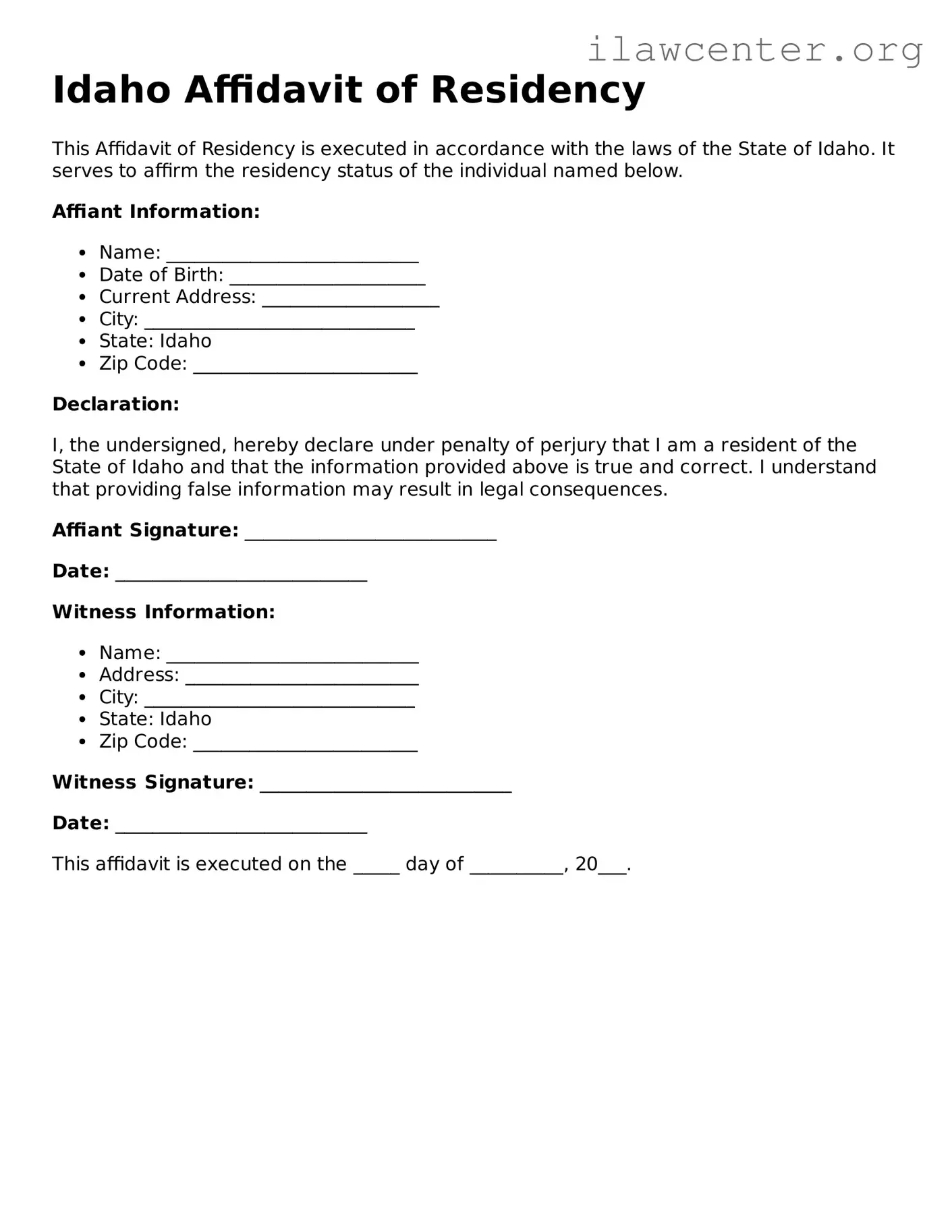
Idaho Affidavit of Residency

This Affidavit of Residency is executed in accordance with the laws of the State of Idaho. It serves to affirm the residency status of the individual named below.

Affiant Information:

  • Name: ___________________________
  • Date of Birth: _____________________
  • Current Address: ___________________
  • City: _____________________________
  • State: Idaho
  • Zip Code: ________________________

Declaration:

I, the undersigned, hereby declare under penalty of perjury that I am a resident of the State of Idaho and that the information provided above is true and correct. I understand that providing false information may result in legal consequences.

Affiant Signature: ___________________________

Date: ___________________________

Witness Information:

  • Name: ___________________________
  • Address: _________________________
  • City: _____________________________
  • State: Idaho
  • Zip Code: ________________________

Witness Signature: ___________________________

Date: ___________________________

This affidavit is executed on the _____ day of __________, 20___.

PDF Form Characteristics

Fact Name Description
Purpose The Idaho Affidavit of Residency form is used to verify a person's residency status in Idaho.
Governing Law This form is governed by Idaho Code § 33-2002, which outlines residency requirements for public education.
Eligibility Individuals who are applying for in-state tuition or other residency-based benefits must complete this form.
Submission The completed affidavit must be submitted to the appropriate educational institution or agency for processing.

Instructions on Utilizing Idaho Affidavit of Residency

Completing the Idaho Affidavit of Residency form is an important step for individuals needing to establish their residency in Idaho. This form requires accurate information to ensure it reflects your current living situation. Once you have filled it out, you will typically submit it to the relevant authority, which could be a school district, state agency, or local government office.

  1. Begin by downloading the Idaho Affidavit of Residency form from the official state website or obtain a physical copy from the appropriate office.
  2. Carefully read the instructions provided on the form to understand the requirements.
  3. In the first section, enter your full name as it appears on your identification.
  4. Provide your current residential address, ensuring that it is complete and accurate.
  5. Fill in the date you moved to this address. This helps establish your residency timeline.
  6. Next, include any previous addresses you have lived at within the last five years, if applicable.
  7. In the designated area, indicate the purpose of completing the affidavit, such as enrolling a child in school.
  8. Sign and date the form at the bottom. Your signature confirms the truthfulness of the information provided.
  9. If required, have the form notarized. A notary public will verify your identity and witness your signature.
  10. Finally, submit the completed affidavit to the appropriate agency or organization as instructed.

Important Facts about Idaho Affidavit of Residency

What is the Idaho Affidavit of Residency form?

The Idaho Affidavit of Residency form is a legal document used to verify an individual's residency in Idaho. This form is often required for various purposes, such as enrolling in schools, obtaining driver's licenses, or qualifying for state services. By completing this affidavit, individuals affirm that they reside at a specified address within the state of Idaho, which may be necessary for eligibility in certain programs or services.

Who needs to complete the Idaho Affidavit of Residency form?

Individuals who are establishing residency in Idaho may need to complete this form. This includes students enrolling in public schools, individuals applying for a driver's license or state identification, and those seeking to access state-funded services. It is essential for anyone who needs to prove their residency status to submit this affidavit as part of their application process.

How do I complete the Idaho Affidavit of Residency form?

To complete the Idaho Affidavit of Residency form, individuals should provide their full name, current address, and any other required information as specified on the form. It is crucial to ensure that all details are accurate and truthful. After filling out the form, the individual must sign it in the presence of a notary public, who will then notarize the document. This step adds a layer of authenticity to the affidavit.

Where can I submit the Idaho Affidavit of Residency form?

The completed Idaho Affidavit of Residency form should be submitted to the appropriate agency or institution that requires it. This may include local school districts, the Department of Motor Vehicles (DMV), or other state agencies. It is advisable to check with the specific entity to confirm submission guidelines, as some may allow electronic submission while others may require a physical copy.

Common mistakes

When filling out the Idaho Affidavit of Residency form, people often make several common mistakes that can lead to delays or complications. One frequent error is failing to provide accurate information. This form requires specific details about your residency status, including your address and the duration of your residency. If any of this information is incorrect or incomplete, it can result in the rejection of your affidavit.

Another mistake involves not signing the affidavit. The form must be signed in front of a notary public to be valid. Many individuals forget this crucial step, thinking that merely filling out the form is sufficient. Without a signature, the affidavit lacks authenticity and cannot be accepted.

Additionally, some people overlook the importance of including supporting documents. The Idaho Affidavit of Residency may require proof of residency, such as utility bills or lease agreements. Failing to attach these documents can lead to questions about your residency status, causing unnecessary delays in processing.

Lastly, individuals often neglect to read the instructions carefully. Each section of the form has specific requirements, and misunderstanding these can lead to mistakes. Taking the time to thoroughly review the instructions can help ensure that the affidavit is filled out correctly and completely.

Documents used along the form

The Idaho Affidavit of Residency form is a crucial document for establishing residency in the state. It is often accompanied by several other forms and documents that can help clarify or support residency claims. Here are five commonly used documents that may be needed alongside the affidavit.

  • Proof of Identity: A government-issued photo ID, such as a driver's license or passport, is essential for verifying the identity of the individual submitting the affidavit. This helps confirm that the person claiming residency is who they say they are.
  • Utility Bills: Recent utility bills, such as electricity, water, or gas statements, can serve as proof of residency. These documents should display the individual's name and address to support their claim of living in Idaho.
  • Lease Agreement: A signed lease agreement can provide evidence of residency, especially for renters. This document outlines the terms of the rental arrangement and should include the tenant's name and the property address.
  • Bank Statements: Recent bank statements that show the individual's name and address can further establish residency. These documents often reflect the person's financial activities and are typically mailed to the home address.
  • Employment Records: Documents from an employer, such as pay stubs or a letter confirming employment, can also support a residency claim. They should include the employee's name and address, reinforcing the connection to the Idaho residence.

When submitting the Idaho Affidavit of Residency, including these additional documents can strengthen the case for residency. Each piece of evidence plays a role in creating a comprehensive picture of an individual's ties to the state.

Similar forms

  • Lease Agreement: This document outlines the terms under which a tenant can occupy a property, similar to how an affidavit confirms residency at a specific address.
  • Utility Bill: A utility bill serves as proof of residency by showing the name and address of the individual receiving services at that location.
  • Voter Registration Card: This card indicates where a person is registered to vote, which often corresponds to their current residency.
  • Bank Statement: A bank statement with the account holder's name and address can verify residency, much like an affidavit does.
  • Government-Issued ID: An ID, such as a driver's license, provides proof of residency by displaying the individual's current address.
  • Tax Return: A tax return can show an individual's address and confirm their residency for tax purposes.
  • Employment Records: Documents from an employer, such as pay stubs or offer letters, often include an address, verifying where a person resides.
  • School Enrollment Records: These records indicate where a child is enrolled in school, which can confirm the family's residency.
  • Affidavit of Support: This document is used to affirm a person's financial support and often includes their address, linking it to residency.
  • Homeowner's Insurance Policy: This policy includes the insured address, serving as evidence of residency for the homeowner.

Dos and Don'ts

Filling out the Idaho Affidavit of Residency form requires attention to detail. Here are some essential do's and don'ts to keep in mind:

  • Do read the instructions carefully before starting.
  • Do provide accurate and truthful information about your residency.
  • Do sign and date the form after completing it.
  • Do keep a copy of the completed form for your records.
  • Don't leave any required fields blank.
  • Don't use white-out or make corrections that are not clear.
  • Don't submit the form without checking for errors.

By following these guidelines, you can help ensure that your Affidavit of Residency is processed smoothly and efficiently.

Misconceptions

When it comes to the Idaho Affidavit of Residency form, many people hold misconceptions that can lead to confusion. Here are six common misunderstandings:

  • It’s only for students. Many believe that the affidavit is exclusively for students attending school in Idaho. In reality, anyone needing to establish residency for various purposes, such as voting or obtaining a driver’s license, can use this form.
  • It requires a notary. Some think that the affidavit must be notarized. However, while notarization can add an extra layer of authenticity, it is not a requirement for the form to be valid.
  • It must be filed with the state. Many people assume that the affidavit needs to be submitted to a state office. In fact, the form is typically kept for personal records and may only need to be presented when requested.
  • Only homeowners can fill it out. There is a belief that only those who own property can complete the affidavit. In truth, renters and those living with family or friends can also establish their residency using this form.
  • It’s a complicated legal document. Some think the affidavit is filled with complex legal language. On the contrary, the form is straightforward and designed to be easy to understand for anyone.
  • Once submitted, it can’t be changed. Lastly, many worry that once they submit the affidavit, they can’t make changes. However, if circumstances change, individuals can complete a new affidavit to reflect their current residency status.

Understanding these misconceptions can help you navigate the residency process in Idaho more effectively. Always ensure you have the correct information to avoid unnecessary complications.

Key takeaways

When filling out and using the Idaho Affidavit of Residency form, keep these key takeaways in mind:

  1. Eligibility: Ensure that you meet the eligibility requirements to use the affidavit. This form is typically for individuals who need to verify their residency in Idaho.
  2. Accurate Information: Provide accurate and truthful information. Any discrepancies can lead to complications or rejection of the form.
  3. Signature Requirement: Remember to sign the affidavit. Your signature confirms that all the information provided is correct.
  4. Notarization: The affidavit must be notarized. This adds a layer of authenticity and is often a requirement for acceptance.
  5. Submission Process: Familiarize yourself with the submission process. Know where to send the completed form and any additional documentation needed.