Attorney-Verified  Divorce Settlement Agreement Document for Idaho

Attorney-Verified Divorce Settlement Agreement Document for Idaho

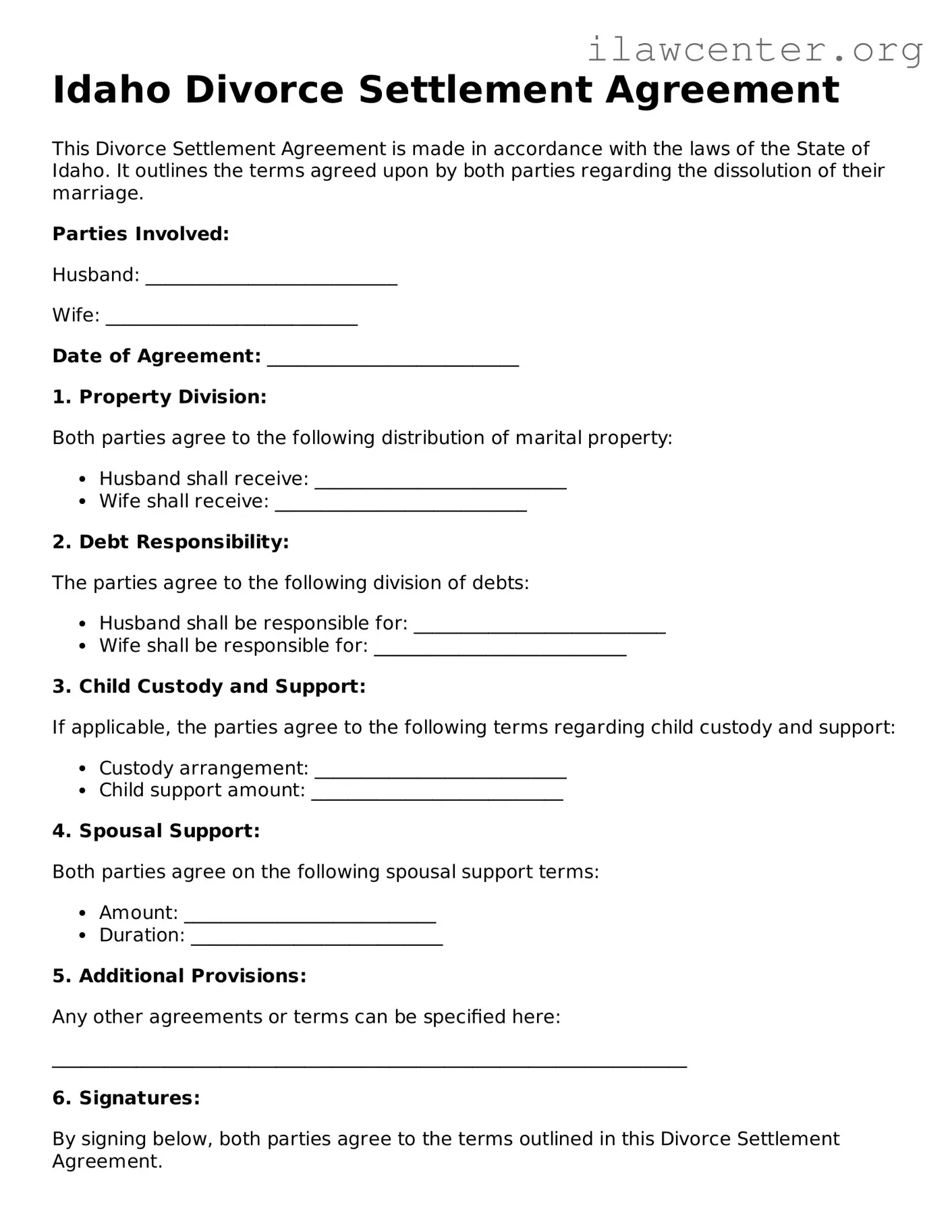
The Idaho Divorce Settlement Agreement form is a legal document that outlines the terms agreed upon by both spouses during a divorce. This form covers various aspects such as property division, child custody, and support arrangements. Completing this form is essential for finalizing your divorce, so be sure to fill it out by clicking the button below.

Article Guide

When navigating the emotional and often complex journey of divorce, understanding the legal documentation involved is crucial for both parties. In Idaho, the Divorce Settlement Agreement form serves as a foundational document that outlines the terms of the divorce, addressing various aspects such as the division of assets and debts, child custody arrangements, and spousal support. This form acts as a binding contract between the spouses, ensuring that both individuals agree on how to manage their shared responsibilities and resources post-divorce. By clearly delineating each party's rights and obligations, the agreement fosters clarity and helps prevent future disputes. It is essential for individuals to approach this form with careful consideration, as it not only reflects their immediate needs but also sets the stage for their future interactions, especially if children are involved. Understanding the components of the Divorce Settlement Agreement can empower individuals to make informed decisions, ultimately leading to a more amicable resolution during a challenging time.

Idaho Divorce Settlement Agreement Preview

Idaho Divorce Settlement Agreement

This Divorce Settlement Agreement is made in accordance with the laws of the State of Idaho. It outlines the terms agreed upon by both parties regarding the dissolution of their marriage.

Parties Involved:

Husband: ___________________________

Wife: ___________________________

Date of Agreement: ___________________________

1. Property Division:

Both parties agree to the following distribution of marital property:

  • Husband shall receive: ___________________________
  • Wife shall receive: ___________________________

2. Debt Responsibility:

The parties agree to the following division of debts:

  • Husband shall be responsible for: ___________________________
  • Wife shall be responsible for: ___________________________

3. Child Custody and Support:

If applicable, the parties agree to the following terms regarding child custody and support:

  • Custody arrangement: ___________________________
  • Child support amount: ___________________________

4. Spousal Support:

Both parties agree on the following spousal support terms:

  • Amount: ___________________________
  • Duration: ___________________________

5. Additional Provisions:

Any other agreements or terms can be specified here:

____________________________________________________________________

6. Signatures:

By signing below, both parties agree to the terms outlined in this Divorce Settlement Agreement.

Husband Signature: ___________________________ Date: ___________

Wife Signature: ___________________________ Date: ___________

This agreement is intended to be a complete and final settlement of all issues arising from the marriage. It is advisable for both parties to seek independent legal advice before signing.

PDF Form Characteristics

Fact Name Description
Purpose The Idaho Divorce Settlement Agreement form is used to outline the terms agreed upon by both parties regarding the division of assets, debts, child custody, and support obligations during a divorce.
Governing Laws This form is governed by the Idaho Statutes Title 32, Chapter 7, which covers divorce and family law matters.
Mutual Agreement Both spouses must sign the form, indicating that they have mutually agreed to the terms outlined within it. This ensures that both parties are on the same page.
Filing Requirement While the form is not filed with the court, it must be submitted during the divorce proceedings as part of the final divorce decree.
Modification Once the agreement is signed and approved by the court, it can only be modified by a new agreement or court order, ensuring stability in the arrangements made.

Instructions on Utilizing Idaho Divorce Settlement Agreement

Completing the Idaho Divorce Settlement Agreement form is an essential step in finalizing a divorce. Once you have filled out the form, it will serve as a written agreement outlining the terms of your divorce, including property division, child custody, and support arrangements. After submitting this form to the court, it will help facilitate the legal process of your divorce.

  1. Begin by obtaining the Idaho Divorce Settlement Agreement form. You can find it online on the Idaho State Judiciary website or at your local courthouse.
  2. Carefully read through the entire form to familiarize yourself with the sections that need to be completed.
  3. In the first section, enter your name and your spouse's name, along with the case number if applicable.
  4. Provide your current addresses and contact information in the designated fields.
  5. Next, indicate the date of marriage and the date of separation. These dates are important for the legal process.
  6. Proceed to the section regarding property division. List all marital assets and debts, and specify how you propose to divide them.
  7. If children are involved, fill out the child custody and support section. Clearly state your proposed custody arrangement and any child support payments.
  8. Review any additional sections that may pertain to spousal support or other relevant agreements.
  9. Once all sections are completed, review the form for accuracy. Ensure that all information is correct and complete.
  10. Sign and date the form at the designated area. Your spouse should also sign if required.
  11. Make copies of the completed form for your records before submitting it to the court.
  12. Finally, file the form with the appropriate court clerk, following any local filing procedures.

Important Facts about Idaho Divorce Settlement Agreement

What is an Idaho Divorce Settlement Agreement?

An Idaho Divorce Settlement Agreement is a legal document that outlines the terms of a divorce between two parties. It typically includes details about the division of assets and debts, child custody arrangements, child support, and spousal support. This agreement is crucial for ensuring that both parties understand their rights and obligations following the divorce.

Who needs to complete a Divorce Settlement Agreement?

How do I create a Divorce Settlement Agreement?

What should be included in the Divorce Settlement Agreement?

Can I modify the Divorce Settlement Agreement after it is signed?

Is the Divorce Settlement Agreement enforceable?

Do I need a lawyer to draft my Divorce Settlement Agreement?

Where do I file the Divorce Settlement Agreement?

Common mistakes

Filling out the Idaho Divorce Settlement Agreement form can be a complex task. Many individuals make common mistakes that can delay the process or even lead to legal complications. Understanding these pitfalls can help ensure a smoother divorce process.

One frequent mistake is failing to provide complete information. Each section of the form requires specific details. Omitting information, even unintentionally, can result in delays or the need to resubmit the form. It is crucial to double-check all entries for completeness.

Another error involves incorrect calculations. When dividing assets or debts, accuracy is vital. Miscalculating values can lead to disputes later on. Always verify numbers and ensure that both parties agree on the valuations presented.

People often overlook the importance of clarity in their language. Ambiguous terms or vague descriptions can create confusion. Clear and precise language helps both parties understand their rights and responsibilities, reducing the likelihood of future disagreements.

Many individuals fail to account for tax implications. Certain assets may have tax consequences that affect their value. It is advisable to consult a tax professional to understand how asset division may impact tax liabilities.

Another common mistake is neglecting to include all relevant assets and debts. It is essential to list all marital property and liabilities. Failing to disclose an asset can lead to legal repercussions down the line.

Some people rush through the form without considering the long-term implications of their decisions. A divorce settlement is not just about the present; it affects future financial stability. Taking the time to think through each decision can prevent regret later.

Inadequate communication between parties can also hinder the process. Both individuals should discuss their expectations and concerns openly. A lack of communication can lead to misunderstandings and an incomplete agreement.

Finally, not seeking legal advice can be a significant oversight. While it is possible to fill out the form independently, having a lawyer review it can provide valuable insights. Legal professionals can identify potential issues and ensure that the agreement is fair and enforceable.

Documents used along the form

When navigating the process of divorce in Idaho, several important forms and documents may accompany the Divorce Settlement Agreement. Understanding these documents can help ensure that all aspects of the divorce are addressed properly and fairly. Below is a list of commonly used forms that you might encounter.

  • Petition for Divorce: This document initiates the divorce process. It outlines the reasons for the divorce and requests the court to dissolve the marriage.
  • Summons: A summons is a legal notice that informs the other spouse of the divorce proceedings. It requires them to respond within a specified time frame.
  • Financial Disclosure Form: This form provides a detailed account of each spouse's financial situation. It includes income, expenses, assets, and debts, ensuring transparency during negotiations.
  • Child Custody Agreement: If children are involved, this document outlines the arrangements for custody, visitation, and parenting responsibilities. It aims to serve the best interests of the children.
  • Child Support Worksheet: This worksheet calculates the amount of financial support one parent will pay to the other for the children's care. It considers various factors such as income and custody arrangements.
  • Property Settlement Agreement: This document details how marital property and debts will be divided between the spouses. It aims to ensure a fair distribution of assets.
  • Motion for Temporary Orders: If immediate decisions are needed regarding custody, support, or property during the divorce process, this motion requests temporary orders from the court.
  • Notice of Hearing: This document informs both parties of the scheduled court hearings related to the divorce. It ensures that everyone is aware of important dates and can prepare accordingly.
  • Final Decree of Divorce: Once all matters are settled, this document officially ends the marriage. It outlines the terms agreed upon by both parties and is filed with the court.

Each of these documents plays a crucial role in the divorce process. By familiarizing yourself with them, you can approach your situation with greater confidence and clarity. Remember, seeking guidance from a qualified professional can provide additional support during this challenging time.

Similar forms

The Divorce Settlement Agreement is a critical document in the process of ending a marriage. However, it shares similarities with several other legal documents that play important roles in family law. Here are seven documents that are similar to the Divorce Settlement Agreement, along with explanations of their similarities:

  • Separation Agreement: This document outlines the terms of a couple's separation before divorce. Like the Divorce Settlement Agreement, it addresses issues such as asset division, child custody, and support, ensuring both parties have a clear understanding of their rights and responsibilities.
  • Child Custody Agreement: This specific agreement focuses solely on the arrangements for children following a divorce. Similar to a Divorce Settlement Agreement, it details custody arrangements, visitation schedules, and parental responsibilities, ensuring the best interests of the child are prioritized.
  • Property Settlement Agreement: This document is used to divide marital property and debts. It shares the goal of the Divorce Settlement Agreement by providing a clear framework for how assets will be distributed, thus preventing future disputes.
  • Spousal Support Agreement: This agreement outlines the financial support one spouse may provide to another after separation or divorce. It is similar to the financial provisions often included in a Divorce Settlement Agreement, ensuring clarity and fairness in financial obligations.
  • Prenuptial Agreement: Although created before marriage, this document can dictate how assets will be divided in the event of a divorce. Like the Divorce Settlement Agreement, it aims to clarify the financial and property rights of each spouse, reducing conflict during divorce proceedings.
  • Postnuptial Agreement: Similar to a prenuptial agreement, this document is created after marriage and outlines the division of assets and financial responsibilities. It serves the same purpose as a Divorce Settlement Agreement by providing a clear plan for asset division in case of separation.
  • Child Support Order: This court order establishes the financial support one parent must provide for their child after a divorce. Like the Divorce Settlement Agreement, it ensures that the financial needs of children are met and provides a legally binding structure for support payments.

Understanding these documents can empower individuals navigating the complexities of divorce. Each serves a unique purpose but ultimately aims to create clarity and fairness in difficult situations.

Dos and Don'ts

When filling out the Idaho Divorce Settlement Agreement form, it’s important to be careful and thorough. Here are some helpful tips on what to do and what to avoid.

Things You Should Do:

  • Read the instructions carefully before you start filling out the form.
  • Provide accurate and complete information to avoid delays.
  • Double-check your entries for any errors or omissions.
  • Sign and date the form where required.
  • Keep a copy of the completed form for your records.

Things You Shouldn't Do:

  • Don’t rush through the form; take your time to ensure accuracy.
  • Don’t leave any sections blank unless instructed to do so.
  • Don’t use legal jargon or complicated language.
  • Don’t forget to review the final document before submission.
  • Don’t submit the form without checking your local court’s filing requirements.

Misconceptions

When navigating the process of divorce in Idaho, many individuals encounter the Divorce Settlement Agreement form. However, several misconceptions can cloud understanding and lead to confusion. Below are five common misconceptions about this important document.

  1. The Divorce Settlement Agreement is only for couples with children.

    This is not true. While the form does address child custody and support issues, it is equally relevant for couples without children. The agreement outlines the division of assets, debts, and other important matters, regardless of whether children are involved.

  2. Once signed, the Divorce Settlement Agreement cannot be changed.

    This misconception can be misleading. While the agreement is a binding contract, it can be modified if both parties agree to the changes. Additionally, if circumstances change significantly, such as a job loss or relocation, a court may allow modifications to the agreement.

  3. Filing the Divorce Settlement Agreement is the last step in the divorce process.

    While it is a crucial step, it is not the final one. After submitting the agreement, the court must review and approve it. Only then can the divorce be finalized. This process ensures that all legal requirements are met and that the agreement is fair to both parties.

  4. Legal representation is not necessary for creating a Divorce Settlement Agreement.

    Although individuals can complete the form on their own, seeking legal advice is highly recommended. A lawyer can provide valuable guidance, ensuring that the agreement is comprehensive and protects one’s rights and interests.

  5. The Divorce Settlement Agreement is the same as the divorce decree.

    This is a common misunderstanding. The Divorce Settlement Agreement details the terms of the divorce, while the divorce decree is the final court order that officially ends the marriage. The decree will reference the agreement but serves a different purpose.

Key takeaways

Filling out and using the Idaho Divorce Settlement Agreement form is a crucial step in the divorce process. Here are some key takeaways to consider:

  • Clarity and Completeness: Ensure that all sections of the form are filled out clearly and completely. Incomplete forms can lead to delays in the divorce process.
  • Mutual Agreement: Both parties must agree on the terms outlined in the settlement. Open communication can facilitate a smoother negotiation process.
  • Legal Review: It is advisable to have the agreement reviewed by a legal professional. This can help identify any potential issues or misunderstandings before submission.
  • Filing Requirements: Be aware of the filing requirements in Idaho. The completed form must be submitted to the appropriate court, along with any required fees and documentation.