Attorney-Verified  Employee Handbook Document for Idaho

Attorney-Verified Employee Handbook Document for Idaho

The Idaho Employee Handbook form serves as a crucial document that outlines workplace policies, expectations, and employee rights in Idaho. It provides clarity for both employers and employees, ensuring everyone understands their roles and responsibilities. To get started on creating your own handbook, click the button below to fill out the form.

Article Guide

Creating an employee handbook is an essential step for any business operating in Idaho. This document serves as a comprehensive guide for employees, outlining the company's policies, procedures, and expectations. It covers various aspects, including workplace conduct, attendance policies, and compensation details, ensuring that employees understand their rights and responsibilities. Additionally, the handbook addresses topics such as benefits, safety protocols, and disciplinary actions, providing clarity on how the company handles various situations. By establishing clear guidelines, the employee handbook fosters a positive work environment and helps to prevent misunderstandings between employers and employees. It is important for employers to tailor the handbook to reflect their unique company culture while also complying with state and federal laws. This ensures that the handbook is not only informative but also a valuable resource for all staff members.

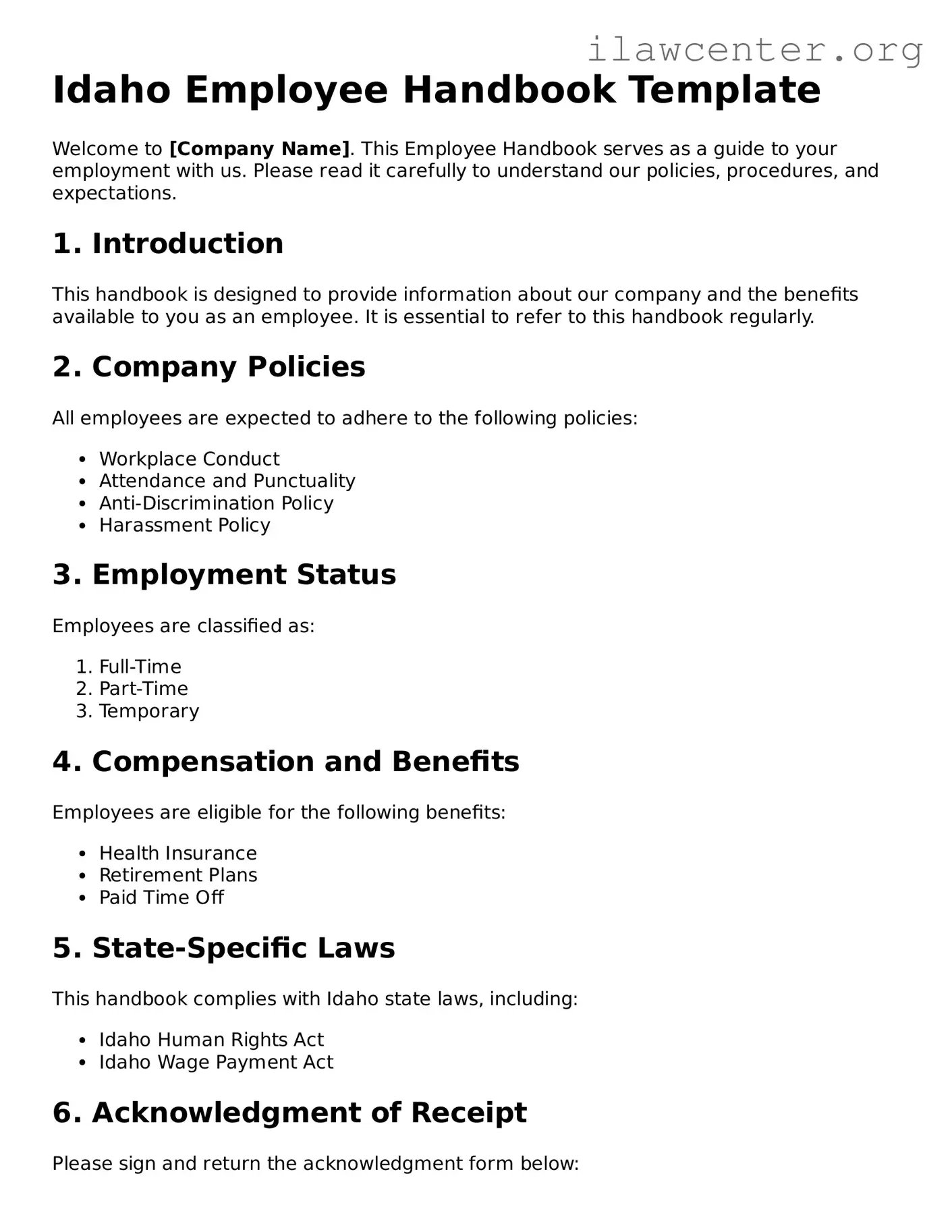
Idaho Employee Handbook Preview

Idaho Employee Handbook Template

Welcome to [Company Name]. This Employee Handbook serves as a guide to your employment with us. Please read it carefully to understand our policies, procedures, and expectations.

1. Introduction

This handbook is designed to provide information about our company and the benefits available to you as an employee. It is essential to refer to this handbook regularly.

2. Company Policies

All employees are expected to adhere to the following policies:

  • Workplace Conduct
  • Attendance and Punctuality
  • Anti-Discrimination Policy
  • Harassment Policy

3. Employment Status

Employees are classified as:

  1. Full-Time
  2. Part-Time
  3. Temporary

4. Compensation and Benefits

Employees are eligible for the following benefits:

  • Health Insurance
  • Retirement Plans
  • Paid Time Off

5. State-Specific Laws

This handbook complies with Idaho state laws, including:

  • Idaho Human Rights Act
  • Idaho Wage Payment Act

6. Acknowledgment of Receipt

Please sign and return the acknowledgment form below:

I, [Employee Name], acknowledge that I have received and read the Idaho Employee Handbook.

Signature: ________________________ Date: _______________

7. Contact Information

If you have questions or need further clarification, please contact:

[HR Representative Name]
[Company Address]
[Phone Number]
[Email Address]

Thank you for being a part of [Company Name]. We look forward to a successful journey together.

PDF Form Characteristics

Fact Name Description
Purpose The Idaho Employee Handbook serves to outline company policies, procedures, and expectations for employees.
Governing Laws The handbook must comply with Idaho state laws, including the Idaho Human Rights Act and employment-related regulations.
Distribution Employers are encouraged to provide the handbook to all employees, ensuring everyone understands their rights and responsibilities.
Updates The handbook should be reviewed and updated regularly to reflect changes in laws or company policies.

Instructions on Utilizing Idaho Employee Handbook

Filling out the Idaho Employee Handbook form is a straightforward process that ensures you understand your rights and responsibilities as an employee. By following these steps, you can complete the form accurately and efficiently.

  1. Begin by reviewing the form carefully. Make sure you have all necessary information at hand, including your personal details and employment specifics.
  2. In the first section, enter your full name as it appears on official documents.
  3. Provide your current address, ensuring that all details are accurate, including city, state, and zip code.
  4. Next, fill in your phone number and email address. Double-check for typos to ensure proper communication.
  5. Move on to the employment section. Indicate your job title and department.
  6. In the next field, enter the date you started working for the company.
  7. If applicable, provide your supervisor's name and contact information.
  8. Read through the employee handbook sections carefully. Acknowledge that you have received and understood the handbook by signing and dating the designated area.
  9. Finally, submit the completed form to your HR department or designated representative as instructed.

Important Facts about Idaho Employee Handbook

What is the Idaho Employee Handbook form?

The Idaho Employee Handbook form serves as a crucial document for employers in Idaho. It outlines company policies, procedures, and expectations for employees. This handbook helps create a consistent work environment and ensures that employees understand their rights and responsibilities within the organization.

Why is an Employee Handbook important?

An Employee Handbook is important because it provides clear guidelines on workplace policies. It helps prevent misunderstandings and disputes by ensuring that all employees are on the same page regarding company rules, benefits, and procedures. Additionally, it can serve as a legal safeguard for employers by documenting their policies and practices.

Who should create the Employee Handbook?

What should be included in the Employee Handbook?

Essential elements of an Employee Handbook include company values, employee rights, work hours, pay schedules, benefits, leave policies, and procedures for reporting misconduct. Additionally, it should cover workplace safety, anti-discrimination policies, and disciplinary procedures. A comprehensive handbook addresses various scenarios that employees may encounter.

How often should the Employee Handbook be updated?

Regular updates to the Employee Handbook are necessary to reflect changes in laws, company policies, or organizational structure. It is recommended to review the handbook at least annually. However, updates may be required sooner if significant changes occur, such as new legislation or shifts in company operations.

How can employees access the Employee Handbook?

Employees should have easy access to the Employee Handbook. This can be achieved by providing physical copies or making it available digitally on the company intranet. Employers should also inform employees about where to find the handbook and encourage them to read it thoroughly.

What if an employee has questions about the handbook?

If an employee has questions about the Employee Handbook, they should feel comfortable reaching out to their supervisor or the human resources department. Open communication is vital, and employers should encourage employees to seek clarification on any policies or procedures they do not understand.

Can the Employee Handbook be used in legal disputes?

Yes, the Employee Handbook can be used in legal disputes. If a conflict arises regarding workplace policies, the handbook serves as a reference point. Courts may consider the handbook as evidence of the company's policies and the expectations set for employees. Therefore, it is crucial to ensure that the handbook is clear, accurate, and up-to-date.

What should employees do if they believe a policy in the handbook is unfair?

If employees believe that a policy in the handbook is unfair, they should address their concerns with their supervisor or the human resources department. Employers should have an open-door policy that allows employees to voice their opinions and suggest changes. Constructive feedback can lead to improvements in company policies.

Is it mandatory for all Idaho employers to have an Employee Handbook?

While it is not legally required for all Idaho employers to have an Employee Handbook, it is highly recommended. Having a handbook can help clarify expectations and protect both the employer and employees. Employers who choose to create a handbook should ensure it complies with relevant laws and regulations.
Common mistakes

Filling out the Idaho Employee Handbook form can seem straightforward, but many people encounter common pitfalls. One frequent mistake is not reading the instructions carefully. Each section of the form has specific requirements. Overlooking these can lead to incomplete or incorrect submissions. Taking the time to understand the guidelines can save a lot of trouble later.

Another common error is failing to provide accurate personal information. This includes names, addresses, and contact details. If any of this information is incorrect, it can create confusion and delays in processing. Double-checking these details ensures that communication remains clear and effective.

Some individuals also forget to sign and date the form. A signature is often a crucial part of the process, as it indicates that the employee agrees to the policies outlined in the handbook. Without a signature, the form may be considered invalid. Always remember to add this important step before submission.

Lastly, many people neglect to ask questions when they are unsure about something. The Employee Handbook form can include complex policies that may not be immediately clear. Seeking clarification can prevent misunderstandings and ensure that all sections are filled out correctly. Don't hesitate to reach out for help when needed.

Documents used along the form

When creating an employee handbook in Idaho, several other forms and documents are often utilized to ensure comprehensive coverage of employment policies and procedures. These documents help clarify expectations and outline rights and responsibilities for both employers and employees. Below are some key forms that are commonly used alongside the Idaho Employee Handbook.

  • Job Description Form: This document outlines the specific duties, responsibilities, and qualifications required for a particular position. It helps both the employer and the employee understand what is expected in the role.
  • Employment Application: This form is used by potential employees to provide their personal information, work history, and qualifications. It serves as a basis for evaluating candidates during the hiring process.
  • Performance Evaluation Form: This document is utilized to assess an employee's job performance over a specific period. It typically includes criteria for evaluation, feedback, and areas for improvement.
  • Employee Acknowledgment Form: This form is signed by employees to confirm that they have received and understood the employee handbook. It serves as a record that the employee is aware of the company policies.

Utilizing these forms alongside the Idaho Employee Handbook can help create a structured and clear employment environment. They provide essential information that supports both the employer's and employee's understanding of their roles and responsibilities in the workplace.

Similar forms

  • Policy Manual: Similar to an Employee Handbook, a policy manual outlines the rules and procedures that employees must follow. It serves as a comprehensive guide to the company's expectations and standards.
  • Onboarding Guide: An onboarding guide helps new employees understand their roles and responsibilities. It provides essential information about the company culture, training programs, and initial tasks, much like an Employee Handbook.
  • Code of Conduct: The code of conduct sets the standards for behavior within the workplace. It details acceptable and unacceptable actions, similar to how an Employee Handbook addresses workplace behavior and ethics.
  • Employee Agreement: An employee agreement outlines the terms of employment, including job duties and compensation. This document complements the Employee Handbook by providing specific details about the employment relationship.
  • Safety Manual: A safety manual focuses on workplace safety protocols and procedures. It shares similarities with the Employee Handbook by emphasizing the importance of safety and employee well-being.
  • Benefits Guide: A benefits guide explains the various employee benefits offered by the company, such as health insurance and retirement plans. Like the Employee Handbook, it serves to inform employees about their rights and options within the organization.

Dos and Don'ts

When filling out the Idaho Employee Handbook form, it is essential to approach the task with care. Adhering to best practices can help ensure that the process is smooth and effective. Below is a list of things you should and shouldn't do.

Things You Should Do:

  • Read the entire handbook thoroughly before completing the form.
  • Provide accurate and up-to-date personal information.
  • Ask questions if any part of the handbook is unclear.
  • Sign and date the form to confirm your understanding and agreement.
  • Keep a copy of the completed form for your records.
  • Submit the form by the designated deadline.
  • Review any updates to the handbook periodically.

Things You Shouldn't Do:

  • Do not rush through the form without reading it carefully.
  • Avoid providing incomplete or incorrect information.
  • Do not ignore sections that require your attention.
  • Refrain from making assumptions about policies without clarification.
  • Do not forget to keep your own copy of the signed form.
  • Avoid submitting the form late or missing the deadline.
  • Do not disregard updates or changes to the handbook after submission.

Misconceptions

  • Misconception 1: The Idaho Employee Handbook is optional for all businesses.
  • This is not true. While not every business is legally required to have an employee handbook, having one is strongly recommended. It helps set clear expectations and protects both the employer and employees.

  • Misconception 2: An employee handbook is a legally binding contract.
  • Many people believe that once an employee signs the handbook, they are entering into a legal contract. In reality, most handbooks include disclaimers stating that they are not contracts and can be modified at any time.

  • Misconception 3: All employee handbooks must be the same.
  • Each business is unique, and so should be its handbook. The content should reflect the specific policies, culture, and needs of the organization.

  • Misconception 4: Once created, the handbook does not need to be updated.
  • Policies, laws, and company practices can change. Regularly reviewing and updating the handbook ensures that it remains relevant and compliant with current laws.

  • Misconception 5: Only large companies need an employee handbook.
  • Small businesses can benefit just as much from having an employee handbook. It helps establish professionalism and provides guidance for employees.

  • Misconception 6: The handbook only needs to cover basic policies.
  • A comprehensive handbook should address a wide range of topics, including workplace conduct, benefits, and procedures for reporting issues. This ensures clarity and reduces misunderstandings.

  • Misconception 7: Employees don’t need to read the handbook.
  • Employees should be encouraged to read and understand the handbook. It serves as a valuable resource for them to know their rights and responsibilities within the workplace.

Key takeaways

When it comes to filling out and utilizing the Idaho Employee Handbook form, there are several important points to keep in mind. Here are four key takeaways to ensure you navigate the process smoothly:

  1. Understand the Purpose: The Employee Handbook serves as a vital resource for both employers and employees. It outlines company policies, procedures, and expectations, helping to create a transparent workplace environment.
  2. Complete All Sections: Ensure that every section of the form is filled out accurately. Missing information can lead to misunderstandings or compliance issues down the line.
  3. Review Regularly: The handbook should not be a one-time project. Regular reviews and updates are necessary to reflect changes in laws, company policies, or workplace culture.
  4. Distribute and Acknowledge: Once the handbook is finalized, it should be distributed to all employees. Acknowledgment forms can be used to confirm that employees have received and understood the handbook.

By keeping these key points in mind, you can ensure that your Employee Handbook is effective and serves its intended purpose.