Attorney-Verified  Marital Separation Agreement Document for Idaho

Attorney-Verified Marital Separation Agreement Document for Idaho

A Marital Separation Agreement in Idaho is a legal document that outlines the terms of a couple's separation, addressing issues such as asset division, child custody, and support obligations. This agreement serves as a framework for both parties to navigate their responsibilities while living apart. To begin the process, consider filling out the form by clicking the button below.

Article Guide

When couples in Idaho decide to take a step back from their marriage, a Marital Separation Agreement can serve as a crucial tool for navigating this transitional phase. This document outlines the rights and responsibilities of each spouse during the separation period, ensuring clarity and reducing potential conflicts. Key aspects often addressed in the agreement include the division of property and debts, child custody arrangements, and spousal support. By clearly defining these elements, couples can create a structured plan that reflects their individual needs and circumstances. Additionally, the agreement may cover issues related to health insurance and tax implications, providing a comprehensive framework for both parties. Understanding the importance of this form is essential for anyone considering separation, as it lays the groundwork for a more amicable process, whether or not reconciliation is on the horizon.

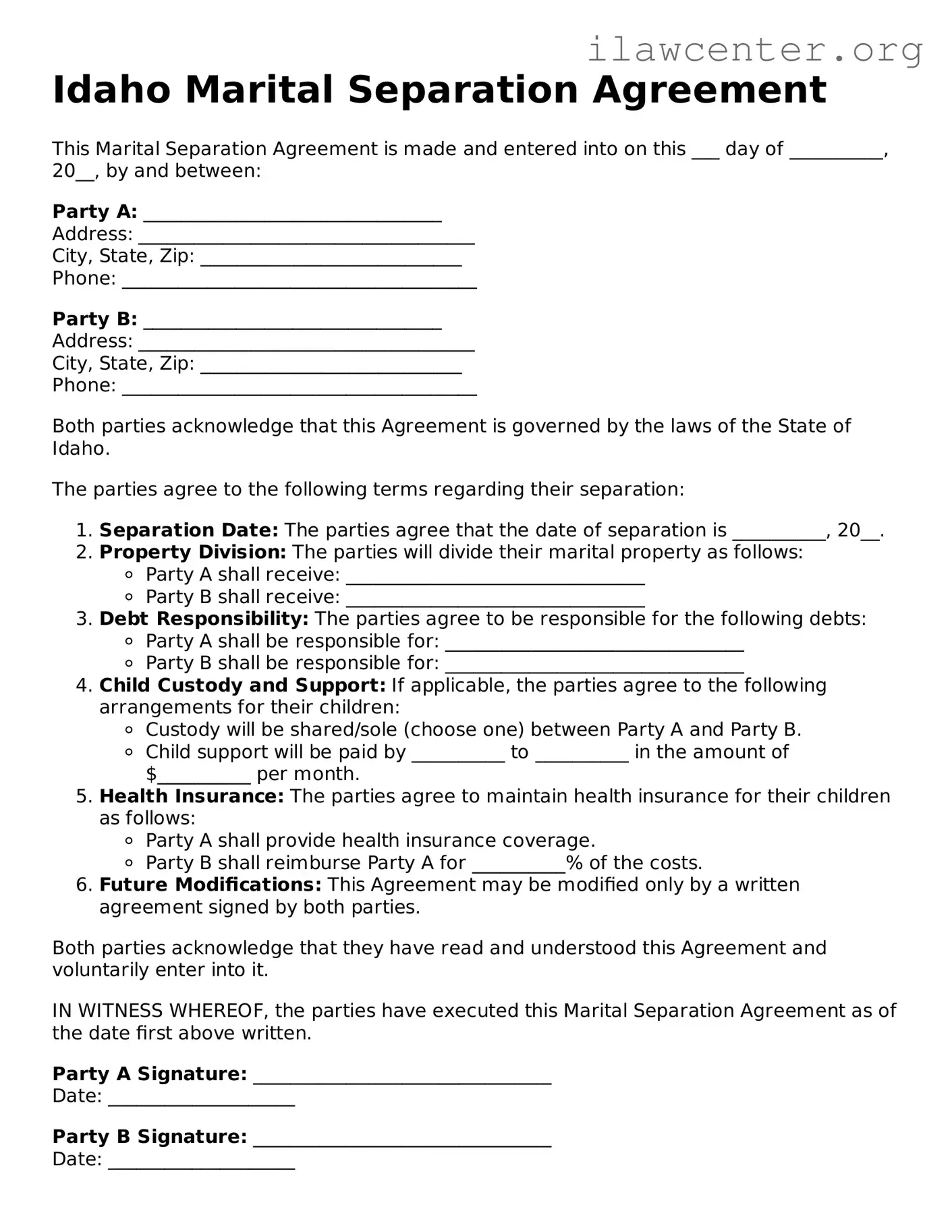
Idaho Marital Separation Agreement Preview

Idaho Marital Separation Agreement

This Marital Separation Agreement is made and entered into on this ___ day of __________, 20__, by and between:

Party A: ________________________________
Address: ____________________________________
City, State, Zip: ____________________________
Phone: ______________________________________

Party B: ________________________________
Address: ____________________________________
City, State, Zip: ____________________________
Phone: ______________________________________

Both parties acknowledge that this Agreement is governed by the laws of the State of Idaho.

The parties agree to the following terms regarding their separation:

  1. Separation Date: The parties agree that the date of separation is __________, 20__.
  2. Property Division: The parties will divide their marital property as follows:
    • Party A shall receive: ________________________________
    • Party B shall receive: ________________________________
  3. Debt Responsibility: The parties agree to be responsible for the following debts:
    • Party A shall be responsible for: ________________________________
    • Party B shall be responsible for: ________________________________
  4. Child Custody and Support: If applicable, the parties agree to the following arrangements for their children:
    • Custody will be shared/sole (choose one) between Party A and Party B.
    • Child support will be paid by __________ to __________ in the amount of $__________ per month.
  5. Health Insurance: The parties agree to maintain health insurance for their children as follows:
    • Party A shall provide health insurance coverage.
    • Party B shall reimburse Party A for __________% of the costs.
  6. Future Modifications: This Agreement may be modified only by a written agreement signed by both parties.

Both parties acknowledge that they have read and understood this Agreement and voluntarily enter into it.

IN WITNESS WHEREOF, the parties have executed this Marital Separation Agreement as of the date first above written.

Party A Signature: ________________________________
Date: ____________________

Party B Signature: ________________________________
Date: ____________________

Witness Signature: ________________________________
Date: ____________________

PDF Form Characteristics

Fact Name Description
Definition An Idaho Marital Separation Agreement is a legal document outlining the terms of separation between spouses.
Governing Laws The agreement is governed by Idaho Code Title 32, which pertains to domestic relations.
Purpose It serves to clarify the rights and responsibilities of each spouse during the separation period.
Content Requirements The agreement typically includes provisions for child custody, support, property division, and debt responsibilities.
Notarization While notarization is not required, having the agreement notarized can add an extra layer of legal validity.
Enforceability Once signed, the agreement can be enforced in court, provided it is fair and reasonable.
Modification The terms of the agreement can be modified later, but both parties must agree to the changes in writing.

Instructions on Utilizing Idaho Marital Separation Agreement

Once you have gathered the necessary information and documentation, you can begin filling out the Idaho Marital Separation Agreement form. This form will help outline the terms of your separation, including issues related to property division, child custody, and support. Completing it accurately is essential for ensuring that both parties understand their rights and responsibilities moving forward.

  1. Begin by entering your full name and your spouse's full name at the top of the form.
  2. Provide the date of your marriage and the date of your separation.
  3. Fill in your current addresses and any other contact information as required.
  4. Detail any children from the marriage, including their names and birthdates.
  5. Outline the terms of property division, specifying which assets and debts belong to each party.
  6. Indicate any agreements regarding child custody, visitation, and child support, if applicable.
  7. Include any other relevant agreements, such as spousal support or health insurance responsibilities.
  8. Both parties should review the document for accuracy and completeness.
  9. Sign and date the form in the designated areas.
  10. Have the form notarized if required, ensuring that both signatures are witnessed.

After completing the form, it is advisable to keep copies for your records. You may need to file the agreement with the appropriate court or provide it to your attorney, depending on your situation. Taking these steps will help ensure that your separation process proceeds smoothly.

Important Facts about Idaho Marital Separation Agreement

What is a Marital Separation Agreement in Idaho?

A Marital Separation Agreement is a legal document that outlines the terms and conditions agreed upon by a couple who has decided to live separately but not divorce. This agreement addresses various aspects such as property division, debt responsibilities, child custody, and support. It serves to clarify each party's rights and obligations during the separation period, providing a framework for how to manage shared responsibilities while living apart.

Is a Marital Separation Agreement legally binding in Idaho?

Yes, once both parties have signed the Marital Separation Agreement, it becomes legally binding. This means that both individuals are obligated to adhere to the terms outlined in the document. However, if circumstances change, either party may seek to modify the agreement through mutual consent or by going to court, depending on the situation.

Do I need a lawyer to create a Marital Separation Agreement?

While it is not legally required to have a lawyer to create a Marital Separation Agreement in Idaho, it is highly recommended. A lawyer can help ensure that the agreement is fair, comprehensive, and compliant with state laws. Having legal guidance can also help avoid potential disputes in the future, making the process smoother for both parties.

What should be included in a Marital Separation Agreement?

A comprehensive Marital Separation Agreement should include several key elements. These typically encompass the division of marital property and debts, arrangements for child custody and visitation, child support obligations, spousal support (if applicable), and any other relevant issues that may arise during the separation. Each section should be detailed to avoid misunderstandings later on.

How does a Marital Separation Agreement affect child custody?

The Marital Separation Agreement can have a significant impact on child custody arrangements. It should specify the custody arrangement—whether joint or sole custody—and outline visitation rights for the non-custodial parent. Additionally, it may address how decisions regarding the child's education, healthcare, and other important aspects will be handled. Clear terms help to minimize conflicts and ensure that the child's best interests are prioritized.

Can a Marital Separation Agreement be changed after it is signed?

Yes, a Marital Separation Agreement can be modified after it has been signed, but both parties must agree to the changes. If one party wishes to alter the terms, they should communicate openly with the other party. If an agreement cannot be reached, it may be necessary to seek legal assistance or go through the court system to resolve the matter.

What happens if one party does not follow the Marital Separation Agreement?

If one party fails to comply with the terms of the Marital Separation Agreement, the other party has the right to seek enforcement through the court. This may involve filing a motion to enforce the agreement, which could result in legal penalties for the non-compliant party. It is important to keep records of any violations to support your case if enforcement becomes necessary.
Common mistakes

When completing the Idaho Marital Separation Agreement form, many individuals inadvertently make common mistakes that can lead to complications down the line. Understanding these pitfalls can help ensure that the agreement is valid and serves its intended purpose. Here are nine mistakes to avoid.

One frequent error is failing to provide complete information. It’s essential to include full names, addresses, and other identifying details for both parties. Omitting this information can create confusion and may lead to legal issues later. Always double-check that all necessary personal details are filled in accurately.

Another common mistake is neglecting to specify the terms of property division clearly. This section should detail how assets and debts will be divided. Vague language can lead to misunderstandings and disputes in the future. Be specific about what belongs to whom and how shared responsibilities will be handled.

People often overlook the importance of addressing child custody and support arrangements. If children are involved, it’s crucial to outline custody arrangements, visitation rights, and child support payments. Failing to include these details can leave both parties unsure of their rights and obligations, potentially leading to conflicts.

Additionally, some individuals forget to consider tax implications when dividing assets. Certain assets can have tax consequences that may affect both parties. Consulting a financial advisor or tax professional can provide valuable insights, ensuring that both parties are aware of potential financial impacts.

Another mistake is not having the agreement reviewed by a legal professional. While it may seem tempting to finalize the document without legal input, this can lead to significant issues. An attorney can help identify any gaps or unclear language, ensuring that the agreement is enforceable and meets legal standards.

Many people also fail to date the document properly. A lack of a clear date can create ambiguity about when the agreement takes effect. This can be particularly problematic if circumstances change or if disputes arise later. Always include the date when both parties sign the agreement.

Forgetting to include a clause for modifications is another oversight. Life circumstances can change, and it’s essential to outline how modifications to the agreement can be made in the future. This proactive approach can save time and stress later on.

Some individuals may assume that the agreement doesn’t need to be notarized. However, having the document notarized can add an extra layer of legitimacy and can help prevent disputes about the authenticity of the signatures. It’s a simple step that can provide peace of mind.

Finally, many people neglect to keep copies of the signed agreement. After all parties have signed, it’s crucial to retain copies for personal records. This ensures that everyone has access to the terms agreed upon and can refer back to them if needed.

By avoiding these common mistakes, individuals can create a more effective and comprehensive Idaho Marital Separation Agreement. Taking the time to carefully complete the form can lead to a smoother transition during what is often a challenging time.

Documents used along the form

When navigating the process of marital separation in Idaho, several forms and documents may be necessary alongside the Marital Separation Agreement. Each of these documents serves a specific purpose, helping to clarify rights and responsibilities during the separation process. Below is a list of commonly used forms that individuals may encounter.

  • Petition for Divorce: This document initiates the divorce process, outlining the reasons for the divorce and the desired outcomes regarding property, custody, and support.
  • Child Custody Agreement: This agreement details the arrangements for child custody and visitation, addressing the best interests of the child involved.
  • Child Support Worksheet: This form calculates the amount of child support one parent may owe to the other based on income and other factors.
  • Property Settlement Agreement: This document outlines how marital assets and debts will be divided between the spouses, ensuring clarity on ownership and responsibility.
  • Spousal Support Agreement: This agreement specifies any financial support one spouse will provide to the other after separation or divorce.
  • Financial Affidavit: This form provides a detailed account of each spouse's financial situation, including income, expenses, assets, and liabilities.
  • Notice of Hearing: This document notifies the parties involved of upcoming court hearings related to the separation or divorce proceedings.
  • Temporary Orders: These orders provide immediate relief on issues such as child custody, support, and possession of property while the divorce is pending.
  • Final Decree of Divorce: This is the court's official order that finalizes the divorce, including all terms related to property division, support, and custody.

Understanding these documents can significantly impact the outcome of a marital separation. Each form plays a crucial role in ensuring that both parties are treated fairly and that the best interests of any children involved are prioritized. It is advisable to seek guidance to navigate this complex process effectively.

Similar forms

The Marital Separation Agreement is a key document for couples who decide to separate but not divorce. Several other documents serve similar purposes in outlining the rights and responsibilities of each party. Here are eight documents that share similarities with the Marital Separation Agreement:

  • Divorce Decree: This is a court order that finalizes the divorce. Like a separation agreement, it addresses the division of property, custody, and support obligations.
  • Child Custody Agreement: This document outlines the terms of child custody and visitation. It is similar in that it aims to protect the interests of the children involved.
  • Property Settlement Agreement: This agreement details how assets and debts will be divided upon separation or divorce, similar to the financial aspects covered in a marital separation agreement.
  • Postnuptial Agreement: Created after marriage, this document outlines financial arrangements and responsibilities, much like a separation agreement but typically used to clarify terms during the marriage.
  • Separation Agreement: This is a broader term that can refer to any agreement made between spouses who are separating, covering similar topics as the marital separation agreement.
  • Alimony Agreement: This document specifies the terms of spousal support, paralleling the financial responsibilities addressed in a marital separation agreement.
  • Parenting Plan: This outlines how parents will manage their responsibilities towards their children post-separation, similar to the custody aspects of a marital separation agreement.
  • Financial Disclosure Statement: This document provides a comprehensive overview of each spouse's financial situation, ensuring transparency and fairness in negotiations, akin to the financial disclosures in a marital separation agreement.

Dos and Don'ts

When completing the Idaho Marital Separation Agreement form, it is important to follow specific guidelines to ensure accuracy and completeness. Here are nine things to consider:

  • Do read the entire form carefully before starting. Understanding the requirements will help you fill it out correctly.
  • Don't leave any sections blank. Every part of the form must be completed to avoid delays.
  • Do provide accurate and honest information. Misrepresentation can lead to legal issues later.
  • Don't rush through the process. Take your time to ensure that all details are correct.
  • Do consult with a legal professional if you have questions. They can provide guidance tailored to your situation.
  • Don't forget to sign and date the form. An unsigned document is not valid.
  • Do make copies of the completed form for your records. Keeping a copy is essential for future reference.
  • Don't submit the form without reviewing it one last time. A final check can catch mistakes.
  • Do ensure you are submitting the form to the correct court. Each jurisdiction may have different requirements.

Misconceptions

When dealing with a marital separation agreement in Idaho, several misconceptions can arise. Understanding these myths can help clarify the process and ensure that individuals make informed decisions. Here are six common misconceptions:

  • 1. A separation agreement is the same as a divorce. Many people believe that a marital separation agreement automatically leads to divorce. However, a separation agreement allows couples to live apart while still being legally married.
  • 2. Separation agreements are not legally binding. Some assume that these agreements have no legal weight. In reality, when properly executed, they can be enforceable in court, just like a divorce decree.
  • 3. You cannot modify a separation agreement. There is a belief that once a separation agreement is signed, it cannot be changed. In fact, couples can modify their agreements if both parties consent to the changes.
  • 4. A separation agreement covers all future issues. Many think that a separation agreement addresses every possible future issue. While it can cover many aspects, it may not account for all potential future circumstances, such as changes in income or living situations.
  • 5. You do not need legal advice to create a separation agreement. Some people feel that they can draft a separation agreement without legal assistance. However, consulting with a legal professional can ensure that the agreement is comprehensive and protects both parties' rights.
  • 6. Separation agreements are only for couples with children. There is a misconception that only couples with children need a separation agreement. In reality, any couple considering separation can benefit from having a formal agreement, regardless of whether children are involved.

By dispelling these misconceptions, individuals can better navigate the complexities of marital separation in Idaho.

Key takeaways

When filling out and using the Idaho Marital Separation Agreement form, consider the following key takeaways:

  • Understand the Purpose: This agreement outlines the terms of separation between spouses, addressing issues such as property division, child custody, and support.
  • Complete All Sections: Ensure that every section of the form is filled out completely. Incomplete forms can lead to delays or complications.
  • Be Clear and Specific: Use clear language when describing terms. Vague terms can lead to misunderstandings later.
  • Consider Legal Advice: It may be beneficial to consult with an attorney to ensure that the agreement meets legal standards and protects your interests.
  • Include Financial Information: Disclose all assets and debts. Transparency is crucial for a fair division of property.
  • Review Child Custody Arrangements: Clearly outline custody and visitation rights to avoid conflicts in the future.
  • Sign and Date the Agreement: Both parties must sign and date the document for it to be legally binding.
  • Keep Copies: After completing the agreement, make multiple copies. Each party should retain a copy for their records.