Attorney-Verified  Medical Power of Attorney Document for Idaho

Attorney-Verified Medical Power of Attorney Document for Idaho

The Idaho Medical Power of Attorney form is a legal document that allows individuals to designate someone they trust to make medical decisions on their behalf if they become unable to do so. This form ensures that your healthcare preferences are honored, even when you cannot communicate them yourself. To take control of your medical decisions, consider filling out the form by clicking the button below.

Article Guide

The Idaho Medical Power of Attorney form serves as a crucial legal document for individuals seeking to ensure their healthcare preferences are honored when they are unable to communicate their wishes. This form allows a person, known as the principal, to designate a trusted individual, referred to as an agent, to make medical decisions on their behalf. Key elements of the form include the specific powers granted to the agent, which can encompass decisions about treatment options, surgeries, and end-of-life care. Additionally, the document may outline any limitations on the agent's authority, providing a clear framework for medical decision-making that aligns with the principal's values and desires. It’s essential for individuals to understand the implications of this form, as it not only empowers the chosen agent but also safeguards the principal's rights and preferences in potentially vulnerable situations. Proper execution of the Idaho Medical Power of Attorney form, including necessary signatures and witness requirements, ensures its validity and effectiveness when needed most.

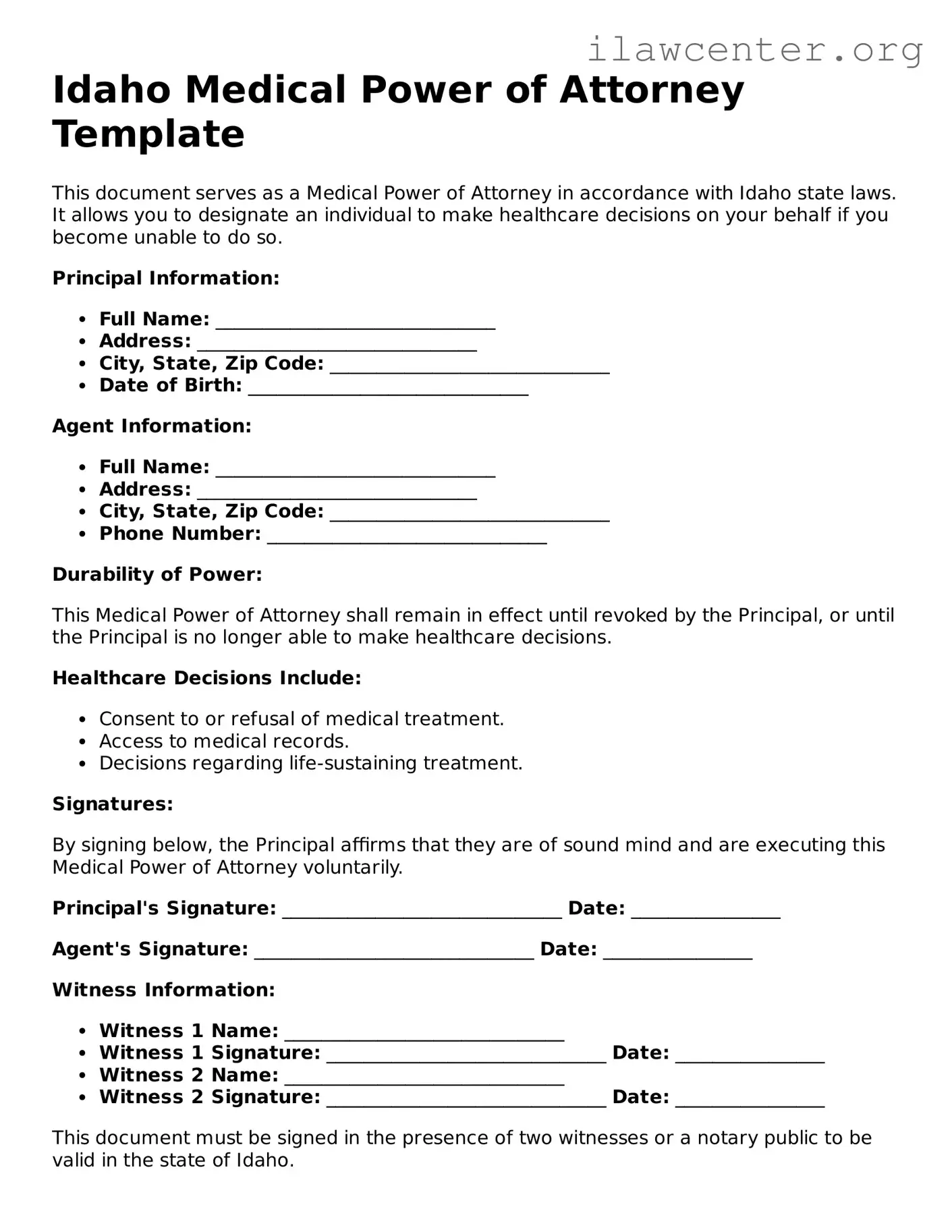
Idaho Medical Power of Attorney Preview

Idaho Medical Power of Attorney Template

This document serves as a Medical Power of Attorney in accordance with Idaho state laws. It allows you to designate an individual to make healthcare decisions on your behalf if you become unable to do so.

Principal Information:

  • Full Name: ______________________________
  • Address: ______________________________
  • City, State, Zip Code: ______________________________
  • Date of Birth: ______________________________

Agent Information:

  • Full Name: ______________________________
  • Address: ______________________________
  • City, State, Zip Code: ______________________________
  • Phone Number: ______________________________

Durability of Power:

This Medical Power of Attorney shall remain in effect until revoked by the Principal, or until the Principal is no longer able to make healthcare decisions.

Healthcare Decisions Include:

  • Consent to or refusal of medical treatment.
  • Access to medical records.
  • Decisions regarding life-sustaining treatment.

Signatures:

By signing below, the Principal affirms that they are of sound mind and are executing this Medical Power of Attorney voluntarily.

Principal's Signature: ______________________________ Date: ________________

Agent's Signature: ______________________________ Date: ________________

Witness Information:

  • Witness 1 Name: ______________________________
  • Witness 1 Signature: ______________________________ Date: ________________
  • Witness 2 Name: ______________________________
  • Witness 2 Signature: ______________________________ Date: ________________

This document must be signed in the presence of two witnesses or a notary public to be valid in the state of Idaho.

PDF Form Characteristics

Fact Name Description
Governing Law The Idaho Medical Power of Attorney is governed by Idaho Code § 39-4501 et seq.
Purpose This form allows an individual to designate another person to make medical decisions on their behalf in the event they are unable to do so.
Requirements The form must be signed by the principal (the person granting authority) and witnessed by two individuals or notarized.
Durability The authority granted through this document remains effective even if the principal becomes incapacitated.
Revocation The principal can revoke the Medical Power of Attorney at any time, as long as they are competent to do so.

Instructions on Utilizing Idaho Medical Power of Attorney

After obtaining the Idaho Medical Power of Attorney form, it's essential to complete it accurately to ensure your healthcare decisions are honored. Follow these steps carefully to fill out the form correctly.

  1. Begin by entering your full legal name in the designated space at the top of the form.
  2. Provide your address, including city, state, and ZIP code.
  3. Identify the person you are appointing as your agent by writing their full name in the specified section.
  4. Include the agent's address, ensuring it is complete with city, state, and ZIP code.
  5. Clearly state any limitations or specific instructions regarding the powers you are granting to your agent.
  6. Sign and date the form in the appropriate areas. Ensure your signature is consistent with your legal name.
  7. Have the form witnessed by at least two individuals who are not related to you or your agent. They should sign and print their names in the designated areas.
  8. Consider having the document notarized for added validity, although it may not be required.

Once the form is completed, keep a copy for your records and provide a copy to your appointed agent and your healthcare provider. This ensures that your wishes are communicated effectively when needed.

Important Facts about Idaho Medical Power of Attorney

What is a Medical Power of Attorney in Idaho?

A Medical Power of Attorney is a legal document that allows you to appoint someone to make healthcare decisions on your behalf if you become unable to do so. This person, known as your agent or proxy, will act according to your wishes regarding medical treatment and care.

Who can be my agent for a Medical Power of Attorney?

Your agent can be anyone you trust to make medical decisions for you. This could be a family member, friend, or other trusted individual. It’s important to choose someone who understands your values and wishes regarding healthcare.

Do I need to be a specific age to create a Medical Power of Attorney in Idaho?

Is there a specific format for the Medical Power of Attorney form in Idaho?

Do I need witnesses or a notary to sign my Medical Power of Attorney?

Can I change or revoke my Medical Power of Attorney?

What happens if I do not have a Medical Power of Attorney?

Can I include specific medical wishes in my Medical Power of Attorney?

Is a Medical Power of Attorney valid in other states?

How do I ensure my Medical Power of Attorney is respected by healthcare providers?

Common mistakes

Filling out a Medical Power of Attorney form in Idaho can seem straightforward, but many people make common mistakes that can lead to complications down the road. One frequent error is not selecting the right agent. Your agent should be someone you trust completely to make medical decisions on your behalf. If you choose someone who may not understand your wishes or values, it could result in decisions that don’t align with what you would want.

Another mistake is failing to discuss your wishes with your chosen agent. It’s essential to have an open conversation about your healthcare preferences. Without this discussion, your agent may be left guessing about your desires in critical situations. This can create unnecessary stress and confusion during difficult times.

Many people also overlook the importance of signing and dating the form properly. In Idaho, your Medical Power of Attorney must be signed by you and dated to be valid. If either of these steps is missing, the document may not hold up when needed. Always double-check that your signature is clear and that the date is accurate.

Some individuals mistakenly think that a Medical Power of Attorney is a one-time task. In reality, life changes, and so do your preferences. Regularly reviewing and updating your form is crucial, especially after significant life events like marriage, divorce, or the birth of a child. Keeping your document current ensures that it reflects your current wishes.

Another common pitfall is neglecting to have witnesses or a notary present during the signing process. Idaho law requires that the form be witnessed by two individuals or notarized. Failing to meet this requirement can invalidate the document, which defeats its purpose. Make sure to follow the legal guidelines to ensure your form is enforceable.

Additionally, some people forget to provide copies of the completed form to their healthcare providers and family members. It’s important that those who may need to refer to your Medical Power of Attorney know its existence and understand your wishes. Distributing copies can prevent confusion and ensure that your decisions are honored.

Lastly, many individuals do not take the time to read the entire form carefully. Skimming through can lead to misunderstandings about the powers you are granting. Each section of the form has specific implications. Taking a moment to read and comprehend each part can save you from potential issues later on.

Documents used along the form

The Idaho Medical Power of Attorney form allows individuals to designate someone to make medical decisions on their behalf if they become unable to do so. Along with this important document, several other forms and documents can enhance your healthcare planning. Below is a list of related documents commonly used in conjunction with the Idaho Medical Power of Attorney.

  • Advance Healthcare Directive: This document outlines your preferences for medical treatment and care. It can include specific instructions about life-sustaining measures and other healthcare choices.
  • Living Will: A living will details your wishes regarding end-of-life care. It specifies the types of medical treatments you would or would not want if you are terminally ill or in a persistent vegetative state.
  • HIPAA Release Form: This form allows designated individuals to access your medical records and communicate with healthcare providers on your behalf. It ensures that your privacy is maintained while allowing trusted persons to obtain necessary information.
  • Do Not Resuscitate (DNR) Order: A DNR order instructs medical personnel not to perform CPR if your heart stops or if you stop breathing. This document must be signed by a physician to be valid.
  • Healthcare Proxy: Similar to a Medical Power of Attorney, a healthcare proxy designates someone to make healthcare decisions for you. It is specifically focused on medical decisions rather than broader legal or financial matters.

Using these documents together with the Idaho Medical Power of Attorney can provide comprehensive guidance for your healthcare preferences. It ensures that your wishes are respected and that your designated representatives have the authority to act on your behalf when needed.

Similar forms

  • Durable Power of Attorney: This document allows an individual to appoint someone to manage their financial and legal affairs if they become incapacitated. Like a Medical Power of Attorney, it grants authority to another person, but it focuses on financial decisions rather than medical ones.
  • Living Will: A Living Will outlines an individual's wishes regarding medical treatment in situations where they are unable to communicate their preferences. While a Medical Power of Attorney designates someone to make decisions, a Living Will specifies the type of care one desires, especially at the end of life.
  • Healthcare Proxy: This document is similar to a Medical Power of Attorney in that it allows a person to appoint someone to make healthcare decisions on their behalf. The key difference lies in the terminology and specific state laws governing each document, but both serve the purpose of ensuring that medical preferences are respected.
  • Do Not Resuscitate (DNR) Order: A DNR order instructs medical personnel not to perform CPR if a person's heart stops or they stop breathing. While it is more specific than a Medical Power of Attorney, both documents aim to communicate an individual's healthcare preferences and ensure that their wishes are honored.

Dos and Don'ts

When filling out the Idaho Medical Power of Attorney form, it’s essential to approach the task with care and attention. Here’s a list of six important do's and don'ts to keep in mind:

  • Do clearly identify the person you are designating as your agent. Make sure their name and contact information are accurate.
  • Do discuss your wishes and preferences regarding medical treatment with your agent. Open communication ensures they understand your values.
  • Do sign and date the form in the presence of a witness or notary, as required by Idaho law. This step adds validity to your document.
  • Do keep a copy of the completed form in a safe place and provide copies to your agent and healthcare providers.
  • Don't leave any sections of the form blank. Incomplete information can lead to confusion or misinterpretation of your wishes.
  • Don't choose an agent who may have conflicting interests, such as someone who could benefit financially from your medical decisions.

By following these guidelines, you can ensure that your Idaho Medical Power of Attorney form accurately reflects your intentions and preferences. Your health care decisions deserve clarity and respect.

Misconceptions

Understanding the Idaho Medical Power of Attorney form is crucial for making informed decisions about healthcare. However, several misconceptions can lead to confusion. Here are seven common misconceptions:

  1. It only applies to end-of-life decisions.

    This is not true. The Idaho Medical Power of Attorney can be used for any medical decisions when a person is unable to communicate their wishes, not just at the end of life.

  2. Anyone can serve as an agent.

    While you can choose anyone you trust, there are specific restrictions. For example, your healthcare provider cannot serve as your agent.

  3. It must be notarized to be valid.

    Notarization is not required in Idaho. However, the form must be signed by two witnesses who meet certain criteria.

  4. It is permanent and cannot be changed.

    You can revoke or change your Medical Power of Attorney at any time, as long as you are mentally competent.

  5. It only covers medical decisions.

    While primarily focused on healthcare, this document can also address specific preferences regarding treatments and procedures.

  6. Once signed, it takes effect immediately.

    The authority granted to your agent only activates when you are unable to make decisions for yourself, as specified in the document.

  7. It's the same as a living will.

    A Medical Power of Attorney designates an agent to make decisions, while a living will outlines your wishes regarding medical treatment. They serve different purposes.

Clarifying these misconceptions can help individuals make better choices about their healthcare planning in Idaho.

Key takeaways

Understanding the Idaho Medical Power of Attorney form is crucial for ensuring that your healthcare wishes are respected. Here are some key takeaways to consider:

  • Definition: A Medical Power of Attorney allows you to designate someone to make healthcare decisions on your behalf if you become unable to do so.
  • Choosing an Agent: Select a trusted individual as your agent. This person should understand your values and preferences regarding medical treatment.
  • Completing the Form: Fill out the form carefully, ensuring that all required sections are completed. Any omissions can lead to complications later.
  • Witness Requirements: Idaho law requires that the form be signed in the presence of two witnesses or a notary public to be valid.
  • Revocation: You have the right to revoke your Medical Power of Attorney at any time. Make sure to inform your agent and any healthcare providers if you do so.
  • Sharing Copies: Once completed, share copies of the signed form with your healthcare providers, your agent, and family members to ensure everyone is informed.
  • Review Regularly: Life circumstances change. Regularly review and update your Medical Power of Attorney to reflect your current wishes.
  • State-Specific Laws: Familiarize yourself with Idaho’s specific laws regarding Medical Power of Attorney to ensure compliance and effectiveness.