Attorney-Verified  Notary Acknowledgement Document for Idaho

Attorney-Verified Notary Acknowledgement Document for Idaho

The Idaho Notary Acknowledgement form is a legal document used to verify the identity of a signer and confirm that they willingly signed a document. This form plays a crucial role in ensuring the authenticity of signatures, thereby enhancing the integrity of various legal transactions. To get started on your own Notary Acknowledgement form, click the button below.

Article Guide

The Idaho Notary Acknowledgement form serves as a crucial tool in the realm of document verification and authenticity. This form is typically used when an individual needs to confirm their identity and the voluntary nature of their signature on important documents, such as contracts or legal agreements. It plays a vital role in ensuring that the signatory understands the content of the document they are signing, thereby providing a layer of protection against fraud. The form requires the notary public to witness the signature and then affix their seal, which lends credibility to the transaction. Additionally, it includes essential details such as the date of the acknowledgment, the name of the signer, and the notary's information. Understanding how to properly complete and utilize this form can streamline various legal processes and foster trust in transactions across the state.

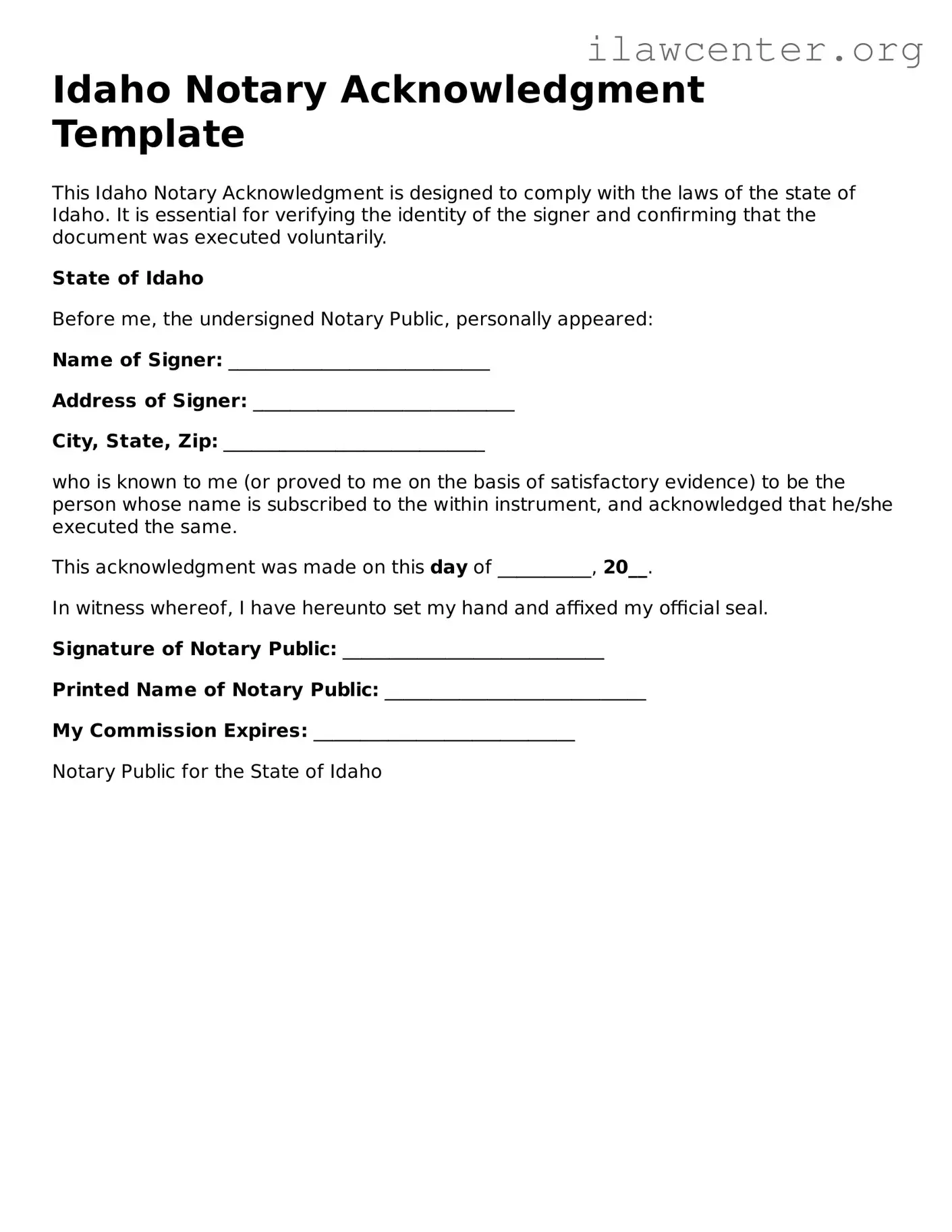
Idaho Notary Acknowledgement Preview

Idaho Notary Acknowledgment Template

This Idaho Notary Acknowledgment is designed to comply with the laws of the state of Idaho. It is essential for verifying the identity of the signer and confirming that the document was executed voluntarily.

State of Idaho

Before me, the undersigned Notary Public, personally appeared:

Name of Signer: ____________________________

Address of Signer: ____________________________

City, State, Zip: ____________________________

who is known to me (or proved to me on the basis of satisfactory evidence) to be the person whose name is subscribed to the within instrument, and acknowledged that he/she executed the same.

This acknowledgment was made on this day of __________, 20__.

In witness whereof, I have hereunto set my hand and affixed my official seal.

Signature of Notary Public: ____________________________

Printed Name of Notary Public: ____________________________

My Commission Expires: ____________________________

Notary Public for the State of Idaho

PDF Form Characteristics

Fact Name Description
Purpose The Idaho Notary Acknowledgement form is used to verify the identity of individuals signing documents.
Governing Law The form is governed by Idaho Code § 51-101 et seq.
Signature Requirement The signer must personally appear before the notary at the time of signing.
Identification The notary must verify the identity of the signer through acceptable forms of identification.
Notary Seal A notary seal or stamp is required to validate the acknowledgement.
Record Keeping Notaries are required to maintain a record of all acknowledgements performed.
Expiration The Idaho Notary Acknowledgement form does not have a set expiration date but should be used in a timely manner.
Usage This form is commonly used for real estate transactions, powers of attorney, and other legal documents.

Instructions on Utilizing Idaho Notary Acknowledgement

Once you have the Idaho Notary Acknowledgment form in hand, you are ready to fill it out. Completing this form accurately is essential for ensuring that the notary's acknowledgment is valid and recognized. Follow these steps carefully to ensure you fill it out correctly.

  1. Begin by locating the section labeled "State of Idaho" at the top of the form.
  2. In the space provided, write the name of the county where the acknowledgment will take place.
  3. Next, find the area that asks for the date. Fill in the date when the acknowledgment is being made.
  4. Proceed to the section where the name of the person whose signature is being acknowledged is required. Write their full name clearly.
  5. In the next line, indicate the type of identification the person is presenting. This could be a driver's license, passport, or another form of ID.
  6. Fill in the ID number from the identification document provided by the signer.
  7. After that, sign your name as the notary public in the designated area.
  8. Next, print your name beneath your signature to ensure clarity.
  9. Finally, include your notary commission number and the expiration date of your commission in the appropriate sections.

After completing the form, double-check all entries for accuracy. Once verified, the form is ready for submission or filing as needed.

Important Facts about Idaho Notary Acknowledgement

What is an Idaho Notary Acknowledgement form?

The Idaho Notary Acknowledgement form is a legal document used to verify that a signature on a document was made voluntarily and with the signer’s consent. This form is typically utilized when a person signs a document in the presence of a notary public, who then acknowledges that the signature is genuine. It serves as proof that the signer was properly identified and that they understood the contents of the document they were signing.

Who can serve as a notary public in Idaho?

In Idaho, a notary public must be at least 18 years old, a resident of Idaho or a non-resident who works in the state, and must complete the required application process. The individual must also pass a background check and take an oath of office. Once appointed, the notary is authorized to perform notarial acts, including acknowledging signatures on documents.

What is the process for completing a Notary Acknowledgement form?

To complete a Notary Acknowledgement form, the signer must appear in person before the notary public. The signer should bring a valid form of identification, such as a driver’s license or passport. The notary will then ask the signer to confirm their identity and willingness to sign the document. After the signature is made, the notary will fill out the acknowledgment section, affix their seal, and sign the form, thereby completing the notarial act.

Is there a fee for notarization in Idaho?

Yes, Idaho law allows notaries to charge a fee for their services. The maximum fee for a standard acknowledgment is typically set by state regulations. However, notaries may choose to charge less than the maximum amount. It is advisable to inquire about the fee in advance to avoid any surprises during the notarization process.

Can the Notary Acknowledgement form be used for any type of document?

Generally, the Notary Acknowledgement form can be used for a wide range of documents, including contracts, deeds, and affidavits. However, it is essential to ensure that the document being notarized does not contain any illegal or fraudulent content. Some documents may have specific requirements for notarization, so it is wise to consult with a legal professional if there are any uncertainties.

Common mistakes

Filling out the Idaho Notary Acknowledgment form can seem straightforward, but many people make common mistakes that can lead to delays or complications. One frequent error is failing to include the correct date. The date is essential as it indicates when the acknowledgment took place. Without it, the document may be considered incomplete.

Another mistake involves not properly identifying the signer. The form requires the notary to confirm the identity of the individual signing the document. If the notary does not include the full name as it appears on the identification, this can create issues later on. Always ensure that the name matches the ID exactly.

People often overlook the requirement for the signer to be present during the acknowledgment. A notary cannot acknowledge a signature if the signer is not physically present. This rule is in place to prevent fraud and ensure the authenticity of the signature.

Additionally, some individuals forget to check the notary's commission details. The notary's commission number and expiration date must be filled out correctly. If these details are missing or incorrect, the acknowledgment may not hold up in court.

Another common error is neglecting to sign the form. The notary must sign the acknowledgment to validate it. Some people mistakenly think that just filling out the form is enough, but the signature is a critical part of the process.

Inadequate wording can also be a problem. The acknowledgment should clearly state that the signer appeared before the notary and acknowledged their signature. Vague language can lead to confusion or misinterpretation of the document's intent.

Using the wrong notary seal is another mistake. Each notary has a specific seal that must be used on the acknowledgment. Using a seal that does not belong to the notary can invalidate the document.

Some individuals fail to provide the correct type of identification for the signer. The notary must verify the identity using an acceptable form of ID, such as a driver's license or passport. Using an expired ID or one that is not recognized can cause problems.

Moreover, forgetting to include the venue can lead to issues. The acknowledgment must state where the notarization took place. Omitting this information can result in a lack of jurisdiction, which may affect the document's validity.

Lastly, many people do not review the completed form before submission. Taking a moment to double-check for errors can save time and prevent future complications. A thorough review ensures that all necessary information is included and accurately presented.

Documents used along the form

In the context of notarization in Idaho, several forms and documents often accompany the Notary Acknowledgment form. Each of these documents serves a specific purpose in the notarization process, ensuring that the necessary legal formalities are adhered to. Below are some common forms used alongside the Notary Acknowledgment.

  • Affidavit: An affidavit is a written statement made under oath. It is often used to provide evidence in legal proceedings. The signer swears to the truth of the contents before a notary public, adding credibility to the document.
  • Power of Attorney: This document allows one person to act on behalf of another in legal or financial matters. A notary public typically witnesses the signing of the Power of Attorney to confirm the identity of the signer and their understanding of the document's implications.
  • Deed: A deed is a legal document that conveys ownership of property from one party to another. Notarization of a deed is crucial, as it helps prevent fraud and ensures that the transaction is legitimate and enforceable.
  • Contract: Contracts are agreements between two or more parties. While not all contracts require notarization, having a notary public witness the signing can enhance the document's validity and enforceability in court.

Understanding these forms can help individuals navigate the notarization process more effectively. Each document plays a vital role in ensuring that legal transactions are conducted smoothly and securely.

Similar forms

  • Affidavit: An affidavit is a written statement confirmed by oath or affirmation, often used as evidence in court. Like a notary acknowledgment, it requires a notary to verify the identity of the signer and witness the signing process.
  • Power of Attorney: This document allows one person to act on behalf of another in legal or financial matters. Similar to a notary acknowledgment, it must be signed in the presence of a notary to ensure the authenticity of the signatures and the intentions of the parties involved.
  • Deed: A deed transfers ownership of property from one person to another. Notarization is crucial here, as it helps confirm that the parties involved are who they claim to be and that they are signing voluntarily.
  • Certificate of Acknowledgment: This document is often used in conjunction with other legal documents to confirm that the signer appeared before a notary and acknowledged their signature. It serves a similar purpose to a notary acknowledgment by verifying the identity and willingness of the signer.
  • Will: A will outlines how a person’s assets will be distributed after their death. While not always required, notarization can add an extra layer of validation to the document, similar to a notary acknowledgment, ensuring that the testator’s identity and intent are clear.

Dos and Don'ts

When filling out the Idaho Notary Acknowledgement form, it's important to follow certain guidelines. Here’s a list of things you should and shouldn’t do:

  • Do ensure that the signer is present when you complete the form.
  • Do verify the identity of the signer with a valid ID.
  • Do fill out the form completely and accurately.
  • Do use black or blue ink when signing the form.
  • Do include the date of the acknowledgment.
  • Don't sign the form without the signer being present.
  • Don't use a form that has been altered or is incomplete.
  • Don't charge a fee that exceeds the allowed amount for notary services.
  • Don't forget to keep a record of the notarial act in your journal.
  • Don't provide legal advice or interpretation of the document.

Misconceptions

Here are nine common misconceptions about the Idaho Notary Acknowledgment form, along with explanations to clarify these misunderstandings:

  1. Notaries can notarize any document.

    This is not true. Notaries in Idaho are only authorized to notarize documents that require a notarial act. Certain documents may have specific requirements or restrictions.

  2. All notaries are lawyers.

    Many people believe that notaries must be attorneys. In Idaho, this is incorrect. Notaries can be individuals from various professions who have completed the necessary training and certification.

  3. A notary must witness the signing of the document.

    While it is common for notaries to witness signings, it is not always required. The key factor is that the signer must appear before the notary, regardless of whether the signing happens in their presence.

  4. Notaries can provide legal advice.

    Notaries are not allowed to give legal advice or help with legal documents. Their role is strictly to verify identities and witness signatures.

  5. Notarization guarantees the legality of a document.

    Notarization does not ensure that a document is legally binding or valid. It simply confirms that the signer is who they claim to be and that they signed the document willingly.

  6. Notaries can refuse to notarize any document.

    While notaries have the right to refuse notarization, they must have a valid reason, such as concerns about the signer's identity or the legality of the document.

  7. Idaho notaries can notarize documents for anyone, anywhere.

    This is a misconception. Notaries must be commissioned in Idaho to notarize documents within the state. They cannot notarize documents for individuals outside their jurisdiction.

  8. Notaries are responsible for the content of the documents.

    Notaries are not responsible for the accuracy or legality of the document's content. Their responsibility is limited to verifying identities and witnessing signatures.

  9. Notary acknowledgments are only needed for real estate transactions.

    While many people associate notary acknowledgments with real estate, they are required for various documents, including powers of attorney, contracts, and more.

Key takeaways

When filling out and using the Idaho Notary Acknowledgement form, it is essential to keep several key points in mind. These takeaways will help ensure the process is smooth and legally sound.

  • Understand the Purpose: The form serves to verify that a signer has willingly signed a document in front of a notary.
  • Complete All Required Fields: Ensure all necessary information, such as the date, signer's name, and notary's details, is filled out accurately.
  • Signature Requirement: The signer must be present when the notary acknowledges the signature; this is crucial for the validity of the document.
  • Identification: The notary must confirm the identity of the signer, typically through a government-issued ID.
  • Record Keeping: Notaries should maintain a record of the acknowledgment in their journal, which is important for legal purposes.
  • State Compliance: Ensure that the form adheres to Idaho state laws regarding notarial acts to avoid any legal issues.