Attorney-Verified  Promissory Note Document for Idaho

Attorney-Verified Promissory Note Document for Idaho

A Promissory Note is a written promise to pay a specified amount of money to a designated person or entity at a certain time or on demand. In Idaho, this form serves as a crucial legal document that outlines the terms of a loan agreement between the borrower and the lender. Understanding how to properly fill out this form can help ensure clarity and protection for both parties involved.

Ready to get started? Fill out the form by clicking the button below!

Article Guide

The Idaho Promissory Note form serves as a vital financial instrument that outlines the terms of a loan between a lender and a borrower. This document details the amount borrowed, the interest rate, and the repayment schedule, providing clarity and security for both parties involved. Additionally, it specifies any collateral that may be tied to the loan, ensuring that the lender has recourse in case of default. The form also includes provisions for late payments and potential penalties, which help set expectations for timely repayment. By using this standardized form, individuals and businesses can formalize their financial agreements, minimizing misunderstandings and fostering trust. Understanding the nuances of the Idaho Promissory Note is essential for anyone looking to engage in lending or borrowing, as it lays the groundwork for a successful financial relationship.

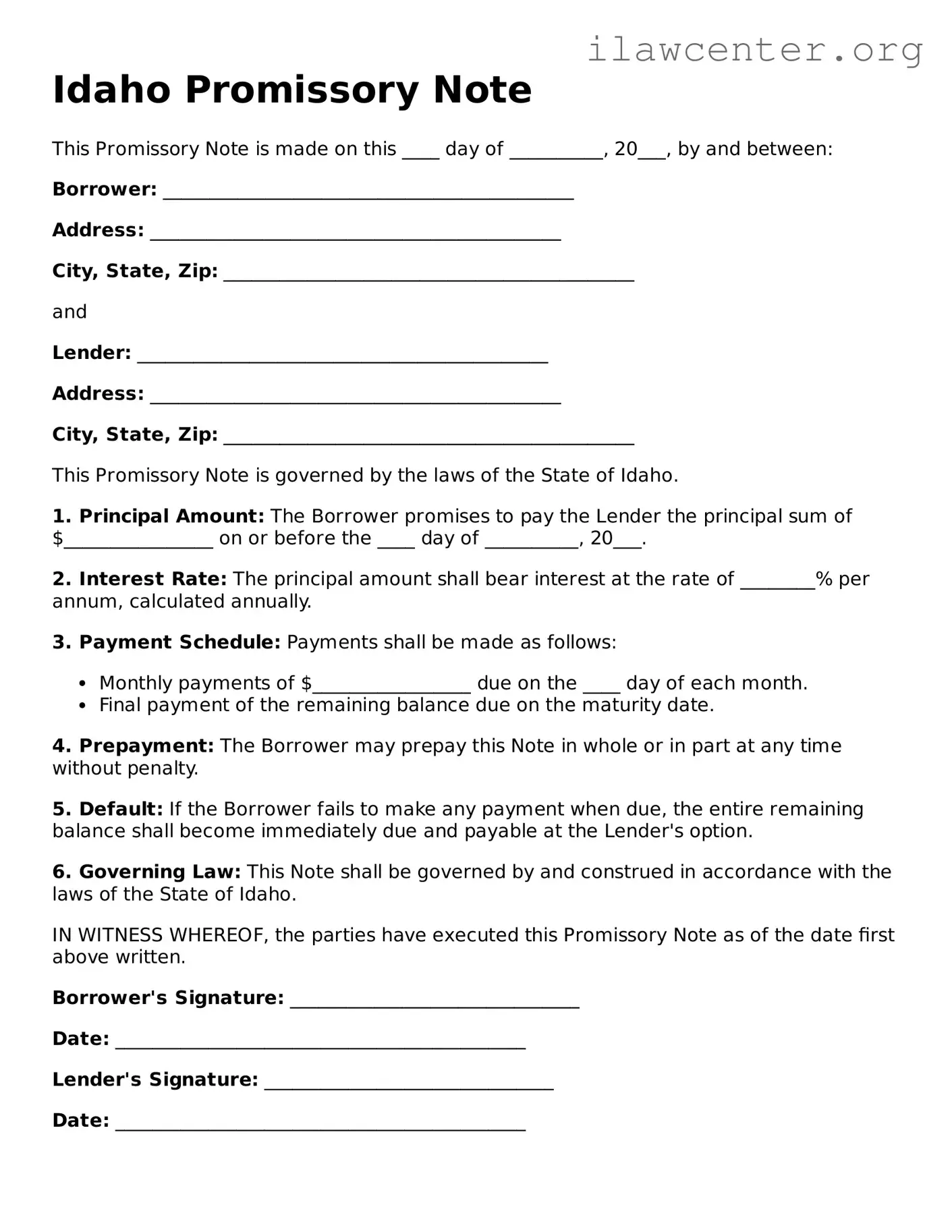
Idaho Promissory Note Preview

Idaho Promissory Note

This Promissory Note is made on this ____ day of __________, 20___, by and between:

Borrower: ____________________________________________

Address: ____________________________________________

City, State, Zip: ____________________________________________

and

Lender: ____________________________________________

Address: ____________________________________________

City, State, Zip: ____________________________________________

This Promissory Note is governed by the laws of the State of Idaho.

1. Principal Amount: The Borrower promises to pay the Lender the principal sum of $________________ on or before the ____ day of __________, 20___.

2. Interest Rate: The principal amount shall bear interest at the rate of ________% per annum, calculated annually.

3. Payment Schedule: Payments shall be made as follows:

  • Monthly payments of $_________________ due on the ____ day of each month.
  • Final payment of the remaining balance due on the maturity date.

4. Prepayment: The Borrower may prepay this Note in whole or in part at any time without penalty.

5. Default: If the Borrower fails to make any payment when due, the entire remaining balance shall become immediately due and payable at the Lender's option.

6. Governing Law: This Note shall be governed by and construed in accordance with the laws of the State of Idaho.

IN WITNESS WHEREOF, the parties have executed this Promissory Note as of the date first above written.

Borrower's Signature: _______________________________

Date: ____________________________________________

Lender's Signature: _______________________________

Date: ____________________________________________

PDF Form Characteristics

Fact Name Details
Definition A promissory note is a written promise to pay a specified amount of money to a designated person at a defined time.
Governing Law Idaho Code § 28-3-104 governs the use and enforcement of promissory notes in Idaho.
Parties Involved The note involves two primary parties: the maker (borrower) and the payee (lender).
Interest Rate Interest rates must be clearly stated in the note. Idaho law does not impose a maximum rate unless the parties agree otherwise.
Payment Terms Payment terms should specify the amount due, payment frequency, and due dates.
Default Conditions The note should outline what constitutes a default and the remedies available to the payee.
Signatures Both parties must sign the note for it to be legally binding.
Enforceability Promissory notes are generally enforceable in Idaho courts if they meet the legal requirements.

Instructions on Utilizing Idaho Promissory Note

Once you have your Idaho Promissory Note form ready, it’s time to fill it out carefully. Each section of the form requires specific information, and accuracy is key to ensure that the document serves its purpose effectively.

  1. Obtain the Form: Start by downloading the Idaho Promissory Note form from a reliable source or obtain a physical copy.
  2. Fill in the Date: Write the date on which the note is being created at the top of the form.
  3. Identify the Borrower: Clearly state the full name and address of the borrower. This is the individual or entity receiving the loan.
  4. Identify the Lender: Next, provide the full name and address of the lender. This is the person or organization providing the loan.
  5. Loan Amount: Enter the total amount of money being borrowed. This should be written both in numbers and in words to avoid any confusion.
  6. Interest Rate: Specify the interest rate applicable to the loan. Make sure to indicate whether it is fixed or variable.
  7. Payment Terms: Outline the payment schedule, including the frequency of payments (monthly, quarterly, etc.) and the due date for each payment.
  8. Late Fees: If applicable, detail any late fees that will be charged if payments are not made on time.
  9. Signatures: Finally, both the borrower and lender must sign and date the document to make it legally binding.

After completing the form, keep a copy for your records and provide a copy to the other party involved. This ensures that everyone has access to the same information and terms outlined in the agreement.

Important Facts about Idaho Promissory Note

What is an Idaho Promissory Note?

An Idaho Promissory Note is a legal document that outlines a borrower's promise to repay a loan to a lender under specified terms. It typically includes details such as the loan amount, interest rate, repayment schedule, and any penalties for late payments. This document serves as evidence of the debt and protects both parties involved in the transaction.

Who can use an Idaho Promissory Note?

Anyone can use an Idaho Promissory Note, including individuals, businesses, and organizations. It is commonly used in personal loans, business loans, and real estate transactions. Both the lender and borrower should understand the terms before signing to ensure clarity and mutual agreement.

What are the key components of an Idaho Promissory Note?

Key components of an Idaho Promissory Note include the names and addresses of the borrower and lender, the principal amount of the loan, the interest rate, the repayment schedule, and any collateral involved. Additionally, it should outline the consequences of default and any applicable fees. Clarity in these components is crucial for enforceability.

Is it necessary to have the Idaho Promissory Note notarized?

While notarization is not strictly required for an Idaho Promissory Note to be valid, it is highly recommended. Having the document notarized adds an extra layer of authenticity and can help prevent disputes regarding the validity of signatures. It may also be beneficial if legal action is needed in the future.

What happens if the borrower defaults on the loan?

If the borrower defaults on the loan, the lender has the right to take legal action to recover the owed amount. This may include filing a lawsuit or seeking a judgment against the borrower. The specific consequences of default should be clearly outlined in the Promissory Note, including any late fees or penalties that may apply.

Common mistakes

When completing the Idaho Promissory Note form, individuals often overlook key details that can lead to complications later on. One common mistake is failing to include the correct names of the parties involved. Both the borrower and lender must be clearly identified to avoid confusion or disputes. Missing or incorrect names can invalidate the agreement.

Another frequent error is neglecting to specify the loan amount. This figure should be clearly stated in both numeric and written form to ensure clarity. If the amount is not clearly defined, it could lead to misunderstandings about the terms of repayment.

Many people also forget to include the interest rate. This is a critical element of the promissory note. If the interest rate is not specified, it can create ambiguity and lead to disputes regarding how much the borrower actually owes.

Additionally, some individuals fail to outline the repayment schedule. It's essential to indicate when payments are due, whether they are monthly, quarterly, or in a lump sum. Without a clear repayment schedule, borrowers may miss payments, leading to penalties or legal issues.

Another common mistake is not including a late payment clause. This clause outlines the penalties for late payments and helps both parties understand the consequences of missing a payment. Without this clause, it can be difficult to enforce penalties if payments are not made on time.

People often overlook the importance of having the document signed by both parties. A promissory note is not legally binding unless it is signed. Additionally, failing to have the signatures witnessed or notarized can lead to challenges in enforcing the note later.

In some cases, individuals might forget to include the date of the agreement. This date is crucial as it marks the beginning of the loan period. Without it, there can be confusion about when the terms of the agreement take effect.

Another mistake is not keeping a copy of the signed promissory note. Both parties should retain a copy for their records. If a dispute arises, having a copy can provide clarity and serve as evidence of the terms agreed upon.

Some individuals also fail to review the entire document before signing. It’s vital to read through the entire note to ensure all terms are understood and agreed upon. Missing even a small detail can have significant implications.

Lastly, people may not seek legal advice when needed. While the form may seem straightforward, consulting with a legal professional can help ensure that all terms are fair and that the document complies with Idaho law. This can prevent future issues and protect the interests of both parties.

Documents used along the form

When engaging in a loan agreement in Idaho, a Promissory Note is a critical document. However, several other forms and documents often accompany it to ensure clarity and legal compliance. Here are some of the commonly used documents:

  • Loan Agreement: This document outlines the terms and conditions of the loan, including the amount borrowed, interest rate, repayment schedule, and any collateral involved.
  • Security Agreement: If the loan is secured, this document specifies the collateral that the borrower pledges to ensure repayment. It details the rights of the lender in case of default.
  • Disclosure Statement: This form provides important information about the loan, including fees, terms, and the total cost of borrowing. It ensures that the borrower understands the financial implications of the loan.
  • Amortization Schedule: This document breaks down the repayment plan, showing how much of each payment goes toward principal and interest over the life of the loan.
  • Guaranty Agreement: In some cases, a third party may agree to guarantee the loan. This document outlines their commitment to repay the loan if the borrower defaults.
  • Modification Agreement: If changes to the original loan terms are necessary, this document formally modifies the existing agreement, ensuring both parties are in agreement on the new terms.

These documents collectively enhance the legal framework surrounding the loan, protecting both the lender and the borrower. Understanding each of these forms can help individuals navigate the borrowing process more effectively.

Similar forms

  • Loan Agreement: Similar to a promissory note, a loan agreement outlines the terms of a loan, including the amount borrowed, interest rates, and repayment schedule. However, it is typically more detailed and may include conditions for default.
  • Security Agreement: This document is used when a borrower pledges collateral to secure a loan. Like a promissory note, it creates a legal obligation but focuses on the collateral rather than just the repayment terms.
  • Mortgage: A mortgage is a specific type of loan secured by real property. It contains similar elements to a promissory note, such as the borrower's promise to repay, but also includes details about the property and foreclosure rights.
  • Installment Agreement: This agreement outlines a plan for paying off a debt in regular installments. It shares similarities with a promissory note in that it specifies payment amounts and due dates, but it may cover various types of debts, not just loans.
  • Letter of Credit: A letter of credit is a financial document from a bank guaranteeing a buyer's payment to a seller. While it serves a different purpose, both documents involve a promise to pay and often include terms and conditions.
  • Personal Guarantee: This document involves an individual agreeing to be responsible for a debt if the primary borrower defaults. Like a promissory note, it creates a binding commitment to pay but is typically used in business transactions.

Dos and Don'ts

When filling out the Idaho Promissory Note form, it's important to follow some key guidelines. Here’s a list of things you should and shouldn't do:

  • Do read the entire form carefully before starting.
  • Do provide accurate information about the borrower and lender.
  • Do specify the loan amount clearly.
  • Do include the interest rate if applicable.
  • Do state the repayment terms in simple language.
  • Don't leave any fields blank unless instructed to do so.
  • Don't use vague terms; be specific about payment dates.
  • Don't forget to sign and date the document.
  • Don't use correction fluid to make changes.
  • Don't rush through the form; take your time to ensure accuracy.

By following these tips, you can help ensure that your Promissory Note is filled out correctly and is legally binding.

Misconceptions

Understanding the Idaho Promissory Note form is crucial for anyone involved in lending or borrowing situations. However, several misconceptions can lead to confusion. Here are seven common misconceptions:

  1. All Promissory Notes are the Same:

    Many people believe that all promissory notes function identically. In reality, the Idaho Promissory Note form has specific requirements and legal implications unique to the state.

  2. Only Banks Use Promissory Notes:

    This form is not exclusive to banks or financial institutions. Individuals can also utilize promissory notes for personal loans or agreements.

  3. A Verbal Agreement is Sufficient:

    Some individuals think a verbal agreement suffices. However, having a written promissory note provides legal protection and clarity for both parties involved.

  4. Promissory Notes Cannot Be Modified:

    There is a belief that once a promissory note is signed, it cannot be changed. In truth, both parties can agree to modify the terms, provided it is documented properly.

  5. Interest Rates are Fixed:

    Many assume that interest rates in promissory notes are always fixed. However, the Idaho Promissory Note can specify variable interest rates, depending on the agreement.

  6. Only Large Loans Require a Promissory Note:

    Some people think that only significant loans necessitate a promissory note. However, even small loans benefit from having a formal agreement to avoid misunderstandings.

  7. Promissory Notes Are Not Legally Binding:

    This misconception suggests that promissory notes lack legal enforceability. In fact, when properly executed, they are legally binding documents that can be upheld in court.

Clearing up these misconceptions can help individuals navigate their financial agreements with confidence and understanding.

Key takeaways

When filling out and using the Idaho Promissory Note form, it is important to keep several key points in mind. These takeaways will help ensure that your document is accurate and legally binding.

  • Identify the Parties Clearly: Make sure to include the full names and addresses of both the borrower and the lender. This clarity helps prevent any confusion later on.
  • Specify the Loan Amount: Clearly state the total amount being borrowed. This figure should be exact to avoid any misunderstandings.
  • Outline the Repayment Terms: Include details about the repayment schedule. Specify whether payments will be made monthly, quarterly, or in a lump sum.
  • Include Interest Rates: If applicable, state the interest rate clearly. This should be in compliance with Idaho state laws regarding maximum allowable rates.
  • Signatures Are Essential: Ensure that both parties sign and date the document. Without signatures, the promissory note may not be enforceable.

By keeping these points in mind, you can create a clear and effective promissory note that protects the interests of both the lender and the borrower.