Attorney-Verified  Small Estate Affidavit Document for Idaho

Attorney-Verified Small Estate Affidavit Document for Idaho

The Idaho Small Estate Affidavit is a legal document that allows individuals to settle the estate of a deceased person without going through the lengthy probate process. This form simplifies the transfer of assets when the total value of the estate is below a certain threshold. If you need to fill out the form, click the button below to get started.

Article Guide

In the state of Idaho, the Small Estate Affidavit serves as a vital tool for individuals navigating the complexities of settling a deceased person's estate when the total value of the estate falls below a specific threshold. This form simplifies the process, allowing heirs to claim assets without the need for formal probate proceedings, which can be time-consuming and costly. Designed for estates valued at $100,000 or less, the affidavit can streamline the transfer of property, bank accounts, and personal belongings directly to the rightful heirs. To utilize this form, certain eligibility requirements must be met, including a declaration that the decedent has passed away and that no other probate proceedings are underway. The affidavit must be signed under penalty of perjury, ensuring that all provided information is accurate and truthful. By understanding the nuances of the Idaho Small Estate Affidavit, individuals can effectively manage the distribution of assets, allowing families to focus on healing during a difficult time rather than getting bogged down in legal intricacies.

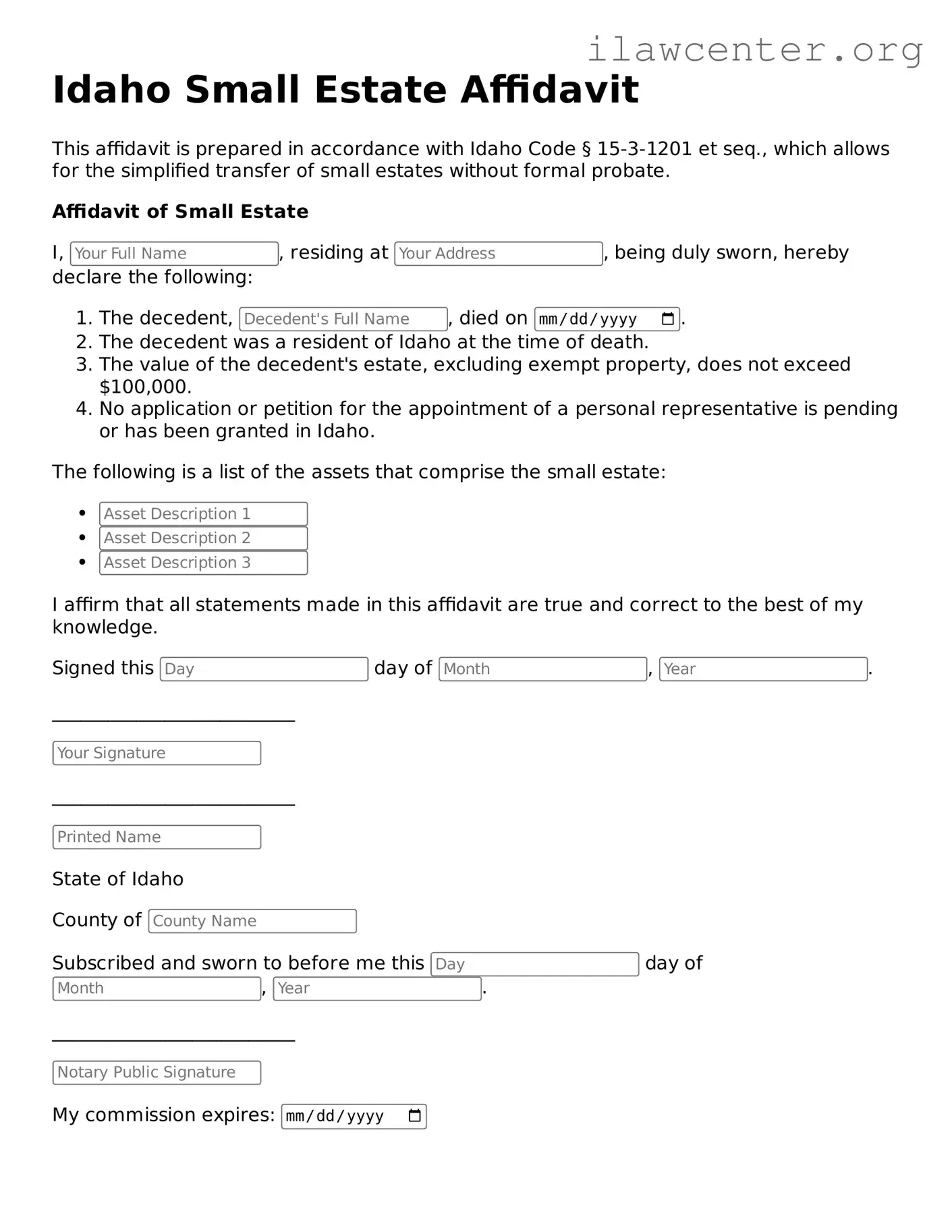
Idaho Small Estate Affidavit Preview

Idaho Small Estate Affidavit

This affidavit is prepared in accordance with Idaho Code § 15-3-1201 et seq., which allows for the simplified transfer of small estates without formal probate.

Affidavit of Small Estate

I, , residing at , being duly sworn, hereby declare the following:

  1. The decedent, , died on .
  2. The decedent was a resident of Idaho at the time of death.
  3. The value of the decedent's estate, excluding exempt property, does not exceed $100,000.
  4. No application or petition for the appointment of a personal representative is pending or has been granted in Idaho.

The following is a list of the assets that comprise the small estate:

I affirm that all statements made in this affidavit are true and correct to the best of my knowledge.

Signed this day of , .

__________________________

__________________________

State of Idaho

County of

Subscribed and sworn to before me this day of , .

__________________________

My commission expires:

PDF Form Characteristics

Fact Name Description
Governing Law The Idaho Small Estate Affidavit is governed by Idaho Code § 15-3-1201 through § 15-3-1205.
Eligibility This form is applicable when the total value of the estate is $100,000 or less, excluding certain assets.
Filing Requirement The affidavit must be filed with the county clerk in the county where the decedent resided.
Affidavit Signers Only the surviving spouse or heirs can sign the affidavit to claim the estate.
Asset Types Real property, personal property, and financial accounts can be included in the small estate process.
Debts and Liabilities The affidavit process does not eliminate the need to settle any outstanding debts of the decedent.
Timeframe The affidavit must be filed within a reasonable time after the decedent's death, typically within a year.
Notarization The affidavit must be notarized to ensure its validity and authenticity.
Use of Form The Idaho Small Estate Affidavit can facilitate the transfer of assets without the need for formal probate.

Instructions on Utilizing Idaho Small Estate Affidavit

Filling out the Idaho Small Estate Affidavit form is an important step in managing the estate of a deceased person when the estate qualifies as a small estate. This process allows you to claim the assets without going through a lengthy probate process. Once the form is completed, it will need to be filed with the appropriate court, and the assets can then be distributed according to the wishes of the deceased.

  1. Obtain the Idaho Small Estate Affidavit form. You can find it online or at your local courthouse.
  2. Begin by entering the name of the deceased person at the top of the form.
  3. Fill in the date of death. Ensure this is accurate, as it is crucial for the affidavit.
  4. Provide the last known address of the deceased. This helps establish their residency.
  5. List the names and addresses of all heirs. Include their relationship to the deceased.
  6. Detail the assets of the estate. Include bank accounts, real estate, and personal property. Be thorough in your descriptions.
  7. Indicate the total value of the estate. Make sure this value does not exceed the small estate limit set by Idaho law.
  8. Sign the affidavit. Your signature must be dated and should be witnessed by a notary public.
  9. Make copies of the completed affidavit for your records and for the heirs.
  10. File the affidavit with the appropriate court in Idaho. Check for any specific filing requirements or fees.

Important Facts about Idaho Small Estate Affidavit

What is the Idaho Small Estate Affidavit form?

The Idaho Small Estate Affidavit form is a legal document that allows individuals to claim assets of a deceased person without going through the formal probate process. This form is typically used when the total value of the deceased's estate is below a certain threshold, which simplifies the transfer of property to heirs or beneficiaries.

Who is eligible to use the Small Estate Affidavit in Idaho?

In Idaho, the Small Estate Affidavit can be used by heirs or beneficiaries of a deceased person. To be eligible, the total value of the estate must not exceed $100,000, excluding any liens or encumbrances. Additionally, at least 30 days must have passed since the death of the individual before filing the affidavit.

What information is required to complete the Small Estate Affidavit?

To complete the Small Estate Affidavit, you will need to provide specific information about the deceased, including their name, date of death, and a description of the property and assets involved. You must also list the names and addresses of all heirs and indicate their relationship to the deceased. Lastly, a statement affirming that the estate qualifies for the small estate process must be included.

How do I file the Small Estate Affidavit in Idaho?

The completed Small Estate Affidavit must be filed with the probate court in the county where the deceased person resided. You may also need to provide copies of the death certificate and any other relevant documents. It is advisable to keep a copy of the filed affidavit for your records.

What happens after I file the Small Estate Affidavit?

Once the Small Estate Affidavit is filed, the court will not review it in the same manner as a formal probate case. Instead, the affidavit serves as a legal declaration that allows the heirs or beneficiaries to collect the assets directly. Financial institutions and other entities will typically accept the affidavit as proof of authority to transfer the deceased's assets.

Can the Small Estate Affidavit be contested?

Yes, while the Small Estate Affidavit simplifies the process, it can still be contested. If an interested party believes that the affidavit was filed improperly or that the estate does not qualify, they may challenge the affidavit in court. It is important to ensure that all information is accurate and that the process is followed correctly to minimize the risk of disputes.

Common mistakes

Filling out the Idaho Small Estate Affidavit form can be a straightforward process, but many individuals make common mistakes that can delay or complicate the handling of an estate. Understanding these pitfalls can help ensure that the form is completed correctly and efficiently.

One frequent mistake is providing inaccurate information about the deceased. It’s essential to ensure that the name, date of birth, and date of death are all correct. Even minor errors can lead to significant delays in the probate process. Double-checking these details can save time and prevent complications.

Another common error is failing to list all assets accurately. The Small Estate Affidavit is meant for estates that do not exceed a certain value, and all assets must be accounted for to qualify. Omitting any property or financial accounts can lead to legal issues down the line. It’s advisable to take inventory of all assets before completing the form.

Many people also overlook the requirement for signatures. The affidavit must be signed by the person claiming the estate, and in some cases, additional signatures from heirs may be necessary. Missing a signature can render the affidavit invalid, which can cause delays in accessing the estate’s assets.

Additionally, not providing the necessary supporting documents can be a significant oversight. In Idaho, the affidavit often requires attachments such as a death certificate or proof of the deceased's property ownership. Failing to include these documents can lead to rejection of the affidavit, prolonging the process of settling the estate.

Lastly, individuals sometimes misinterpret the legal requirements surrounding the Small Estate Affidavit. Each state has its own rules, and it’s crucial to understand Idaho's specific regulations. Consulting with a legal expert can provide clarity and ensure compliance with state laws, thus avoiding unnecessary complications.

Documents used along the form

When dealing with the Idaho Small Estate Affidavit, several other forms and documents may be necessary to ensure a smooth process. These documents help clarify the estate's details and facilitate the transfer of assets. Below is a list of commonly used forms that may accompany the Small Estate Affidavit.

  • Death Certificate: This official document verifies the passing of the individual whose estate is being settled. It is often required to prove the decedent's death.
  • Will: If the deceased left a will, this document outlines their wishes regarding asset distribution. It may need to be submitted alongside the affidavit.
  • List of Assets: A detailed inventory of the decedent's assets, including property, bank accounts, and personal belongings, is often helpful in the affidavit process.
  • Affidavit of Heirship: This document may be used to establish the legal heirs of the decedent, especially when there is no will present.
  • Tax Returns: Previous tax returns may be required to assess any outstanding tax obligations of the decedent's estate.
  • Creditors' Claims: Any claims made by creditors against the estate should be documented to ensure proper handling of debts.
  • Notice to Creditors: This form is used to inform creditors of the decedent's passing and allows them to present any claims against the estate.
  • Court Filings: Depending on the situation, additional court documents may be necessary to validate the Small Estate Affidavit.
  • Verification of Identity: A form of identification, such as a driver's license or state ID, may be needed to verify the identity of the person filing the affidavit.

Each of these documents plays a crucial role in the estate settlement process. Gathering them ahead of time can help streamline the procedure and ensure that all necessary information is readily available.

Similar forms

The Small Estate Affidavit serves a specific purpose in estate administration, particularly for simplifying the transfer of assets when the estate's value is below a certain threshold. Several other legal documents share similarities with the Small Estate Affidavit, each designed to facilitate the management and distribution of a deceased person's assets. Below are six documents that are comparable to the Small Estate Affidavit:

  • Will: A will outlines how a person's assets should be distributed after their death. Like the Small Estate Affidavit, it serves as a legal document to convey the deceased's wishes, though it typically requires probate to be executed.
  • Trust: A trust allows for the management of assets during a person's lifetime and specifies how those assets should be distributed after death. Similar to the Small Estate Affidavit, a trust can help avoid probate, making the transfer of assets more efficient.
  • Letters of Administration: This document is issued by a court to appoint an administrator for an estate when there is no will. Both the Letters of Administration and the Small Estate Affidavit help facilitate the distribution of assets, but the former involves court oversight.
  • Probate Petition: A probate petition is filed to initiate the probate process for a deceased person's estate. While the Small Estate Affidavit can bypass probate for smaller estates, both documents aim to settle the affairs of the deceased.
  • Affidavit of Heirship: This document is used to establish the heirs of a deceased person, especially when no will exists. Like the Small Estate Affidavit, it provides a sworn statement to clarify asset distribution, although it does not directly transfer ownership.
  • Transfer on Death Deed: This deed allows a property owner to designate beneficiaries who will automatically receive the property upon their death. Similar to the Small Estate Affidavit, it simplifies the transfer process and avoids probate for the designated property.

Dos and Don'ts

When filling out the Idaho Small Estate Affidavit form, it's important to approach the process carefully. Here are some key do's and don'ts to keep in mind:

  • Do ensure that you meet the eligibility requirements for using the Small Estate Affidavit.
  • Do provide accurate information about the deceased and their assets.
  • Do sign the affidavit in front of a notary public to validate your claim.
  • Do keep copies of all documents submitted for your records.
  • Don't attempt to use the affidavit for estates that exceed the value limit set by Idaho law.
  • Don't omit any required information, as this can delay the process.
  • Don't forget to check for any outstanding debts or obligations of the deceased.
  • Don't submit the affidavit without confirming that all signatures are complete.

By following these guidelines, you can help ensure a smoother process in handling the estate matters in Idaho.

Misconceptions

The Idaho Small Estate Affidavit is a useful tool for settling the estates of individuals who have passed away, but many people hold misconceptions about its use and requirements. Here are seven common misunderstandings:

  1. Only estates under a certain value can use the affidavit.

    While it’s true that the Idaho Small Estate Affidavit is designed for smaller estates, the limit is not as low as many think. Currently, estates valued at $100,000 or less in real property and $50,000 or less in personal property can qualify.

  2. All heirs must agree to use the affidavit.

    This is a misconception. The affidavit can be used by a single heir or representative of the estate, even if not all heirs are in agreement. However, it is wise to communicate with all parties involved.

  3. The affidavit is the same as a will.

    These are different documents. A will is a legal declaration of how a person wants their estate distributed after death, while a Small Estate Affidavit is a way to collect assets without going through probate.

  4. Filing the affidavit is complicated.

    In reality, the process is straightforward. The form can be filled out with basic information about the deceased and their assets, making it accessible for most people.

  5. You must go to court to use the affidavit.

    This is not true. One of the main advantages of the Small Estate Affidavit is that it allows heirs to avoid the court process entirely, streamlining the transfer of assets.

  6. Only family members can use the affidavit.

    While family members often use it, anyone with a legitimate claim to the estate can file the affidavit. This includes friends or business partners, provided they meet the requirements.

  7. The affidavit can be used for any type of asset.

    This is a common misunderstanding. The Small Estate Affidavit is specifically for certain types of assets. Real estate and personal property are included, but not all assets may qualify, such as those held in trust.

Understanding these misconceptions can help individuals navigate the process of settling a small estate in Idaho more effectively. It’s always best to consult with a legal professional for personalized guidance.

Key takeaways

Filling out the Idaho Small Estate Affidavit form can be a straightforward process, but there are important points to keep in mind to ensure everything goes smoothly. Here are six key takeaways to consider:

  • Eligibility Criteria: The estate must not exceed $100,000 in value, excluding liens and encumbrances. This limit applies to personal property and does not include real estate.
  • Required Information: You will need to provide details about the deceased, including their full name, date of death, and last known address. Additionally, a description of the estate assets is necessary.
  • Affidavit Signatures: The affidavit must be signed by the person claiming the assets. If there are multiple heirs, all must sign the document, affirming their agreement.
  • Notarization: A notary public must witness the signing of the affidavit. This step adds a layer of authenticity and helps prevent disputes.
  • Filing Requirements: After completing the affidavit, it should be filed with the county clerk in the county where the deceased lived at the time of death. This filing is essential for the process to be legally recognized.
  • Asset Distribution: Once the affidavit is filed, the claimant can collect the assets. It is crucial to distribute the assets according to the wishes of the deceased or state law if no will exists.

Understanding these key points can make the process of managing a small estate in Idaho much easier. Being informed helps ensure that all legal requirements are met and that the estate is handled efficiently.