Attorney-Verified  Affidavit of Correction Document for Illinois

Attorney-Verified Affidavit of Correction Document for Illinois

The Illinois Affidavit of Correction form is a legal document used to correct errors in official records. This form helps ensure that information is accurate and up-to-date, providing clarity for all parties involved. If you need to correct a mistake, consider filling out the form by clicking the button below.

Article Guide

The Illinois Affidavit of Correction form serves as a vital tool for individuals seeking to amend or rectify errors in official documents, such as property deeds or certificates. This form is particularly important when inaccuracies, whether they are typographical errors or misstatements, could lead to confusion or legal complications. By completing this affidavit, individuals can clarify the intended information, thereby ensuring that records accurately reflect the true nature of the transaction or ownership. The process typically involves providing essential details, including the original document's information, the specific corrections being made, and a declaration under oath. This sworn statement lends credibility to the corrections and helps maintain the integrity of public records. Understanding how to properly utilize this form can significantly ease the burden of addressing documentation errors, ultimately leading to smoother transactions and clearer legal standing.

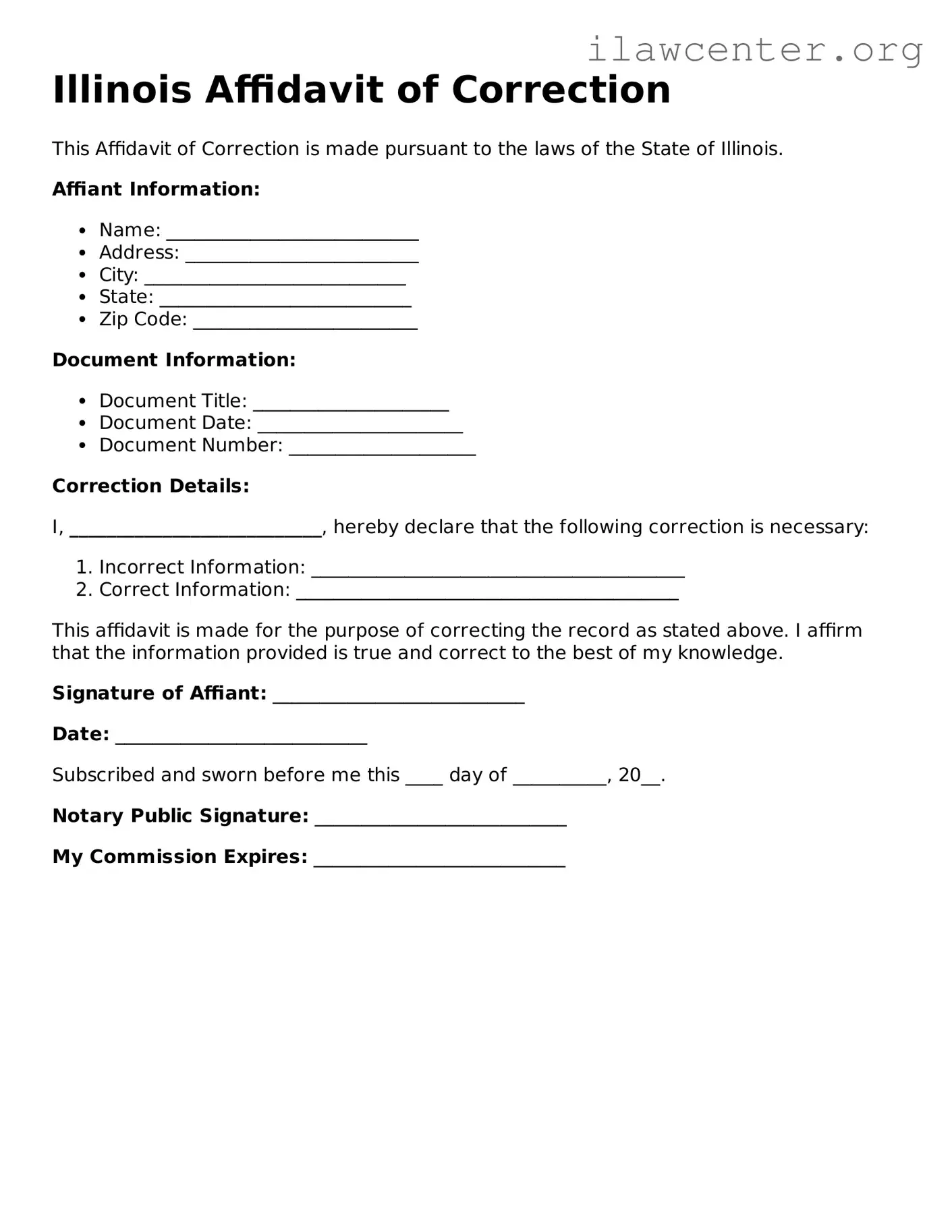
Illinois Affidavit of Correction Preview

Illinois Affidavit of Correction

This Affidavit of Correction is made pursuant to the laws of the State of Illinois.

Affiant Information:

  • Name: ___________________________
  • Address: _________________________
  • City: ____________________________
  • State: ___________________________
  • Zip Code: ________________________

Document Information:

  • Document Title: _____________________
  • Document Date: ______________________
  • Document Number: ____________________

Correction Details:

I, ___________________________, hereby declare that the following correction is necessary:

  1. Incorrect Information: ________________________________________
  2. Correct Information: _________________________________________

This affidavit is made for the purpose of correcting the record as stated above. I affirm that the information provided is true and correct to the best of my knowledge.

Signature of Affiant: ___________________________

Date: ___________________________

Subscribed and sworn before me this ____ day of __________, 20__.

Notary Public Signature: ___________________________

My Commission Expires: ___________________________

PDF Form Characteristics

Fact Name Description
Purpose The Illinois Affidavit of Correction is used to correct errors in public records, such as deeds or other legal documents.
Governing Law This form is governed by the Illinois Compiled Statutes, specifically 765 ILCS 1005/1.
Eligibility Any individual or entity that has a vested interest in the document may file this affidavit to correct inaccuracies.
Common Errors Common corrections include misspellings, incorrect dates, or misidentified parties involved in the document.
Filing Process The affidavit must be signed in the presence of a notary public before being filed with the appropriate county recorder's office.
Required Information The affidavit must include the original document's details, the specific errors, and the corrected information.
Impact on Original Document Once filed, the affidavit serves as an official correction and should be referenced in relation to the original document.
Fees Filing fees may apply and vary by county; it is advisable to check with the local recorder's office for specific amounts.
Legal Advice While the form can be completed without an attorney, seeking legal advice is recommended to ensure compliance with all requirements.

Instructions on Utilizing Illinois Affidavit of Correction

After obtaining the Illinois Affidavit of Correction form, you will need to complete it accurately. This form allows you to make corrections to certain documents. Follow the steps below to fill it out properly.

  1. Start by downloading the Illinois Affidavit of Correction form from the official website or obtain a physical copy.
  2. Read the instructions carefully to understand what information is needed.
  3. Fill in your name and contact information at the top of the form.
  4. Provide the details of the document that needs correction, including the title and date of the original document.
  5. Clearly state the specific corrections that need to be made. Be concise and accurate.
  6. Include any relevant case numbers or identifiers associated with the document.
  7. Sign and date the form at the bottom. Make sure your signature matches the name provided.
  8. If required, have the form notarized by a licensed notary public.
  9. Make copies of the completed form for your records.
  10. Submit the form to the appropriate office or agency as instructed.

Important Facts about Illinois Affidavit of Correction

What is the Illinois Affidavit of Correction form?

The Illinois Affidavit of Correction form is a legal document used to correct errors in previously filed documents. This form is typically utilized when there are mistakes in public records, such as property deeds, marriage certificates, or other official documents. By submitting this affidavit, individuals can ensure that the correct information is officially recorded.

Who can file an Affidavit of Correction in Illinois?

Any individual or entity that identifies an error in a public record can file an Affidavit of Correction. This includes property owners, married couples, or any party involved in the documentation that needs correction. It is important that the person filing the affidavit has a legitimate interest in the record being corrected.

What information is required to complete the form?

To complete the Illinois Affidavit of Correction form, you will need to provide specific details. This includes your name, contact information, and a description of the error. You must also include the correct information that should replace the erroneous details. Additionally, you may need to provide information about the original document, such as the date it was filed and any relevant identification numbers.

Where do I submit the Affidavit of Correction?

The completed Affidavit of Correction should be submitted to the office where the original document was filed. This could be the county recorder’s office, the clerk’s office, or another relevant agency, depending on the type of document being corrected. Always check with the specific office for their submission guidelines and any associated fees.

Is there a fee associated with filing the Affidavit of Correction?

Yes, there may be a fee for filing the Affidavit of Correction. The amount can vary depending on the office where you are submitting the form and the type of document being corrected. It is advisable to contact the relevant office beforehand to inquire about the exact fee and payment methods accepted.

Common mistakes

One common mistake people make when filling out the Illinois Affidavit of Correction form is providing incomplete information. Each section of the form requires specific details. Omitting any required information can lead to delays or even rejection of the affidavit. Always ensure that every field is filled out accurately and completely before submission.

Another frequent error is failing to sign the affidavit. The form must be signed by the individual making the correction. Without a signature, the document is not valid. It is crucial to double-check that the signature is present and matches the name provided on the form.

People often overlook the importance of using the correct date. The date on the affidavit should reflect when the correction is being made, not when the original document was filed. Using an incorrect date can cause confusion and may invalidate the affidavit. Always verify that the date is accurate.

Lastly, individuals sometimes submit the affidavit without proper notarization. The Illinois Affidavit of Correction must be notarized to be legally binding. Failing to have the document notarized can result in it being deemed invalid. Ensure that a notary public witnesses the signing of the affidavit to avoid this mistake.

Documents used along the form

The Illinois Affidavit of Correction form is often used in conjunction with several other important documents. These forms help ensure that corrections to public records are made properly and legally. Below is a list of common forms that may accompany the Affidavit of Correction.

  • Certificate of Correction: This document is typically filed with the appropriate state office to officially record the corrections made to a previously filed document. It serves as a formal acknowledgment of the changes and provides a clear reference for future inquiries.
  • Notarized Affidavit: A notarized affidavit is a sworn statement that confirms the accuracy of the information being corrected. It is often required to add credibility to the claims made in the Affidavit of Correction.
  • Application for Change of Name: If the correction involves a name change, this application must be submitted to the court or relevant agency. It outlines the reasons for the change and provides necessary details to facilitate the process.
  • Petition for Relief: In certain cases, a petition may be necessary to request a court’s approval for the correction. This document outlines the specifics of the request and any legal grounds for the change.
  • Supporting Documentation: Various forms of supporting documentation may be required, such as identification, prior records, or other evidence that substantiates the need for correction. These documents help to clarify the situation and support the claims made in the affidavit.

Understanding these related forms is crucial for anyone looking to make corrections to official documents in Illinois. Each plays a unique role in ensuring that the correction process is smooth and legally sound.

Similar forms

  • Affidavit of Identity: This document confirms a person's identity and is often used to rectify discrepancies in personal records, similar to how an Affidavit of Correction addresses errors in official documents.
  • Affidavit of Support: Used primarily in immigration cases, this form demonstrates financial support for a visa applicant. Like the Affidavit of Correction, it serves to clarify and support a specific situation.
  • Declaration of Trust: This document outlines the terms of a trust and can be amended to correct errors or update information, akin to the function of an Affidavit of Correction.
  • Quitclaim Deed: A quitclaim deed transfers interest in property and can be used to correct names or descriptions on property records, similar to how an Affidavit of Correction amends official documents.
  • Power of Attorney: This document grants someone the authority to act on another's behalf. If errors occur in the original document, an Affidavit of Correction can clarify the intent and authority.
  • Certificate of Correction: Specifically used to correct errors in filed documents, this certificate serves a similar purpose as an Affidavit of Correction, ensuring accuracy in public records.
  • Notice of Error: This document formally notifies relevant parties of an error in a public record and can lead to the filing of an Affidavit of Correction to amend the record.
  • Amendment to Articles of Incorporation: Corporations use this document to correct or change information in their founding documents, much like how an Affidavit of Correction addresses inaccuracies.
  • Change of Name Affidavit: This document is used to legally change a person's name and may involve correcting records, paralleling the purpose of an Affidavit of Correction.
  • Release of Lien: This document removes a lien from a property. If there are errors in the lien documentation, an Affidavit of Correction may be necessary to resolve those issues.

Dos and Don'ts

When filling out the Illinois Affidavit of Correction form, it is important to follow certain guidelines to ensure accuracy and compliance. Here are four things you should and shouldn't do:

  • Do: Read the instructions carefully before starting the form.
  • Do: Provide accurate and complete information to avoid delays.
  • Don't: Leave any required fields blank, as this can result in rejection.
  • Don't: Use white-out or any correction fluid on the form; it can invalidate the document.

Misconceptions

  • Misconception 1: The Affidavit of Correction can be used for any type of error.
  • This form is specifically designed for correcting clerical or typographical errors in documents. It cannot be used for substantive changes or to correct errors related to the content of the document.

  • Misconception 2: Anyone can file an Affidavit of Correction.
  • Only the person who executed the original document or their legal representative can file this affidavit. This ensures that the corrections are authorized and legitimate.

  • Misconception 3: Filing an Affidavit of Correction is a lengthy process.
  • The process is typically straightforward and can be completed quickly, depending on the court’s workload. Most corrections can be made without extensive delays.

  • Misconception 4: The Affidavit of Correction is the same as a new filing.
  • This affidavit is meant to amend existing documents, not to create new ones. It serves to clarify or rectify specific mistakes without altering the original intent.

  • Misconception 5: There is no fee for filing an Affidavit of Correction.
  • While some jurisdictions may not charge a fee, others do. It’s important to check with the local court to understand any associated costs.

  • Misconception 6: The corrections made by the Affidavit of Correction are not legally binding.
  • Once filed and accepted by the court, the corrections are legally binding. They are recognized as official amendments to the original document.

  • Misconception 7: An Affidavit of Correction can be used to change legal rights or obligations.
  • This form cannot be used to alter legal rights or obligations established in the original document. It is strictly for correcting clerical errors.

  • Misconception 8: The Affidavit of Correction must be notarized.
  • While notarization is often recommended, it is not always required. Check the specific requirements of the local court to ensure compliance.

Key takeaways

The Illinois Affidavit of Correction form serves a specific purpose in the legal process. Below are key takeaways regarding its use and completion.

  • The form is used to correct clerical errors in legal documents.
  • It must be filled out accurately to ensure the correction is recognized by the court.
  • Both the original document and the Affidavit of Correction should be submitted together.
  • Signatures of all parties involved may be required on the affidavit.
  • Notarization of the affidavit is typically necessary to validate the document.
  • Filing fees may apply when submitting the affidavit to the court.
  • Ensure that the corrections made do not alter the original intent of the document.
  • Consultation with a legal professional can provide clarity on the process.
  • Keep copies of all submitted documents for personal records.
  • Timeliness is important; file the affidavit as soon as the error is discovered.