Attorney-Verified  Deed Document for Illinois

Attorney-Verified Deed Document for Illinois

The Illinois Deed form is a legal document used to transfer ownership of real estate in the state of Illinois. This form serves as a record of the transaction and provides essential details about the property and the parties involved. Ready to take the next step? Fill out the form by clicking the button below.

Article Guide

When it comes to transferring property ownership in Illinois, the Illinois Deed form plays a crucial role in ensuring a smooth and legally binding transaction. This form serves as the official document that conveys the title of real estate from one party to another, outlining essential details such as the names of the grantor (the seller) and grantee (the buyer), a description of the property, and any conditions or warranties associated with the transfer. Different types of deeds, including warranty deeds and quitclaim deeds, cater to various needs and levels of protection for the parties involved. Additionally, the form must be signed, notarized, and recorded with the appropriate county office to establish public notice of the transaction. Understanding the Illinois Deed form is essential for anyone looking to navigate the complexities of real estate transactions in the state, ensuring that rights are protected and ownership is clearly established.

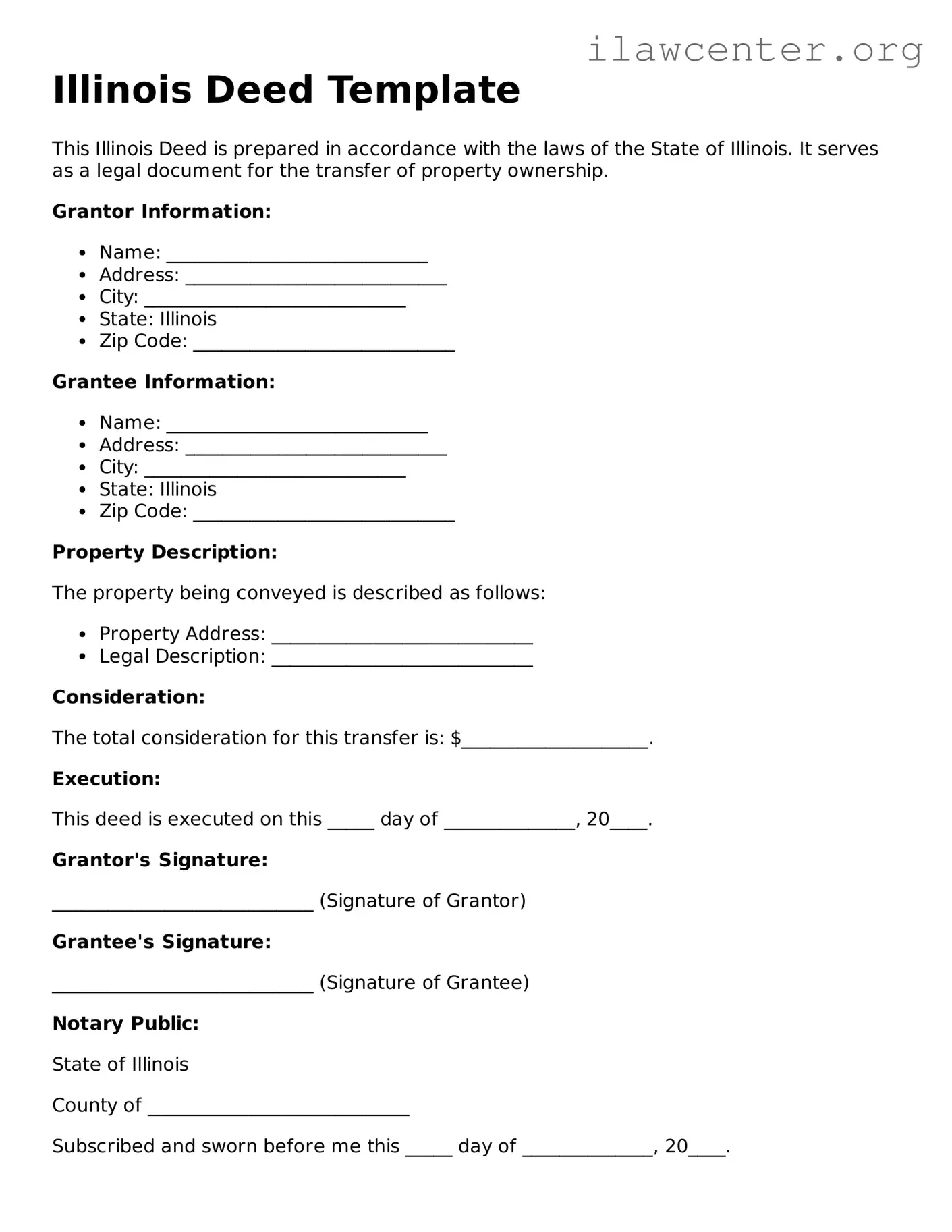
Illinois Deed Preview

Illinois Deed Template

This Illinois Deed is prepared in accordance with the laws of the State of Illinois. It serves as a legal document for the transfer of property ownership.

Grantor Information:

  • Name: ____________________________
  • Address: ____________________________
  • City: ____________________________
  • State: Illinois
  • Zip Code: ____________________________

Grantee Information:

  • Name: ____________________________
  • Address: ____________________________
  • City: ____________________________
  • State: Illinois
  • Zip Code: ____________________________

Property Description:

The property being conveyed is described as follows:

  • Property Address: ____________________________
  • Legal Description: ____________________________

Consideration:

The total consideration for this transfer is: $____________________.

Execution:

This deed is executed on this _____ day of ______________, 20____.

Grantor's Signature:

____________________________ (Signature of Grantor)

Grantee's Signature:

____________________________ (Signature of Grantee)

Notary Public:

State of Illinois

County of ____________________________

Subscribed and sworn before me this _____ day of ______________, 20____.

____________________________ (Notary Public Signature)

My commission expires: ________________.

PDF Form Characteristics

Fact Name Description
Purpose The Illinois Deed form is used to transfer ownership of real property from one party to another.
Types of Deeds Common types include warranty deeds, quitclaim deeds, and special warranty deeds.
Governing Law The Illinois Compiled Statutes, specifically 765 ILCS 1005, govern the use of deeds in Illinois.
Signature Requirements The grantor must sign the deed in the presence of a notary public for it to be valid.
Recording To provide public notice, the completed deed must be recorded with the local county recorder's office.

Instructions on Utilizing Illinois Deed

Filling out the Illinois Deed form is a straightforward process that requires attention to detail. After completing the form, it will need to be signed and submitted to the appropriate local government office for recording. Ensure that all information is accurate to avoid any delays.

  1. Obtain the Illinois Deed form from a reliable source or the local county recorder's office.
  2. Fill in the names of the grantor(s) (the person(s) transferring the property) at the top of the form.
  3. Enter the names of the grantee(s) (the person(s) receiving the property) in the designated section.
  4. Provide the legal description of the property. This can often be found on the current deed or property tax records.
  5. Indicate the property address, including the city and zip code.
  6. Specify the consideration (the amount paid for the property) in the appropriate field.
  7. Include any necessary additional information, such as the date of the transfer.
  8. Sign the form in the presence of a notary public. Ensure that the notary also signs and stamps the document.
  9. Make copies of the completed deed for your records.
  10. Submit the original deed to the county recorder's office for recording.

Important Facts about Illinois Deed

What is an Illinois Deed form?

An Illinois Deed form is a legal document used to transfer ownership of real property from one party to another within the state of Illinois. This form serves as official proof of the transaction and outlines the details of the property being transferred, including the names of the parties involved, a description of the property, and any relevant terms of the transfer.

What types of Deed forms are available in Illinois?

Illinois recognizes several types of Deeds, including Warranty Deeds, Quitclaim Deeds, and Special Warranty Deeds. A Warranty Deed provides the highest level of protection to the buyer, guaranteeing that the seller holds clear title to the property. A Quitclaim Deed, on the other hand, transfers whatever interest the seller has in the property without any guarantees. Special Warranty Deeds offer limited warranties and are often used in specific transactions.

How do I complete an Illinois Deed form?

To complete an Illinois Deed form, you must provide accurate information about the property and the parties involved. This includes the legal description of the property, the names and addresses of the grantor (seller) and grantee (buyer), and the date of the transfer. It is essential to ensure that all information is correct to avoid issues during the transfer process. The form must then be signed in the presence of a notary public.

Do I need to have the Deed form notarized?

Yes, an Illinois Deed form must be notarized to be legally valid. The notary public verifies the identities of the parties signing the document and ensures that they are signing voluntarily. This step is crucial for preventing fraud and protecting the interests of both parties involved in the transaction.

Is there a fee associated with recording the Deed in Illinois?

Yes, there is typically a fee for recording the Deed with the county recorder's office in Illinois. The fee can vary by county, so it is advisable to check with the local recorder's office for the specific amount. Recording the Deed is important, as it provides public notice of the property transfer and protects the buyer's interest in the property.

What is the difference between a Warranty Deed and a Quitclaim Deed?

A Warranty Deed provides a guarantee that the seller has clear title to the property and has the right to transfer it. This type of Deed protects the buyer from future claims against the property. In contrast, a Quitclaim Deed offers no such guarantees; it simply transfers whatever interest the seller may have, if any. This makes Quitclaim Deeds less secure for buyers, as they do not ensure clear title.

Can I use a Deed form for transferring property to a family member?

Yes, you can use an Illinois Deed form to transfer property to a family member. Many people use Quitclaim Deeds for such transfers, as they are simple and do not require extensive legal documentation. However, it is important to consider any potential tax implications and to ensure that the transfer is properly recorded to avoid future disputes.

Where can I obtain an Illinois Deed form?

Illinois Deed forms can be obtained from various sources, including online legal form providers, local county recorder's offices, and legal stationery stores. It is crucial to ensure that the form you obtain is the correct version for your specific needs and complies with Illinois state law.
Common mistakes

Filling out the Illinois Deed form can be straightforward, but mistakes are common. One frequent error is incorrect property description. This can lead to confusion about which property is being transferred. It's essential to provide a complete and accurate legal description, including the parcel number and any relevant details about the property boundaries.

Another mistake involves the names of the parties involved. People often misspell names or use incorrect legal names. This can cause issues during the transfer process. Always double-check that the names match official documents, such as driver's licenses or previous deeds.

Signatures are also a critical area where errors occur. Both the grantor and grantee must sign the deed. If one party forgets to sign or if a signature is not notarized, the deed may be considered invalid. Ensuring that all required signatures are present and properly notarized is vital for a successful transfer.

Additionally, individuals sometimes overlook the need for a witness. In Illinois, certain types of deeds require at least one witness to be present during the signing. Failing to have a witness can complicate the validity of the deed and may lead to challenges later on.

Finally, people may forget to file the deed with the appropriate county office. After completing the form, it is necessary to submit it to the recorder of deeds in the county where the property is located. Not filing the deed can result in the transfer not being recognized legally, leading to potential disputes or issues with ownership.

Documents used along the form

When completing a property transfer in Illinois, several forms and documents accompany the Illinois Deed form to ensure a smooth and legally binding transaction. Each of these documents serves a specific purpose, helping to clarify ownership and protect the interests of all parties involved.

  • Property Transfer Tax Declaration: This document is required to report the transfer of property and assess any applicable taxes. It provides information about the sale price and the nature of the transfer.
  • Title Insurance Policy: This policy protects the buyer against any potential defects in the title of the property. It ensures that the buyer has clear ownership and can defend against any claims.
  • Affidavit of Title: This sworn statement confirms the seller's ownership of the property and that there are no outstanding claims or liens against it. It provides assurance to the buyer regarding the property's legal status.
  • Closing Statement: Also known as a HUD-1 statement, this document itemizes all the costs associated with the property transfer. It outlines the financial details, including fees, taxes, and the final amounts due.
  • Power of Attorney: In some cases, a seller may grant someone else the authority to sign documents on their behalf. This document must be executed properly to be valid and effective.
  • Real Estate Purchase Agreement: This contract outlines the terms of the sale, including the price, contingencies, and other conditions. It serves as a binding agreement between the buyer and seller.
  • Certificate of Occupancy: This document certifies that a property meets all building codes and is safe for occupancy. It may be required for properties being sold or transferred.
  • Notice of Transfer: This document notifies local authorities about the change in ownership. It may be necessary for tax records and to update property assessments.

Ensuring that all necessary documents are in order can significantly ease the property transfer process in Illinois. Each form plays a vital role in protecting the rights of both buyers and sellers, promoting transparency and compliance with state regulations.

Similar forms

  • Title Transfer Document: Like a deed, a title transfer document officially records the change of ownership of property. Both documents serve to prove who holds legal title to a property.
  • Bill of Sale: This document transfers ownership of personal property from one party to another. Similar to a deed, it provides proof of ownership and details about the transaction.
  • Lease Agreement: A lease agreement outlines the terms under which one party rents property from another. While a deed transfers ownership, a lease temporarily grants possession, making both essential in real estate transactions.
  • Trust Agreement: This document establishes a trust and outlines how assets are managed. Both a trust agreement and a deed can involve the transfer of property, but a trust focuses on management and distribution.
  • Quitclaim Deed: This specific type of deed allows one party to transfer any interest they have in a property to another party without guaranteeing that the title is clear. It serves a similar purpose to a standard deed but with less legal assurance.
  • Power of Attorney: A power of attorney document allows one person to act on behalf of another in legal matters. While not a property transfer document itself, it can facilitate the signing of a deed when the owner is unable to do so.

Dos and Don'ts

Filling out the Illinois Deed form is a critical step in the property transfer process. It is essential to approach this task with care and attention to detail. Below are important guidelines to follow and pitfalls to avoid.

Things You Should Do:

  • Ensure you have the correct form for the type of deed you are filing.
  • Provide accurate and complete information about the property, including legal descriptions.
  • Include the names and addresses of both the grantor and grantee.
  • Sign the deed in the presence of a notary public.
  • Check for any local requirements that may affect the deed submission.

Things You Shouldn't Do:

  • Do not leave any fields blank; incomplete forms can lead to delays.
  • Avoid using abbreviations or informal language in the legal description.
  • Do not forget to date the document before submitting it.
  • Refrain from making any alterations or corrections without proper notarization.
  • Do not ignore the filing fees; ensure payment is included with your submission.

By following these guidelines, you can help ensure a smooth and efficient process when filling out the Illinois Deed form. Take the time to review your work carefully before submitting it to avoid complications down the line.

Misconceptions

Understanding the Illinois Deed form can be challenging, and several misconceptions often arise. Below is a list of common misunderstandings, along with clarifications to help navigate the complexities of property transfer in Illinois.

  • All deeds are the same. Different types of deeds serve different purposes. For instance, a warranty deed provides a guarantee of clear title, while a quitclaim deed transfers whatever interest the grantor has without any warranty.
  • Only a lawyer can prepare a deed. While it is advisable to consult a lawyer for legal advice, individuals can prepare their own deeds using the appropriate forms, as long as they comply with state requirements.
  • Deeds must be notarized to be valid. In Illinois, a deed must be signed by the grantor and acknowledged by a notary public to be valid for recording. However, it is important to note that the deed itself is valid upon execution.
  • All deeds need to be recorded. Recording a deed is not mandatory for the deed to be valid. However, recording provides public notice and protects the grantee's interests against claims from third parties.
  • Only property owners can create a deed. In some cases, individuals who are not the owners of the property can create a deed, such as when they are acting as an agent or attorney-in-fact for the owner.
  • Once a deed is recorded, it cannot be changed. While a recorded deed is a matter of public record, it can be amended or revoked through the execution of a new deed, provided that proper legal procedures are followed.
  • There are no tax implications when transferring property. Property transfers can trigger various taxes, including transfer taxes and potential capital gains taxes, depending on the circumstances of the sale.
  • Deeds do not need to specify the type of ownership. It is crucial to specify the type of ownership, such as joint tenancy or tenancy in common, as this affects how the property is owned and what happens upon the death of an owner.

By clarifying these misconceptions, individuals can better understand the Illinois Deed form and the implications of property transfer. It is always wise to seek professional guidance to ensure compliance with all legal requirements.

Key takeaways

When filling out and using the Illinois Deed form, keep the following key takeaways in mind:

  • Ensure that all required fields are completed accurately to avoid delays.
  • Use clear and legible handwriting or type the information to enhance readability.
  • Include the names of both the grantor (seller) and grantee (buyer) as they appear on official documents.
  • Provide a complete legal description of the property being transferred.
  • Sign the deed in the presence of a notary public to validate the document.
  • File the completed deed with the appropriate county recorder's office to make it official.
  • Be aware of any transfer taxes that may apply to the transaction.
  • Keep a copy of the filed deed for your records after submission.

Following these steps will help ensure a smooth transfer of property ownership in Illinois.