Attorney-Verified  Divorce Settlement Agreement Document for Illinois

Attorney-Verified Divorce Settlement Agreement Document for Illinois

The Illinois Divorce Settlement Agreement form is a crucial document that outlines the terms agreed upon by both parties during a divorce. This form addresses various aspects such as asset division, child custody, and support arrangements, ensuring that both individuals have a clear understanding of their rights and responsibilities. To facilitate a smoother process, consider filling out the form by clicking the button below.

Article Guide

The Illinois Divorce Settlement Agreement form plays a crucial role in the divorce process, serving as a comprehensive document that outlines the terms agreed upon by both parties. This form addresses various aspects of the divorce, including the division of marital property, child custody arrangements, child support obligations, and spousal maintenance. It is designed to ensure that both parties have a clear understanding of their rights and responsibilities post-divorce. By detailing the specifics of asset distribution and outlining the arrangements for any children involved, the form helps to minimize potential conflicts and misunderstandings. Furthermore, it is essential for the form to be completed accurately and thoroughly, as it will be submitted to the court for approval, making it a legally binding agreement once ratified. Understanding the nuances of this form is vital for individuals navigating the complexities of divorce in Illinois, as it can significantly impact their financial and familial future.

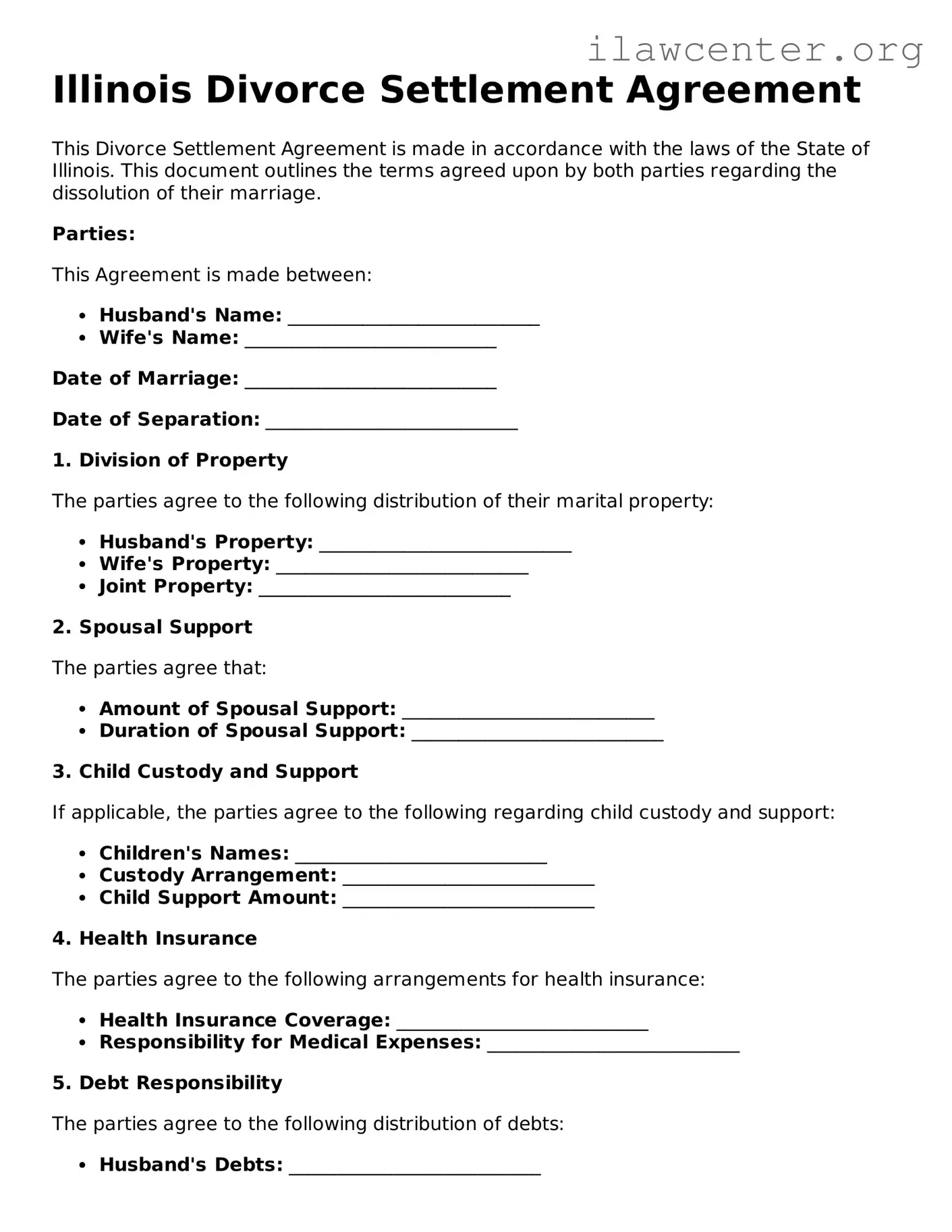
Illinois Divorce Settlement Agreement Preview

Illinois Divorce Settlement Agreement

This Divorce Settlement Agreement is made in accordance with the laws of the State of Illinois. This document outlines the terms agreed upon by both parties regarding the dissolution of their marriage.

Parties:

This Agreement is made between:

  • Husband's Name: ___________________________
  • Wife's Name: ___________________________

Date of Marriage: ___________________________

Date of Separation: ___________________________

1. Division of Property

The parties agree to the following distribution of their marital property:

  • Husband's Property: ___________________________
  • Wife's Property: ___________________________
  • Joint Property: ___________________________

2. Spousal Support

The parties agree that:

  • Amount of Spousal Support: ___________________________
  • Duration of Spousal Support: ___________________________

3. Child Custody and Support

If applicable, the parties agree to the following regarding child custody and support:

  • Children's Names: ___________________________
  • Custody Arrangement: ___________________________
  • Child Support Amount: ___________________________

4. Health Insurance

The parties agree to the following arrangements for health insurance:

  • Health Insurance Coverage: ___________________________
  • Responsibility for Medical Expenses: ___________________________

5. Debt Responsibility

The parties agree to the following distribution of debts:

  • Husband's Debts: ___________________________
  • Wife's Debts: ___________________________

6. Miscellaneous Provisions

Additional agreements include:

  • Property Disposition: ___________________________
  • Future Modifications: ___________________________

This Agreement is intended to be a complete and final settlement of all issues arising from the marriage of the parties. Each party acknowledges that they have had the opportunity to seek independent legal counsel before signing this Agreement.

IN WITNESS WHEREOF, the parties have executed this Divorce Settlement Agreement as of the date below:

Husband's Signature: ___________________________ Date: ___________________________

Wife's Signature: ___________________________ Date: ___________________________

PDF Form Characteristics

Fact Name Description
Governing Law The Illinois Divorce Settlement Agreement is governed by the Illinois Marriage and Dissolution of Marriage Act.
Purpose This form is used to outline the terms of a divorce settlement between spouses, addressing issues like property division, alimony, and child custody.
Mutual Agreement Both parties must agree to the terms outlined in the settlement for it to be valid and enforceable.
Filing Requirement The completed agreement must be filed with the court as part of the divorce proceedings.
Modification Once signed and approved by the court, the terms can only be modified through mutual consent or a significant change in circumstances.
Child Support Provisions for child support must be included if there are minor children involved, in accordance with Illinois guidelines.
Property Division The agreement should detail how marital property and debts will be divided between the parties.
Legal Representation While not required, it is highly recommended that each party consult with an attorney before signing the agreement.
Enforcement If one party fails to comply with the terms, the other party can seek enforcement through the court.

Instructions on Utilizing Illinois Divorce Settlement Agreement

Filling out the Illinois Divorce Settlement Agreement form is an important step in the divorce process. Once completed, this form will help outline the terms agreed upon by both parties regarding property division, child custody, and other essential matters. Below are the steps to guide you through filling out the form.

  1. Begin by entering your full name and your spouse's full name at the top of the form.
  2. Provide your current address and your spouse's current address in the designated sections.
  3. Fill in the date of your marriage and the date of separation.
  4. Detail any children involved, including their names and birth dates.
  5. Outline the division of property by listing all assets and debts, indicating who will receive each item.
  6. Specify arrangements for child custody, including physical and legal custody details.
  7. Include any child support agreements, stating the amount and frequency of payments.
  8. Address spousal support, if applicable, by detailing the terms and duration of payments.
  9. Sign and date the form at the bottom, ensuring both parties have signed where required.

Important Facts about Illinois Divorce Settlement Agreement

What is an Illinois Divorce Settlement Agreement?

An Illinois Divorce Settlement Agreement is a legal document that outlines the terms of a divorce. It details how assets, debts, and responsibilities will be divided between the spouses. This agreement is crucial for ensuring that both parties understand their rights and obligations following the divorce.

Who needs to complete a Divorce Settlement Agreement?

Both spouses involved in a divorce must complete this agreement if they wish to settle their divorce amicably. It is particularly important for couples who have shared assets, debts, or children. A well-drafted agreement can help avoid lengthy court battles and provide clarity on each party's responsibilities.

What should be included in the Divorce Settlement Agreement?

The agreement should include several key elements: division of property, allocation of debts, child custody arrangements, visitation rights, and child support obligations. Each section should be clearly defined to prevent misunderstandings later. It is advisable to be thorough and transparent about all assets and liabilities.

Can I modify the Divorce Settlement Agreement after it is signed?

Yes, modifications can be made to the Divorce Settlement Agreement after it is signed, but both parties must agree to any changes. If circumstances change significantly, such as a job loss or relocation, it may be necessary to revisit the agreement. Legal assistance is recommended to ensure modifications are properly documented.

Is a Divorce Settlement Agreement legally binding?

Once signed by both parties and approved by the court, the Divorce Settlement Agreement becomes legally binding. This means that both spouses are obligated to adhere to the terms outlined in the agreement. Failure to comply can lead to legal consequences, including enforcement actions.

How do I file the Divorce Settlement Agreement with the court?

To file the Divorce Settlement Agreement with the court, you must submit it along with your divorce petition or during the divorce proceedings. It is essential to follow the specific filing procedures of your local court. Ensure that all required forms are completed accurately to avoid delays in processing.

What happens if we cannot reach an agreement?

If the spouses cannot reach an agreement, the case may go to trial. A judge will then make decisions regarding asset division, custody, and support. This process can be lengthy and costly, so it is generally advisable to try to negotiate a settlement before resorting to litigation.

Should I hire a lawyer for the Divorce Settlement Agreement?

While it is not mandatory to hire a lawyer, it is highly recommended. A legal professional can provide valuable guidance, ensure that your rights are protected, and help draft an agreement that meets legal standards. This support can be crucial in navigating the complexities of divorce.
Common mistakes

When completing the Illinois Divorce Settlement Agreement form, many individuals encounter common pitfalls that can lead to complications later on. One frequent mistake is failing to provide complete information. Omitting details about assets, debts, or income can create disputes and delays in the divorce process.

Another common error is misunderstanding the terms used in the form. It is essential to grasp the meaning of terms like "marital property" and "separate property." Misinterpretation can lead to incorrect declarations, which may affect the final settlement.

Some individuals neglect to include all relevant assets. For example, accounts, properties, and personal items must be listed. Leaving out significant assets can result in an unfair distribution and potential legal consequences.

Inaccurate valuations of assets often occur as well. It is crucial to provide realistic and fair valuations. Overestimating or underestimating the worth of an asset can skew the settlement and lead to disputes.

People also sometimes fail to consider tax implications. Certain assets may have tax consequences that affect their overall value. Not accounting for these can lead to unexpected financial burdens after the divorce is finalized.

Another mistake is not addressing spousal support or alimony correctly. Individuals might overlook the need for clear terms regarding payments, duration, and conditions. This oversight can lead to confusion and conflict in the future.

Some individuals rush through the form without reviewing it carefully. Typos or errors in calculations can invalidate parts of the agreement. Taking the time to proofread can prevent these issues.

Ignoring state-specific requirements is also a common error. Each state has its own rules regarding divorce settlements. Not adhering to Illinois guidelines can result in rejection of the form or delays in processing.

Many forget to sign and date the form. A missing signature can render the entire agreement invalid. Ensuring that all parties sign and date the document is crucial for its acceptance.

Finally, individuals often fail to seek legal advice. Consulting with a legal professional can provide clarity and help avoid mistakes. Understanding one’s rights and obligations is essential for a fair settlement.

Documents used along the form

When navigating the complexities of divorce in Illinois, several important documents often accompany the Divorce Settlement Agreement. Each of these forms plays a crucial role in ensuring that the divorce process is clear, fair, and legally binding. Here’s a brief overview of some key documents you may encounter.

  • Petition for Dissolution of Marriage: This is the initial document filed with the court to start the divorce process. It outlines the reasons for the divorce and requests the court to dissolve the marriage.
  • Summons: A legal notice that informs the other spouse of the divorce proceedings. It also provides instructions on how to respond and the time frame for doing so.
  • Financial Affidavit: This form details the financial situation of both spouses, including income, expenses, assets, and debts. It is essential for determining issues like alimony and property division.
  • Parenting Plan: If children are involved, this document outlines custody arrangements, visitation schedules, and other important parenting responsibilities. It focuses on the best interests of the children.
  • Judgment for Dissolution of Marriage: This is the final court order that officially ends the marriage. It incorporates the terms agreed upon in the Divorce Settlement Agreement and any other related orders.
  • Marital Settlement Agreement: Often included with the Divorce Settlement Agreement, this document details the division of property, debts, and any support obligations between the spouses.
  • Notice of Motion: This document is used to inform the court and the other spouse about a request for a court hearing. It outlines what the requesting spouse is asking for during the hearing.

Understanding these documents is vital for anyone going through a divorce. Each form serves a specific purpose and contributes to a smoother process. By being informed, individuals can better navigate their divorce journey and work towards a resolution that meets their needs.

Similar forms

  • Separation Agreement: This document outlines the terms under which a couple agrees to live apart. It often addresses issues like property division and child custody, similar to a divorce settlement but without the formal dissolution of marriage.
  • Child Custody Agreement: This agreement specifically focuses on the arrangements for child custody and visitation. It ensures that both parents understand their rights and responsibilities, paralleling the custody provisions found in a divorce settlement.
  • Property Settlement Agreement: This document details how a couple's assets and debts will be divided. It shares similarities with the property division section of a divorce settlement, ensuring fairness in asset distribution.
  • Alimony Agreement: This outlines the terms of spousal support payments. Like the divorce settlement, it addresses financial obligations post-separation.
  • Prenuptial Agreement: Although created before marriage, this document can influence divorce settlements. It establishes how assets will be divided in the event of a divorce, similar to the provisions in a divorce settlement.
  • Postnuptial Agreement: Similar to a prenuptial agreement, this document is created after marriage to outline asset distribution. It can serve as a basis for negotiations in a divorce settlement.
  • Memorandum of Understanding: This informal agreement outlines the terms that both parties have agreed upon. While less formal than a divorce settlement, it can serve as a precursor to a more binding document.
  • Parenting Plan: This is a detailed plan that outlines how parents will raise their children after separation. It often mirrors the child custody arrangements found in a divorce settlement.
  • Settlement Agreement in Mediation: This document results from mediation sessions and outlines the agreements made by both parties. It shares the goal of resolving disputes, similar to the objectives of a divorce settlement.

Dos and Don'ts

When filling out the Illinois Divorce Settlement Agreement form, it's important to approach the task with care and attention. The details you provide can significantly impact your divorce proceedings. Here are some key dos and don'ts to consider:

  • Do read the instructions carefully before starting.
  • Do provide accurate and complete information about your finances.
  • Do discuss the terms with your spouse, if possible, to reach a mutual agreement.
  • Do keep a copy of the completed form for your records.
  • Do seek legal advice if you have questions about the process.
  • Don't leave any sections blank; if something doesn't apply, indicate that clearly.
  • Don't use ambiguous language that could lead to misunderstandings.
  • Don't rush through the form; take your time to ensure accuracy.
  • Don't forget to sign and date the form before submission.
  • Don't ignore deadlines; timely submission is crucial in divorce proceedings.

By following these guidelines, you can help ensure that your Divorce Settlement Agreement is filled out correctly and efficiently, paving the way for a smoother divorce process.

Misconceptions

Understanding the Illinois Divorce Settlement Agreement form is essential for anyone going through a divorce. However, several misconceptions can lead to confusion. Here are ten common misconceptions about this form:

  1. It is only for couples with children. Many believe that the Divorce Settlement Agreement is only necessary for couples with children. In reality, this form is applicable to all divorcing couples, regardless of whether they have children.
  2. It can only be filed by attorneys. Some people think that only attorneys can file this form. However, individuals can also complete and file the form on their own, provided they understand the requirements.
  3. All agreements are automatically approved by the court. There is a misconception that if both parties agree, the court will automatically approve the settlement. The court must review the agreement to ensure it is fair and in compliance with the law.
  4. Once signed, it cannot be changed. Many believe that after signing the agreement, it cannot be modified. In fact, couples can negotiate changes to the agreement before it is finalized by the court.
  5. It covers only financial matters. While the form does address financial matters, it also includes provisions related to child custody, visitation, and other important issues.
  6. It is a one-size-fits-all document. Some assume that the Divorce Settlement Agreement is a standard form that applies to all cases. Each agreement should be tailored to the specific circumstances of the couple.
  7. It is unnecessary if the divorce is amicable. Even in amicable divorces, a Divorce Settlement Agreement is important. It provides a clear record of the terms agreed upon by both parties.
  8. Filing the form is the last step in the divorce process. Many think that submitting the form is the final step. However, the court must still hold a hearing to finalize the divorce.
  9. It is only relevant during the divorce process. Some individuals believe that the agreement is only important during the divorce. However, it can also be referenced later if disputes arise.
  10. Legal advice is not necessary. Lastly, there is a misconception that legal advice is not needed when completing the form. Consulting with a legal professional can provide clarity and help avoid potential pitfalls.

Being aware of these misconceptions can help individuals navigate the divorce process more effectively. Understanding the purpose and implications of the Divorce Settlement Agreement is crucial for ensuring a fair outcome.

Key takeaways

Filling out and using the Illinois Divorce Settlement Agreement form is a crucial step in the divorce process. Here are some key takeaways to keep in mind:

  • Understand the Purpose: This form outlines the terms of your divorce, including asset division, child custody, and support arrangements.
  • Be Thorough: Complete all sections of the form. Incomplete forms can delay the process or lead to misunderstandings.
  • Consider Legal Advice: Consulting with a lawyer can help ensure that your rights are protected and that the agreement is fair.
  • Review State Laws: Familiarize yourself with Illinois laws regarding divorce to ensure compliance and understanding of your rights.
  • Negotiate Fairly: Open communication with your spouse can lead to a more amicable agreement, which is beneficial for all parties involved.
  • File Correctly: After completing the form, ensure it is filed with the court properly to avoid any legal complications.

By keeping these points in mind, you can navigate the divorce settlement process more effectively.