Attorney-Verified  Firearm Bill of Sale Document for Illinois

Attorney-Verified Firearm Bill of Sale Document for Illinois

The Illinois Firearm Bill of Sale form is a legal document that records the sale and transfer of firearms between individuals in Illinois. This form ensures that both the buyer and seller have a clear understanding of the transaction and provides a written record for future reference. To facilitate a smooth transfer, consider filling out the form by clicking the button below.

Article Guide

The Illinois Firearm Bill of Sale form serves as an essential document in the transfer of firearm ownership between private parties within the state. This form captures critical information about the transaction, including the details of the firearm being sold, such as its make, model, and serial number. It also requires the names and addresses of both the seller and the buyer, ensuring that there is a clear record of the parties involved. Additionally, the form includes a declaration that both parties are legally eligible to engage in the transaction, thereby helping to uphold state and federal regulations regarding firearm ownership. This documentation is particularly important in Illinois, where strict laws govern the sale and transfer of firearms. By providing a written record of the sale, the Firearm Bill of Sale form not only protects the interests of both the seller and the buyer but also serves as a safeguard for legal compliance in future transactions.

Illinois Firearm Bill of Sale Preview

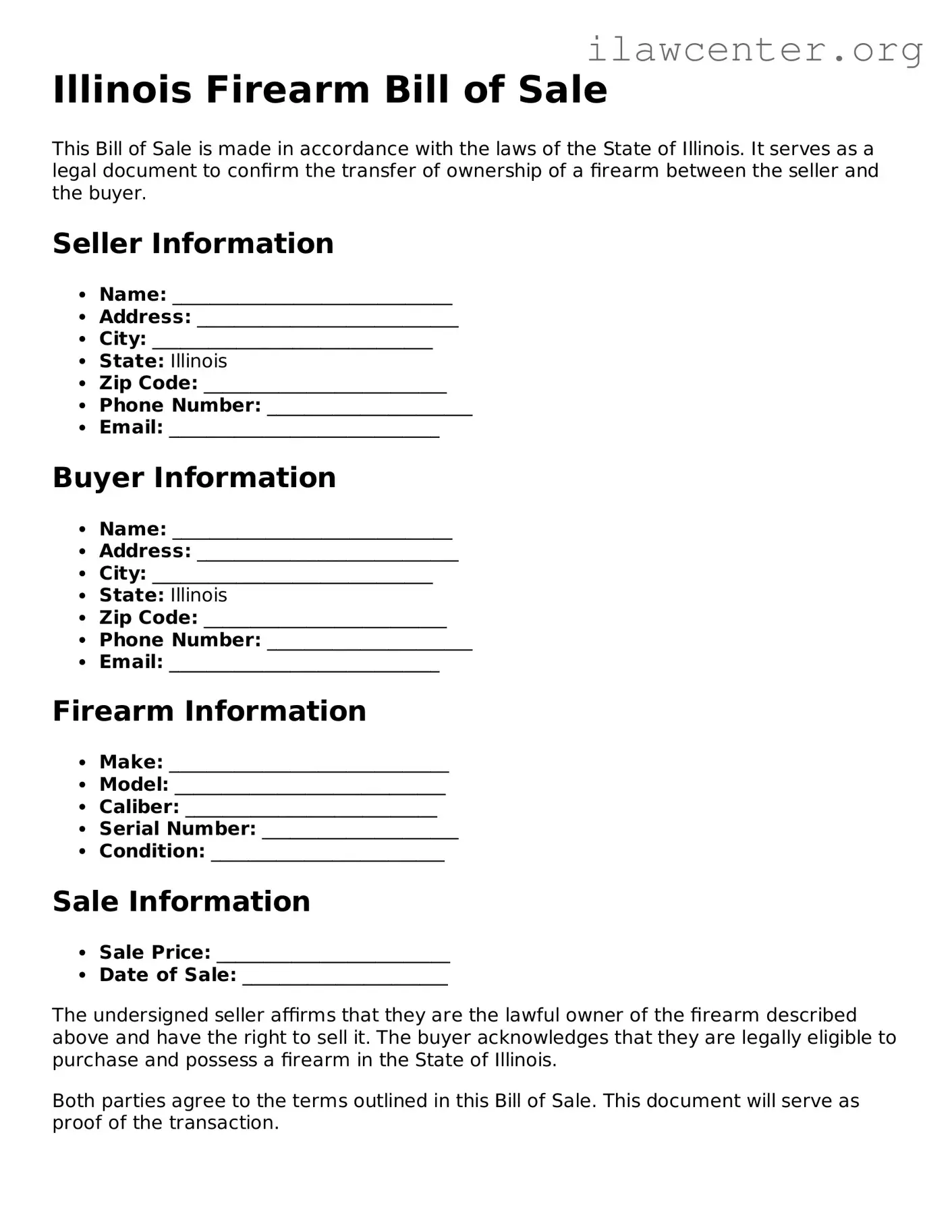
Illinois Firearm Bill of Sale

This Bill of Sale is made in accordance with the laws of the State of Illinois. It serves as a legal document to confirm the transfer of ownership of a firearm between the seller and the buyer.

Seller Information

  • Name: ______________________________
  • Address: ____________________________
  • City: ______________________________
  • State: Illinois
  • Zip Code: __________________________
  • Phone Number: ______________________
  • Email: _____________________________

Buyer Information

  • Name: ______________________________
  • Address: ____________________________
  • City: ______________________________
  • State: Illinois
  • Zip Code: __________________________
  • Phone Number: ______________________
  • Email: _____________________________

Firearm Information

  • Make: ______________________________
  • Model: _____________________________
  • Caliber: ___________________________
  • Serial Number: _____________________
  • Condition: _________________________

Sale Information

  • Sale Price: _________________________
  • Date of Sale: ______________________

The undersigned seller affirms that they are the lawful owner of the firearm described above and have the right to sell it. The buyer acknowledges that they are legally eligible to purchase and possess a firearm in the State of Illinois.

Both parties agree to the terms outlined in this Bill of Sale. This document will serve as proof of the transaction.

Signatures

  1. Seller's Signature: ____________________________ Date: ____________
  2. Buyer's Signature: ____________________________ Date: ____________

This Bill of Sale is executed on the date indicated above and is binding upon both parties.

PDF Form Characteristics

Fact Name Details
Purpose The Illinois Firearm Bill of Sale form is used to document the sale or transfer of a firearm between private parties.
Governing Law The form is governed by the Illinois Compiled Statutes, specifically 430 ILCS 65/2.
Parties Involved The form requires information from both the seller and the buyer, including names and addresses.
Firearm Details It must include specific details about the firearm, such as make, model, and serial number.
Signature Requirement Both parties must sign the form to validate the transaction.
Record Keeping It is advisable for both parties to keep a copy of the completed form for their records.
Age Requirement Buyers must be at least 18 years old to purchase a firearm in Illinois.
Background Check While a bill of sale is important, buyers must also pass a background check to legally own a firearm in Illinois.

Instructions on Utilizing Illinois Firearm Bill of Sale

Once you have the Illinois Firearm Bill of Sale form in hand, you will need to carefully complete it to ensure all necessary information is accurately recorded. This document serves as a receipt for the transaction and should be kept for your records. Below are the steps to fill out the form correctly.

  1. Begin by entering the date of the transaction at the top of the form.
  2. Provide the full name of the seller, including any middle initials.
  3. Next, include the seller's address, ensuring that it is complete with street, city, state, and ZIP code.
  4. Then, write the full name of the buyer, also including any middle initials.
  5. List the buyer's address in the same format as the seller's address.
  6. Clearly describe the firearm being sold. Include details such as the make, model, caliber, and serial number.
  7. Indicate the purchase price of the firearm in the designated space.
  8. Both the seller and the buyer should sign and date the form at the bottom to validate the transaction.

After completing these steps, ensure that both parties retain a copy of the signed document for their records. This will provide proof of the transaction and may be necessary for future reference.

Important Facts about Illinois Firearm Bill of Sale

What is the Illinois Firearm Bill of Sale form?

The Illinois Firearm Bill of Sale form is a document used to record the sale or transfer of a firearm between two parties. It serves as proof of the transaction and includes important details such as the buyer's and seller's information, the firearm's description, and the date of the sale.

Is the Firearm Bill of Sale form required in Illinois?

While the Firearm Bill of Sale is not a mandatory document in Illinois, it is highly recommended. Having a bill of sale provides legal protection for both the buyer and the seller, ensuring that there is a clear record of the transaction. This can be particularly important in case of future disputes or legal inquiries.

What information should be included in the form?

The form should include the names and addresses of both the buyer and seller, the date of the sale, a detailed description of the firearm (including make, model, caliber, and serial number), and the purchase price. Both parties should sign the document to validate the transaction.

Can I use a generic bill of sale template for firearms?

Yes, you can use a generic bill of sale template, but it is advisable to ensure that it meets the specific requirements for firearm transactions in Illinois. Customizing the template to include all necessary details relevant to the firearm being sold can help avoid potential issues.

Do I need to have the bill of sale notarized?

No, notarization is not required for the Illinois Firearm Bill of Sale. However, having the document notarized can add an extra layer of authenticity and may be beneficial in case of future disputes.

How long should I keep the bill of sale?

It is advisable to keep the bill of sale for as long as you own the firearm. If you sell or transfer the firearm again, you should retain the document as part of your records. Keeping a copy can help establish ownership and protect against liability.

What if the firearm is not in working condition?

If the firearm is not in working condition, it is still important to disclose this information in the bill of sale. Both parties should agree on the condition of the firearm at the time of sale. Clear communication can help prevent misunderstandings later on.

Where can I obtain a Firearm Bill of Sale form?

Firearm Bill of Sale forms can be obtained from various sources, including online legal document providers, gun shops, and local law enforcement agencies. It is important to ensure that the form you choose complies with Illinois state laws.
Common mistakes

When completing the Illinois Firearm Bill of Sale form, individuals often overlook essential details that can lead to complications. One common mistake is failing to include all required information about the firearm. This includes the make, model, caliber, and serial number. Omitting any of these details can render the bill of sale invalid, which can create issues for both the buyer and seller.

Another frequent error is not providing accurate identification information. Both parties must include their full names, addresses, and valid identification numbers. If any of this information is incorrect or missing, it may lead to legal challenges or difficulties in future transactions.

People sometimes forget to date the bill of sale. Including the date is crucial, as it establishes when the transaction took place. Without a date, it may be difficult to prove the timing of the sale, which can be important for legal and ownership purposes.

Many individuals also neglect to sign the form. Both the buyer and seller must provide their signatures to validate the transaction. A missing signature can invalidate the document, leaving both parties without proper proof of the sale.

Another mistake is not keeping a copy of the bill of sale. After filling out the form, it’s essential for both parties to retain a copy for their records. This documentation can serve as important evidence of the transaction in case of disputes or future inquiries.

Some people may not understand the need for witnesses or notarization. While not always required, having a witness or notarizing the document can add an extra layer of protection and legitimacy to the transaction. Skipping this step can lead to complications if the sale is ever questioned.

Inaccurate descriptions of the firearm's condition can also pose problems. Buyers and sellers should clearly describe the firearm’s condition to avoid misunderstandings. Misrepresenting the condition can lead to disputes after the sale has been completed.

Finally, individuals sometimes fail to check for compliance with local laws. Firearm regulations can vary widely by jurisdiction. Ensuring that the sale adheres to all local laws is crucial for avoiding legal issues down the line.

Documents used along the form

When engaging in the sale or transfer of firearms in Illinois, several documents can complement the Firearm Bill of Sale form. These documents help ensure that the transaction is legal, transparent, and well-documented. Below is a list of forms and documents that are often used alongside the Firearm Bill of Sale.

  • Firearm Transfer Record: This document records the details of the firearm being transferred, including its make, model, and serial number. It is essential for tracking ownership and ensuring compliance with state laws.
  • Background Check Authorization: A form that allows the seller to conduct a background check on the buyer. This step is crucial to verify that the buyer is legally eligible to own a firearm.
  • Affidavit of Firearm Ownership: This sworn statement confirms that the seller is the rightful owner of the firearm being sold. It helps protect both parties in the event of a dispute.
  • Illinois Concealed Carry License: If applicable, this document proves that the buyer has completed the necessary training and has been granted a license to carry a concealed firearm in Illinois.
  • Firearm Registration Certificate: Some local jurisdictions may require this certificate to ensure that the firearm is registered in the new owner's name after the sale.
  • Bill of Sale for Accessories: If additional items such as ammunition, holsters, or magazines are included in the sale, a separate bill of sale for these accessories may be necessary.
  • Transfer of Ownership Form: This form officially documents the transfer of ownership from the seller to the buyer, ensuring that both parties have a record of the transaction.
  • Warranty or Guarantee Document: If the seller provides any warranties or guarantees regarding the firearm's condition, this document outlines those terms and conditions.
  • Release of Liability: This form protects the seller from future claims related to the firearm after the sale is completed. It is an important safeguard for both parties.
  • State and Local Compliance Forms: Depending on local laws, additional forms may be required to ensure compliance with specific state or municipal regulations regarding firearm sales.

Using these documents in conjunction with the Illinois Firearm Bill of Sale form can provide clarity and security for both buyers and sellers. Proper documentation not only helps to protect individual rights but also promotes responsible firearm ownership within the community.

Similar forms

The Firearm Bill of Sale form is similar to several other documents that facilitate the transfer of ownership or rights. Each of these documents serves a specific purpose and shares common elements, such as identifying the parties involved and detailing the item being transferred. Here are ten documents that are similar to the Firearm Bill of Sale:

  • Vehicle Bill of Sale: This document records the sale of a vehicle, including details about the buyer, seller, and the vehicle itself.
  • Boat Bill of Sale: Similar to the vehicle bill, this form outlines the transfer of ownership of a boat, including registration details and purchase price.
  • Real Estate Purchase Agreement: This agreement details the sale of property, specifying the terms and conditions of the transaction.
  • Personal Property Bill of Sale: This document is used for the sale of personal items, such as furniture or electronics, including descriptions and prices.
  • Lease Agreement: This document outlines the terms under which one party rents property from another, detailing the rights and responsibilities of both parties.
  • Gift Letter: A gift letter documents the transfer of ownership of an item without monetary exchange, similar to a bill of sale but without a sale price.
  • Business Asset Sale Agreement: This agreement details the sale of business assets, including inventory and equipment, along with terms of the sale.
  • Loan Agreement: This document outlines the terms of a loan, including the amount borrowed and the repayment schedule, similar in structure to a bill of sale.
  • Stock Transfer Form: This form is used to transfer ownership of shares in a company, detailing the number of shares and the parties involved.
  • Pet Adoption Agreement: This agreement outlines the transfer of ownership of a pet, including responsibilities and care requirements for the new owner.

Dos and Don'ts

When filling out the Illinois Firearm Bill of Sale form, it's important to follow specific guidelines to ensure accuracy and compliance. Here are six things to keep in mind:

  • Do provide accurate information about the firearm, including make, model, and serial number.
  • Do include the full names and addresses of both the buyer and the seller.
  • Do sign and date the form to validate the transaction.
  • Do keep a copy of the completed form for your records.
  • Don't leave any fields blank; incomplete forms can lead to issues.
  • Don't falsify any information, as this can result in legal consequences.

By following these guidelines, you can ensure a smoother transaction when buying or selling a firearm in Illinois.

Misconceptions

Understanding the Illinois Firearm Bill of Sale form can be challenging due to various misconceptions. Here are eight common misunderstandings clarified.

  • It is not required for private sales. Many believe that a bill of sale is mandatory for all firearm transactions. However, in Illinois, while it is recommended for documentation, it is not legally required for private sales between individuals.
  • It must be notarized. Some think that the bill of sale must be notarized to be valid. In reality, notarization is not a requirement for the Illinois Firearm Bill of Sale.
  • Only licensed dealers can use it. There is a misconception that only licensed dealers can complete a bill of sale. In fact, both private individuals and dealers can use this form to document a sale.
  • It serves as a background check. A common misunderstanding is that the bill of sale acts as a background check. This form does not replace the need for a background check, which is required for certain sales.
  • It can be used for any type of firearm. Some people think the bill of sale can be used for all types of firearms. However, specific regulations apply to certain firearms, such as assault weapons, which may require additional documentation.
  • It guarantees ownership transfer. While the bill of sale documents the transaction, it does not guarantee that the seller has the legal right to sell the firearm. Buyers should ensure the seller is the rightful owner.
  • It is only for sales, not gifts. Another misconception is that the bill of sale is only applicable for sales. The form can also be used for gifts, providing a record of the transfer.
  • It is a federal requirement. Many assume that a federal law mandates the use of a bill of sale for firearm transactions. This is incorrect; the requirement varies by state, and Illinois has its own specific regulations.

Being informed about these misconceptions can help individuals navigate firearm transactions more effectively and responsibly.

Key takeaways

When filling out and using the Illinois Firearm Bill of Sale form, it is essential to understand the following key points:

  1. Purpose of the Form: The Bill of Sale serves as a legal document that records the transfer of ownership of a firearm from one person to another.
  2. Identification Requirements: Both the seller and buyer must provide valid identification. This helps verify the identities of the parties involved in the transaction.
  3. Details of the Firearm: The form requires specific information about the firearm being sold, including its make, model, and serial number. Accurate details are crucial for proper documentation.
  4. Signatures: Both parties must sign the Bill of Sale. This signature indicates agreement to the terms of the sale and confirms the transfer of ownership.
  5. Record Keeping: It is advisable for both the buyer and seller to keep a copy of the completed Bill of Sale for their records. This can be important for future reference or legal purposes.
  6. Legal Compliance: Ensure that the sale complies with all local, state, and federal laws regarding firearm transactions. Familiarity with these laws can prevent legal issues down the line.