Attorney-Verified  Hold Harmless Agreement Document for Illinois

Attorney-Verified Hold Harmless Agreement Document for Illinois

The Illinois Hold Harmless Agreement is a legal document designed to protect one party from liability for certain risks associated with activities or events. By signing this form, individuals or organizations agree to assume responsibility for any potential damages or injuries that may occur, thereby safeguarding the other party from legal claims. To ensure proper protection and understanding, it is essential to fill out this agreement accurately; click the button below to get started.

Article Guide

The Illinois Hold Harmless Agreement form serves as a crucial tool for individuals and organizations seeking to manage risk and protect themselves from potential liabilities. This form is often utilized in various contexts, such as events, construction projects, or partnerships, where one party agrees to assume responsibility for any claims or damages that may arise during the course of an activity. By signing this agreement, one party essentially agrees to "hold harmless" the other party, meaning they will not hold them accountable for specific risks. The form typically outlines the scope of the agreement, including the parties involved, the nature of the activity, and the extent of liability coverage. It is designed to clarify expectations and responsibilities, ensuring that all parties understand their roles and the potential risks associated with the activity at hand. Additionally, the Illinois Hold Harmless Agreement can be tailored to fit various situations, providing flexibility while maintaining legal protection. Understanding this form is essential for anyone involved in activities that carry inherent risks, as it helps foster a sense of security and trust among participants.

Illinois Hold Harmless Agreement Preview

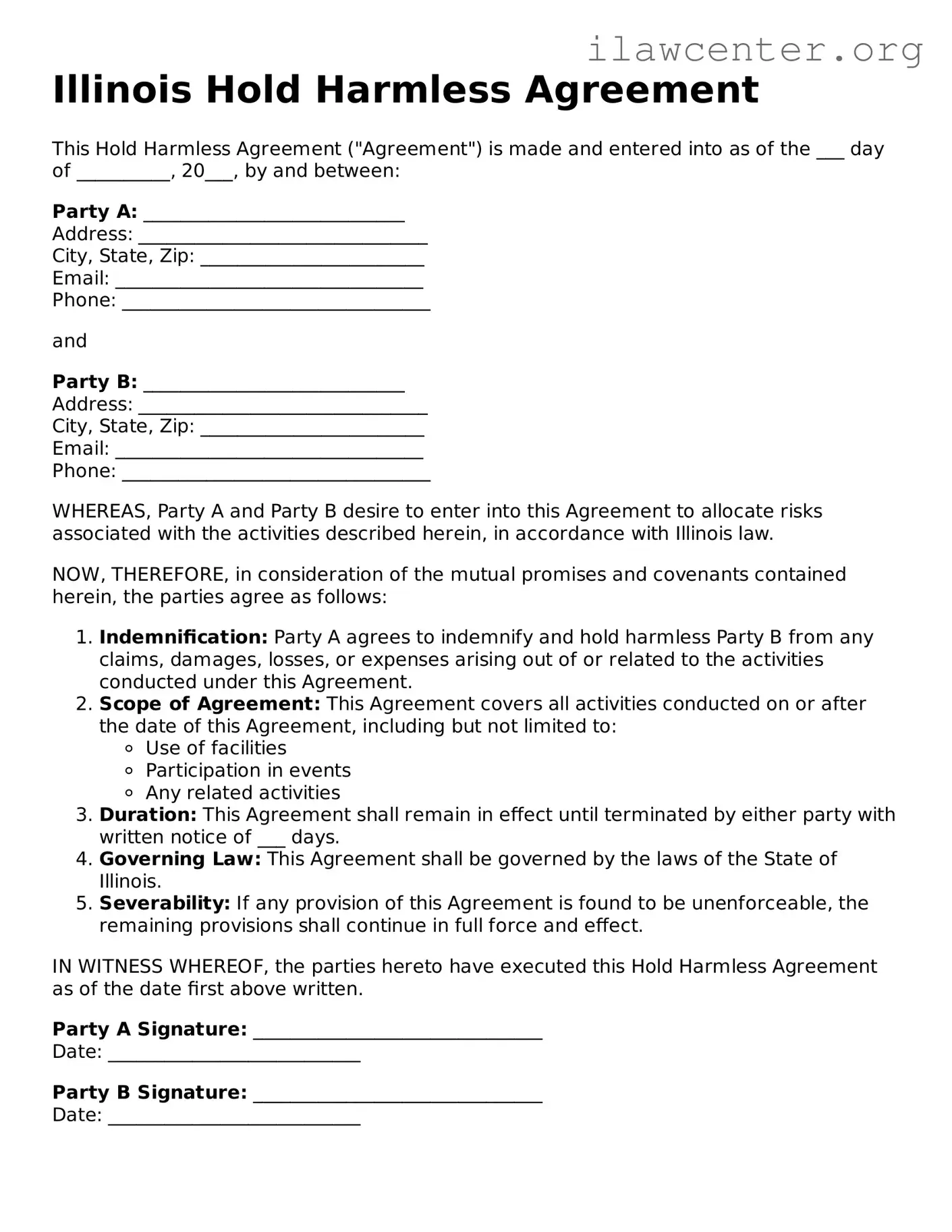
Illinois Hold Harmless Agreement

This Hold Harmless Agreement ("Agreement") is made and entered into as of the ___ day of __________, 20___, by and between:

Party A: ____________________________
Address: _______________________________
City, State, Zip: ________________________
Email: _________________________________
Phone: _________________________________

and

Party B: ____________________________
Address: _______________________________
City, State, Zip: ________________________
Email: _________________________________
Phone: _________________________________

WHEREAS, Party A and Party B desire to enter into this Agreement to allocate risks associated with the activities described herein, in accordance with Illinois law.

NOW, THEREFORE, in consideration of the mutual promises and covenants contained herein, the parties agree as follows:

  1. Indemnification: Party A agrees to indemnify and hold harmless Party B from any claims, damages, losses, or expenses arising out of or related to the activities conducted under this Agreement.
  2. Scope of Agreement: This Agreement covers all activities conducted on or after the date of this Agreement, including but not limited to:
    • Use of facilities
    • Participation in events
    • Any related activities
  3. Duration: This Agreement shall remain in effect until terminated by either party with written notice of ___ days.
  4. Governing Law: This Agreement shall be governed by the laws of the State of Illinois.
  5. Severability: If any provision of this Agreement is found to be unenforceable, the remaining provisions shall continue in full force and effect.

IN WITNESS WHEREOF, the parties hereto have executed this Hold Harmless Agreement as of the date first above written.

Party A Signature: _______________________________
Date: ___________________________

Party B Signature: _______________________________
Date: ___________________________

PDF Form Characteristics

Fact Name Details
Definition The Illinois Hold Harmless Agreement is a legal document designed to protect one party from liability for certain actions or events.
Purpose This agreement aims to ensure that one party does not hold the other responsible for injuries or damages that may occur during specified activities.
Common Uses It is frequently used in situations involving events, recreational activities, and contracts where one party wishes to limit their liability.
Governing Law The agreement is governed by the laws of the State of Illinois, specifically under the Illinois Compiled Statutes.
Parties Involved Typically, there are two parties involved: the indemnitor (the party providing the hold harmless agreement) and the indemnitee (the party receiving the protection).
Enforceability For the agreement to be enforceable, it must be clear, specific, and not against public policy.
Limitations The agreement may not protect against gross negligence or willful misconduct, as these are often exceptions in liability waivers.
Legal Review It is advisable for parties to seek legal counsel before signing to ensure the agreement meets their needs and complies with state laws.
Modification Any modifications to the agreement should be made in writing and agreed upon by all parties involved to ensure clarity and enforceability.
Signatures For validity, the agreement should be signed by all parties, indicating their acceptance of the terms and conditions outlined.

Instructions on Utilizing Illinois Hold Harmless Agreement

After obtaining the Illinois Hold Harmless Agreement form, it is essential to complete it accurately. This process involves providing specific information and signatures. Follow the steps below to ensure proper completion of the form.

  1. Begin by downloading or printing the Illinois Hold Harmless Agreement form.
  2. Read through the entire form to understand the required information.
  3. In the first section, fill in your name, address, and contact information as the party entering the agreement.
  4. Provide the name and contact information of the other party involved in the agreement.
  5. Clearly state the purpose of the agreement in the designated section.
  6. Review the terms and conditions outlined in the form. Make sure you understand each clause.
  7. Sign and date the form where indicated. Ensure your signature matches the name provided earlier.
  8. If required, have the other party sign and date the form as well.
  9. Make copies of the completed form for your records.
  10. Submit the original form to the appropriate party or organization as instructed.

Important Facts about Illinois Hold Harmless Agreement

What is an Illinois Hold Harmless Agreement?

An Illinois Hold Harmless Agreement is a legal document designed to protect one party from liability for any injuries or damages that may occur during a specific activity or event. This agreement typically involves two parties: the indemnitor, who agrees to assume the risk, and the indemnitee, who is being protected from claims. It is commonly used in various contexts, such as rental agreements, events, and construction projects.

Why would someone use a Hold Harmless Agreement?

People use Hold Harmless Agreements to minimize their exposure to legal claims. For example, if you are hosting an event, you might ask participants to sign this agreement to ensure that they cannot hold you liable for any accidents that happen during the event. This provides peace of mind and encourages participation, knowing that you have taken steps to manage risk.

Are Hold Harmless Agreements enforceable in Illinois?

Yes, Hold Harmless Agreements are generally enforceable in Illinois, provided they meet certain legal criteria. The agreement must be clear and unambiguous, and both parties must voluntarily consent to its terms. Courts may scrutinize these agreements, especially if they appear to waive liability for gross negligence or willful misconduct.

What should be included in a Hold Harmless Agreement?

A well-drafted Hold Harmless Agreement should include several key elements: the names of the parties involved, a clear description of the activity or event, the scope of the indemnity, and any specific limitations or exclusions. Additionally, it is wise to include a clause addressing the governing law, which specifies that Illinois law will apply to the agreement.

Can a Hold Harmless Agreement protect against all types of liability?

No, a Hold Harmless Agreement cannot protect against all types of liability. While it can provide protection against ordinary negligence, it typically does not shield a party from liability resulting from gross negligence or intentional misconduct. Courts may refuse to enforce provisions that attempt to waive liability for such serious conduct.

Is it necessary to have a lawyer draft a Hold Harmless Agreement?

While it is not strictly necessary to have a lawyer draft a Hold Harmless Agreement, it is highly recommended. Legal professionals can ensure that the agreement is properly structured, complies with Illinois law, and addresses all necessary considerations. This can help prevent potential disputes or misunderstandings in the future.

How can I ensure that my Hold Harmless Agreement is valid?

To ensure that your Hold Harmless Agreement is valid, make sure it is written clearly and concisely. Both parties should read and understand the terms before signing. Additionally, having witnesses or notarization can add an extra layer of legitimacy. It’s also advisable to keep a copy of the signed agreement for your records.

What happens if someone violates the Hold Harmless Agreement?

If someone violates the terms of a Hold Harmless Agreement, the injured party may seek legal recourse. The indemnitor may be held liable for any damages or injuries that occur despite the agreement. The specifics will depend on the language of the agreement and the circumstances surrounding the incident.

Can a Hold Harmless Agreement be revoked?

A Hold Harmless Agreement can be revoked, but this typically requires mutual consent from both parties. It is important to formally document any revocation in writing. If one party wishes to terminate the agreement, it should be done in a manner that is clear and unambiguous to avoid any future disputes.
Common mistakes

Filling out the Illinois Hold Harmless Agreement form can be a straightforward process, but many individuals stumble along the way. Understanding common mistakes can help ensure that the agreement is filled out correctly, protecting all parties involved. Here are seven common errors to avoid.

One frequent mistake is neglecting to read the entire document before signing. Many people skim through the agreement, assuming they understand its implications. This can lead to misunderstandings about the responsibilities and liabilities being assumed. Taking the time to read the entire form can prevent future disputes.

Another common error is failing to provide accurate information. Whether it’s names, addresses, or dates, accuracy is crucial. Incomplete or incorrect details can render the agreement invalid or unenforceable. Double-checking all entries before submission can save a lot of trouble later.

People often overlook the importance of notarization. In some cases, the agreement may need to be notarized to be legally binding. Skipping this step can lead to complications if the agreement is challenged in court. Always check if notarization is required and make arrangements accordingly.

Additionally, many individuals do not understand the scope of the agreement. It’s essential to know what liabilities are being waived and what risks are being accepted. Without this understanding, one might inadvertently agree to terms that could have serious consequences. Clarifying these points before signing is vital.

Another mistake is not discussing the agreement with all parties involved. Communication is key. If one party signs without fully understanding the implications or without discussing it with others, it can lead to mistrust and conflict. Open dialogue ensures that everyone is on the same page.

Some people also forget to keep a copy of the signed agreement. After signing, it’s important to retain a copy for personal records. This can be crucial if questions arise later about the terms of the agreement. Keeping a copy ensures that you have a reference point should any issues occur.

Finally, a significant mistake is not seeking legal advice when needed. While the form may seem simple, there are nuances that could affect its enforceability. Consulting with a legal professional can provide clarity and ensure that the agreement meets all legal requirements. It’s better to be safe than sorry when it comes to legal documents.

Documents used along the form

When working with the Illinois Hold Harmless Agreement, several other documents may be necessary to ensure clarity and protection for all parties involved. Each of these forms serves a specific purpose, contributing to a comprehensive understanding of the agreement and its implications.

  • Indemnity Agreement: This document outlines the responsibilities of one party to compensate another for any losses or damages that may arise. It typically complements the Hold Harmless Agreement by providing further assurance against financial liability.
  • Liability Waiver: A liability waiver is often used to release one party from legal responsibility for any injuries or damages that may occur. This form is particularly useful in activities where risks are inherent.
  • Insurance Certificate: An insurance certificate provides proof of coverage. It demonstrates that a party has adequate insurance to cover potential liabilities, which can strengthen the Hold Harmless Agreement.
  • Service Agreement: This document outlines the terms and conditions under which services will be provided. It can clarify the scope of work and responsibilities, ensuring that all parties are on the same page.
  • Release of Liability: Similar to a liability waiver, this form releases one party from future claims. It is often used in conjunction with activities that involve a risk of injury.
  • Contractor Agreement: This agreement defines the relationship between a contractor and a client. It specifies the expectations, deliverables, and liabilities, providing a framework for the Hold Harmless Agreement.
  • Non-Disclosure Agreement (NDA): An NDA protects confidential information shared between parties. It ensures that sensitive details related to the agreement remain private and secure.
  • Scope of Work Document: This document details the specific tasks and responsibilities of each party involved. It helps prevent misunderstandings and provides a clear outline of expectations.

Incorporating these documents alongside the Illinois Hold Harmless Agreement can enhance protection and clarity. Each form plays a vital role in ensuring that all parties understand their rights and responsibilities, fostering a collaborative and secure environment.

Similar forms

  • Indemnity Agreement: This document also protects one party from financial loss due to the actions of another. It establishes a duty to compensate for damages or losses incurred.
  • Liability Waiver: A liability waiver releases one party from responsibility for injuries or damages. It typically requires the participant to acknowledge risks and agree not to hold the provider accountable.
  • Release of Liability: Similar to a liability waiver, this document allows individuals to relinquish their right to sue for any injuries sustained during an activity. It is often used in recreational contexts.
  • Contractual Risk Transfer: This agreement shifts the risk of loss from one party to another. It outlines the responsibilities of each party and clarifies who is liable in case of an incident.
  • Insurance Policy Endorsement: An endorsement modifies an existing insurance policy to include or exclude certain coverage. It can protect against specific liabilities, similar to a Hold Harmless Agreement.

Dos and Don'ts

When filling out the Illinois Hold Harmless Agreement form, it is essential to approach the task with care and attention to detail. Below is a list of things you should and shouldn't do to ensure the form is completed accurately and effectively.

  • Do read the entire form carefully before beginning to fill it out.
  • Do provide accurate and complete information in all required fields.
  • Do seek clarification on any terms or sections you do not understand.
  • Do sign and date the form in the appropriate places.
  • Do keep a copy of the completed form for your records.
  • Don't rush through the form; take your time to avoid mistakes.
  • Don't leave any required fields blank; this could lead to delays.
  • Don't use abbreviations or shorthand unless specified.
  • Don't forget to review the form before submitting it to ensure everything is correct.

By following these guidelines, you can help ensure that the Hold Harmless Agreement is filled out properly, minimizing the risk of complications later on.

Misconceptions

Misconceptions about the Illinois Hold Harmless Agreement form can lead to confusion and misinterpretation. Understanding these misconceptions is essential for proper use and implementation. Here are eight common misunderstandings:

  1. It guarantees complete protection from lawsuits. Many believe that signing a Hold Harmless Agreement completely shields them from any legal claims. In reality, it only limits liability to some extent and does not eliminate all legal responsibilities.
  2. It is only necessary for high-risk activities. Some think that these agreements are only required for activities like extreme sports or construction. However, they can be useful in various situations, including events, services, and even everyday transactions.
  3. All Hold Harmless Agreements are the same. There is a misconception that all agreements have identical terms and conditions. In fact, each agreement can vary significantly based on the specific circumstances and parties involved.
  4. Signing means you cannot pursue a claim. Many individuals assume that by signing, they forfeit their right to seek compensation for damages. This is not always true, as the enforceability of the agreement can depend on its specific language and context.
  5. They are only for businesses. Some people think that Hold Harmless Agreements are exclusively for corporate entities. Individuals can also benefit from these agreements in personal transactions and agreements.
  6. They are unnecessary if insurance is in place. A common belief is that having insurance negates the need for a Hold Harmless Agreement. However, the two can work together to provide a more comprehensive risk management strategy.
  7. They are legally binding in all situations. Some assume that all Hold Harmless Agreements are enforceable by law. The enforceability can depend on various factors, including the clarity of the language and the circumstances surrounding the agreement.
  8. They protect against negligence. There is a misconception that these agreements automatically protect individuals from claims related to negligence. While they can limit liability, they may not cover situations involving gross negligence or intentional misconduct.

Understanding these misconceptions can help individuals and organizations make informed decisions when considering the use of Hold Harmless Agreements in Illinois.

Key takeaways

When filling out and using the Illinois Hold Harmless Agreement form, keep these key takeaways in mind:

  1. Understand the Purpose: This agreement protects one party from liability for any injuries or damages that may occur during an event or activity.
  2. Identify the Parties: Clearly state the names and roles of all parties involved. This includes the party being held harmless and the party assuming the risk.
  3. Be Specific: Detail the activities or events covered by the agreement. Vague language can lead to misunderstandings or disputes.
  4. Consider Legal Review: It’s wise to have a legal professional review the agreement to ensure it meets all legal requirements and adequately protects your interests.
  5. Keep a Copy: After signing, retain a copy of the agreement for your records. This can be crucial if any issues arise later.