Attorney-Verified  Living Will Document for Illinois

Attorney-Verified Living Will Document for Illinois

A Living Will is a legal document that allows individuals in Illinois to outline their preferences for medical treatment in case they become unable to communicate their wishes. This form serves as a guide for healthcare providers and loved ones, ensuring that a person's values and choices are respected during critical moments. To take control of your medical decisions, consider filling out the form by clicking the button below.

Article Guide

The Illinois Living Will form serves as a crucial legal document that allows individuals to express their wishes regarding medical treatment in the event they become unable to communicate their preferences due to a terminal condition or a state of permanent unconsciousness. This form empowers individuals to make decisions about life-sustaining treatments, such as resuscitation efforts, mechanical ventilation, and other interventions, ensuring that their personal values and beliefs are respected. It is important for individuals to complete this document while they are still capable of making informed decisions, as it provides clarity to healthcare providers and loved ones during critical moments. Additionally, the Illinois Living Will form can be complemented by other advance directives, such as a durable power of attorney for healthcare, which designates a trusted person to make medical decisions on behalf of the individual. Understanding the implications of this form and the process of its execution is essential for anyone wishing to take control of their healthcare choices in advance of potential medical crises.

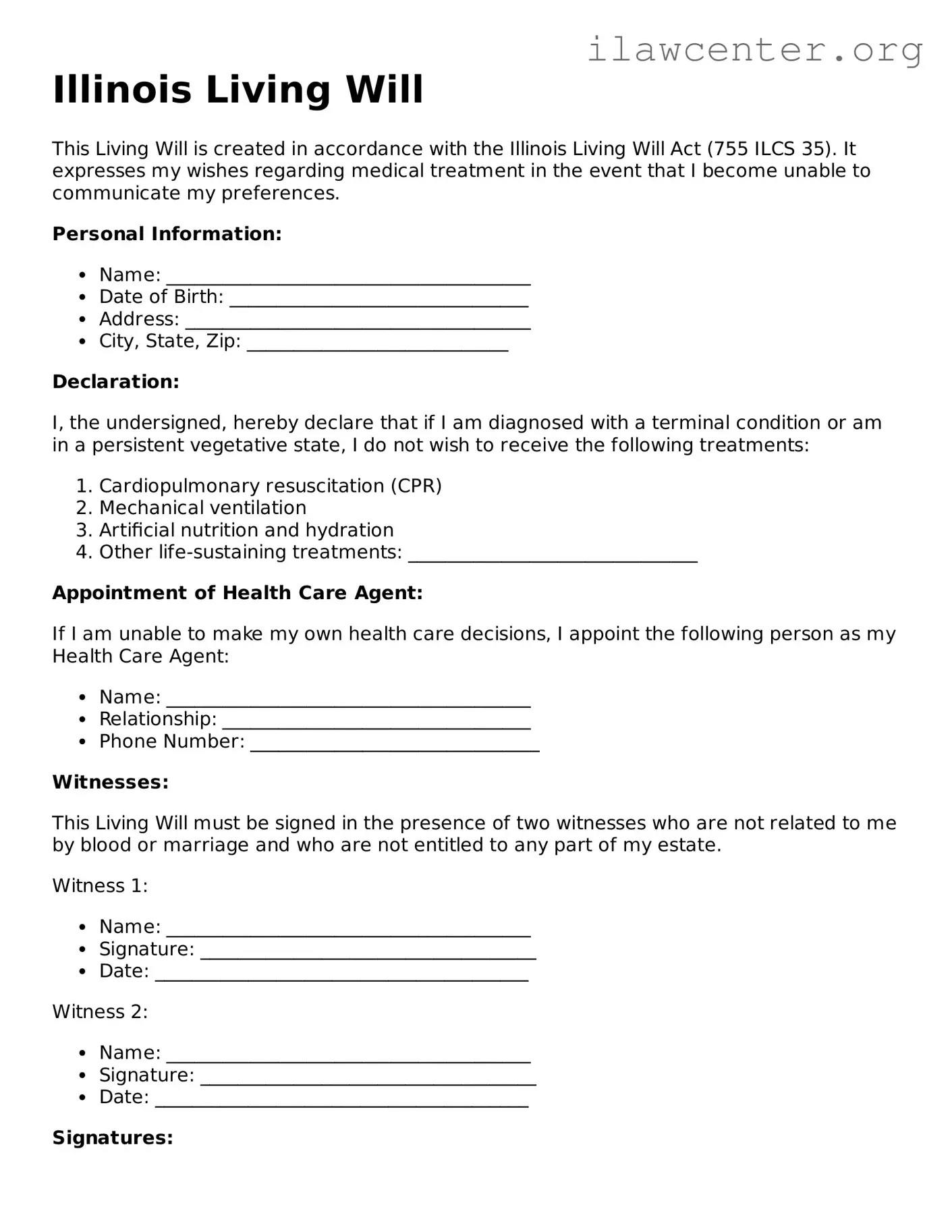
Illinois Living Will Preview

Illinois Living Will

This Living Will is created in accordance with the Illinois Living Will Act (755 ILCS 35). It expresses my wishes regarding medical treatment in the event that I become unable to communicate my preferences.

Personal Information:

  • Name: _______________________________________
  • Date of Birth: ________________________________
  • Address: _____________________________________
  • City, State, Zip: ____________________________

Declaration:

I, the undersigned, hereby declare that if I am diagnosed with a terminal condition or am in a persistent vegetative state, I do not wish to receive the following treatments:

  1. Cardiopulmonary resuscitation (CPR)
  2. Mechanical ventilation
  3. Artificial nutrition and hydration
  4. Other life-sustaining treatments: _______________________________

Appointment of Health Care Agent:

If I am unable to make my own health care decisions, I appoint the following person as my Health Care Agent:

  • Name: _______________________________________
  • Relationship: _________________________________
  • Phone Number: _______________________________

Witnesses:

This Living Will must be signed in the presence of two witnesses who are not related to me by blood or marriage and who are not entitled to any part of my estate.

Witness 1:

  • Name: _______________________________________
  • Signature: ____________________________________
  • Date: ________________________________________

Witness 2:

  • Name: _______________________________________
  • Signature: ____________________________________
  • Date: ________________________________________

Signatures:

By signing below, I confirm that I understand the contents of this Living Will and that it reflects my wishes regarding my medical treatment.

Signature: ______________________________________

Date: ___________________________________________

PDF Form Characteristics

Fact Name Description
Governing Law The Illinois Living Will form is governed by the Illinois Compiled Statutes, specifically 755 ILCS 35.
Purpose This form allows individuals to express their wishes regarding medical treatment in the event they become unable to communicate.
Eligibility Any adult who is 18 years or older can complete a Living Will in Illinois.
Witness Requirement The form must be signed in the presence of at least two witnesses who are not related to the individual.
Revocation A Living Will can be revoked at any time by the individual, verbally or in writing.
Healthcare Proxy This form does not appoint a healthcare proxy; a separate document is needed for that purpose.
Durability The Living Will remains effective until it is revoked by the individual.
Medical Treatment Decisions It specifically addresses decisions about life-sustaining treatment and resuscitation efforts.
Distribution It is advisable to provide copies of the completed Living Will to family members and healthcare providers.

Instructions on Utilizing Illinois Living Will

Filling out the Illinois Living Will form is an important step in expressing your healthcare preferences. Once completed, the form should be signed and witnessed to ensure it is legally valid. Follow these steps carefully to ensure that your wishes are clearly articulated.

  1. Begin by downloading the Illinois Living Will form from a reliable source or obtain a physical copy from a healthcare provider or legal office.
  2. Read the instructions provided with the form to understand the requirements and implications of your choices.
  3. In the designated section, fill in your full name, address, and date of birth. Ensure that this information is accurate and legible.
  4. Next, indicate your wishes regarding medical treatment. You will typically have options to choose from, such as whether you want life-sustaining treatment or not.
  5. Clearly state any specific instructions or preferences you may have regarding your medical care in the provided space.
  6. Once you have completed the form, sign and date it at the bottom. Your signature should be in the presence of a witness.
  7. Ask at least two witnesses to sign the form. They must be individuals who are not related to you by blood or marriage and who will not benefit from your estate.
  8. Make copies of the signed form for your records and distribute copies to your healthcare providers and family members.

Important Facts about Illinois Living Will

What is a Living Will in Illinois?

A Living Will is a legal document that allows individuals to express their wishes regarding medical treatment in the event they become unable to communicate their preferences. This document specifically addresses situations where a person is terminally ill or permanently unconscious and outlines the types of medical interventions they would or would not want to receive.

Who can create a Living Will in Illinois?

Any adult who is at least 18 years old and of sound mind can create a Living Will in Illinois. It is essential for the individual to understand the implications of the document and to express their wishes clearly.

What should be included in a Living Will?

A Living Will should clearly state the individual's preferences regarding life-sustaining treatments, such as resuscitation, mechanical ventilation, and feeding tubes. It may also include specific instructions about pain management and comfort care. Additionally, individuals may want to name a healthcare proxy to make decisions on their behalf if they cannot do so.

How is a Living Will different from a Power of Attorney for Healthcare?

While both documents deal with healthcare decisions, a Living Will focuses specifically on an individual's wishes regarding medical treatment in certain situations. In contrast, a Power of Attorney for Healthcare designates a person to make healthcare decisions on behalf of someone else when they are unable to do so. It is possible to have both documents in place for comprehensive healthcare planning.

Do I need a lawyer to create a Living Will in Illinois?

No, you do not need a lawyer to create a Living Will in Illinois. However, it is advisable to seek legal advice to ensure that the document meets all legal requirements and accurately reflects your wishes. This can help avoid any potential disputes or confusion in the future.

How do I make my Living Will official?

To make a Living Will official in Illinois, you must sign the document in the presence of two witnesses. These witnesses cannot be your healthcare providers or anyone who stands to gain from your estate. Alternatively, you may have the document notarized to meet the legal requirements.

Can I change or revoke my Living Will?

Yes, you can change or revoke your Living Will at any time, as long as you are of sound mind. To make changes, you should create a new Living Will that clearly states your updated wishes. It is important to inform your healthcare providers and any designated proxies about any changes made to your Living Will.

Where should I keep my Living Will?

It is essential to keep your Living Will in a safe but accessible location. Consider providing copies to your healthcare providers, family members, and anyone designated as your healthcare proxy. This ensures that your wishes are known and can be followed when needed.

What happens if I don’t have a Living Will?

If you do not have a Living Will and become unable to communicate your healthcare preferences, medical decisions will be made by your family members or healthcare providers based on their understanding of what you would want. This can lead to uncertainty and conflict among family members regarding your care.

Is a Living Will valid in other states?

A Living Will created in Illinois is generally valid in other states, but it is advisable to check the specific laws of the state in which you are residing or receiving care. Some states may have different requirements or forms, so it may be beneficial to create a Living Will that complies with those laws if you frequently travel or move.
Common mistakes

Filling out a Living Will form in Illinois is a significant step in ensuring that your healthcare wishes are respected. However, many people make mistakes that can lead to confusion or unintended consequences. Understanding these common pitfalls can help you navigate the process more smoothly.

One frequent error is not being specific enough about your wishes. A Living Will should clearly outline your preferences regarding medical treatment in various scenarios. If your instructions are vague or ambiguous, healthcare providers may struggle to interpret your intentions, which could lead to decisions that do not align with your desires.

Another mistake is failing to sign and date the form. A Living Will is not legally valid unless it is properly executed. This means that you must sign and date the document in front of witnesses or a notary, depending on the requirements in your state. Without these essential steps, your Living Will may not hold up when it’s needed most.

People often overlook the importance of choosing the right witnesses. In Illinois, your witnesses cannot be your family members, your healthcare providers, or anyone who stands to gain financially from your death. Selecting appropriate witnesses is crucial, as having an invalid witness can render your Living Will ineffective.

Additionally, many individuals make the mistake of not reviewing their Living Will regularly. Life circumstances change, and so may your healthcare preferences. It's a good idea to revisit your Living Will periodically to ensure it still reflects your wishes. Updating the document as needed can prevent misunderstandings down the line.

Another common error is not discussing your wishes with family and healthcare providers. Simply filling out the form is not enough. Engaging in conversations with your loved ones and medical professionals can help ensure that everyone understands your preferences. This communication can alleviate confusion and stress during difficult times.

Lastly, people sometimes assume that a Living Will is the only document they need. While a Living Will is essential, it’s often beneficial to have additional documents, such as a durable power of attorney for healthcare. This can provide a more comprehensive approach to your healthcare decisions, ensuring that someone you trust can advocate for you if you’re unable to do so yourself.

Documents used along the form

In Illinois, a Living Will is an important document that outlines an individual's wishes regarding medical treatment in the event they become unable to communicate. However, several other forms and documents are often used in conjunction with a Living Will to ensure comprehensive planning for healthcare decisions. Below is a list of these documents, each playing a vital role in healthcare planning.

  • Power of Attorney for Healthcare: This document allows an individual to appoint someone else to make medical decisions on their behalf if they become incapacitated. It provides clarity on who can make choices regarding treatment and care.
  • Do Not Resuscitate (DNR) Order: A DNR order is a medical order that prevents healthcare providers from performing CPR if a person's heart stops or they stop breathing. This document is crucial for those who wish to avoid aggressive resuscitation efforts.
  • Physician Orders for Life-Sustaining Treatment (POLST): This form translates a patient’s wishes about life-sustaining treatments into actionable medical orders. It is often used for individuals with serious health conditions.
  • Advance Directive: An advance directive is a broader term that includes both Living Wills and Powers of Attorney for Healthcare. It serves as a general guide for healthcare providers about a person's treatment preferences.
  • Healthcare Proxy: Similar to a Power of Attorney for Healthcare, a healthcare proxy designates a trusted individual to make medical decisions when one is unable to do so. It is essential for ensuring that a person’s wishes are honored.
  • Mental Health Advance Directive: This document specifically addresses an individual’s preferences regarding mental health treatment. It can outline how they wish to be treated during a mental health crisis.
  • Living Trust: While primarily a financial document, a living trust can also include provisions for healthcare decisions, ensuring that a person's wishes regarding both health and assets are clearly stated.
  • Organ Donation Registration: This document indicates an individual’s wishes regarding organ donation after death. It is an essential part of planning for those who wish to help others through organ donation.

These documents work together to create a clear and comprehensive plan for healthcare decisions. Having them in place can provide peace of mind for individuals and their loved ones, ensuring that wishes are respected and followed during critical times.

Similar forms

  • Advance Directive: This document outlines a person's healthcare preferences in advance, similar to a Living Will. Both serve to communicate wishes regarding medical treatment when an individual cannot express them directly.
  • Durable Power of Attorney for Healthcare: This form allows an individual to appoint someone to make healthcare decisions on their behalf. While a Living Will specifies treatment preferences, this document designates a trusted person to make those decisions.
  • Do Not Resuscitate (DNR) Order: A DNR order instructs medical personnel not to perform CPR if a person stops breathing or their heart stops. Like a Living Will, it communicates specific wishes regarding end-of-life care.
  • Healthcare Proxy: This document designates a person to make medical decisions if the individual is unable to do so. It works in tandem with a Living Will, which provides guidance on the types of care the proxy should consider.
  • POLST (Physician Orders for Life-Sustaining Treatment): A POLST form translates a patient's wishes regarding treatment into actionable medical orders. It is similar to a Living Will but is typically used for individuals with serious illnesses.
  • Financial Power of Attorney: While primarily focused on financial matters, this document can include healthcare decisions. It differs from a Living Will, which is specifically about medical treatment preferences.
  • Organ Donation Form: This form specifies a person's wishes regarding organ donation after death. Like a Living Will, it addresses end-of-life decisions, though it focuses specifically on the donation of organs.

Dos and Don'ts

When filling out the Illinois Living Will form, it’s important to be careful and informed. Here are some things you should and shouldn't do:

  • Do read the entire form carefully before starting.
  • Do clearly state your wishes regarding medical treatment.
  • Do sign and date the form in front of a witness.
  • Do discuss your wishes with your family and healthcare providers.
  • Do keep a copy of the completed form for your records.
  • Don't leave any sections blank; complete all necessary parts.
  • Don't use vague language that could be misunderstood.
  • Don't forget to have your witness sign the form at the same time as you.
  • Don't assume that verbal wishes are enough; they should be in writing.
  • Don't forget to update the form if your wishes change.

Misconceptions

When it comes to the Illinois Living Will form, several misconceptions can lead to confusion. Here are four common misunderstandings:

  • Misconception 1: A Living Will is the same as a Last Will and Testament.
  • This is not true. A Living Will specifically addresses medical treatment preferences in the event of a terminal illness or incapacitation, while a Last Will and Testament deals with the distribution of assets after death.

  • Misconception 2: You cannot change your Living Will once it is signed.
  • This is incorrect. Individuals can revise or revoke their Living Will at any time, as long as they are of sound mind. It’s important to keep your wishes current.

  • Misconception 3: A Living Will only applies to end-of-life situations.
  • While it primarily focuses on end-of-life decisions, a Living Will can also address situations where a person is unable to communicate their wishes due to serious illness or injury.

  • Misconception 4: You need a lawyer to create a Living Will.
  • This is a common belief, but it is not necessary. Individuals can create a Living Will on their own, using state-approved forms, as long as they follow the required guidelines.

Key takeaways

When considering the Illinois Living Will form, it's important to understand the key aspects that will guide you through the process. Here are some essential takeaways:

  • Purpose: The Illinois Living Will allows you to express your wishes regarding medical treatment in the event you become unable to communicate your preferences.
  • Eligibility: You must be at least 18 years old and of sound mind to create a valid Living Will in Illinois.
  • Specificity: Clearly outline your preferences regarding life-sustaining treatments. Be as specific as possible to avoid confusion later.
  • Signature Requirement: You must sign the document in the presence of two witnesses or a notary public to make it legally binding.
  • Revocation: You have the right to revoke your Living Will at any time, as long as you are mentally competent. Inform your healthcare provider and witnesses of your decision.
  • Distribution: Share copies of your Living Will with your healthcare provider, family members, and anyone involved in your care to ensure your wishes are known.

Understanding these key points can help ensure that your wishes are respected and that your Living Will is properly executed.