Attorney-Verified  Loan Agreement Document for Illinois

Attorney-Verified Loan Agreement Document for Illinois

A Loan Agreement form in Illinois is a legal document that outlines the terms and conditions under which a borrower receives funds from a lender. This form serves to protect both parties by detailing the repayment schedule, interest rates, and any other obligations. To get started with your Loan Agreement, fill out the form by clicking the button below.

Article Guide

The Illinois Loan Agreement form serves as a crucial document for individuals and businesses seeking to formalize a loan arrangement. This form outlines the terms and conditions of the loan, including the principal amount, interest rate, repayment schedule, and any applicable fees. It is designed to protect the interests of both the lender and the borrower, ensuring clarity and mutual understanding. Key elements often included are the duration of the loan, the consequences of default, and any collateral involved. Additionally, the form may address the governing law, typically stating that Illinois law will apply to the agreement. By providing a structured framework, the Illinois Loan Agreement helps to mitigate disputes and fosters a transparent lending process.

Illinois Loan Agreement Preview

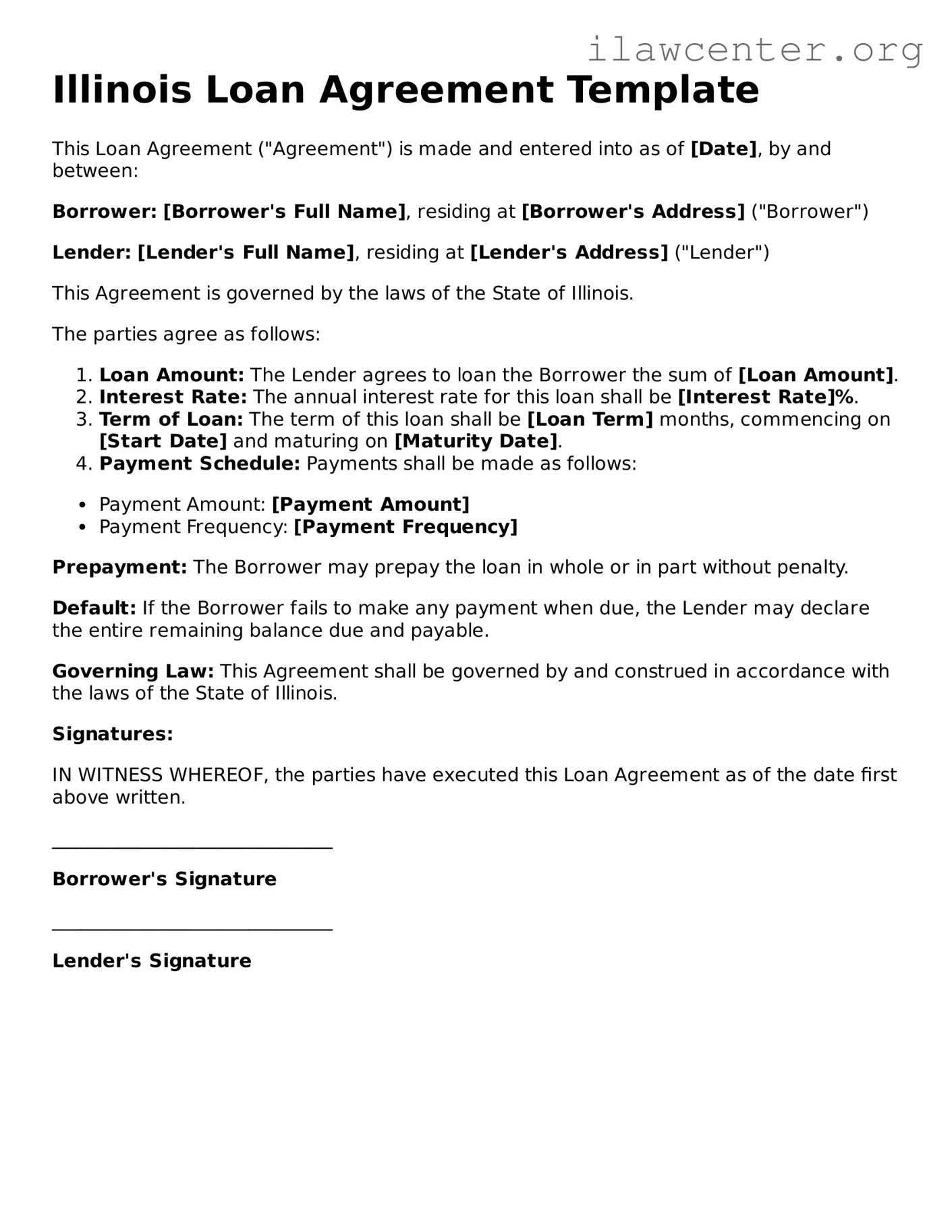
Illinois Loan Agreement Template

This Loan Agreement ("Agreement") is made and entered into as of [Date], by and between:

Borrower: [Borrower's Full Name], residing at [Borrower's Address] ("Borrower")

Lender: [Lender's Full Name], residing at [Lender's Address] ("Lender")

This Agreement is governed by the laws of the State of Illinois.

The parties agree as follows:

  1. Loan Amount: The Lender agrees to loan the Borrower the sum of [Loan Amount].
  2. Interest Rate: The annual interest rate for this loan shall be [Interest Rate]%.
  3. Term of Loan: The term of this loan shall be [Loan Term] months, commencing on [Start Date] and maturing on [Maturity Date].
  4. Payment Schedule: Payments shall be made as follows:
  • Payment Amount: [Payment Amount]
  • Payment Frequency: [Payment Frequency]

Prepayment: The Borrower may prepay the loan in whole or in part without penalty.

Default: If the Borrower fails to make any payment when due, the Lender may declare the entire remaining balance due and payable.

Governing Law: This Agreement shall be governed by and construed in accordance with the laws of the State of Illinois.

Signatures:

IN WITNESS WHEREOF, the parties have executed this Loan Agreement as of the date first above written.

______________________________

Borrower's Signature

______________________________

Lender's Signature

PDF Form Characteristics

Fact Name Description
Purpose The Illinois Loan Agreement form is used to outline the terms and conditions of a loan between a lender and a borrower.
Governing Law This agreement is governed by the laws of the State of Illinois.
Required Information The form typically requires details such as the loan amount, interest rate, repayment schedule, and parties involved.
Signatures Both the lender and borrower must sign the agreement for it to be legally binding.
Amendments Any changes to the agreement must be documented in writing and signed by both parties.
Default Terms The form should specify what constitutes a default and the remedies available to the lender.

Instructions on Utilizing Illinois Loan Agreement

Once you have the Illinois Loan Agreement form in hand, you are ready to complete it. Follow these steps to ensure that all required information is accurately provided.

  1. Begin by entering the date at the top of the form.
  2. Fill in the names and addresses of both the borrower and the lender. Ensure that all details are correct.
  3. Specify the loan amount clearly. This should be a numerical figure.
  4. Indicate the interest rate applicable to the loan. Be precise to avoid any misunderstandings.
  5. Outline the repayment terms, including the schedule and duration of the loan. Include any grace periods if applicable.
  6. Provide details regarding any collateral, if required. Clearly describe the items or assets involved.
  7. Both parties should sign and date the form at the designated areas. Ensure that signatures are legible.
  8. Make a copy of the completed form for your records before submission.

After filling out the form, it is important to review all entries for accuracy. This will help prevent any future disputes or misunderstandings regarding the loan agreement.

Important Facts about Illinois Loan Agreement

What is the Illinois Loan Agreement form?

The Illinois Loan Agreement form is a legal document used to outline the terms and conditions of a loan between a lender and a borrower. This form specifies the amount of money being borrowed, the interest rate, repayment schedule, and any collateral involved. It serves to protect both parties by clearly defining their rights and responsibilities throughout the loan period.

Who should use the Illinois Loan Agreement form?

This form is suitable for individuals or businesses looking to formalize a loan arrangement in Illinois. Whether you are lending money to a friend, family member, or a business, using this agreement helps to prevent misunderstandings and disputes. It is advisable for both lenders and borrowers to use this form to ensure that all terms are agreed upon and documented.

What are the key components of the Illinois Loan Agreement form?

Key components include the loan amount, interest rate, repayment terms, due dates, and any penalties for late payments. The agreement should also outline the consequences of defaulting on the loan, such as legal actions or the seizure of collateral. Clarity in these areas is essential to avoid potential conflicts in the future.

Is the Illinois Loan Agreement form legally binding?

Yes, once both parties sign the Illinois Loan Agreement form, it becomes a legally binding contract. This means that both the lender and borrower are obligated to adhere to the terms outlined in the document. If either party fails to comply with the agreement, the other party may seek legal remedies to enforce the terms or recover any losses incurred.

Common mistakes

Filling out the Illinois Loan Agreement form can be straightforward, but several common mistakes can lead to complications. One frequent error is failing to provide complete personal information. This includes not only your name but also your address, phone number, and email. Incomplete information can delay the processing of your loan and may even lead to a rejection. Always double-check that all required fields are filled out accurately.

Another common mistake involves the loan amount. Many individuals either miscalculate the amount they need or do not specify it clearly on the form. It’s crucial to ensure that the loan amount requested matches your financial needs. If you request too little, you may find yourself needing additional funds later, while requesting too much can raise red flags for lenders.

Additionally, people often overlook the importance of reading the terms and conditions thoroughly. Many borrowers skip this step, thinking they understand the basic premise of the loan. However, each loan may have unique stipulations that could affect repayment. Failing to grasp these details can lead to unexpected fees or penalties down the line. Always take the time to read through the agreement carefully.

Finally, signatures can be a source of confusion. Some individuals forget to sign the document or fail to provide the date next to their signature. Without a proper signature, the agreement may be considered invalid. Ensure that you sign where required and include the date to confirm your acceptance of the terms. Paying attention to these details can save you time and trouble in the long run.

Documents used along the form

When entering into a loan agreement in Illinois, several additional forms and documents may be necessary to ensure clarity and legal compliance. These documents help outline the terms of the loan, protect the interests of both parties, and provide a framework for the transaction. Below is a list of commonly used forms alongside the Illinois Loan Agreement.

  • Promissory Note: This document outlines the borrower's promise to repay the loan. It includes details such as the loan amount, interest rate, repayment schedule, and any penalties for late payments.
  • Security Agreement: If the loan is secured by collateral, this agreement specifies what assets are being used as security. It details the rights of the lender in the event of default.
  • Disclosure Statement: This document provides essential information about the loan terms, including the total cost of the loan, interest rates, and any fees. It ensures that borrowers are fully informed before signing the agreement.
  • Loan Application: Often completed by the borrower, this form gathers personal and financial information necessary for the lender to assess creditworthiness and determine loan eligibility.
  • Guaranty Agreement: In cases where a third party agrees to take responsibility for the loan if the borrower defaults, this document outlines that obligation and the terms under which it applies.
  • Amortization Schedule: This schedule breaks down each payment over the life of the loan, showing how much goes toward principal and interest. It helps borrowers understand their payment structure.

These documents work together to create a comprehensive framework for the loan transaction. Understanding each of them can empower borrowers and lenders alike, ensuring a smoother process and clearer expectations throughout the duration of the loan.

Similar forms

  • Promissory Note: This document outlines a borrower's promise to repay a loan under specified terms. Like a Loan Agreement, it includes details such as the loan amount, interest rate, and repayment schedule.
  • Mortgage Agreement: This is used when a loan is secured by real property. Similar to a Loan Agreement, it details the terms of the loan but also includes information about the collateral backing the loan.
  • Credit Agreement: This document governs the terms of a credit facility. It shares similarities with a Loan Agreement in that it outlines the obligations of both the lender and borrower, including fees and repayment terms.
  • Security Agreement: This document is used to secure a loan with collateral. It is similar to a Loan Agreement in that it specifies the terms of the loan and the conditions under which the lender can claim the collateral if the borrower defaults.

Dos and Don'ts

When filling out the Illinois Loan Agreement form, it's important to follow certain guidelines to ensure accuracy and compliance. Here are four things you should and shouldn't do:

  • Do: Read the entire form carefully before starting. Understanding each section will help you provide the correct information.
  • Do: Use clear and legible handwriting or type your responses. This minimizes the risk of misinterpretation.
  • Do: Double-check all numbers and amounts. Accuracy in financial figures is crucial.
  • Do: Sign and date the form where required. An unsigned form may not be considered valid.
  • Don't: Leave any required fields blank. Incomplete forms can lead to delays or rejection.
  • Don't: Use abbreviations or shorthand. Clarity is key, so spell everything out.
  • Don't: Provide false information. Misrepresentation can have serious legal consequences.
  • Don't: Forget to keep a copy of the completed form for your records. This is important for your own reference.

Misconceptions

Below are five common misconceptions about the Illinois Loan Agreement form, along with explanations to clarify each point.

  • The Illinois Loan Agreement form is only for large loans. This is incorrect. The form can be used for both small and large loans. It is designed to formalize any loan arrangement, regardless of the amount.
  • All loan agreements must be notarized. Not all loan agreements require notarization. While having a notary can add an extra layer of validation, it is not a legal requirement for the agreement to be enforceable in Illinois.
  • Only banks can issue loan agreements. This misconception is false. Individuals and private lenders can also create loan agreements. The form is applicable to various lending scenarios, not just those involving financial institutions.
  • The Illinois Loan Agreement form is the same as a promissory note. While both documents relate to loans, they serve different purposes. The loan agreement outlines the terms and conditions of the loan, whereas a promissory note is a written promise to repay the loan.
  • Once signed, the terms of the loan cannot be changed. This is not entirely accurate. The terms can be modified if both parties agree to the changes and document them properly. Flexibility exists as long as both parties consent to the new terms.

Key takeaways

Filling out and using the Illinois Loan Agreement form requires attention to detail and understanding of the terms involved. Here are key takeaways to keep in mind:

  1. Identify the Parties: Clearly state the names and addresses of both the lender and the borrower to avoid any confusion.
  2. Specify the Loan Amount: Clearly indicate the total amount being loaned. This should be a precise figure.
  3. Detail the Interest Rate: Include the interest rate applicable to the loan. Ensure it complies with Illinois state laws regarding maximum rates.
  4. Outline Repayment Terms: Specify how and when the borrower will repay the loan. Include payment frequency and due dates.
  5. Include Late Fees: State any penalties for late payments. This encourages timely repayment and clarifies consequences.
  6. Define Default Terms: Clearly outline what constitutes a default on the loan and the lender's rights in such an event.
  7. Signatures Required: Both parties must sign the agreement. This indicates mutual consent to the terms outlined.
  8. Consider Notarization: While not always required, having the agreement notarized can provide additional legal protection.
  9. Keep Copies: Both the lender and borrower should retain copies of the signed agreement for their records.

By following these key points, individuals can ensure that their Illinois Loan Agreement is properly completed and legally binding.