Attorney-Verified  Medical Power of Attorney Document for Illinois

Attorney-Verified Medical Power of Attorney Document for Illinois

The Illinois Medical Power of Attorney form is a legal document that allows individuals to designate someone to make healthcare decisions on their behalf if they become unable to do so. This form is essential for ensuring that your medical preferences are honored and that someone you trust is empowered to advocate for your health. To get started on securing your healthcare wishes, fill out the form by clicking the button below.

Article Guide

In Illinois, the Medical Power of Attorney form serves as a vital tool for individuals seeking to ensure their healthcare preferences are honored when they are unable to communicate their wishes. This legal document allows you to appoint a trusted person, often referred to as your agent, to make medical decisions on your behalf. The form outlines specific powers granted to your agent, which can include choices about medical treatments, procedures, and end-of-life care. It's important to note that the form must be signed and dated in the presence of a witness or a notary public to be valid. Additionally, individuals can customize their Medical Power of Attorney to reflect their unique values and preferences regarding health care. By taking the time to complete this form, you can provide peace of mind for yourself and your loved ones, knowing that your medical decisions will align with your wishes, even if you cannot voice them yourself.

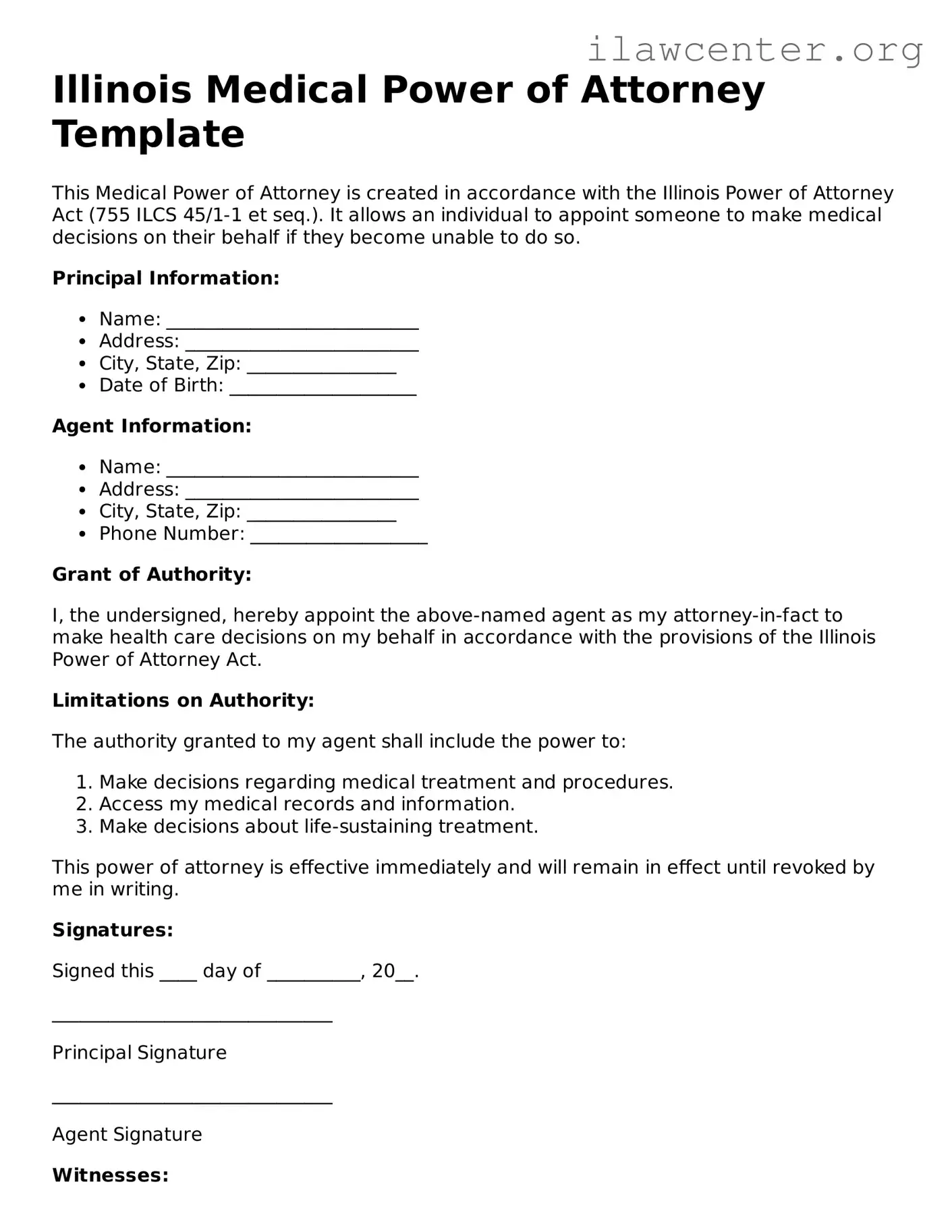
Illinois Medical Power of Attorney Preview

Illinois Medical Power of Attorney Template

This Medical Power of Attorney is created in accordance with the Illinois Power of Attorney Act (755 ILCS 45/1-1 et seq.). It allows an individual to appoint someone to make medical decisions on their behalf if they become unable to do so.

Principal Information:

  • Name: ___________________________
  • Address: _________________________
  • City, State, Zip: ________________
  • Date of Birth: ____________________

Agent Information:

  • Name: ___________________________
  • Address: _________________________
  • City, State, Zip: ________________
  • Phone Number: ___________________

Grant of Authority:

I, the undersigned, hereby appoint the above-named agent as my attorney-in-fact to make health care decisions on my behalf in accordance with the provisions of the Illinois Power of Attorney Act.

Limitations on Authority:

The authority granted to my agent shall include the power to:

  1. Make decisions regarding medical treatment and procedures.
  2. Access my medical records and information.
  3. Make decisions about life-sustaining treatment.

This power of attorney is effective immediately and will remain in effect until revoked by me in writing.

Signatures:

Signed this ____ day of __________, 20__.

______________________________

Principal Signature

______________________________

Agent Signature

Witnesses:

This document must be witnessed by two individuals who are not related to the principal or the agent.

Witness 1: ___________________________

Witness 2: ___________________________

PDF Form Characteristics

Fact Name Details
Governing Law The Illinois Medical Power of Attorney is governed by the Illinois Power of Attorney Act, 755 ILCS 45/1-1 et seq.
Purpose This form allows an individual to appoint someone to make medical decisions on their behalf if they become unable to do so.
Eligibility Any adult who is of sound mind can create a Medical Power of Attorney in Illinois.
Signatures Required The form must be signed by the principal and witnessed by two individuals or notarized.
Revocation The principal can revoke the Medical Power of Attorney at any time, as long as they are still competent.
Effective Date The authority granted by the Medical Power of Attorney becomes effective when the principal is determined to be incapacitated.

Instructions on Utilizing Illinois Medical Power of Attorney

Completing the Illinois Medical Power of Attorney form is a straightforward process that allows you to designate someone to make medical decisions on your behalf. Follow these steps carefully to ensure that the document is filled out correctly.

  1. Obtain the Illinois Medical Power of Attorney form. You can find it online or through legal service providers.
  2. Begin by filling in your name and address at the top of the form.
  3. Identify the individual you wish to appoint as your agent. Provide their full name, address, and phone number.
  4. Specify any limitations or preferences regarding your medical care. Be clear about what decisions your agent can make on your behalf.
  5. Include your signature and date at the designated area of the form.
  6. Have the form witnessed by two individuals who are not related to you and who will not benefit from your estate.
  7. Alternatively, you can have the form notarized. If you choose this option, sign the form in front of a notary public.
  8. Make copies of the completed form for your records and provide copies to your agent and any healthcare providers.

Important Facts about Illinois Medical Power of Attorney

What is a Medical Power of Attorney in Illinois?

A Medical Power of Attorney is a legal document that allows an individual to appoint someone else to make healthcare decisions on their behalf if they become unable to do so. This document is important for ensuring that a person's medical preferences are honored when they cannot communicate their wishes directly.

Who can be appointed as an agent in a Medical Power of Attorney?

In Illinois, any competent adult can be appointed as an agent. This includes family members, friends, or trusted individuals. It is crucial that the person chosen understands the individual's values and wishes regarding medical treatment.

How does one create a Medical Power of Attorney in Illinois?

To create a Medical Power of Attorney, an individual must fill out the appropriate form, which can often be found online or obtained through legal resources. The form must be signed by the individual and witnessed by two adults, or notarized. It is important to follow the specific requirements to ensure the document is valid.

Can a Medical Power of Attorney be revoked?

Yes, an individual can revoke a Medical Power of Attorney at any time as long as they are competent to do so. This can be done by creating a new document that explicitly states the revocation or by destroying the original document. It is advisable to inform the appointed agent and any healthcare providers of the revocation.

What happens if a person does not have a Medical Power of Attorney?

If an individual does not have a Medical Power of Attorney and becomes incapacitated, medical decisions may be made by family members or, in some cases, by the court. This can lead to disagreements among family members and may not reflect the individual's wishes regarding their medical care.

Are there any limitations to the authority granted in a Medical Power of Attorney?

Yes, the authority granted can be limited by the individual. They may specify certain medical treatments that the agent can or cannot make decisions about. It is essential to clearly outline any limitations in the document to avoid confusion later.

Is a Medical Power of Attorney the same as a living will?

No, a Medical Power of Attorney and a living will are different documents. A Medical Power of Attorney designates someone to make healthcare decisions, while a living will outlines an individual's wishes regarding end-of-life care and medical treatments. Both documents can work together to ensure that a person's healthcare preferences are respected.

How often should a Medical Power of Attorney be reviewed?

It is advisable to review a Medical Power of Attorney periodically, especially after significant life events such as marriage, divorce, or the death of the appointed agent. Changes in health status or personal beliefs may also prompt a review. Regularly updating the document ensures that it accurately reflects current wishes and circumstances.
Common mistakes

Filling out the Illinois Medical Power of Attorney form can be a straightforward process, but many individuals make common mistakes that can lead to complications. One frequent error is failing to specify the name of the agent clearly. The agent is the person designated to make medical decisions on behalf of the individual. Omitting this information or using vague language can result in confusion and potential disputes.

Another mistake is neglecting to sign and date the document. A Medical Power of Attorney form must be signed by the principal, the person granting the authority, to be valid. Without a signature, the document holds no legal weight. Additionally, forgetting to date the form can create uncertainty about when the authority was granted, which may lead to complications in urgent situations.

People often overlook the importance of witnessing the document. In Illinois, the form requires either two witnesses or a notary public. Failing to have the required witnesses present during the signing can invalidate the form. It’s crucial to ensure that the witnesses are not related to the principal or the agent to avoid conflicts of interest.

Choosing an inappropriate agent can also be a significant mistake. The selected agent should be someone trustworthy and capable of making difficult medical decisions. Some individuals may appoint a family member out of obligation rather than considering their ability to handle such responsibilities effectively.

Another common oversight is not discussing the wishes with the appointed agent. It’s essential for the principal to communicate their medical preferences and values to the agent. Without this conversation, the agent may struggle to make decisions that align with the principal’s wishes, leading to unwanted outcomes.

In addition, many people forget to review and update their Medical Power of Attorney regularly. Life circumstances change, and so do relationships. If the principal’s situation evolves, such as a divorce or a change in health status, the form should be revised to reflect current wishes and relationships.

Some individuals mistakenly think that a Medical Power of Attorney can cover all medical decisions. However, it’s important to understand that this document is limited to medical decisions only. It does not grant authority over financial matters or other legal issues, which may require separate documents.

Another error is not considering the implications of the agent's decisions. The agent has significant power and responsibility. Individuals should be aware of the potential consequences of granting this authority and ensure they are comfortable with their choice.

Lastly, neglecting to keep copies of the signed form can lead to difficulties. It’s advisable to provide copies to the agent, healthcare providers, and family members. This ensures that everyone involved is aware of the principal's wishes and can act accordingly when needed.

Documents used along the form

The Illinois Medical Power of Attorney form allows individuals to designate someone to make healthcare decisions on their behalf if they become unable to do so. It is often used in conjunction with other important documents to ensure comprehensive planning for medical and legal situations. Below is a list of related forms and documents that may be relevant.

  • Living Will: This document specifies an individual's wishes regarding medical treatment in situations where they are terminally ill or in a persistent vegetative state.
  • Durable Power of Attorney: This form grants someone the authority to make financial decisions on behalf of another person, effective immediately or upon incapacitation.
  • Do Not Resuscitate (DNR) Order: A DNR order instructs medical personnel not to perform CPR if a person's heart stops or they stop breathing.
  • Healthcare Proxy: Similar to the Medical Power of Attorney, this document allows a person to appoint someone to make healthcare decisions, but it may not be limited to specific medical situations.
  • Advance Directive: This is a broader term that encompasses both Living Wills and Medical Powers of Attorney, outlining a person's preferences for medical treatment.
  • Organ Donation Registration: This document indicates a person's wishes regarding organ donation after death, ensuring that their preferences are known and honored.
  • Patient Advocate Designation: This form allows individuals to appoint a patient advocate who can help navigate the healthcare system and ensure that their wishes are respected.

Each of these documents serves a specific purpose and can work together with the Illinois Medical Power of Attorney to provide clear guidance regarding medical and financial decisions. It is advisable to consider these forms carefully to ensure that personal wishes are documented and respected in various situations.

Similar forms

  • Durable Power of Attorney: Similar to a Medical Power of Attorney, this document allows an individual to appoint someone to make financial decisions on their behalf if they become incapacitated.
  • Living Will: This document outlines a person's wishes regarding medical treatment in situations where they cannot communicate. It complements the Medical Power of Attorney by providing specific instructions about end-of-life care.
  • Healthcare Proxy: Like a Medical Power of Attorney, a healthcare proxy designates someone to make medical decisions for an individual. The terms may vary slightly, but both serve the same fundamental purpose.
  • Do Not Resuscitate (DNR) Order: A DNR order instructs medical personnel not to perform CPR if a patient stops breathing or their heart stops. It is similar in that it communicates a patient's wishes regarding medical interventions.
  • Advance Healthcare Directive: This document combines elements of both a Living Will and a Medical Power of Attorney, allowing individuals to express their healthcare preferences and appoint a decision-maker.
  • Guardian Appointment: A court may appoint a guardian to make decisions for an individual who cannot make them. This document is similar as it designates someone to act on behalf of another, although it often involves a legal process.
  • Patient Advocate Designation: This document allows individuals to choose someone to advocate for their medical care preferences, similar to a Medical Power of Attorney, but often without the formal legal structure.
  • HIPAA Authorization: This document grants permission for designated individuals to access medical records. While it does not make decisions, it complements the Medical Power of Attorney by ensuring that the appointed agent can obtain necessary information.
  • Informed Consent Form: This document is used to ensure that patients understand the risks and benefits of a treatment before consenting. It is similar in that it relates to medical decision-making, although it typically involves immediate treatment decisions rather than long-term planning.
  • End-of-Life Care Plan: This document outlines a person's wishes regarding care at the end of life. It is similar to a Medical Power of Attorney as it addresses decisions that may need to be made when an individual is unable to communicate.

Dos and Don'ts

When filling out the Illinois Medical Power of Attorney form, it is essential to follow certain guidelines to ensure that your document is valid and reflects your wishes. Here are six things you should and shouldn't do:

  • Do clearly identify your agent. Make sure to provide their full name and contact information.
  • Don't leave any sections blank. Each part of the form must be completed to avoid confusion.
  • Do discuss your medical preferences with your agent beforehand. This ensures they understand your wishes.
  • Don't use ambiguous language. Be specific about your healthcare preferences to avoid misinterpretation.
  • Do sign and date the form in the presence of a witness. This step is crucial for the document's validity.
  • Don't forget to provide copies of the completed form to your agent and relevant healthcare providers.

Misconceptions

Many people have misunderstandings about the Illinois Medical Power of Attorney form. Here are five common misconceptions:

  1. Misconception 1: The Medical Power of Attorney is only for end-of-life decisions.

    This is not true. While it can be used for end-of-life care, it also covers a wide range of medical decisions when a person is unable to communicate their wishes.

  2. Misconception 2: Anyone can be appointed as an agent.

    In Illinois, you cannot appoint someone who is your healthcare provider or an employee of your healthcare provider unless they are related to you. This rule is in place to avoid conflicts of interest.

  3. Misconception 3: The form needs to be notarized to be valid.

    While notarization can add an extra layer of validation, it is not a requirement in Illinois. The form must be signed by you and two witnesses who are not related to you.

  4. Misconception 4: A Medical Power of Attorney is permanent and cannot be changed.

    This is incorrect. You can revoke or change your Medical Power of Attorney at any time, as long as you are mentally competent to do so.

  5. Misconception 5: The Medical Power of Attorney is the same as a living will.

    These are different documents. A Medical Power of Attorney designates someone to make decisions on your behalf, while a living will outlines your wishes regarding medical treatment in specific situations.

Key takeaways

Filling out and using the Illinois Medical Power of Attorney form is an important step in ensuring your healthcare wishes are respected. Here are some key takeaways to consider:

  1. Choose Your Agent Wisely: Select someone you trust to make medical decisions on your behalf. This person should understand your values and preferences regarding healthcare.
  2. Be Specific: Clearly outline your wishes regarding medical treatment. The more specific you are, the easier it will be for your agent to make decisions that align with your desires.
  3. Sign and Date the Form: Make sure to sign and date the form in front of a witness. This step is crucial for the document to be legally valid in Illinois.
  4. Review Regularly: Your healthcare preferences may change over time. Review your Medical Power of Attorney periodically and update it if necessary.
  5. Inform Your Agent: Discuss your healthcare wishes with your chosen agent. Make sure they are comfortable and willing to take on this responsibility.

By keeping these key points in mind, you can ensure that your Medical Power of Attorney form effectively communicates your healthcare wishes. This will help provide peace of mind for both you and your loved ones.