Attorney-Verified  Non-compete Agreement Document for Illinois

Attorney-Verified Non-compete Agreement Document for Illinois

A Non-compete Agreement in Illinois is a legal document that restricts an employee from engaging in business activities that compete with their employer after leaving the company. This form outlines the terms and conditions under which the employee agrees not to pursue similar work in a defined geographic area for a specified time period. To ensure compliance and protect your business interests, consider filling out the Non-compete Agreement form by clicking the button below.

Article Guide

In Illinois, the Non-compete Agreement form serves as a critical tool for employers seeking to protect their business interests while balancing the rights of employees. This legal document outlines the terms under which an employee agrees not to engage in competitive activities after leaving the company. Key aspects of the form include the duration of the non-compete period, the geographical scope of the restrictions, and the specific activities that are prohibited. Employers must ensure that the terms are reasonable and not overly restrictive, as Illinois law requires non-compete agreements to be supported by adequate consideration, such as employment or a promotion. Additionally, the form may address issues related to confidentiality and the protection of trade secrets. Understanding these components is essential for both employers and employees to navigate the complexities of non-compete agreements effectively.

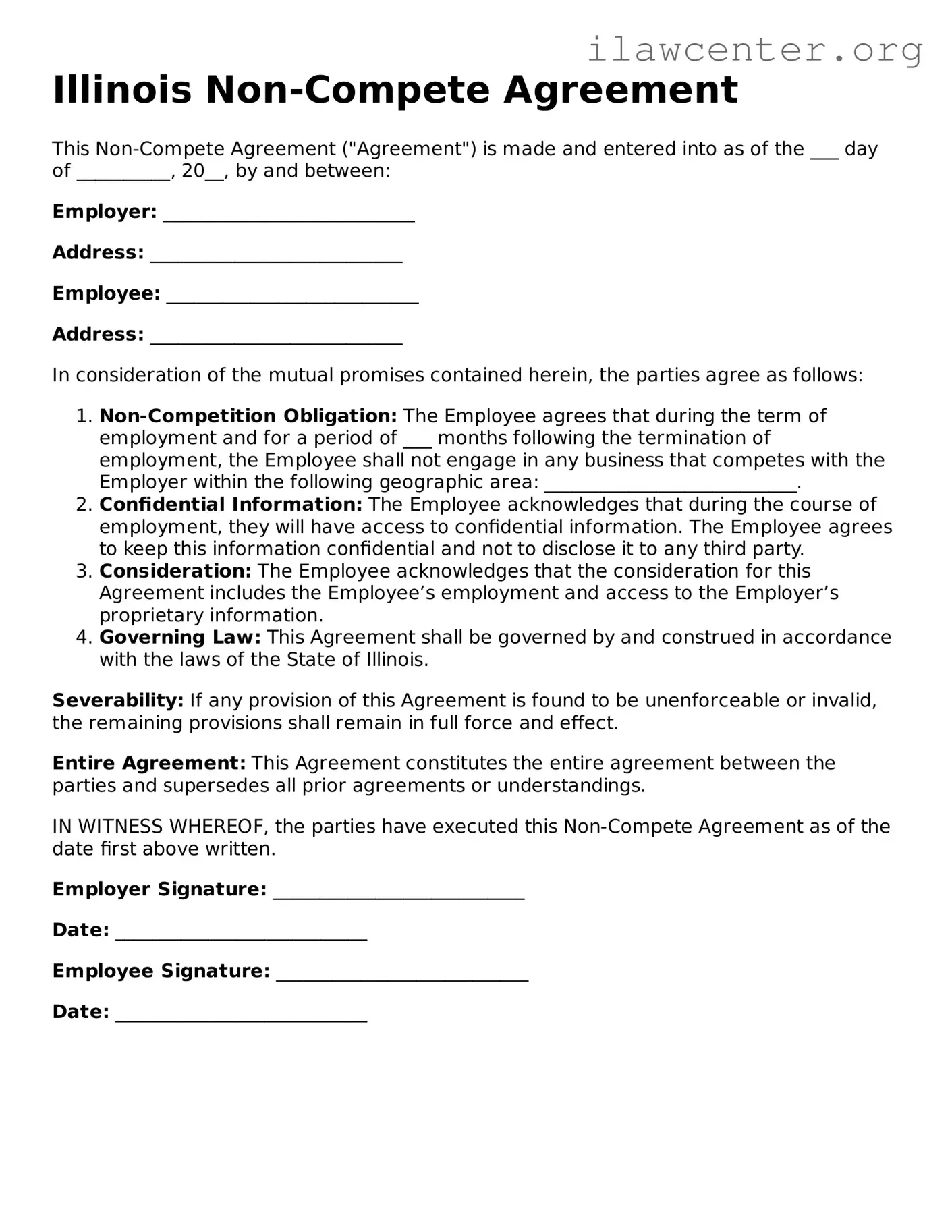
Illinois Non-compete Agreement Preview

Illinois Non-Compete Agreement

This Non-Compete Agreement ("Agreement") is made and entered into as of the ___ day of __________, 20__, by and between:

Employer: ___________________________

Address: ___________________________

Employee: ___________________________

Address: ___________________________

In consideration of the mutual promises contained herein, the parties agree as follows:

  1. Non-Competition Obligation: The Employee agrees that during the term of employment and for a period of ___ months following the termination of employment, the Employee shall not engage in any business that competes with the Employer within the following geographic area: ___________________________.
  2. Confidential Information: The Employee acknowledges that during the course of employment, they will have access to confidential information. The Employee agrees to keep this information confidential and not to disclose it to any third party.
  3. Consideration: The Employee acknowledges that the consideration for this Agreement includes the Employee’s employment and access to the Employer’s proprietary information.
  4. Governing Law: This Agreement shall be governed by and construed in accordance with the laws of the State of Illinois.

Severability: If any provision of this Agreement is found to be unenforceable or invalid, the remaining provisions shall remain in full force and effect.

Entire Agreement: This Agreement constitutes the entire agreement between the parties and supersedes all prior agreements or understandings.

IN WITNESS WHEREOF, the parties have executed this Non-Compete Agreement as of the date first above written.

Employer Signature: ___________________________

Date: ___________________________

Employee Signature: ___________________________

Date: ___________________________

PDF Form Characteristics

Fact Name Description
Definition An Illinois Non-compete Agreement restricts an employee from working for competitors after leaving a job.
Governing Law The agreement is governed by the Illinois Freedom to Work Act.
Enforceability Non-compete agreements must be reasonable in scope, duration, and geographic area to be enforceable.
Consideration There must be valid consideration, such as a job offer or promotion, for the agreement to be binding.
Restrictions Illinois law prohibits non-compete clauses for low-wage workers earning less than $75,000 annually.
Legal Recourse Employees can challenge the validity of non-compete agreements in court if they believe the terms are unreasonable.

Instructions on Utilizing Illinois Non-compete Agreement

After obtaining the Illinois Non-compete Agreement form, you will need to complete it accurately to ensure its validity. Follow these steps carefully to fill out the form correctly.

  1. Begin by entering the date at the top of the form. Use the format MM/DD/YYYY.
  2. Provide your full name in the designated field. Include your middle name if applicable.
  3. Next, fill in your address. Include the street address, city, state, and zip code.
  4. Identify the employer's name. Write the full legal name of the company or organization.
  5. Fill in the employer's address, including the street address, city, state, and zip code.
  6. Specify the position or role you hold with the employer. Clearly state your job title.
  7. Indicate the duration of the non-compete agreement. This should be a specific time frame, such as months or years.
  8. Detail the geographic area where the non-compete will apply. Be specific about the locations included.
  9. Include any additional terms or conditions that may apply. Ensure these are clear and concise.
  10. Finally, sign and date the form at the bottom. Ensure your signature is legible.

Important Facts about Illinois Non-compete Agreement

What is a Non-compete Agreement in Illinois?

A Non-compete Agreement is a legal contract between an employer and an employee. It restricts the employee from engaging in certain activities that may compete with the employer’s business after leaving the job. In Illinois, these agreements must meet specific criteria to be enforceable, including a legitimate business interest and reasonable time and geographic limitations.

Who can use a Non-compete Agreement in Illinois?

Employers in various industries can utilize Non-compete Agreements to protect their business interests. This includes businesses in technology, sales, and professional services. Employees, particularly those with access to sensitive information or trade secrets, may be required to sign such agreements as a condition of employment.

What are the requirements for a Non-compete Agreement to be enforceable in Illinois?

For a Non-compete Agreement to be enforceable in Illinois, it must be reasonable in duration, geographic scope, and the activities it restricts. Additionally, the employer must demonstrate a legitimate business interest that justifies the restrictions. Courts may evaluate these factors on a case-by-case basis.

How long can a Non-compete Agreement last in Illinois?

The duration of a Non-compete Agreement in Illinois varies depending on the nature of the business and the specific circumstances. Generally, a duration of six months to two years is considered reasonable. However, longer periods may be enforceable if justified by the employer’s business interests.

Can an employee negotiate the terms of a Non-compete Agreement?

Yes, employees can negotiate the terms of a Non-compete Agreement before signing. It is advisable to discuss any concerns regarding the restrictions with the employer. Modifications to the duration, geographic scope, or specific activities may be possible to reach a mutually agreeable arrangement.

What happens if a Non-compete Agreement is violated?

If an employee violates a Non-compete Agreement, the employer may take legal action. This could involve seeking an injunction to prevent the employee from continuing the competing activities and potentially pursuing damages. The outcome will depend on the specific terms of the agreement and the circumstances of the violation.

Can a Non-compete Agreement be enforced after employment ends?

Yes, a Non-compete Agreement is typically enforceable after employment ends, provided it meets the legal requirements. The enforceability will depend on the reasonableness of the restrictions and the legitimate business interests of the employer. Courts will review these factors if a dispute arises.
Common mistakes

When filling out the Illinois Non-compete Agreement form, many individuals inadvertently make mistakes that can affect the enforceability of the agreement. One common error is failing to specify the duration of the non-compete clause. Without a clear time frame, the agreement may be deemed overly broad and unenforceable. It is essential to define how long the restrictions will last, as Illinois courts generally favor agreements that are reasonable in duration.

Another frequent mistake is neglecting to outline the geographic scope of the non-compete. A vague or overly expansive geographic area can lead to challenges in court. It is crucial to limit the area to where the employee worked or where the employer has legitimate business interests. By doing so, the agreement will be more likely to hold up under scrutiny.

Many people also overlook the need for consideration when signing a non-compete agreement. In Illinois, there must be something of value exchanged for the agreement to be valid. This could be a job offer, a promotion, or even specialized training. If no consideration is provided, the agreement may be considered void, leaving both parties unprotected.

Lastly, individuals often fail to read and understand the terms of the agreement fully. Signing a document without comprehension can lead to unintended consequences. It is wise to take the time to review the entire agreement, ask questions, and seek legal advice if necessary. Understanding the implications of a non-compete can help individuals make informed decisions about their career paths.

Documents used along the form

When entering into a non-compete agreement in Illinois, several other forms and documents may be relevant to ensure clarity and legal compliance. Here’s a list of these documents, along with a brief description of each.

  • Employment Agreement: This document outlines the terms of employment, including job responsibilities, compensation, and other benefits. It often includes clauses related to confidentiality and non-compete provisions.
  • Confidentiality Agreement: Also known as a non-disclosure agreement (NDA), this document protects sensitive information shared between the employer and employee. It ensures that proprietary information is not disclosed to third parties.
  • Severance Agreement: This agreement is used when an employee leaves a company. It may include terms regarding severance pay, benefits continuation, and any ongoing obligations, such as non-compete clauses.
  • Intellectual Property Assignment Agreement: This document assigns ownership of any intellectual property created by the employee during their employment to the employer. It ensures that the company retains rights to innovations developed by its employees.
  • Offer Letter: This letter formally offers a position to a candidate. It typically includes details about the job, salary, and may reference the need for a non-compete agreement.
  • Performance Review Documents: These records assess an employee's performance. They can be relevant in discussions about non-compete agreements, especially if an employee's performance impacts their eligibility for certain roles.
  • Employee Handbook: This document outlines company policies, procedures, and expectations. It often includes sections on non-compete agreements and confidentiality to inform employees of their obligations.
  • Exit Interview Form: This form collects feedback from departing employees. It may touch on the understanding of non-compete obligations and other agreements in place.

Understanding these documents can help both employers and employees navigate their rights and responsibilities. Each form plays a role in creating a clear framework for the working relationship and protecting the interests of both parties.

Similar forms

A Non-compete Agreement is a legal document that restricts an individual from entering into competition with a former employer for a certain period of time and within a specific geographic area. Several other legal documents share similarities with a Non-compete Agreement. Here are eight such documents:

  • Non-disclosure Agreement (NDA): This document prevents individuals from disclosing confidential information obtained during their employment. Like a Non-compete Agreement, it aims to protect a company's interests.
  • Non-solicitation Agreement: This agreement restricts an employee from soliciting clients or employees of the former employer. Both agreements serve to protect business relationships and proprietary information.
  • Employment Contract: An employment contract outlines the terms of employment, including duties and compensation. Non-compete clauses can be included within these contracts to limit post-employment competition.
  • Confidentiality Agreement: Similar to an NDA, this document requires parties to keep certain information private. Both agreements focus on safeguarding sensitive information from being shared with competitors.
  • Severance Agreement: This agreement outlines the terms under which an employee will receive severance pay. Often, it includes a Non-compete clause to ensure the employee does not compete immediately after leaving the company.
  • Partnership Agreement: This document governs the relationship between business partners. It may contain provisions similar to Non-compete Agreements to protect the business from departing partners.
  • Independent Contractor Agreement: This agreement outlines the terms for independent contractors. It may include Non-compete clauses to limit the contractor's ability to work with competitors after the contract ends.
  • Intellectual Property Assignment Agreement: This document ensures that any intellectual property created during employment is owned by the employer. It often aligns with Non-compete Agreements by protecting the employer’s innovations and competitive edge.

Dos and Don'ts

When filling out the Illinois Non-compete Agreement form, it's important to approach the process with care. Here are some key dos and don'ts to keep in mind:

  • Do read the entire agreement thoroughly before signing.
  • Do consult with a legal professional if you have any questions.
  • Do ensure that all information is accurate and up to date.
  • Do understand the implications of the agreement on your future employment.
  • Do keep a copy of the signed agreement for your records.
  • Don't rush through the form without understanding its terms.
  • Don't sign the agreement if you feel pressured or uncertain.
  • Don't leave any sections blank; complete all required fields.
  • Don't ignore any clauses that seem unclear or overly restrictive.
  • Don't forget to check for any expiration dates or conditions.

Misconceptions

Many individuals and businesses in Illinois have questions about non-compete agreements. Misunderstandings can lead to confusion and potential legal issues. Below are five common misconceptions about the Illinois Non-compete Agreement form.

  1. Non-compete agreements are always enforceable.

    While many non-compete agreements can be enforced, they are not universally valid. Illinois courts will consider factors such as reasonableness in time and geographic scope, as well as the necessity for protecting legitimate business interests.

  2. All employees must sign a non-compete agreement.

    Not every employee is required to sign a non-compete agreement. Employers typically reserve these agreements for key positions where sensitive information or trade secrets are involved.

  3. Non-compete agreements can last indefinitely.

    Illinois law requires that non-compete agreements be reasonable in duration. Generally, agreements lasting more than two years may face scrutiny in court.

  4. Signing a non-compete means you cannot work in your field at all.

    This is not necessarily true. A non-compete agreement may restrict employment with specific competitors or within a certain geographic area, but it does not prohibit all work in the industry.

  5. Non-compete agreements are the same as non-disclosure agreements.

    These two types of agreements serve different purposes. A non-disclosure agreement protects confidential information, while a non-compete agreement restricts employment opportunities after leaving a job.

Understanding these misconceptions can help individuals and employers navigate the complexities of non-compete agreements in Illinois more effectively.

Key takeaways

When considering a Non-compete Agreement in Illinois, it is essential to understand its implications and requirements. Below are key takeaways that can guide individuals and employers in effectively filling out and utilizing this form.

  • Understand the Purpose: A Non-compete Agreement is designed to protect a business's interests by restricting an employee's ability to work for competitors after leaving the company.
  • Know the Legal Framework: Illinois law governs Non-compete Agreements, and specific criteria must be met for these agreements to be enforceable.
  • Consider Duration: The agreement should specify a reasonable duration for the restrictions. Commonly, durations range from six months to two years.
  • Define Geographic Scope: Clearly outline the geographic area where the restrictions apply. This area should be relevant to the business's operations.
  • Identify Protected Interests: The agreement should articulate what business interests are being protected, such as trade secrets or customer relationships.
  • Offer Consideration: For the agreement to be valid, the employee must receive something of value in exchange for signing, such as a job offer or a promotion.
  • Ensure Clarity: Use clear and unambiguous language in the agreement to avoid confusion or misinterpretation of the terms.
  • Review for Reasonableness: Courts in Illinois will assess whether the restrictions are reasonable in terms of duration, geographic scope, and the interests being protected.
  • Consult Legal Counsel: It is advisable to seek legal advice when drafting or signing a Non-compete Agreement to ensure compliance with applicable laws.

Understanding these aspects can help both employers and employees navigate the complexities of Non-compete Agreements in Illinois, promoting fair practices and protecting legitimate business interests.