Attorney-Verified  Notary Acknowledgement Document for Illinois

Attorney-Verified Notary Acknowledgement Document for Illinois

The Illinois Notary Acknowledgement form is a legal document used to confirm that a signer has willingly signed a document in the presence of a notary public. This form serves as proof that the notary has verified the identity of the signer and witnessed the signing process. Ensure your documents are properly acknowledged by filling out the form below.

Article Guide

The Illinois Notary Acknowledgement form serves a crucial role in the legal process, providing a verified record that a signature has been made willingly and with the signer's identity confirmed. This form is often required for various documents, such as contracts, deeds, and affidavits, ensuring that the signatory's intentions are clear and legally binding. It includes essential details like the name of the person signing, the date of the acknowledgment, and the notary's official signature and seal. By using this form, individuals can enhance the credibility of their documents, making it easier to enforce agreements and protect their rights. Understanding the components and requirements of the Illinois Notary Acknowledgement form is vital for anyone involved in legal transactions, as it helps prevent disputes and misunderstandings down the line.

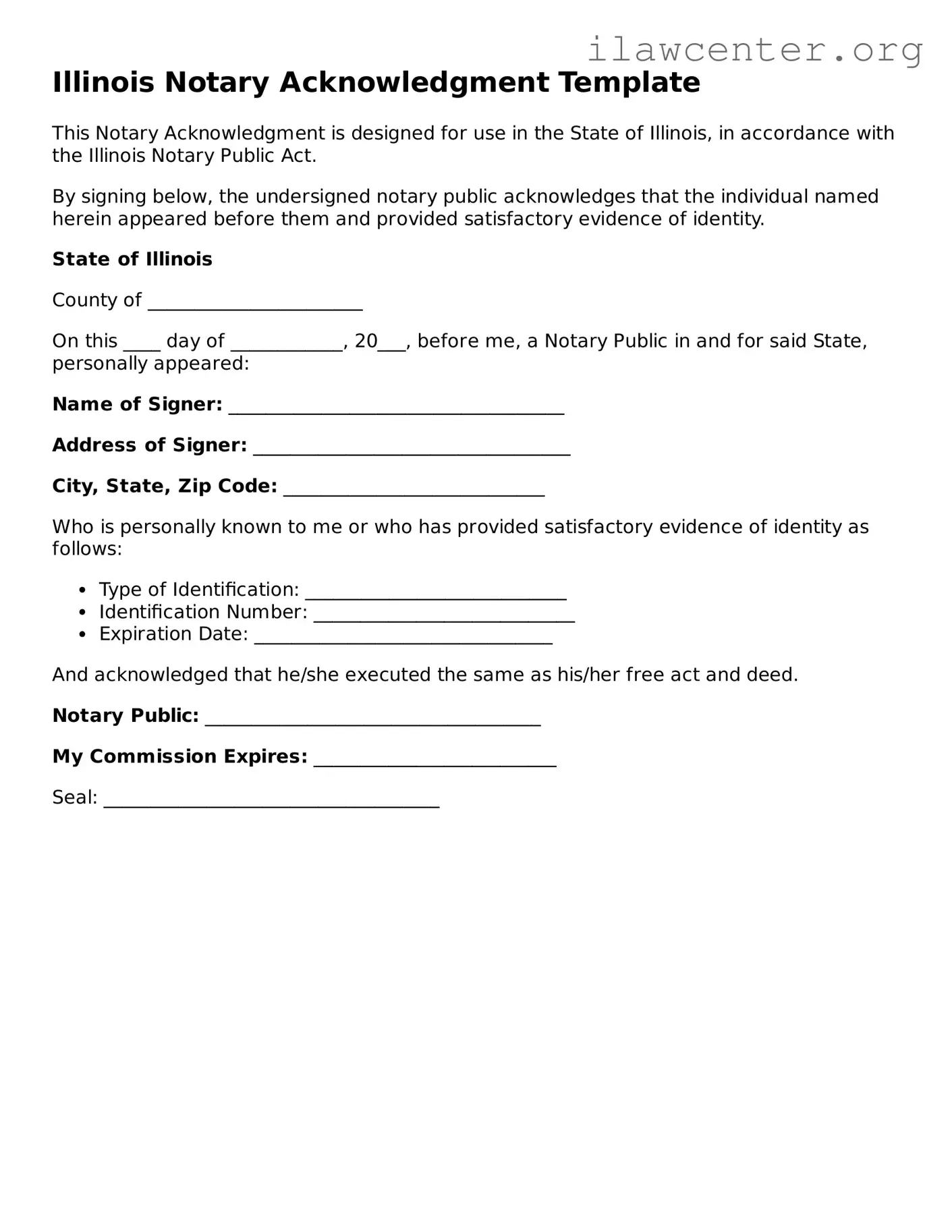
Illinois Notary Acknowledgement Preview

Illinois Notary Acknowledgment Template

This Notary Acknowledgment is designed for use in the State of Illinois, in accordance with the Illinois Notary Public Act.

By signing below, the undersigned notary public acknowledges that the individual named herein appeared before them and provided satisfactory evidence of identity.

State of Illinois

County of _______________________

On this ____ day of ____________, 20___, before me, a Notary Public in and for said State, personally appeared:

Name of Signer: ____________________________________

Address of Signer: __________________________________

City, State, Zip Code: ____________________________

Who is personally known to me or who has provided satisfactory evidence of identity as follows:

  • Type of Identification: ____________________________
  • Identification Number: ____________________________
  • Expiration Date: ________________________________

And acknowledged that he/she executed the same as his/her free act and deed.

Notary Public: ____________________________________

My Commission Expires: __________________________

Seal: ____________________________________

PDF Form Characteristics

Fact Name Description
Purpose The Illinois Notary Acknowledgement form is used to verify the identity of a signer and confirm their willingness to sign a document.
Governing Law This form is governed by the Illinois Notary Public Act (5 ILCS 312).
Signature Requirement The signer must personally appear before the notary at the time of the acknowledgment.
Notary's Role The notary public's role is to witness the signing and to complete the acknowledgment by filling out the form.
Form Elements The form typically includes the name of the signer, the date, and the notary's signature and seal.
Record Keeping Notaries are required to keep a record of all acknowledgments performed, which helps maintain transparency and accountability.

Instructions on Utilizing Illinois Notary Acknowledgement

After obtaining the Illinois Notary Acknowledgment form, you will need to fill it out accurately. This step is essential for ensuring that the document is valid and can be used as intended. Follow these instructions carefully to complete the form.

  1. Begin by writing the date at the top of the form.
  2. In the first blank space, enter the name of the person who is signing the document.
  3. Next, provide the address of the person signing the document in the designated area.
  4. Identify the type of document being signed. Write this in the appropriate section.
  5. In the next section, the signer must acknowledge that they are signing voluntarily. This may require a statement or a check box to confirm.
  6. Leave space for the notary’s signature and seal. This is where the notary will sign once the document is completed.
  7. Finally, review the entire form for accuracy. Ensure that all information is complete and correct before submission.

Important Facts about Illinois Notary Acknowledgement

What is an Illinois Notary Acknowledgement form?

The Illinois Notary Acknowledgement form is a document used to verify that a person has signed a document in the presence of a notary public. This form serves as proof that the signer’s identity was confirmed and that they willingly signed the document. It is often required for legal documents, including deeds, contracts, and affidavits.

Who can act as a notary public in Illinois?

In Illinois, a notary public must be at least 18 years old, a resident of the state or a non-resident who is employed in Illinois, and must have no felony convictions. They must also complete the application process and receive a commission from the Secretary of State.

Why is a notary acknowledgement necessary?

A notary acknowledgement provides a layer of security and authenticity to important documents. It helps to prevent fraud by confirming that the person signing the document is indeed who they claim to be. This is especially important in legal matters where the validity of the document may be questioned.

How do I complete an Illinois Notary Acknowledgement form?

To complete the form, the signer must appear before the notary public. The notary will ask the signer to provide identification to confirm their identity. After confirming the identity, the notary will complete the acknowledgement section of the form, which includes details such as the date, location, and the notary’s signature and seal.

Is there a fee for notarization in Illinois?

Yes, notaries in Illinois are allowed to charge a fee for their services. As of 2023, the maximum fee for a notary acknowledgement is $1 per signature. However, some notaries may charge additional fees for travel or other services, so it’s a good idea to discuss fees upfront.

Can I use a Notary Acknowledgement form for any document?

Generally, a Notary Acknowledgement can be used for most legal documents. However, certain documents may have specific requirements. It is always wise to check the requirements for the particular document you are working with to ensure compliance.

How long is an Illinois Notary Acknowledgement valid?

The validity of a notary acknowledgement does not have a specific expiration date. However, the underlying document may have its own time constraints. It is essential to ensure that the document is executed within any applicable timeframes to avoid issues later on.

What should I do if my notary acknowledgement is rejected?

If your notary acknowledgement is rejected, first determine the reason for the rejection. It could be due to missing information, improper notarization, or issues with the document itself. Address the issue promptly by contacting the notary for clarification or seeking assistance to correct the problem.

Can a notary public refuse to notarize a document?

Yes, a notary public has the right to refuse notarization if they believe that the signer is not acting voluntarily, if the document is incomplete, or if they cannot verify the identity of the signer. Notaries must adhere to ethical standards and ensure that the notarization process is legitimate.

Where can I find a notary public in Illinois?

Notary publics can often be found at banks, law offices, and public libraries. Additionally, many online directories provide listings of notaries in your area. It is advisable to contact the notary beforehand to confirm their availability and any fees associated with their services.
Common mistakes

Filling out the Illinois Notary Acknowledgement form can seem straightforward, but many individuals make common mistakes that can lead to delays or complications. One frequent error is failing to include the correct date. The date must reflect when the acknowledgment is made, not when the document was signed. This oversight can cause confusion and may invalidate the acknowledgment.

Another common mistake is not providing the signer's name clearly. It’s essential that the name matches the identification presented. If the name is misspelled or incomplete, the notary may not be able to properly verify the identity of the signer, which could jeopardize the document's validity.

Additionally, some people forget to include the notary's signature. The notary must sign the acknowledgment to confirm that the procedure was followed correctly. Without this signature, the document lacks the necessary authentication and may not be accepted by other parties.

Moreover, individuals often neglect to provide the notary's seal. The seal is a critical component of the acknowledgment. If it is missing, it raises questions about the legitimacy of the notarization. Ensuring that the seal is affixed properly can prevent future issues.

Another mistake involves not checking the jurisdiction. The acknowledgment must specify the county where the notarization takes place. Failing to indicate this can lead to complications, especially if the document is used in a different jurisdiction.

People also sometimes overlook the requirement for the notary to personally witness the signing of the document. If the notary does not witness the signature, they cannot provide a valid acknowledgment. This step is crucial for maintaining the integrity of the notarization process.

In addition, individuals may mistakenly think that a notary can certify documents without being present. A notary must always be present when the document is signed. This ensures that the signer is doing so willingly and understands the content of the document.

Another frequent error is using an outdated form. Notary laws can change, and using an old version of the acknowledgment form may not comply with current regulations. It is vital to ensure that the most recent form is being used to avoid any legal issues.

Lastly, individuals sometimes fail to read the instructions carefully. Each section of the acknowledgment form has specific requirements. Skipping over these instructions can lead to incomplete or incorrect submissions, which can delay the notarization process.

Documents used along the form

When dealing with the Illinois Notary Acknowledgment form, several other documents often accompany it to ensure that transactions are properly executed and legally binding. Understanding these documents can help you navigate the process more smoothly.

  • Power of Attorney: This document allows one person to grant authority to another to act on their behalf in legal or financial matters. It often requires notarization to ensure its validity.
  • Affidavit: An affidavit is a written statement confirmed by oath or affirmation, used as evidence in court. Notarization helps verify the identity of the person making the statement.
  • Deed: A deed is a legal document that conveys property ownership from one party to another. Notarization is typically required to validate the transfer.
  • Contract: This is a legally binding agreement between two or more parties. Certain contracts may need to be notarized to be enforceable, especially those involving real estate.
  • Loan Documents: These documents outline the terms of a loan agreement. Many lenders require notarization to protect against fraud and ensure all parties are aware of their obligations.
  • Wills: A will is a legal document that outlines how a person's assets will be distributed after their death. Notarization can add an extra layer of authenticity.
  • Living Trust: This document establishes a trust during a person's lifetime, allowing them to manage their assets. Notarization can help confirm the trust's legitimacy.
  • Release of Liability: This form protects one party from legal claims made by another. Notarization ensures that all parties understand and agree to the terms.
  • Certification of Trust: This document certifies the existence of a trust and outlines its terms. Notarization can help verify its authenticity.

Familiarizing yourself with these documents can make the process of notarization more efficient and effective. Each plays a crucial role in ensuring that agreements and transactions are legally sound and respected.

Similar forms

The Notary Acknowledgement form serves a specific purpose in verifying the identity of individuals signing a document. However, several other documents share similarities in their function and importance. Here are five documents that are akin to the Notary Acknowledgement form:

  • Affidavit: Like a Notary Acknowledgement, an affidavit is a written statement confirmed by oath or affirmation. It often requires a notary to validate the identity of the signer and ensure the statement is made voluntarily.
  • Power of Attorney: This document allows one person to act on behalf of another. A notary often verifies the identities of both parties, ensuring that the principal is granting authority willingly and understands the implications.
  • Deed: A property deed transfers ownership from one party to another. Notarization is typically required to confirm that the signatures are genuine and that the parties involved are who they claim to be.
  • Will: A will outlines an individual's wishes regarding the distribution of their assets after death. Notarization can provide an extra layer of authenticity, verifying the identity of the testator and ensuring that the will is executed properly.
  • Contract: Contracts are agreements between parties that can be legally enforced. While not always required, having a contract notarized adds credibility, confirming that the parties signed the document willingly and were properly identified.

Understanding these documents and their similarities to the Notary Acknowledgement form is crucial. Each plays a vital role in ensuring the integrity and legality of important agreements and statements.

Dos and Don'ts

When filling out the Illinois Notary Acknowledgement form, it is essential to follow certain guidelines to ensure that the process is smooth and valid. Below is a list of things you should and shouldn't do while completing this important document.

  • Do ensure that the signer is present when you complete the acknowledgment. The signer must personally appear before you.
  • Do verify the identity of the signer. Acceptable forms of identification include a government-issued ID with a photo.
  • Do fill out the form completely and accurately. Any missing or incorrect information may invalidate the acknowledgment.
  • Do sign and stamp the form with your official notary seal. This step is crucial for the document's legitimacy.
  • Don't allow the signer to leave without completing the acknowledgment. The process must be done in one sitting.
  • Don't use a notary acknowledgment form that has been altered or is not the correct version. Using the wrong form can lead to complications.

By adhering to these guidelines, you can help ensure that the notary acknowledgment process is carried out effectively and in compliance with Illinois law.

Misconceptions

When dealing with the Illinois Notary Acknowledgement form, it's common for misunderstandings to arise. Here are four misconceptions that people often have:

  1. Notaries can verify the content of documents.

    This is not true. A notary's role is to witness the signing of a document and confirm the identity of the signer. They do not assess or verify the content of the document itself.

  2. All documents require notarization.

    Not every document needs to be notarized. While some legal documents do require notarization to be valid, many do not. It’s essential to check whether notarization is necessary for your specific document.

  3. Notaries are responsible for ensuring the signer understands the document.

    This is a common misconception. Notaries are not responsible for explaining the document's contents or implications to the signer. It is the signer's responsibility to understand what they are signing.

  4. Once a document is notarized, it cannot be changed.

    This is misleading. A notarized document can still be amended or revoked, but any changes made after notarization may require re-notarization to maintain legal validity.

Understanding these points can help clarify the role of notaries and the process of notarization in Illinois. Always ensure that you have the correct information before proceeding with any legal documents.

Key takeaways

When it comes to the Illinois Notary Acknowledgement form, understanding its purpose and proper use is crucial. Here are some key takeaways to keep in mind:

  • Purpose: The form serves to verify the identity of the signer and confirm that they willingly signed the document.
  • Signature Requirement: The signer must be present at the time of notarization and must sign in front of the notary.
  • Identification: Valid identification is necessary. Acceptable forms include a driver's license or a state-issued ID.
  • Notary's Role: The notary public is responsible for ensuring the signer understands the document before signing.
  • Completeness: All sections of the form must be filled out completely to avoid any issues with the notarization.
  • Record Keeping: Notaries should maintain a log of all acknowledgments performed, which can be helpful for future reference.
  • Legal Weight: A properly completed acknowledgment can lend legal credibility to the document it accompanies.
  • State-Specific Rules: Always check for any changes in state laws regarding notary practices to ensure compliance.

By keeping these points in mind, you can navigate the process of using the Illinois Notary Acknowledgement form with confidence and ease.