Attorney-Verified  Notice to Quit Document for Illinois

Attorney-Verified Notice to Quit Document for Illinois

The Illinois Notice to Quit form is a legal document used by landlords to formally notify tenants that they must vacate the rental property. This notice is a crucial step in the eviction process, outlining the reasons for the eviction and providing a timeline for the tenant to leave. Understanding how to properly fill out and serve this form is essential for both landlords and tenants alike.

Ready to take the next step? Fill out the form by clicking the button below.

Article Guide

In Illinois, the Notice to Quit form serves as a critical document in the landlord-tenant relationship, particularly when a landlord seeks to terminate a tenancy. This form is an essential first step in the eviction process, providing tenants with formal notification that they must vacate the rental property. It typically outlines the reasons for termination, which may include failure to pay rent, violation of lease terms, or other lawful grounds. The Notice to Quit must be delivered to the tenant in a specific manner, ensuring that it meets state legal requirements. Understanding the nuances of this form is vital for both landlords and tenants, as it establishes the timeline for vacating the premises and can influence the subsequent legal proceedings. Proper completion and delivery of the Notice to Quit can help prevent misunderstandings and disputes, making it a key element in maintaining a smooth rental experience.

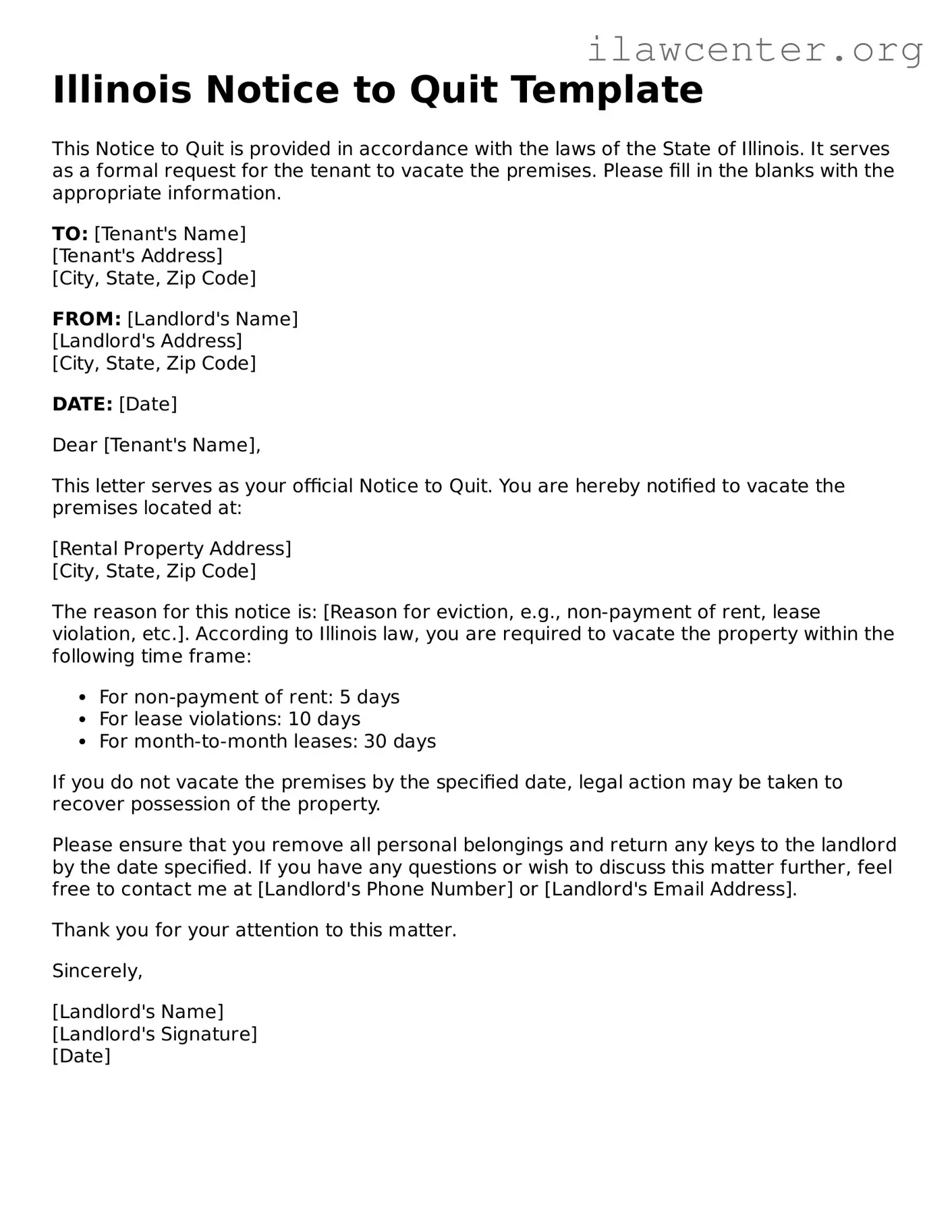
Illinois Notice to Quit Preview

Illinois Notice to Quit Template

This Notice to Quit is provided in accordance with the laws of the State of Illinois. It serves as a formal request for the tenant to vacate the premises. Please fill in the blanks with the appropriate information.

TO: [Tenant's Name]
[Tenant's Address]
[City, State, Zip Code]

FROM: [Landlord's Name]
[Landlord's Address]
[City, State, Zip Code]

DATE: [Date]

Dear [Tenant's Name],

This letter serves as your official Notice to Quit. You are hereby notified to vacate the premises located at:

[Rental Property Address]
[City, State, Zip Code]

The reason for this notice is: [Reason for eviction, e.g., non-payment of rent, lease violation, etc.]. According to Illinois law, you are required to vacate the property within the following time frame:

  • For non-payment of rent: 5 days
  • For lease violations: 10 days
  • For month-to-month leases: 30 days

If you do not vacate the premises by the specified date, legal action may be taken to recover possession of the property.

Please ensure that you remove all personal belongings and return any keys to the landlord by the date specified. If you have any questions or wish to discuss this matter further, feel free to contact me at [Landlord's Phone Number] or [Landlord's Email Address].

Thank you for your attention to this matter.

Sincerely,

[Landlord's Name]
[Landlord's Signature]
[Date]

PDF Form Characteristics

Fact Name Details
Purpose The Illinois Notice to Quit form is used by landlords to inform tenants of the termination of their lease.
Governing Law The form is governed by the Illinois Compiled Statutes, specifically 735 ILCS 5/9-207.
Delivery Method The notice can be delivered in person, by mail, or by posting on the tenant's door.
Timeframe Typically, a 5-day notice is required for non-payment of rent, while a 10-day notice is for lease violations.
Signature Requirement The landlord must sign the notice to make it valid.
Tenant's Rights Tenants have the right to dispute the notice and may seek legal advice.
Form Variations Different versions exist for various lease violations and non-payment scenarios.
Record Keeping Landlords should keep a copy of the notice for their records.
Legal Consequences Failure to comply with the notice can lead to eviction proceedings.

Instructions on Utilizing Illinois Notice to Quit

After completing the Illinois Notice to Quit form, you will need to deliver it to the tenant. This step is crucial as it formally notifies them of the need to vacate the premises. Ensure you keep a copy for your records.

  1. Begin by downloading the Illinois Notice to Quit form from a reliable source.
  2. Fill in the date at the top of the form, indicating when the notice is being issued.
  3. Enter your name and address in the designated fields. This identifies you as the landlord.
  4. Provide the tenant’s name and address. Make sure this information is accurate to avoid confusion.
  5. Specify the reason for the notice. This could be for non-payment of rent or lease violations.
  6. Indicate the number of days the tenant has to vacate the property. This period depends on the reason for the notice.
  7. Sign the form at the bottom. This shows that you are the one issuing the notice.
  8. Make a copy of the completed form for your records before delivering it.

Important Facts about Illinois Notice to Quit

What is the Illinois Notice to Quit form?

The Illinois Notice to Quit form is a legal document used by landlords to inform tenants that they must vacate the rental property. This notice is typically issued when a tenant has violated the lease agreement, such as failing to pay rent or causing damage to the property. The form outlines the reasons for eviction and provides a specified timeframe for the tenant to leave the premises.

When should a landlord use a Notice to Quit?

A landlord should use a Notice to Quit when they have a legitimate reason to terminate the tenancy. Common reasons include non-payment of rent, lease violations, or illegal activity on the property. It is essential for landlords to follow the proper legal procedures, as failing to do so may delay the eviction process.

How much notice is required for a Notice to Quit in Illinois?

The amount of notice required can vary depending on the reason for eviction. Generally, for non-payment of rent, a landlord must provide a 5-day notice. For lease violations, a 10-day notice may be required. If the lease has expired, a 30-day notice is typically sufficient. It is crucial to check local laws, as they may impose different requirements.

Can a tenant contest a Notice to Quit?

Yes, a tenant can contest a Notice to Quit. If a tenant believes the notice is unjust or the reasons for eviction are unfounded, they can respond to the landlord and seek to resolve the issue. If the situation escalates, the tenant may choose to defend against the eviction in court. Legal advice may be beneficial in such cases.

What happens if a tenant does not comply with a Notice to Quit?

If a tenant does not comply with a Notice to Quit, the landlord may proceed with the eviction process. This typically involves filing a lawsuit in the appropriate court. The court will then schedule a hearing where both parties can present their case. If the court rules in favor of the landlord, the tenant may be ordered to vacate the property.

Is the Notice to Quit form available online?

Yes, the Notice to Quit form can often be found online. Various legal websites and state resources provide templates that landlords can use. However, it is important to ensure that the form complies with current Illinois laws and regulations. Customizing the form to fit the specific situation is also recommended.

What should landlords include in the Notice to Quit?

Landlords should include specific details in the Notice to Quit, such as the tenant's name, the address of the rental property, the reason for the notice, and the timeframe within which the tenant must vacate. Clear and concise language helps avoid misunderstandings. Additionally, it is advisable to keep a copy of the notice for record-keeping purposes.
Common mistakes

Filling out the Illinois Notice to Quit form can be a straightforward process, but there are common mistakes that can lead to complications. One frequent error is not providing the correct address of the tenant. It's essential to ensure that the address is complete and accurate. Missing details can delay the process or even invalidate the notice.

Another common mistake is failing to specify the reason for the eviction. The form requires a clear explanation of why the notice is being issued. Omitting this information can cause confusion and may lead to disputes later on. Make sure to provide a concise reason that aligns with the grounds for eviction.

People often overlook the importance of including the date. The notice must indicate when it was served to the tenant. Without this date, it may be difficult to establish timelines, which are crucial for any legal proceedings that may follow.

Additionally, some individuals forget to sign the form. A signature is necessary to validate the notice. Without it, the document may be considered incomplete. Ensure that the form is signed by the landlord or the authorized representative.

Lastly, not keeping a copy of the completed Notice to Quit is a mistake that can have serious consequences. Always retain a copy for your records. This can serve as proof of the notice being issued and can be helpful if the matter escalates to court.

Documents used along the form

When dealing with rental agreements and tenant issues in Illinois, several forms may be necessary alongside the Illinois Notice to Quit form. Each of these documents serves a specific purpose in the process of managing rental properties and addressing tenant-related matters.

  • Lease Agreement: This document outlines the terms and conditions of the rental arrangement between the landlord and tenant. It includes details such as rent amount, payment due dates, and rules for the property.
  • Notice of Non-Payment of Rent: This notice is given to tenants who have not paid their rent. It informs them of the overdue payment and usually provides a specific timeframe to pay before further action is taken.
  • Eviction Notice: Also known as a Summons and Complaint, this document is filed with the court to formally begin the eviction process. It outlines the reasons for eviction and provides the tenant with information on how to respond.
  • Rental Application: This form is used to screen potential tenants. It collects personal and financial information to help landlords decide if a tenant is a good fit for their property.

Understanding these documents can help landlords and tenants navigate their rights and responsibilities more effectively. Having the right forms on hand can make the process smoother and less stressful for everyone involved.

Similar forms

  • Eviction Notice: This document informs a tenant that they must vacate the property due to a lease violation or non-payment of rent. Like a Notice to Quit, it sets a timeline for the tenant to leave.
  • Lease Termination Notice: A landlord uses this form to notify tenants that their lease will not be renewed at the end of the term. It shares similarities with the Notice to Quit in that it provides a clear end date for occupancy.
  • Demand for Possession: This document is often used in legal proceedings to demand that a tenant leave the property. It resembles the Notice to Quit in its purpose to reclaim possession of the property.
  • Notice of Non-Renewal: This is sent to tenants to inform them that their lease will not be renewed. It functions similarly to the Notice to Quit by establishing a deadline for moving out.
  • Notice of Default: This document alerts a tenant to their failure to comply with lease terms, such as late rent. It parallels the Notice to Quit by indicating a need for corrective action or departure.
  • Notice of Rent Increase: While primarily focused on rent changes, this notice can serve as a precursor to a Notice to Quit if the tenant does not agree to the new terms. Both documents communicate changes in the rental agreement.
  • Termination of Tenancy Notice: This document formally ends a tenant's right to occupy the property. It is similar to the Notice to Quit in that it provides a clear timeframe for the tenant to vacate.
  • Notice of Violation: This informs a tenant of specific lease violations. If the issues are not resolved, it may lead to a Notice to Quit, highlighting its role in the eviction process.

Dos and Don'ts

When filling out the Illinois Notice to Quit form, it's important to follow certain guidelines to ensure the process goes smoothly. Here are ten things you should and shouldn't do:

  • Do clearly state the reason for the notice.
  • Do include the date by which the tenant must vacate the property.
  • Do provide your contact information for any follow-up questions.
  • Do keep a copy of the completed form for your records.
  • Do deliver the notice in a manner that complies with state laws.
  • Don't use vague language that could confuse the tenant.
  • Don't forget to sign and date the form.
  • Don't leave out important details, such as the tenant's name and address.
  • Don't assume the tenant will understand the notice without clear instructions.
  • Don't ignore local regulations that may affect the notice process.

By adhering to these guidelines, you can help ensure that the Notice to Quit is effective and legally sound.

Misconceptions

Misconceptions about the Illinois Notice to Quit form can lead to confusion for both landlords and tenants. Understanding these misconceptions is crucial for ensuring compliance with the law. Here are eight common misconceptions:

  1. The Notice to Quit is the same as an eviction notice. Many believe that these two terms are interchangeable. However, a Notice to Quit is a preliminary step that informs the tenant of the need to vacate the premises, while an eviction notice is a formal legal action that follows if the tenant does not comply.
  2. A Notice to Quit can be issued for any reason. This is not accurate. In Illinois, a Notice to Quit must be issued for specific reasons, such as non-payment of rent or lease violations. It cannot be used arbitrarily.
  3. Landlords can issue a Notice to Quit without prior communication. While a Notice to Quit can be issued without prior notice, it is often recommended that landlords communicate with tenants first to resolve issues amicably.
  4. The Notice to Quit must be delivered in person. This misconception suggests that personal delivery is the only acceptable method. In reality, landlords can also send the Notice to Quit via certified mail or post it on the property, following proper procedures.
  5. Once a Notice to Quit is issued, the tenant must leave immediately. Tenants have a specified period, typically five days for non-payment of rent, to respond or vacate. Immediate departure is not required.
  6. Only landlords can issue a Notice to Quit. Tenants may also issue a Notice to Quit if they are facing issues such as uninhabitable living conditions. This form can serve as a notice to the landlord to address these issues.
  7. A Notice to Quit is a guarantee of eviction. This is misleading. Issuing a Notice to Quit does not guarantee that eviction will occur. The tenant may choose to resolve the issue or negotiate with the landlord.
  8. There is a standard form for the Notice to Quit in Illinois. While there are guidelines for creating a Notice to Quit, landlords often have flexibility in how they format the document, as long as it meets legal requirements.

Clarifying these misconceptions can help both landlords and tenants navigate the rental process more effectively, ensuring that everyone understands their rights and responsibilities.

Key takeaways

Filling out and using the Illinois Notice to Quit form is an important step for landlords seeking to terminate a lease. Here are some key takeaways to keep in mind:

  • The Notice to Quit must be delivered to the tenant in a timely manner, typically at least five days before any legal action is taken.
  • Ensure that the form includes all necessary details, such as the tenant's name, the property address, and the reason for termination.
  • It is crucial to specify the date by which the tenant must vacate the property.
  • Delivery methods can vary; you may choose to hand deliver, send via certified mail, or post it on the door, depending on the situation.
  • Keep a copy of the completed Notice to Quit for your records, as it may be needed for future legal proceedings.
  • Consult local laws or a legal professional if unsure about any specific requirements or procedures related to the Notice to Quit.