Attorney-Verified  Power of Attorney for a Child Document for Illinois

Attorney-Verified Power of Attorney for a Child Document for Illinois

The Illinois Power of Attorney for a Child form allows a parent or guardian to designate another adult to make decisions on behalf of their child. This legal document is essential for ensuring that a trusted individual can act in the child's best interest when the parent is unavailable. To get started on filling out the form, click the button below.

Article Guide

The Illinois Power of Attorney for a Child form is a legal document designed to grant specific authority to an individual, often referred to as the agent, to make decisions on behalf of a minor child. This form is particularly useful for parents or legal guardians who may need to delegate their parental responsibilities temporarily, such as during travel or extended absences. It allows the appointed agent to manage various aspects of the child's welfare, including decisions related to education, healthcare, and general day-to-day activities. The form requires the signatures of both the parent or guardian and the designated agent, ensuring that the arrangement is consensual and legally binding. It is essential to understand the scope of authority being granted, as the form can be tailored to fit specific needs, whether for a limited time or a broader, ongoing arrangement. Additionally, the Illinois Power of Attorney for a Child can be revoked at any time by the parent or guardian, providing flexibility and control over the child's care. Proper completion and execution of this form can help facilitate smooth transitions in caregiving and ensure that the child's best interests are upheld during the designated period.

Illinois Power of Attorney for a Child Preview

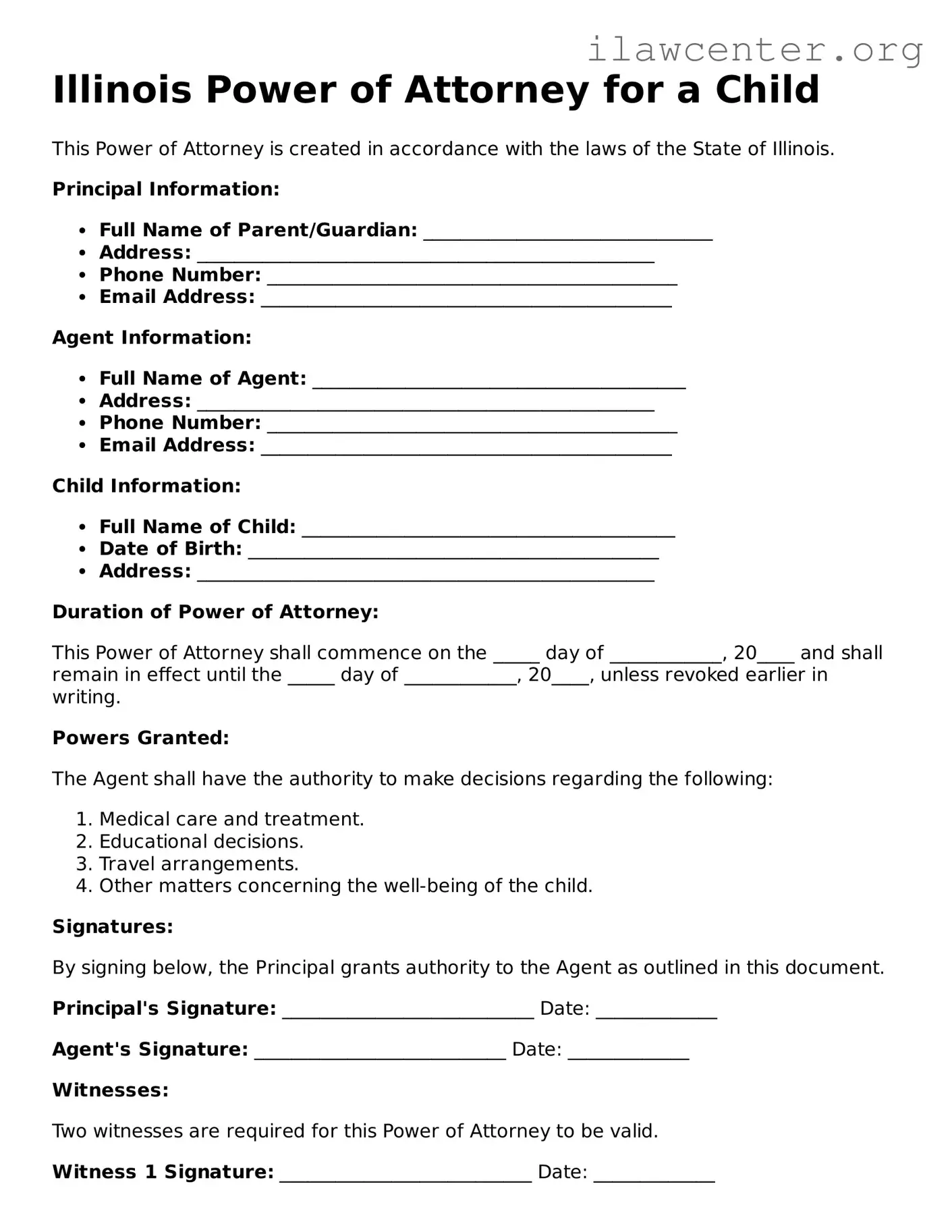
Illinois Power of Attorney for a Child

This Power of Attorney is created in accordance with the laws of the State of Illinois.

Principal Information:

  • Full Name of Parent/Guardian: _______________________________
  • Address: _________________________________________________
  • Phone Number: ____________________________________________
  • Email Address: ____________________________________________

Agent Information:

  • Full Name of Agent: ________________________________________
  • Address: _________________________________________________
  • Phone Number: ____________________________________________
  • Email Address: ____________________________________________

Child Information:

  • Full Name of Child: ________________________________________
  • Date of Birth: ____________________________________________
  • Address: _________________________________________________

Duration of Power of Attorney:

This Power of Attorney shall commence on the _____ day of ____________, 20____ and shall remain in effect until the _____ day of ____________, 20____, unless revoked earlier in writing.

Powers Granted:

The Agent shall have the authority to make decisions regarding the following:

  1. Medical care and treatment.
  2. Educational decisions.
  3. Travel arrangements.
  4. Other matters concerning the well-being of the child.

Signatures:

By signing below, the Principal grants authority to the Agent as outlined in this document.

Principal's Signature: ___________________________ Date: _____________

Agent's Signature: ___________________________ Date: _____________

Witnesses:

Two witnesses are required for this Power of Attorney to be valid.

Witness 1 Signature: ___________________________ Date: _____________

Witness 2 Signature: ___________________________ Date: _____________

This document should be kept in a safe place and copies should be provided to the Agent and any relevant parties.

PDF Form Characteristics

Fact Name Description
Purpose The Illinois Power of Attorney for a Child form allows a parent or guardian to designate another adult to make decisions on behalf of their child in specific situations.
Governing Law This form is governed by the Illinois Power of Attorney Act, specifically 755 ILCS 45/1-1 et seq.
Duration The authority granted through this form can be limited to a specific time frame or event, ensuring flexibility for the parent or guardian.
Notarization The form must be signed in the presence of a notary public to be legally valid, ensuring the authenticity of the signatures.
Revocation A parent or guardian can revoke the Power of Attorney at any time, provided they follow the proper procedures outlined in the law.
Limitations This form does not grant the agent the authority to make medical decisions unless specified; a separate medical power of attorney may be required for that purpose.

Instructions on Utilizing Illinois Power of Attorney for a Child

To fill out the Illinois Power of Attorney for a Child form, gather the necessary information and follow the steps carefully. This process ensures that the document is completed correctly, allowing you to designate someone to make decisions on behalf of a child.

  1. Obtain the Illinois Power of Attorney for a Child form. You can find it online or request a copy from a legal office.
  2. Begin by filling in the child’s full name at the top of the form.
  3. Provide the child’s date of birth. This information is crucial for identification.
  4. Enter the name of the person you are appointing as the attorney-in-fact. This is the individual who will have the authority to make decisions for the child.
  5. Include the attorney-in-fact’s address and phone number. This ensures that they can be contacted easily.
  6. Specify the duration of the power of attorney. Indicate whether it is effective immediately or if there is a specific time frame.
  7. Sign and date the form in the designated area. Your signature confirms that you understand and agree to the terms outlined in the document.
  8. Have the form notarized. A notary public will verify your identity and witness your signature, which is often required for the document to be valid.

Once completed, keep a copy for your records and provide a copy to the attorney-in-fact. This ensures that all parties have access to the document when needed.

Important Facts about Illinois Power of Attorney for a Child

What is a Power of Attorney for a Child in Illinois?

A Power of Attorney for a Child is a legal document that allows a parent or legal guardian to appoint another adult to make decisions on behalf of their child. This can include decisions about healthcare, education, and general welfare. It is particularly useful for situations where the parent may be temporarily unavailable, such as during travel or in emergencies.

Who can be appointed as an agent for my child?

In Illinois, you can appoint any trusted adult as your child's agent. This can be a family member, friend, or neighbor. It’s important to choose someone who is responsible and capable of making decisions in your child's best interest. The agent should also be willing to accept this responsibility.

How long does the Power of Attorney for a Child remain in effect?

The Power of Attorney for a Child can remain in effect until the specified expiration date you set in the document, or until you revoke it. If no expiration date is provided, it generally lasts until the child turns 18 years old. However, it’s a good idea to review the document periodically to ensure it still meets your needs.

Do I need to have the Power of Attorney for a Child notarized?

Yes, in Illinois, the Power of Attorney for a Child must be signed in the presence of a notary public. This helps to ensure that the document is legally valid and can be recognized by schools, healthcare providers, and other institutions. Make sure to keep a copy of the notarized document for your records.

Can I revoke the Power of Attorney for a Child once it is created?

Yes, you can revoke the Power of Attorney for a Child at any time. To do so, you should create a written notice stating that you are revoking the document. It’s a good idea to notify the agent and any institutions that may have a copy of the original Power of Attorney to prevent any confusion.

What should I consider before creating a Power of Attorney for my child?

Before creating a Power of Attorney for your child, consider your child’s specific needs and the circumstances under which the agent may need to act. Discuss the responsibilities with the person you wish to appoint, ensuring they understand the role. It’s also wise to think about any medical or educational preferences you have for your child, as these can guide the agent’s decisions.

Common mistakes

Filling out the Illinois Power of Attorney for a Child form can be a straightforward process, but many people make common mistakes that can lead to complications later on. One significant error is failing to provide complete information about the child. The form requires specific details such as the child’s full name, date of birth, and address. Omitting any of this information can render the document incomplete and may cause issues when it is needed.

Another mistake is not clearly identifying the agent who will have the authority to make decisions on behalf of the child. It is essential to include the agent’s full name and contact information. If the agent’s identity is vague or unclear, it can lead to confusion about who is responsible for making decisions. This can create unnecessary stress during critical times when decisions need to be made swiftly.

People often overlook the importance of signatures on the form. Both the parent or guardian granting the power and the agent must sign the document. Failing to obtain the necessary signatures can invalidate the entire form. Additionally, if the signatures are not dated, it may lead to questions about when the authority was granted, complicating matters further.

Another common oversight is neglecting to specify the duration of the power of attorney. Some individuals may assume that the authority lasts indefinitely, but this is not always the case. Clearly stating the start and end dates of the power of attorney can prevent misunderstandings and ensure that the arrangement aligns with the family’s needs.

Lastly, many people forget to review the form thoroughly before submitting it. It is crucial to double-check all entries for accuracy and completeness. Errors or omissions may not be apparent at first glance, but they can lead to significant problems later. Taking the time to review the document can save families from potential legal issues down the line.

Documents used along the form

When creating a Power of Attorney for a Child in Illinois, there are several other documents that may be important to consider. These forms can help ensure that the child's needs are met and that legal matters are handled smoothly. Below is a list of commonly used documents that often accompany the Power of Attorney for a Child form.

  • Medical Consent Form: This document allows the designated agent to make medical decisions on behalf of the child in case of emergencies or when parents are unavailable.
  • Authorization for Release of Information: This form permits healthcare providers to share the child's medical records with the designated agent, ensuring they have access to necessary information.
  • Emergency Contact Information: A simple list of contacts, including family members and friends, who can be reached in case of an emergency involving the child.
  • Travel Consent Form: If the child will be traveling with the designated agent, this form grants permission for the agent to take the child on trips, especially out of state or internationally.
  • School Authorization Form: This document allows the designated agent to enroll the child in school, attend parent-teacher meetings, and access educational records.
  • Financial Power of Attorney: If the agent needs to manage financial matters for the child, this form grants them the authority to handle banking and other financial transactions.
  • Child Care Agreement: This agreement outlines the responsibilities of the designated agent regarding the child's care, including daily routines and activities.
  • Affidavit of Guardianship: This legal document can be used to affirm the agent's role and responsibilities, providing additional support for their authority over the child.

Having these documents prepared and organized can significantly ease the process of caring for a child when the parents are not available. It is crucial to ensure that all necessary permissions and authorizations are in place to avoid any complications. Always consult with a legal professional to ensure compliance with Illinois laws and regulations.

Similar forms

  • Durable Power of Attorney: This document allows one person to designate another to make decisions on their behalf, even if they become incapacitated. Like the Power of Attorney for a Child, it grants authority but is broader in scope.
  • Medical Power of Attorney: This form specifically gives someone the authority to make medical decisions for another individual. Similar to the Power of Attorney for a Child, it focuses on decision-making but is limited to health-related matters.
  • Financial Power of Attorney: This document allows someone to manage financial affairs for another person. It shares the same principle of delegation but pertains solely to financial decisions.
  • Guardianship Documents: These legal papers establish a guardian for a minor. While the Power of Attorney for a Child allows temporary decision-making authority, guardianship is a more permanent arrangement.
  • Consent to Medical Treatment: This document allows a designated person to consent to medical care for a child. It is similar in that it focuses on health decisions, but it is often used for specific treatments rather than broad authority.
  • Travel Consent Form: This form grants permission for a child to travel with someone other than their parents. Like the Power of Attorney for a Child, it ensures that the caregiver has the authority to act in the child's best interest during travel.
  • Child Care Agreement: This document outlines the responsibilities of a caregiver for a child. Similar to the Power of Attorney for a Child, it establishes authority but is more focused on the day-to-day care of the child.
  • Temporary Custody Agreement: This is a legal arrangement that grants temporary custody of a child to another person. It shares similarities with the Power of Attorney for a Child in that it provides authority for a specific time frame.
  • Educational Power of Attorney: This form allows someone to make educational decisions for a child. Like the Power of Attorney for a Child, it focuses on a specific area of authority, in this case, education.

Dos and Don'ts

When filling out the Illinois Power of Attorney for a Child form, it is important to approach the process with care. Below are some essential dos and don'ts to consider.

  • Do ensure that you understand the responsibilities you are taking on.
  • Do provide accurate and complete information about the child and the designated agent.
  • Do sign the form in the presence of a notary public to validate it.
  • Do keep a copy of the completed form for your records.
  • Do review the form periodically to ensure it still meets your needs.
  • Don't rush through the form; take your time to avoid mistakes.
  • Don't leave any sections blank, as this can lead to confusion or legal issues.
  • Don't assume that verbal agreements are sufficient; written documentation is essential.
  • Don't forget to discuss the arrangement with the child, if appropriate, to ensure they understand.
  • Don't ignore state laws and requirements; familiarize yourself with them before submitting the form.

Misconceptions

Understanding the Illinois Power of Attorney for a Child form is crucial for parents and guardians. However, several misconceptions can lead to confusion about its purpose and implications. Here are seven common misconceptions:

  1. It is only for emergencies.

    Many believe that this form is only necessary in emergencies. In reality, it can be used for planned situations where a parent needs someone else to care for their child temporarily.

  2. It gives up parental rights.

    Some people think that signing this form means they are relinquishing their parental rights. This is not true. The form allows temporary authority but does not transfer custody permanently.

  3. Any adult can be designated.

    While it may seem that any adult can be named as an agent, the law requires that the designated person be trustworthy and capable of making decisions in the child's best interest.

  4. It is a complicated legal document.

    Many assume that the Power of Attorney for a Child form is overly complex. In fact, it is designed to be straightforward and user-friendly for parents.

  5. It is only valid in Illinois.

    Some believe that this form is only valid within Illinois. While it is primarily governed by Illinois law, it may be recognized in other states, depending on their laws.

  6. It can only be used for medical decisions.

    While medical decisions can be part of the authority granted, the form can also cover other areas, such as education and general care, allowing for a broader range of responsibilities.

  7. It must be notarized.

    There is a misconception that the form must be notarized to be valid. However, it only requires the signatures of the parents or legal guardians, although notarization can add an extra layer of authenticity.

Addressing these misconceptions can help ensure that parents and guardians utilize the Illinois Power of Attorney for a Child form effectively and confidently.

Key takeaways

Filling out and using the Illinois Power of Attorney for a Child form is a crucial step for parents and guardians. Here are some key takeaways to consider:

  • The form allows a parent or legal guardian to delegate authority to another adult to make decisions for their child.
  • It is important to choose a trustworthy individual, as they will have significant responsibilities.
  • The form must be signed in the presence of a notary public to be legally valid.
  • Specify the duration of the power of attorney; it can be temporary or more long-term.
  • Ensure that the form includes specific powers granted, such as healthcare decisions or educational choices.
  • Review the document periodically to ensure it still meets your needs and reflects your wishes.
  • Keep copies of the signed form accessible for the appointed individual and any relevant institutions.