Attorney-Verified  Power of Attorney Document for Illinois

Attorney-Verified Power of Attorney Document for Illinois

The Illinois Power of Attorney form is a legal document that allows an individual to appoint someone else to make decisions on their behalf, particularly in financial or healthcare matters. This form is essential for ensuring that your wishes are honored when you are unable to communicate them yourself. To get started on securing your future, consider filling out the form by clicking the button below.

Article Guide

The Illinois Power of Attorney form is a crucial legal document that allows you to designate someone you trust to make decisions on your behalf when you are unable to do so. This form can cover a range of powers, including financial matters and healthcare decisions. By completing this form, you ensure that your wishes are respected and that your affairs are managed according to your preferences. It is important to understand the different types of powers you can grant, as well as the responsibilities of the person you choose as your agent. Additionally, the Illinois Power of Attorney form requires specific signatures and may need to be notarized to be legally binding. Being informed about these key aspects will help you navigate the process effectively and ensure that your rights and interests are protected.

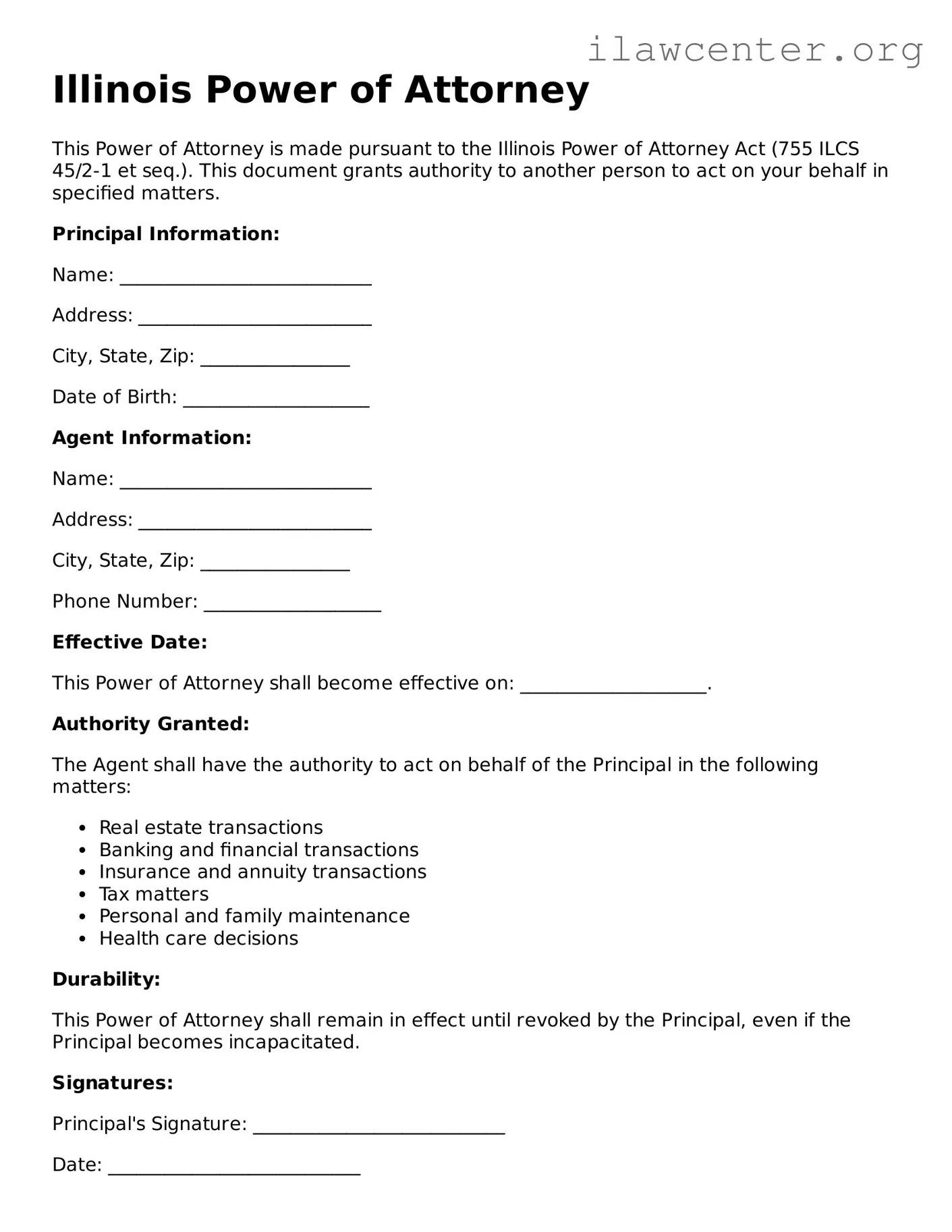
Illinois Power of Attorney Preview

Illinois Power of Attorney

This Power of Attorney is made pursuant to the Illinois Power of Attorney Act (755 ILCS 45/2-1 et seq.). This document grants authority to another person to act on your behalf in specified matters.

Principal Information:

Name: ___________________________

Address: _________________________

City, State, Zip: ________________

Date of Birth: ____________________

Agent Information:

Name: ___________________________

Address: _________________________

City, State, Zip: ________________

Phone Number: ___________________

Effective Date:

This Power of Attorney shall become effective on: ____________________.

Authority Granted:

The Agent shall have the authority to act on behalf of the Principal in the following matters:

  • Real estate transactions
  • Banking and financial transactions
  • Insurance and annuity transactions
  • Tax matters
  • Personal and family maintenance
  • Health care decisions

Durability:

This Power of Attorney shall remain in effect until revoked by the Principal, even if the Principal becomes incapacitated.

Signatures:

Principal's Signature: ___________________________

Date: ___________________________

Agent's Signature: ___________________________

Date: ___________________________

Witnesses:

1. Witness Name: ___________________________

Signature: ___________________________

Date: ___________________________

2. Witness Name: ___________________________

Signature: ___________________________

Date: ___________________________

Notarization:

State of Illinois, County of ________________

Subscribed and sworn before me on this _____ day of ____________, 20__.

Notary Public Signature: ___________________________

My commission expires: ___________________________

PDF Form Characteristics

Fact Name Details
Governing Law The Illinois Power of Attorney is governed by the Illinois Power of Attorney Act (755 ILCS 45/1-1 et seq.).
Types of Power of Attorney There are two main types: Durable Power of Attorney for Health Care and Durable Power of Attorney for Property.
Durability A Durable Power of Attorney remains effective even if the principal becomes incapacitated.
Agent's Authority The agent can make decisions regarding finances, property, and health care, depending on the form used.
Principal's Signature The form must be signed by the principal to be valid.
Witness Requirements At least one witness is required to sign the Power of Attorney document, and the witness cannot be the agent.
Notarization While notarization is not required, it is recommended to enhance the document's validity.
Revocation The principal can revoke the Power of Attorney at any time as long as they are competent.
Healthcare Decisions In the case of health care, the agent can make medical decisions if the principal is unable to do so.
State-Specific Forms Illinois has specific forms that must be used to comply with state laws.

Instructions on Utilizing Illinois Power of Attorney

Filling out the Illinois Power of Attorney form is an important step in ensuring that your wishes are respected regarding your financial and healthcare decisions. After completing the form, it will need to be signed and possibly witnessed or notarized, depending on the specific requirements. Below are the steps to guide you through the process of filling out the form.

  1. Begin by obtaining the official Illinois Power of Attorney form. You can find it online or at a local legal office.
  2. Carefully read through the entire form to understand the sections and requirements.
  3. In the designated area, provide your full name and address as the principal, the person granting the authority.
  4. Next, identify the agent you are appointing. This person will act on your behalf. Include their full name and address.
  5. Specify the powers you wish to grant to your agent. You can choose to give broad authority or limit it to specific tasks.
  6. If applicable, include any additional instructions or limitations regarding the authority granted.
  7. Sign and date the form in the presence of a witness or a notary public, as required.
  8. Ensure that your agent also signs the form, acknowledging their acceptance of the responsibilities.
  9. Keep a copy of the completed form for your records and provide copies to your agent and any relevant parties.

Important Facts about Illinois Power of Attorney

What is a Power of Attorney in Illinois?

A Power of Attorney (POA) in Illinois is a legal document that allows one person, known as the principal, to authorize another person, called the agent or attorney-in-fact, to act on their behalf. This can include making financial decisions, managing property, or handling medical care. The POA can be tailored to grant specific powers or can be broad in scope, depending on the needs of the principal.

How do I create a Power of Attorney in Illinois?

To create a Power of Attorney in Illinois, you must complete the appropriate form, which can be found online or through legal resources. It is important to clearly outline the powers you wish to grant to your agent. After filling out the form, you must sign it in front of a notary public. In some cases, witnesses may also be required. Ensure that your agent understands their responsibilities and is willing to act in your best interest.

Can I revoke a Power of Attorney in Illinois?

Yes, you can revoke a Power of Attorney in Illinois at any time, as long as you are mentally competent. To do so, you must create a written revocation document. This document should clearly state your intention to revoke the POA and should be signed and dated. It is advisable to notify your agent and any relevant third parties of the revocation to prevent any confusion.

What happens if I become incapacitated and have not created a Power of Attorney?

If you become incapacitated without having a Power of Attorney in place, your family may need to go through a legal process called guardianship to make decisions on your behalf. This process can be time-consuming and costly. To avoid this situation, it is wise to establish a POA while you are still able to make decisions about your future care and finances.

Common mistakes

Filling out the Illinois Power of Attorney form can be a straightforward process, but many people make common mistakes that can lead to complications later. One of the most frequent errors is not selecting the appropriate type of Power of Attorney. In Illinois, there are different forms for healthcare and property decisions. Ensuring you choose the right one is crucial for your intentions to be honored.

Another common mistake involves failing to specify the powers granted. The form allows you to outline specific authorities that you want to give to your agent. Leaving these sections vague can lead to misunderstandings or disputes about what your agent can or cannot do on your behalf.

People often forget to date the document. A Power of Attorney must be dated to be valid. Without a date, there could be questions about when the authority was granted, which might complicate matters in the future.

Signing the form incorrectly is another issue. It is essential that you, the principal, sign the document in the presence of a notary public. If the signature is missing or improperly executed, the form may not hold up in legal situations.

Many individuals neglect to discuss their decisions with their chosen agent beforehand. It's vital that the person you designate as your agent understands your wishes and is willing to take on this responsibility. Failing to communicate can lead to confusion and stress when the time comes to act.

Another mistake is not having a backup agent. Life can be unpredictable, and your first choice might not be available when needed. Including an alternate agent ensures that your wishes can still be carried out if your primary agent is unable to serve.

Additionally, some people overlook the importance of reviewing the document regularly. Life changes, such as divorce or the death of a loved one, can affect your choices. Regularly revisiting the Power of Attorney can ensure it still reflects your current situation and desires.

People sometimes forget to inform family members about the Power of Attorney. Keeping your family in the loop can prevent potential conflicts or confusion when the time comes to enact the document.

Another common oversight is failing to understand the implications of the powers granted. It's essential to fully grasp what you are allowing your agent to do. Without a clear understanding, you might inadvertently give away more authority than you intended.

Lastly, not seeking legal advice can be a significant error. While the form is designed to be user-friendly, consulting with a legal professional can help ensure that everything is filled out correctly and that your intentions are clearly expressed. Taking this step can provide peace of mind and clarity for you and your loved ones.

Documents used along the form

In Illinois, the Power of Attorney form is a crucial document that allows individuals to designate someone to make decisions on their behalf. However, there are several other forms and documents that often accompany or complement this form. Understanding these documents can help ensure that all aspects of your legal and financial affairs are managed effectively.

  • Healthcare Power of Attorney: This document allows you to appoint someone to make medical decisions for you if you become unable to do so. It ensures that your healthcare preferences are respected when you cannot communicate them yourself.
  • Living Will: A living will outlines your wishes regarding medical treatment in situations where you are terminally ill or incapacitated. This document provides guidance to your healthcare providers and loved ones about the type of care you wish to receive.
  • Durable Power of Attorney: Similar to the general Power of Attorney, this document remains effective even if you become incapacitated. It allows your agent to manage your financial affairs, ensuring that your bills are paid and assets are managed appropriately.
  • Advance Directive: An advance directive combines elements of a living will and a healthcare power of attorney. It provides instructions for medical treatment and designates an agent to make decisions on your behalf, ensuring a comprehensive approach to your healthcare wishes.

Utilizing these documents in conjunction with the Power of Attorney form can provide a robust framework for managing your affairs. It is essential to consider your specific needs and consult with a professional to ensure that all documents reflect your wishes accurately.

Similar forms

  • Living Will: A living will outlines your wishes regarding medical treatment in case you become unable to communicate. Like a Power of Attorney, it allows you to express your preferences, but it specifically focuses on healthcare decisions.
  • Healthcare Proxy: This document designates someone to make medical decisions on your behalf if you are unable to do so. Similar to a Power of Attorney, it grants authority to another person, but it is limited to healthcare matters.
  • Durable Power of Attorney: This is a specific type of Power of Attorney that remains effective even if you become incapacitated. It shares the same purpose of granting authority but has a lasting effect during periods of incapacity.
  • Financial Power of Attorney: This document allows someone to manage your financial affairs. It is similar to a general Power of Attorney but focuses solely on financial matters like paying bills and managing investments.
  • Trust: A trust allows a person to manage assets for the benefit of another. Like a Power of Attorney, it involves delegating authority, but it is often used for long-term asset management rather than immediate decision-making.
  • Will: A will outlines how your assets should be distributed after your death. While a Power of Attorney is used during your lifetime to make decisions on your behalf, a will takes effect only after you pass away.
  • Advance Directive: This document combines a living will and a healthcare proxy. It provides instructions for medical care and designates someone to make decisions, similar to a Power of Attorney, but it specifically addresses end-of-life care.

Dos and Don'ts

When filling out the Illinois Power of Attorney form, it is essential to approach the process with care. Here are some important dos and don'ts to keep in mind:

  • Do ensure that you fully understand the powers you are granting to your agent. Read the form carefully.
  • Do choose a trusted individual as your agent. This person will make decisions on your behalf.
  • Don't rush through the form. Take your time to fill it out accurately to avoid future complications.
  • Don't forget to sign and date the document in front of a notary public. This step is crucial for the form's validity.

Misconceptions

When it comes to the Illinois Power of Attorney form, several misconceptions can lead to confusion. Understanding these can help individuals make informed decisions about their legal affairs. Here are five common misconceptions:

  • Misconception 1: The Power of Attorney is only for elderly individuals.
  • This is not true. Anyone can benefit from having a Power of Attorney, regardless of age. It’s a proactive step that ensures your wishes are followed if you become unable to make decisions.

  • Misconception 2: A Power of Attorney can make decisions against your wishes.
  • In reality, the person you designate as your agent must act in your best interests. They are legally obligated to follow your instructions and respect your wishes as outlined in the document.

  • Misconception 3: A Power of Attorney is permanent and cannot be revoked.
  • This is a common misunderstanding. You can revoke a Power of Attorney at any time, as long as you are mentally competent. It’s important to communicate this revocation clearly to your agent and any relevant institutions.

  • Misconception 4: A Power of Attorney automatically grants access to all your financial information.
  • While a Power of Attorney does allow your agent to manage your financial matters, the extent of their authority depends on the specific powers you grant them. You can limit their access to certain accounts or decisions if you choose.

  • Misconception 5: You only need a Power of Attorney if you are seriously ill.
  • This is a misconception that can lead to delays in important decisions. Having a Power of Attorney in place is a wise precaution, regardless of your current health status. It ensures that someone you trust can act on your behalf if needed.

Key takeaways

When dealing with the Illinois Power of Attorney form, understanding its key aspects can make a significant difference. Here are some essential takeaways:

  • Choose the Right Agent: Select someone you trust to act in your best interest. This person will have significant authority over your financial or medical decisions.
  • Specify Powers Clearly: Clearly outline what powers you are granting. This can include decisions about healthcare, finances, or property management.
  • Understand Durability: Determine whether the Power of Attorney is durable. A durable Power of Attorney remains effective even if you become incapacitated.
  • Sign in Front of Witnesses: Illinois requires that you sign the document in front of at least one witness or a notary public to ensure its validity.
  • Keep Copies Accessible: After completing the form, keep copies in a safe but accessible location. Inform your agent and family members where to find these copies.
  • Review Regularly: Revisit the Power of Attorney periodically to ensure it still reflects your wishes, especially after major life changes.

Understanding these points can help ensure that your Power of Attorney is effective and aligns with your wishes. Proper preparation is key to navigating future decisions smoothly.