Attorney-Verified  Prenuptial Agreement Document for Illinois

Attorney-Verified Prenuptial Agreement Document for Illinois

A prenuptial agreement, often called a prenup, is a legal document that outlines the division of assets and responsibilities in the event of a divorce. In Illinois, this agreement can provide clarity and protection for both parties before they tie the knot. To ensure your rights and interests are safeguarded, consider filling out the Illinois Prenuptial Agreement form by clicking the button below.

Article Guide

Entering into a marriage is often one of the most significant milestones in a person's life, filled with love and hope for the future. However, alongside the excitement of planning a wedding and envisioning a shared life, it is also essential to consider the practical aspects of a partnership. One such aspect is the Illinois Prenuptial Agreement form, which serves as a valuable tool for couples looking to define their financial rights and responsibilities before tying the knot. This legal document allows partners to outline how assets will be divided in the event of a divorce, ensuring that both parties have clarity and protection. It can address various issues, including the management of property, debts, and even spousal support. By discussing these matters openly, couples can foster a sense of trust and understanding, ultimately strengthening their relationship. While some may view prenuptial agreements as unromantic, they can actually promote healthy communication and set a solid foundation for the future. Understanding the key components of the Illinois Prenuptial Agreement form is crucial for couples who wish to navigate this process thoughtfully and effectively.

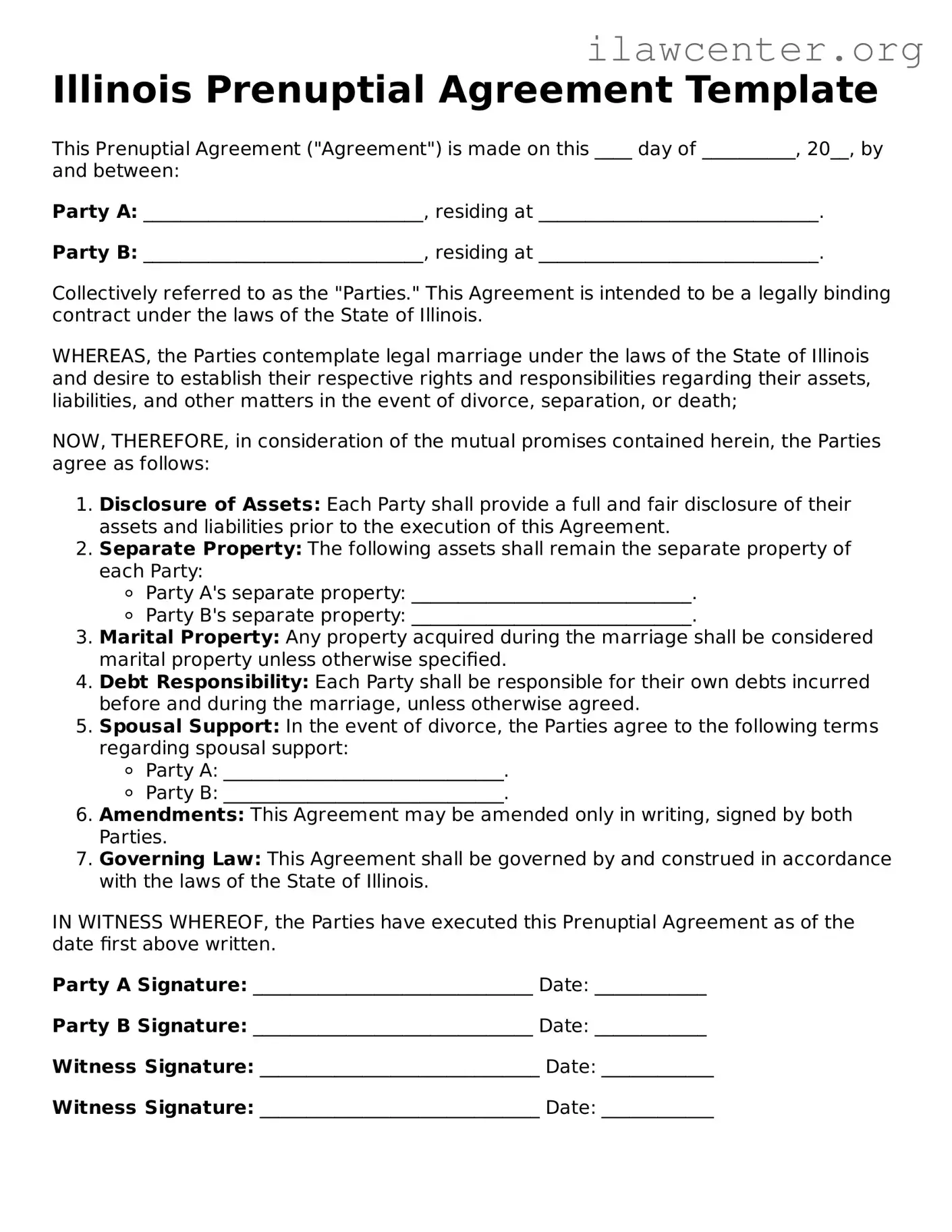
Illinois Prenuptial Agreement Preview

Illinois Prenuptial Agreement Template

This Prenuptial Agreement ("Agreement") is made on this ____ day of __________, 20__, by and between:

Party A: ______________________________, residing at ______________________________.

Party B: ______________________________, residing at ______________________________.

Collectively referred to as the "Parties." This Agreement is intended to be a legally binding contract under the laws of the State of Illinois.

WHEREAS, the Parties contemplate legal marriage under the laws of the State of Illinois and desire to establish their respective rights and responsibilities regarding their assets, liabilities, and other matters in the event of divorce, separation, or death;

NOW, THEREFORE, in consideration of the mutual promises contained herein, the Parties agree as follows:

  1. Disclosure of Assets: Each Party shall provide a full and fair disclosure of their assets and liabilities prior to the execution of this Agreement.
  2. Separate Property: The following assets shall remain the separate property of each Party:
    • Party A's separate property: ______________________________.
    • Party B's separate property: ______________________________.
  3. Marital Property: Any property acquired during the marriage shall be considered marital property unless otherwise specified.
  4. Debt Responsibility: Each Party shall be responsible for their own debts incurred before and during the marriage, unless otherwise agreed.
  5. Spousal Support: In the event of divorce, the Parties agree to the following terms regarding spousal support:
    • Party A: ______________________________.
    • Party B: ______________________________.
  6. Amendments: This Agreement may be amended only in writing, signed by both Parties.
  7. Governing Law: This Agreement shall be governed by and construed in accordance with the laws of the State of Illinois.

IN WITNESS WHEREOF, the Parties have executed this Prenuptial Agreement as of the date first above written.

Party A Signature: ______________________________ Date: ____________

Party B Signature: ______________________________ Date: ____________

Witness Signature: ______________________________ Date: ____________

Witness Signature: ______________________________ Date: ____________

PDF Form Characteristics

Fact Name Description
Governing Law Illinois Prenuptial Agreements are governed by the Illinois Uniform Premarital Agreement Act.
Written Requirement The agreement must be in writing to be enforceable.
Voluntary Execution Both parties must voluntarily sign the agreement without coercion.
Full Disclosure Each party should provide a fair and reasonable disclosure of their financial situation.
Enforceability Courts will enforce the agreement unless it is found to be unconscionable.
Modification The agreement can be modified or revoked, but changes must also be in writing.
Legal Representation It is advisable for both parties to seek independent legal counsel before signing.

Instructions on Utilizing Illinois Prenuptial Agreement

Filling out the Illinois Prenuptial Agreement form is an important step for couples considering marriage. This document helps outline financial arrangements and responsibilities, providing clarity and protection for both parties. Here’s how to complete the form effectively.

  1. Obtain the Form: Start by downloading the Illinois Prenuptial Agreement form from a reliable legal resource or website.
  2. Read the Instructions: Before filling out the form, take a moment to read any accompanying instructions to understand the requirements.
  3. Enter Personal Information: Fill in the full names of both parties, including addresses and contact information. Ensure that all details are accurate.
  4. Outline Assets and Debts: Clearly list all assets and debts for both individuals. This includes property, bank accounts, investments, and any liabilities.
  5. Discuss Financial Arrangements: Specify how finances will be managed during the marriage. Include details about income, expenses, and any agreements regarding joint or separate accounts.
  6. Include Provisions for Spousal Support: If applicable, outline any agreements regarding spousal support in the event of divorce or separation.
  7. Review the Document: After filling in all sections, review the document carefully. Make sure all information is complete and correct.
  8. Sign the Agreement: Both parties must sign the document in the presence of a notary public to ensure its validity.
  9. Keep Copies: After signing, make several copies of the agreement. Store the original in a safe place and provide copies to both parties.

Important Facts about Illinois Prenuptial Agreement

What is a prenuptial agreement in Illinois?

A prenuptial agreement, often called a prenup, is a legal contract made by two individuals before they get married. In Illinois, this agreement outlines how assets and debts will be divided in the event of divorce or separation. It can also address issues like spousal support. This agreement helps couples clarify their financial rights and responsibilities, promoting transparency and reducing potential conflicts in the future.

How do I create a prenuptial agreement in Illinois?

To create a prenuptial agreement in Illinois, both parties should start by discussing their financial situations and expectations. It’s crucial to be open and honest. Once you have a mutual understanding, you can draft the agreement. While you can find templates online, it’s wise to consult with a legal professional to ensure that the agreement meets all legal requirements and is tailored to your specific needs. Both parties must sign the agreement, and it should be notarized to enhance its enforceability.

What should be included in a prenuptial agreement?

A comprehensive prenuptial agreement should cover various aspects, including the division of property, management of debts, and any provisions for spousal support. Additionally, couples may want to include clauses about how to handle future income, inheritances, and gifts. It’s important to ensure that the agreement is fair and reasonable to both parties to avoid potential challenges in court later on.

Can a prenuptial agreement be changed after marriage?

Yes, a prenuptial agreement can be modified after marriage, but both parties must agree to the changes. This is typically done through a postnuptial agreement, which serves a similar purpose as a prenup but is created after the marriage has taken place. Like a prenup, a postnuptial agreement should be in writing, signed by both parties, and ideally reviewed by legal counsel to ensure it is valid and enforceable.

Are prenuptial agreements enforceable in Illinois?

Yes, prenuptial agreements are generally enforceable in Illinois, provided they meet certain legal standards. The agreement must be in writing, signed by both parties, and entered into voluntarily without coercion. It’s also essential that both parties fully disclose their financial situations before signing. If these conditions are met, the agreement is likely to be upheld in court, although specific circumstances may affect its enforceability.

Common mistakes

Filling out the Illinois Prenuptial Agreement form can be a straightforward process, but many individuals make common mistakes that can lead to complications down the line. One of the most frequent errors is failing to disclose all assets and debts. Transparency is crucial in a prenuptial agreement. If one party hides significant financial information, it could invalidate the agreement.

Another mistake is not having the document reviewed by a legal professional. Prenuptial agreements are legal documents, and the nuances of the law can be complex. Without proper guidance, important clauses may be overlooked or misinterpreted, which could lead to disputes later.

Many people also neglect to consider future changes in their financial situation. A prenuptial agreement should account for potential changes, such as income increases, new investments, or the birth of children. Failing to include provisions for these changes can render the agreement less effective.

Additionally, some individuals rush through the signing process without allowing sufficient time for both parties to review the agreement. It’s essential that both partners fully understand the terms before signing. Rushing can lead to misunderstandings and resentment.

Another common oversight is not including a clause for dispute resolution. If disagreements arise in the future, having a pre-agreed method for resolving conflicts can save time and money. Without this clause, couples may find themselves in lengthy and costly legal battles.

People often forget to update their prenuptial agreement after major life events. Changes such as marriage, divorce, or the birth of a child may necessitate revisions to the agreement. Keeping the document current is vital for it to remain valid and effective.

Some couples also overlook the importance of timing. It’s advisable to create and sign the prenuptial agreement well before the wedding date. Last-minute agreements can raise suspicions and may not hold up in court if challenged.

Another mistake is using vague language. Clarity is key in a prenuptial agreement. Ambiguous terms can lead to different interpretations, which can create confusion and disputes later on.

Lastly, individuals often underestimate the emotional aspects involved. Prenuptial agreements can be sensitive topics. Open and honest communication between partners is essential. Addressing concerns and feelings can help both parties feel more comfortable with the agreement.

Documents used along the form

In the process of preparing a prenuptial agreement in Illinois, several other forms and documents may be required or beneficial. These documents help clarify financial arrangements and legal responsibilities between partners. Below is a list of commonly used forms that accompany a prenuptial agreement.

  • Financial Disclosure Statement: This document provides a comprehensive overview of each party's financial situation, including assets, debts, income, and expenses. Transparency is crucial in establishing a fair prenuptial agreement.
  • Property Ownership Agreement: This agreement outlines how property acquired before and during the marriage will be classified and managed. It helps prevent disputes regarding ownership in the future.
  • Postnuptial Agreement: Similar to a prenuptial agreement, this document is created after marriage. It can be useful if circumstances change and the couple wishes to modify their financial arrangements.
  • Separation Agreement: In the event of a separation, this document outlines the terms regarding the division of property, debts, and other responsibilities. It can help streamline the divorce process if necessary.
  • Will: A will specifies how an individual’s assets will be distributed upon their death. Couples may wish to create or update their wills in conjunction with a prenuptial agreement.
  • Trust Document: This document establishes a trust to manage and protect assets. It can be beneficial for individuals with significant assets or those wishing to provide for children from previous relationships.
  • Power of Attorney: This document grants one partner the authority to make financial or medical decisions on behalf of the other in case of incapacity. It is an important consideration for married couples.
  • Marital Settlement Agreement: This agreement outlines the terms of property division, spousal support, and other arrangements in the event of divorce. It can complement a prenuptial agreement.
  • Certificate of Marriage: This official document is required to legally validate the marriage. It is often needed when filing for divorce or updating legal documents post-marriage.

These documents play a vital role in ensuring that both parties understand their rights and responsibilities before entering into marriage. Proper documentation can help prevent misunderstandings and disputes in the future.

Similar forms

  • Postnuptial Agreement: Similar to a prenuptial agreement, this document is created after marriage. It outlines the division of assets and responsibilities in case of divorce or separation.
  • Separation Agreement: This document is used when a couple decides to live apart. It details the terms of their separation, including asset division and child custody arrangements.
  • Divorce Settlement Agreement: This is a final agreement reached during divorce proceedings. It covers the distribution of property, debts, and other marital issues.
  • Living Together Agreement: Also known as a cohabitation agreement, this document is for couples living together. It specifies how assets and responsibilities will be handled during the relationship and in case of separation.
  • Will: A will outlines how a person’s assets will be distributed after death. While it serves a different purpose, both documents address the management of assets.
  • Trust Agreement: This document creates a trust to manage assets for beneficiaries. Like a prenuptial agreement, it involves asset protection and distribution.
  • Power of Attorney: This document allows someone to make decisions on another’s behalf. While not directly related to marriage, it can be part of a broader estate planning strategy.
  • Business Partnership Agreement: This agreement outlines the terms of a business partnership. Similar to a prenuptial agreement, it defines roles, responsibilities, and asset division in case of dissolution.

Dos and Don'ts

When filling out the Illinois Prenuptial Agreement form, it is important to follow certain guidelines to ensure the document is valid and serves its intended purpose. Here are ten things you should and shouldn't do:

  • Do discuss your intentions with your partner openly before starting the process.
  • Don't rush through the form. Take your time to understand each section.
  • Do include full financial disclosures from both parties.
  • Don't hide assets or liabilities. Transparency is crucial.
  • Do consult with a legal professional to review the agreement.
  • Don't use vague language. Be clear and specific about terms.
  • Do consider future circumstances that may affect the agreement.
  • Don't forget to date and sign the document in front of witnesses.
  • Do keep a copy of the signed agreement for your records.
  • Don't assume that verbal agreements are sufficient. Written agreements are necessary.

Misconceptions

There are several misconceptions surrounding the Illinois Prenuptial Agreement form that can lead to confusion. Understanding these can help individuals make informed decisions. Below are four common misconceptions:

  • Prenuptial agreements are only for the wealthy. Many people believe that only those with significant assets need a prenuptial agreement. In reality, anyone entering a marriage can benefit from clarifying financial expectations and responsibilities.
  • Prenuptial agreements are unromantic. Some individuals feel that discussing a prenuptial agreement undermines the romantic nature of marriage. However, these agreements can foster open communication about finances, which is essential for a healthy relationship.
  • Prenuptial agreements are not enforceable. There is a misconception that prenuptial agreements hold no legal weight. In Illinois, as long as the agreement is created and executed properly, it is generally enforceable in court.
  • Prenuptial agreements can cover anything. Some people think that a prenuptial agreement can include any terms they desire. However, Illinois law limits the scope of these agreements to financial matters and cannot include provisions related to child custody or support.

By addressing these misconceptions, individuals can approach the topic of prenuptial agreements with clarity and confidence.

Key takeaways

When considering a prenuptial agreement in Illinois, it is important to understand the key aspects of the process. Here are some essential takeaways:

  1. Understand the Purpose: A prenuptial agreement outlines how assets and debts will be handled in the event of a divorce or separation.
  2. Full Disclosure: Both parties must fully disclose their financial situations, including income, assets, and debts.
  3. Voluntary Agreement: Both individuals should enter into the agreement voluntarily, without any pressure from the other party.
  4. Legal Representation: It is advisable for both parties to have independent legal counsel to ensure that their rights are protected.
  5. Written Document: The agreement must be in writing and signed by both parties to be enforceable.
  6. Consider Timing: Draft and sign the agreement well before the wedding to avoid any claims of coercion.
  7. Review Regularly: Life circumstances change; consider reviewing and updating the agreement periodically.
  8. State Laws: Familiarize yourself with Illinois laws regarding prenuptial agreements, as they can vary from state to state.
  9. Enforceability: Courts may not enforce certain provisions, such as those that are deemed unfair or unconscionable at the time of enforcement.

These points can help ensure that both parties understand their rights and obligations when entering into a prenuptial agreement in Illinois.