Attorney-Verified  Release of Liability Document for Illinois

Attorney-Verified Release of Liability Document for Illinois

The Illinois Release of Liability form is a legal document that protects individuals and organizations from being held liable for injuries or damages that may occur during specific activities. By signing this form, participants acknowledge the risks involved and agree not to hold the organizers responsible. To ensure your safety and understanding, fill out the form by clicking the button below.

Article Guide

The Illinois Release of Liability form serves a critical purpose in various contexts, particularly in activities that carry inherent risks, such as recreational sports, events, or even certain business transactions. This document is designed to protect organizations and individuals from legal claims that may arise from injuries or damages sustained during participation in these activities. By signing the form, participants acknowledge their understanding of the risks involved and agree to waive their right to hold the organization or individual responsible for any potential harm. This waiver not only outlines the responsibilities of the participant but also specifies the limitations of liability, ensuring that both parties have a clear understanding of their rights and obligations. In Illinois, the enforceability of this form depends on its clarity and the voluntary nature of the participant's agreement. As such, it is essential for those utilizing this form to ensure that it is properly drafted and executed to withstand potential legal scrutiny.

Illinois Release of Liability Preview

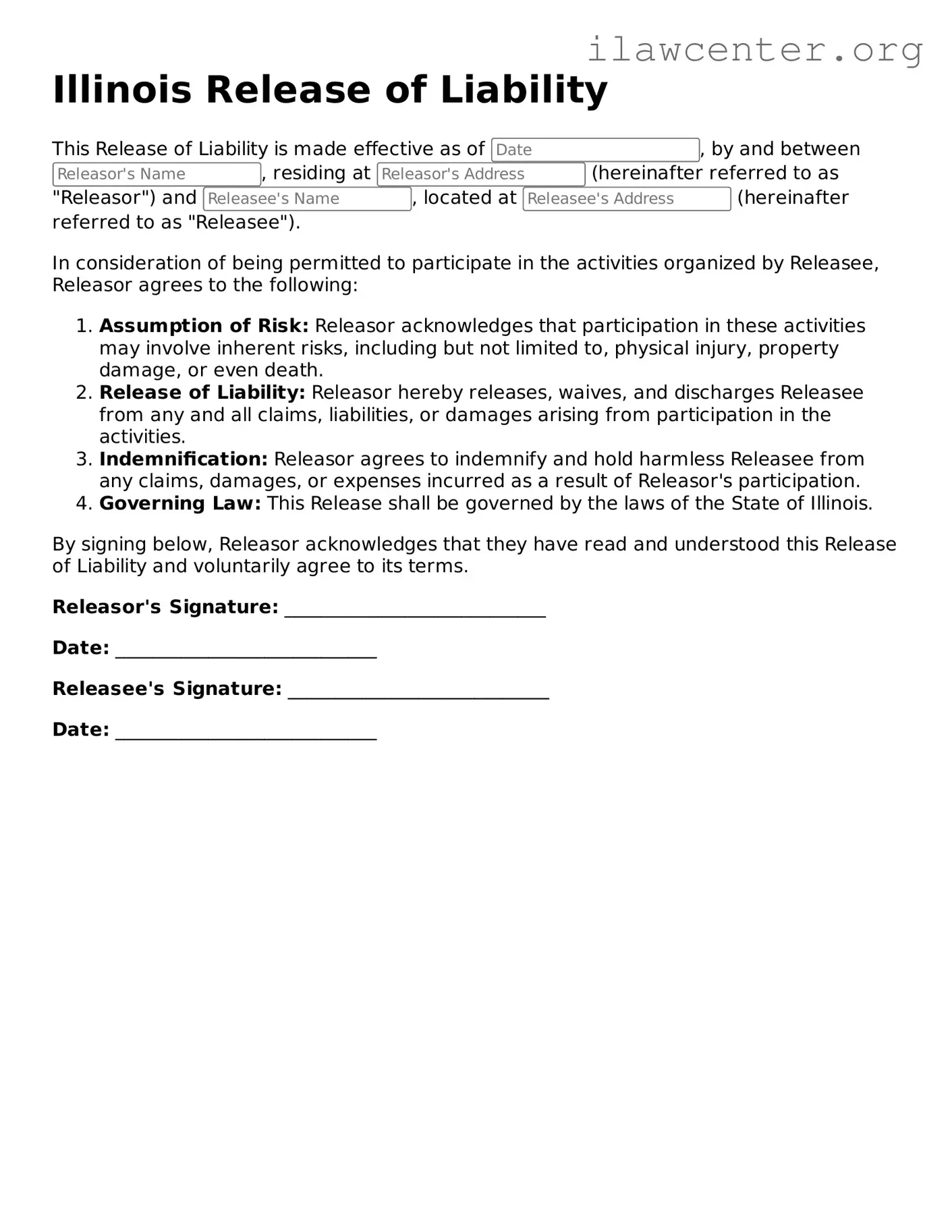
Illinois Release of Liability

This Release of Liability is made effective as of , by and between , residing at (hereinafter referred to as "Releasor") and , located at (hereinafter referred to as "Releasee").

In consideration of being permitted to participate in the activities organized by Releasee, Releasor agrees to the following:

  1. Assumption of Risk: Releasor acknowledges that participation in these activities may involve inherent risks, including but not limited to, physical injury, property damage, or even death.
  2. Release of Liability: Releasor hereby releases, waives, and discharges Releasee from any and all claims, liabilities, or damages arising from participation in the activities.
  3. Indemnification: Releasor agrees to indemnify and hold harmless Releasee from any claims, damages, or expenses incurred as a result of Releasor's participation.
  4. Governing Law: This Release shall be governed by the laws of the State of Illinois.

By signing below, Releasor acknowledges that they have read and understood this Release of Liability and voluntarily agree to its terms.

Releasor's Signature: ____________________________

Date: ____________________________

Releasee's Signature: ____________________________

Date: ____________________________

PDF Form Characteristics

Fact Name Description
Purpose The Illinois Release of Liability form is designed to protect businesses and individuals from legal claims arising from injuries or damages incurred during an activity.
Governing Law This form is governed by Illinois state law, specifically under the principles of contract law and liability waivers.
Voluntary Participation Participants must voluntarily agree to the terms outlined in the release, indicating their understanding of the risks involved.
Scope of Liability The release typically covers ordinary negligence but may not protect against gross negligence or willful misconduct.
Enforceability For the release to be enforceable, it must be clear, unambiguous, and not contrary to public policy.
Minors When minors are involved, a parent or guardian must sign the release on their behalf, adding an extra layer of consideration.
Legal Review It is advisable to have the form reviewed by a legal professional to ensure compliance with current laws and regulations.

Instructions on Utilizing Illinois Release of Liability

Once you have the Illinois Release of Liability form, you'll need to complete it carefully. This form is essential for ensuring that all parties understand their rights and responsibilities. Follow the steps below to fill it out correctly.

  1. Begin by entering the date at the top of the form. This is usually found in the designated space marked for the date.
  2. Next, fill in your name and contact information. Make sure to provide accurate details.
  3. Identify the other party or parties involved. This may include individuals or organizations. Clearly list their names and contact information as well.
  4. Describe the activity or event for which you are releasing liability. Be specific about what is happening.
  5. Read through any clauses or statements carefully. You may need to initial or sign next to certain sections to indicate your understanding and agreement.
  6. Sign and date the form at the bottom. Your signature confirms that you agree to the terms outlined in the document.
  7. If required, have a witness sign the form as well. This adds an extra layer of verification.

After completing the form, keep a copy for your records. You may need to provide the original to the other party involved. Ensure all parties have a clear understanding of the terms laid out in the document.

Important Facts about Illinois Release of Liability

What is an Illinois Release of Liability form?

The Illinois Release of Liability form is a legal document that protects a party from being held liable for injuries or damages that may occur during a specific activity. By signing this form, participants acknowledge the risks involved and agree not to hold the organizer responsible for any accidents or injuries that may happen.

When should I use a Release of Liability form?

This form is commonly used for activities that involve a risk of injury, such as sports events, recreational activities, or any situation where participants may encounter hazards. It’s essential to use this form whenever you want to limit your liability in these scenarios.

Is the Release of Liability form legally binding in Illinois?

Yes, the Release of Liability form can be legally binding in Illinois, provided it meets certain criteria. It must be clear, unambiguous, and voluntarily signed by the participant. However, courts may not enforce it if it is deemed overly broad or if it waives rights that cannot be legally waived.

Can a minor sign a Release of Liability form?

Minors cannot legally sign contracts, including a Release of Liability form. Instead, a parent or guardian must sign on their behalf. This ensures that the minor is protected and that the parent or guardian acknowledges the risks involved.

What information should be included in the form?

The form should include the names of the parties involved, a clear description of the activity, acknowledgment of the risks, and a statement that the participant waives the right to sue. It’s also important to have a section for signatures and dates to validate the agreement.

Can I still sue if I sign the Release of Liability?

Generally, signing the Release of Liability form limits your ability to sue for injuries related to the specified activity. However, if there is evidence of gross negligence or intentional misconduct, you may still have grounds for a lawsuit despite having signed the form.

How do I ensure the form is enforceable?

To ensure the form is enforceable, it should be written in clear language, explicitly outline the risks, and be signed voluntarily. It’s also advisable to consult with a legal professional to ensure compliance with Illinois laws and regulations.

Can the form be revoked after signing?

Once signed, the Release of Liability form typically cannot be revoked. However, if the participant can prove they were coerced or did not fully understand the risks, they might challenge the enforceability of the form in court.

What happens if the activity is canceled?

If the activity is canceled, the Release of Liability form becomes moot. Participants may be entitled to a refund or rescheduling, depending on the organizer's policies. Always check the terms associated with the activity for specific details.

Where can I find a template for the Illinois Release of Liability form?

Templates for the Illinois Release of Liability form can be found online through legal websites or local law offices. It’s essential to customize any template to fit the specific activity and ensure it complies with Illinois law.
Common mistakes

When filling out the Illinois Release of Liability form, many individuals make common mistakes that can lead to complications later. One frequent error is not providing complete information. It is essential to fill in all required fields accurately. Missing details can cause the form to be deemed invalid, which may affect your rights.

Another mistake is overlooking the need for signatures. The form requires signatures from all parties involved. Failing to obtain the necessary signatures can result in disputes about the agreement's validity. Always double-check that everyone has signed before submitting the form.

People often misinterpret the purpose of the form. The Release of Liability is meant to protect against claims related to specific activities. Some individuals mistakenly believe it absolves all responsibility, which is not the case. Understanding the limits of the release is crucial.

Using vague language is another common issue. When describing the activity or event, clarity is key. Ambiguous terms can lead to confusion and may not provide the intended legal protection. Be specific about what is being released.

Many individuals fail to read the entire document before signing. It is vital to understand every clause and condition. Ignoring sections may lead to unexpected obligations or limitations. Taking the time to read the form thoroughly can prevent future misunderstandings.

Another mistake is not consulting with legal counsel. While the form may seem straightforward, having a professional review it can provide peace of mind. Legal advice ensures that your rights are protected and that the form is completed correctly.

Lastly, individuals sometimes neglect to keep a copy of the signed form. Retaining a copy is important for your records. If any disputes arise, having documentation will support your position. Always make sure to keep a copy in a safe place.

Documents used along the form

When dealing with activities that involve potential risks, it's essential to have the right documents in place. The Illinois Release of Liability form is just one part of the puzzle. Here’s a list of other forms and documents that are commonly used alongside it to ensure everyone is protected and informed.

  • Waiver of Liability: This document is similar to the Release of Liability but often includes additional clauses that limit the responsibility of the provider in more specific terms.
  • Assumption of Risk Agreement: Participants acknowledge the inherent risks associated with an activity, understanding that they are voluntarily taking on these risks.
  • Medical Release Form: This form allows organizers to obtain medical information and make decisions in case of an emergency involving a participant.
  • Participant Agreement: This document outlines the expectations and responsibilities of each participant, ensuring everyone is on the same page.
  • Parental Consent Form: For minors, this form secures permission from a parent or guardian, allowing them to participate in activities that require a waiver.
  • Insurance Waiver: This document clarifies that participants are responsible for their own insurance coverage and that the organizer is not liable for any injuries or damages.
  • Event Registration Form: This form collects essential information about participants, including contact details and emergency contacts, ensuring safety and communication.
  • Code of Conduct: This document sets the behavioral expectations for participants, promoting a safe and respectful environment during activities.
  • Release for Media Use: This form grants permission for the use of photographs or videos taken during the event, protecting the rights of both the organizer and the participants.

Having these documents ready can provide clarity and protection for everyone involved. It's always a good idea to ensure that all necessary forms are completed and understood before participating in any activity that carries risk.

Similar forms

A Release of Liability form is a crucial document that helps protect individuals and organizations from legal claims. It is similar to several other documents, each serving a specific purpose in the realm of risk management and legal protection. Below are seven documents that share similarities with the Release of Liability form:

  • Waiver of Liability: This document explicitly states that a participant voluntarily relinquishes their right to hold a party responsible for injuries or damages incurred during an activity. Like a Release of Liability, it emphasizes personal responsibility.
  • Indemnity Agreement: This agreement involves one party agreeing to compensate another for any losses or damages. It often accompanies a Release of Liability, providing an extra layer of protection against potential claims.
  • Consent Form: Commonly used in medical and research settings, a consent form informs participants about risks and obtains their permission to proceed. Similar to a Release of Liability, it ensures that individuals are aware of the potential dangers involved.
  • Hold Harmless Agreement: This document protects one party from being held liable for damages or injuries caused to another party. It operates on the same principle as a Release of Liability, focusing on the allocation of risk.
  • Assumption of Risk Form: This form requires participants to acknowledge the inherent risks associated with an activity. It parallels a Release of Liability by ensuring that individuals understand and accept these risks before participating.
  • Settlement Agreement: Often used to resolve disputes, a settlement agreement can include clauses that release parties from future claims. This aspect mirrors the protective nature of a Release of Liability.
  • Event Registration Form: Many event organizers include liability waivers within their registration forms. This practice aligns with the intent of a Release of Liability, as it seeks to limit liability exposure while participants engage in the event.

Understanding these documents can help individuals and organizations navigate potential legal risks effectively. Each serves a unique purpose but shares the common goal of protecting against liability.

Dos and Don'ts

When filling out the Illinois Release of Liability form, it's important to approach the task with care. This document is designed to protect parties from legal claims, so accuracy and clarity are crucial. Here are some dos and don'ts to keep in mind:

  • Do read the entire form carefully before filling it out.
  • Do provide accurate and complete information to avoid any misunderstandings.
  • Do sign and date the form in the appropriate sections.
  • Do consult with a legal professional if you have questions about the language used in the form.
  • Don't leave any required fields blank; this could render the form invalid.
  • Don't rush through the process; take your time to ensure everything is filled out correctly.
  • Don't ignore any instructions provided with the form.
  • Don't sign the form without fully understanding its implications.

Misconceptions

  • Misconception 1: A Release of Liability form protects against all types of claims.

    Many people believe that signing a Release of Liability form means they cannot sue for any reason. However, this is not entirely true. While the form can protect against certain risks, it may not cover claims arising from negligence or intentional wrongdoing. Courts often scrutinize these forms to ensure they are fair and reasonable.

  • Misconception 2: A Release of Liability form is only necessary for extreme activities.

    Some individuals think that these forms are only required for high-risk activities like skydiving or rock climbing. In reality, any activity that carries some level of risk, including sports, recreational events, or even certain workplace situations, can benefit from a Release of Liability form. It helps clarify the responsibilities of all parties involved.

  • Misconception 3: Signing a Release of Liability form means you cannot hold anyone accountable.

    This is a common misunderstanding. While the form may limit liability for certain risks, it does not absolve all parties from accountability. If a provider acts recklessly or fails to meet safety standards, individuals may still have the right to pursue legal action.

  • Misconception 4: A Release of Liability form is the same as an insurance policy.

    Some people confuse a Release of Liability form with insurance coverage. The form does not provide financial protection or compensation in the event of an injury. Instead, it serves as a legal document that outlines the risks and responsibilities associated with an activity.

  • Misconception 5: Once signed, a Release of Liability form is unchangeable.

    It is a misconception that these forms are permanent and cannot be modified. In fact, parties can negotiate the terms before signing. Additionally, individuals can refuse to sign if they do not agree with the terms, allowing for open communication and adjustments.

Key takeaways

When it comes to the Illinois Release of Liability form, understanding its key aspects is essential for both parties involved. Here are some important takeaways:

  • Purpose: This form is designed to protect individuals or organizations from legal claims arising from injuries or damages that may occur during an activity.
  • Clarity: Ensure that the language used in the form is clear and understandable to avoid confusion.
  • Voluntary Agreement: Signing the form must be voluntary; no one should feel pressured to sign it.
  • Scope of Liability: Clearly outline what activities are covered under the release to avoid any misunderstandings.
  • Age Consideration: If the participant is a minor, a parent or guardian must sign the form on their behalf.
  • Legal Review: It is advisable to have the form reviewed by a legal professional to ensure it complies with Illinois law.
  • Retention: Keep a copy of the signed form for your records, as it may be needed in the event of a dispute.
  • Communication: Discuss the terms of the release with all participants before they sign, ensuring everyone understands their rights.

By keeping these points in mind, you can effectively use the Illinois Release of Liability form to safeguard against potential legal issues while promoting transparency and trust among participants.