Attorney-Verified  Small Estate Affidavit Document for Illinois

Attorney-Verified Small Estate Affidavit Document for Illinois

The Illinois Small Estate Affidavit is a legal document that allows individuals to transfer property from a deceased person's estate without going through the formal probate process. This form is designed for estates valued below a certain threshold, streamlining the process for heirs and beneficiaries. Understanding how to properly fill out this affidavit is crucial for ensuring a smooth transfer of assets.

Ready to simplify the estate transfer process? Fill out the form by clicking the button below.

Article Guide

The Illinois Small Estate Affidavit form serves as a crucial legal document for individuals seeking to simplify the process of transferring assets from a deceased person's estate when the total value falls below a specified threshold. This form allows eligible heirs or beneficiaries to claim property without the need for formal probate proceedings, which can be time-consuming and costly. To utilize the Small Estate Affidavit, certain conditions must be met, including the value of the estate not exceeding $100,000 and the absence of a will. The affidavit requires detailed information about the deceased, including their name, date of death, and a description of the assets being claimed. Additionally, the form must be signed under oath, affirming that the information provided is accurate and that the affiant is entitled to the assets. By streamlining the transfer process, the Small Estate Affidavit provides a more efficient means for heirs to manage their loved one's estate while minimizing legal complexities and expenses.

Illinois Small Estate Affidavit Preview

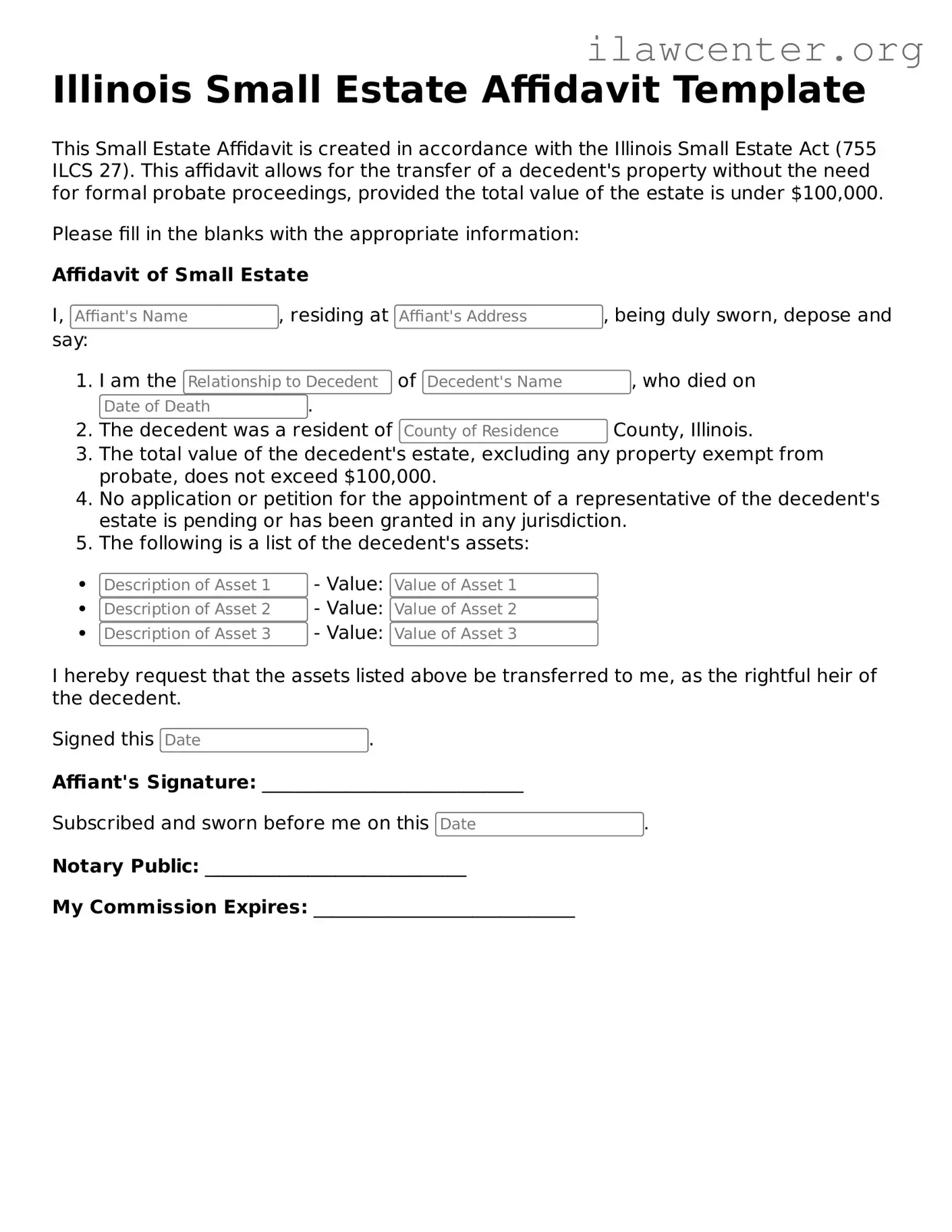
Illinois Small Estate Affidavit Template

This Small Estate Affidavit is created in accordance with the Illinois Small Estate Act (755 ILCS 27). This affidavit allows for the transfer of a decedent's property without the need for formal probate proceedings, provided the total value of the estate is under $100,000.

Please fill in the blanks with the appropriate information:

Affidavit of Small Estate

I, , residing at , being duly sworn, depose and say:

  1. I am the of , who died on .
  2. The decedent was a resident of County, Illinois.
  3. The total value of the decedent's estate, excluding any property exempt from probate, does not exceed $100,000.
  4. No application or petition for the appointment of a representative of the decedent's estate is pending or has been granted in any jurisdiction.
  5. The following is a list of the decedent's assets:
  • - Value:
  • - Value:
  • - Value:

I hereby request that the assets listed above be transferred to me, as the rightful heir of the decedent.

Signed this .

Affiant's Signature: ____________________________

Subscribed and sworn before me on this .

Notary Public: ____________________________

My Commission Expires: ____________________________

PDF Form Characteristics

Fact Name Description
Purpose The Illinois Small Estate Affidavit allows individuals to claim assets of a deceased person without going through formal probate proceedings.
Eligibility This form can be used when the total value of the deceased's assets is less than $100,000, excluding real estate.
Governing Law The use of the Small Estate Affidavit is governed by the Illinois Probate Act, specifically 755 ILCS 5/25-1.
Who Can Use It Heirs or beneficiaries of the deceased can use the affidavit to collect property without the need for a full probate process.
Filing Requirements The affidavit must be signed by the claimant and notarized. It may also require the signature of a witness.
Limitations The affidavit cannot be used for assets that are held in joint tenancy or have designated beneficiaries, such as life insurance policies.

Instructions on Utilizing Illinois Small Estate Affidavit

After obtaining the Illinois Small Estate Affidavit form, you will need to complete it accurately to facilitate the transfer of assets from a deceased person’s estate. This process allows you to claim the assets without going through a lengthy probate procedure. Follow the steps below to fill out the form correctly.

  1. Begin by entering the name of the deceased individual at the top of the form.
  2. Provide the date of death in the designated area.
  3. List the deceased’s last known address, including the city, state, and ZIP code.
  4. Identify yourself as the affiant by writing your name and your relationship to the deceased.
  5. Include your address, city, state, and ZIP code in the appropriate fields.
  6. Indicate whether you are the spouse, child, or another relative of the deceased.
  7. Detail the assets you are claiming, including bank accounts, real estate, and personal property.
  8. Provide the estimated value of each asset listed.
  9. Sign and date the affidavit in the presence of a notary public.
  10. Ensure that the notary public completes their section, including their signature and seal.

Once you have filled out the form, you will need to file it with the appropriate court or financial institution, depending on the assets you are claiming. Be prepared to provide any additional documentation that may be required.

Important Facts about Illinois Small Estate Affidavit

What is the Illinois Small Estate Affidavit?

The Illinois Small Estate Affidavit is a legal document that allows individuals to claim assets from a deceased person's estate without going through the lengthy probate process. This form is particularly useful for estates that do not exceed a certain value, making it easier and quicker for heirs to access their inheritance.

Who can use the Small Estate Affidavit?

Typically, the Small Estate Affidavit can be used by heirs or beneficiaries of the deceased person. To qualify, the total value of the estate must be below a specified threshold, which is currently set at $100,000 in Illinois. This includes all assets, such as bank accounts, real estate, and personal property.

What assets are included in the Small Estate Affidavit?

Assets that can be included in the Small Estate Affidavit are those that the deceased owned solely in their name. This can include cash, bank accounts, vehicles, and personal belongings. However, jointly owned property or assets with designated beneficiaries, like life insurance policies, are typically not included.

How do I complete the Small Estate Affidavit?

To complete the Small Estate Affidavit, you will need to fill out the form accurately, providing information about the deceased and the assets being claimed. You must also sign the affidavit in front of a notary public. Ensure that all information is truthful and complete, as inaccuracies can lead to legal complications.

Do I need to file the Small Estate Affidavit with the court?

Generally, you do not need to file the Small Estate Affidavit with the court unless a specific asset requires it. Instead, you present the affidavit to the financial institutions or other entities holding the deceased's assets to claim them directly. However, some situations may require court involvement, so it’s wise to check with a legal professional.

Is there a deadline for filing the Small Estate Affidavit?

There is no strict deadline for filing the Small Estate Affidavit, but it is advisable to act promptly. Waiting too long may complicate the process or lead to disputes among heirs. It’s best to address the estate matters as soon as possible after the death of the individual.

What if there are disputes among heirs regarding the Small Estate Affidavit?

If disputes arise among heirs, it may complicate the use of the Small Estate Affidavit. In such cases, it might be necessary to consider formal probate proceedings to resolve the disagreements. Seeking legal advice can help navigate these conflicts and ensure that everyone’s rights are respected.

Can I use the Small Estate Affidavit if the deceased had a will?

Yes, you can still use the Small Estate Affidavit even if the deceased left a will. However, the will must not direct that the estate go through probate. If the will names an executor or indicates that probate is necessary, the Small Estate Affidavit may not be the appropriate route. Consulting with a legal expert can clarify your options.
Common mistakes

Filling out the Illinois Small Estate Affidavit form can be a straightforward process, but mistakes can lead to delays or complications. One common error is providing incorrect information about the deceased. It's essential to ensure that the name, date of birth, and date of death are accurate. Any discrepancies can result in the affidavit being rejected.

Another frequent mistake is failing to list all assets owned by the deceased. The affidavit must include all relevant property, including real estate, bank accounts, and personal belongings. Omitting any assets can cause issues, as the affidavit may not fulfill its purpose if it does not account for the entire estate.

People often overlook the requirement for signatures. The affidavit must be signed by the person making the claim and typically requires notarization. Neglecting to have the document notarized can invalidate the affidavit, leading to further complications.

Inaccurate valuations of assets are also a common pitfall. Each asset should be valued correctly to reflect its fair market value. Underestimating or overestimating the value can create problems during the probate process.

Another mistake is not providing the necessary documentation. The affidavit may require supporting documents, such as a death certificate or proof of relationship to the deceased. Failing to include these documents can delay the process significantly.

Individuals sometimes misunderstand the eligibility criteria for using the Small Estate Affidavit. The total value of the estate must fall below a certain threshold. If the estate exceeds this limit, the affidavit cannot be used, and individuals may need to pursue a different probate process.

In some cases, people forget to notify all heirs and beneficiaries. It's crucial to inform everyone who has a legal interest in the estate about the affidavit. Failing to do so can lead to disputes or claims later on.

Incorrectly identifying the appropriate court can also be a significant error. The affidavit must be filed in the correct jurisdiction. If filed in the wrong court, it may not be accepted, requiring additional time and effort to resolve.

Some individuals may not fully understand the implications of the affidavit. It is important to recognize that signing the affidavit carries legal responsibilities. Misrepresenting information or failing to disclose assets can result in legal consequences.

Finally, procrastination can lead to mistakes. Waiting until the last minute to fill out the affidavit can cause rushed decisions and overlooked details. Taking the time to carefully complete the form can help avoid many of these common errors.

Documents used along the form

When navigating the process of settling a small estate in Illinois, several documents may be required in conjunction with the Illinois Small Estate Affidavit. Each of these forms serves a specific purpose in ensuring that the estate is handled according to the law and that the assets are distributed appropriately.

  • Death Certificate: This official document verifies the death of the individual whose estate is being settled. It is often required to prove that the decedent has passed away.
  • Will: If the deceased left a will, it may need to be submitted along with the Small Estate Affidavit. The will outlines the decedent's wishes regarding asset distribution.
  • List of Assets: A comprehensive inventory of the decedent's assets helps clarify what is included in the estate. This list is essential for the proper administration of the estate.
  • Affidavit of Heirship: This document may be used to establish the rightful heirs of the estate. It provides a sworn statement regarding the relationship of the heirs to the decedent.
  • Notice to Creditors: This notice informs creditors of the decedent's passing and invites them to present any claims against the estate. It helps ensure that all debts are settled before asset distribution.
  • Tax Returns: Copies of the decedent's final tax returns may be needed to address any outstanding tax obligations. This is important for ensuring compliance with tax laws.
  • Court Order (if applicable): In some cases, a court order may be necessary to clarify certain aspects of the estate or to resolve disputes among heirs.

Having these documents prepared and organized can facilitate a smoother process when dealing with a small estate. Each form plays a critical role in ensuring that the estate is settled in accordance with Illinois law.

Similar forms

  • Will: A will outlines how a person wishes to distribute their assets after death. Like a Small Estate Affidavit, it serves to simplify the transfer of property, but it requires probate to be validated.
  • Trust: A trust allows a person to manage their assets during their lifetime and dictate their distribution after death. Similar to the Small Estate Affidavit, it can avoid probate, but it requires more formalities to establish.
  • Letters Testamentary: These documents are issued by a court to an executor named in a will. They grant authority to manage the estate, akin to the Small Estate Affidavit, which also allows someone to handle the estate without full probate.
  • Affidavit of Heirship: This document establishes the heirs of a deceased person. It shares similarities with the Small Estate Affidavit in that it provides a way to transfer assets without going through probate.
  • Petition for Summary Administration: This is a court process that allows for a simplified probate procedure for small estates. Like the Small Estate Affidavit, it aims to expedite the distribution of assets.
  • Transfer on Death Deed: This deed allows individuals to transfer real estate upon death without going through probate. It functions similarly to the Small Estate Affidavit in that it simplifies asset transfer.
  • Durable Power of Attorney: This document allows someone to make decisions on behalf of another person, especially in financial matters. While it does not deal with post-death asset transfer, it can simplify management during a person’s life, much like the Small Estate Affidavit does after death.
  • Joint Tenancy Deed: Property held in joint tenancy automatically passes to the surviving owner upon death. This is similar to the Small Estate Affidavit in its ability to avoid probate for asset transfer.
  • Small Estate Petition: This is a request to the court for a simplified probate process for small estates. It parallels the Small Estate Affidavit in its goal to streamline the distribution of a deceased person’s assets.

Dos and Don'ts

When filling out the Illinois Small Estate Affidavit form, it's important to approach the process carefully. Here are some key dos and don'ts to keep in mind:

  • Do ensure that the total value of the estate qualifies as a small estate under Illinois law.
  • Do provide accurate and complete information about the deceased and the estate's assets.
  • Do sign the affidavit in front of a notary public to validate the document.
  • Do keep copies of the affidavit for your records and any future legal requirements.
  • Don't omit any debts or liabilities of the estate; full disclosure is necessary.
  • Don't file the affidavit without confirming that you are eligible to use it.
  • Don't ignore the need for a witness signature if required by the specific circumstances of the estate.

Following these guidelines can help streamline the process and ensure that the affidavit is accepted without complications.

Misconceptions

The Illinois Small Estate Affidavit is a useful legal tool for individuals dealing with the estates of deceased persons. However, several misconceptions surround its use and purpose. Here are five common misunderstandings:

  1. Only wealthy individuals can use the Small Estate Affidavit.

    This is not true. The Small Estate Affidavit is designed for estates that do not exceed a certain value, which is relatively modest. In Illinois, the limit is currently set at $100,000 for personal property. Therefore, it is accessible to a wide range of individuals, not just those with significant wealth.

  2. The Small Estate Affidavit can be used for any type of asset.

    This misconception arises from a misunderstanding of what qualifies as a small estate. The affidavit is primarily intended for personal property and cannot be used for real estate or assets held in a trust. Individuals must be aware of these limitations to avoid complications.

  3. Filing a Small Estate Affidavit is the same as going through probate.

    While both processes deal with the distribution of a deceased person's assets, they are not the same. The Small Estate Affidavit allows for a simplified process that avoids the lengthy and often costly probate court proceedings. This can save time and money for the heirs.

  4. All heirs must agree to use the Small Estate Affidavit.

    This is a common belief, but it is not entirely accurate. While it is beneficial for all heirs to be on the same page, only one heir can initiate the Small Estate Affidavit process. However, it is advisable to communicate with other heirs to prevent disputes later on.

  5. The Small Estate Affidavit can be used indefinitely.

    This misconception overlooks the time-sensitive nature of the process. The affidavit must be filed within a certain period following the death of the individual. If too much time passes, heirs may need to pursue more traditional probate methods, which can be more complex and time-consuming.

Understanding these misconceptions can help individuals navigate the complexities of estate management more effectively. Knowledge empowers heirs to make informed decisions during a challenging time.

Key takeaways

Filling out and using the Illinois Small Estate Affidavit form can simplify the process of transferring assets when someone passes away. Here are some key takeaways to keep in mind:

  • The Small Estate Affidavit is designed for estates with a total value of $100,000 or less, excluding real estate.
  • Only certain individuals, typically heirs or beneficiaries, can file the affidavit. Ensure you meet the eligibility criteria before proceeding.
  • The form must be completed accurately, including all required information about the deceased and their assets.
  • Once filled out, the affidavit must be signed in front of a notary public to ensure its validity.
  • After notarization, the affidavit is submitted to the financial institutions or entities holding the deceased's assets to facilitate the transfer.
  • It is advisable to keep copies of the affidavit and any supporting documents for your records and future reference.

Understanding these key points can help streamline the process and reduce potential complications when handling a small estate in Illinois.