Attorney-Verified  Transfer-on-Death Deed Document for Illinois

Attorney-Verified Transfer-on-Death Deed Document for Illinois

The Illinois Transfer-on-Death Deed form allows property owners to transfer their real estate to designated beneficiaries upon their death, bypassing the probate process. This straightforward tool can simplify estate planning and ensure that your property goes to your loved ones without unnecessary delays. Ready to secure your property’s future? Fill out the form by clicking the button below.

Article Guide

In Illinois, the Transfer-on-Death Deed (TODD) offers a straightforward way to transfer property upon death without the need for probate. This form allows property owners to designate beneficiaries who will receive their real estate automatically, simplifying the transfer process and reducing the burden on loved ones. By filling out and recording the TODD, individuals can maintain control of their property during their lifetime while ensuring a smooth transition after they pass away. It’s important to understand the requirements for creating a valid deed, including the need for proper execution and recording with the county recorder's office. Additionally, property owners should be aware of how this deed interacts with existing wills and trusts, as well as the implications for taxes and debts. Overall, the Illinois Transfer-on-Death Deed serves as a valuable tool for estate planning, providing peace of mind for individuals and their families.

Illinois Transfer-on-Death Deed Preview

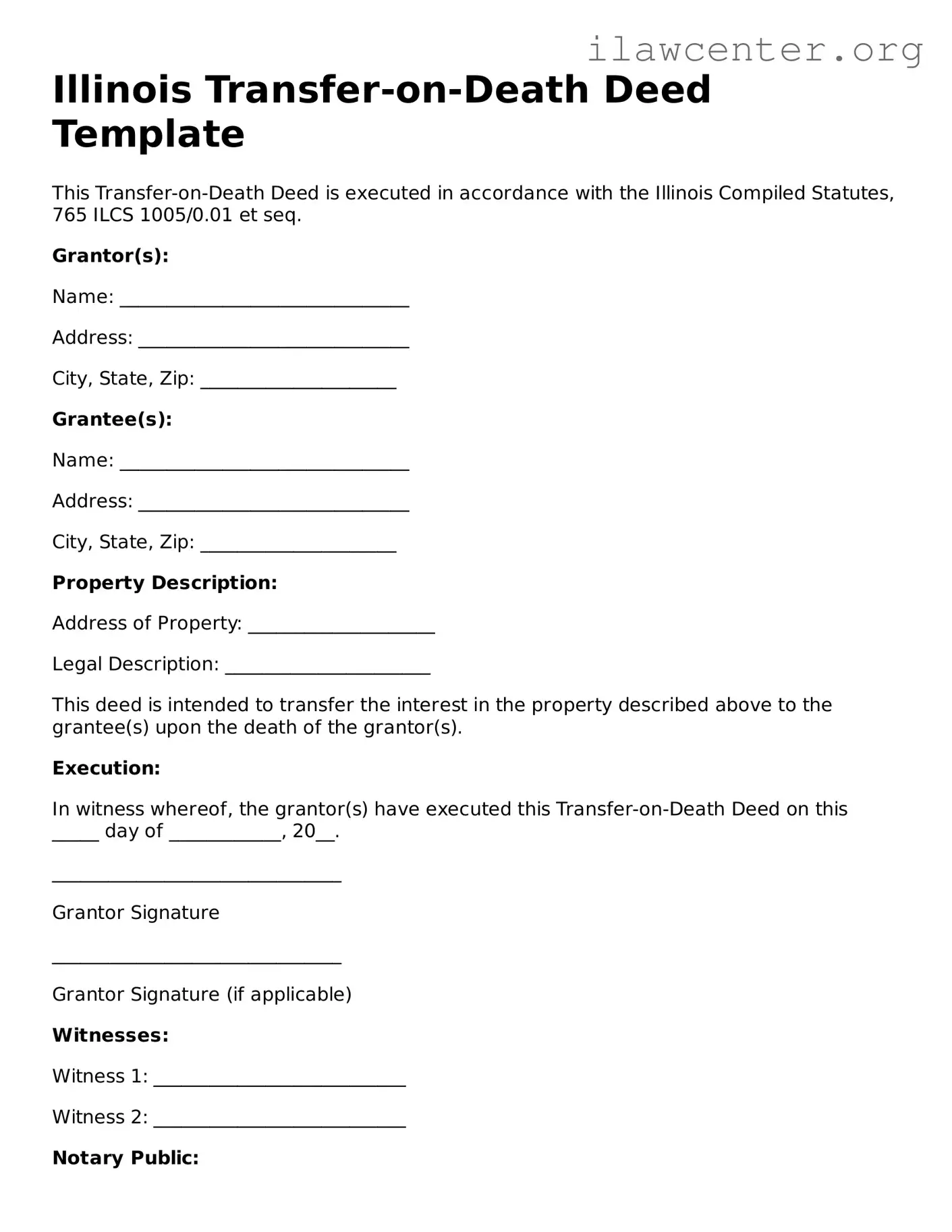
Illinois Transfer-on-Death Deed Template

This Transfer-on-Death Deed is executed in accordance with the Illinois Compiled Statutes, 765 ILCS 1005/0.01 et seq.

Grantor(s):

Name: _______________________________

Address: _____________________________

City, State, Zip: _____________________

Grantee(s):

Name: _______________________________

Address: _____________________________

City, State, Zip: _____________________

Property Description:

Address of Property: ____________________

Legal Description: ______________________

This deed is intended to transfer the interest in the property described above to the grantee(s) upon the death of the grantor(s).

Execution:

In witness whereof, the grantor(s) have executed this Transfer-on-Death Deed on this _____ day of ____________, 20__.

_______________________________

Grantor Signature

_______________________________

Grantor Signature (if applicable)

Witnesses:

Witness 1: ___________________________

Witness 2: ___________________________

Notary Public:

State of Illinois

County of ____________________________

Subscribed and sworn to before me on this _____ day of ____________, 20__.

_______________________________

Notary Public Signature

My Commission Expires: _______________

PDF Form Characteristics

Fact Name Details
Definition The Illinois Transfer-on-Death Deed allows property owners to transfer real estate to beneficiaries upon their death without going through probate.
Governing Law The Transfer-on-Death Deed is governed by the Illinois Compiled Statutes, specifically 765 ILCS 1005.
Eligibility Any individual who owns real estate in Illinois can create a Transfer-on-Death Deed.
Beneficiaries Property owners can name one or more beneficiaries in the deed, including individuals or entities.
Revocation The deed can be revoked at any time before the owner's death, provided the revocation is executed in writing.
Filing Requirements The deed must be recorded with the county recorder's office where the property is located to be effective.
Tax Implications Transfer-on-Death Deeds do not trigger gift taxes, as the transfer occurs only upon the owner's death.
Effect on Creditors The property transferred via a Transfer-on-Death Deed may still be subject to the deceased owner's debts.
Limitations This deed cannot be used for all types of property; it is limited to real estate and does not apply to personal property.

Instructions on Utilizing Illinois Transfer-on-Death Deed

After obtaining the Illinois Transfer-on-Death Deed form, you will need to fill it out carefully. This process ensures that the property will transfer to the designated beneficiary upon the owner's death without going through probate. Follow these steps to complete the form accurately.

  1. Begin by writing the date at the top of the form.
  2. Provide the name of the property owner(s). This should include full legal names as they appear on the property deed.
  3. Next, include the address of the property. Be specific, including the street address, city, state, and zip code.
  4. Identify the beneficiary. Write the full name of the person or entity who will receive the property.
  5. Include the beneficiary's address to ensure proper identification.
  6. Specify the nature of the property being transferred. This may include details such as the type of property (e.g., residential, commercial) and any identifying information like a parcel number.
  7. Sign the form in the presence of a notary public. This step is crucial for the deed to be legally valid.
  8. Have the notary public sign and seal the document, confirming the authenticity of your signature.
  9. Finally, file the completed deed with the appropriate county recorder's office. Ensure you keep a copy for your records.

Important Facts about Illinois Transfer-on-Death Deed

What is a Transfer-on-Death Deed in Illinois?

A Transfer-on-Death Deed (TOD Deed) is a legal document that allows a property owner to designate a beneficiary who will automatically receive the property upon the owner's death. This deed is particularly useful because it bypasses the probate process, making the transfer of property more straightforward and efficient for the beneficiaries.

Who can create a Transfer-on-Death Deed?

Any individual who is the sole owner or a co-owner of real property in Illinois can create a Transfer-on-Death Deed. The property owner must be of legal age and mentally competent to make this decision. It’s important to ensure that the deed is properly executed to be valid.

How does a Transfer-on-Death Deed work?

The property owner fills out the Transfer-on-Death Deed form, naming one or more beneficiaries. The deed must be signed and notarized, then recorded with the county recorder's office where the property is located. Upon the owner's death, the property automatically transfers to the named beneficiaries without going through probate.

Can a Transfer-on-Death Deed be revoked?

Yes, a Transfer-on-Death Deed can be revoked at any time before the owner's death. The owner can do this by creating a new deed that explicitly revokes the previous one, or by recording a written statement of revocation. It’s essential to follow the proper procedures to ensure the revocation is legally recognized.

Are there any limitations on who can be named as a beneficiary?

Beneficiaries can be individuals, but they cannot be entities like corporations or LLCs. Additionally, if a beneficiary predeceases the property owner, their share may not automatically go to their heirs unless specified in the deed. It's advisable to consult with a professional to ensure the deed reflects your wishes accurately.

What happens if the property owner has debts?

While a Transfer-on-Death Deed allows for a smooth transfer of property, it does not shield the property from the owner's debts. Creditors may still claim against the estate. It’s important for property owners to understand their financial situation and consider how debts may affect the transfer of property to beneficiaries.

Common mistakes

When filling out the Illinois Transfer-on-Death Deed form, individuals often make several common mistakes that can lead to complications down the road. One of the most frequent errors is failing to properly identify the property. It's essential to include a complete and accurate legal description of the property being transferred. This description should be precise and may include details like the property's address and parcel number. Without this clarity, the deed may not be valid, and the intended transfer could be challenged.

Another mistake involves the omission of the necessary signatures. All owners of the property must sign the deed for it to be legally binding. If even one owner neglects to sign, the deed may not take effect as intended. This can create confusion and delay the transfer process, potentially leading to disputes among heirs.

People also sometimes overlook the need for witnesses. In Illinois, the law requires that the Transfer-on-Death Deed be signed in the presence of two witnesses. Failing to have witnesses present during the signing can invalidate the deed. Therefore, it is crucial to ensure that the signing process is conducted correctly to avoid any legal issues later on.

In addition, individuals may not consider the implications of transferring property to multiple beneficiaries. If the deed names more than one beneficiary, it’s important to specify how the property should be divided. Without clear instructions, misunderstandings may arise among beneficiaries, leading to potential conflicts and legal disputes.

Another common oversight is not recording the deed with the appropriate county office. Once the deed is completed and signed, it must be filed with the local recorder of deeds. If this step is skipped, the transfer will not be recognized legally, which defeats the purpose of creating the deed in the first place.

Lastly, many individuals fail to review their decisions regarding the Transfer-on-Death Deed. It’s important to understand that this deed is a revocable document. If circumstances change, such as a change in relationships or financial situations, the deed can be revoked or modified. Neglecting to revisit the deed can lead to unintended consequences, such as transferring property to someone no longer desired.

Documents used along the form

When preparing a Transfer-on-Death Deed in Illinois, it's essential to consider other documents that may complement this form. These documents can help ensure that the transfer of property is handled smoothly and according to your wishes. Below are some commonly used forms and documents that often accompany the Transfer-on-Death Deed.

  • Will: A legal document that outlines how a person's assets should be distributed upon their death. While a Transfer-on-Death Deed allows for the direct transfer of property, a will can address other assets and personal wishes.
  • Living Trust: This document allows individuals to place their assets into a trust during their lifetime, which can then be managed by a trustee. A living trust can help avoid probate and may work in conjunction with a Transfer-on-Death Deed.
  • Affidavit of Heirship: This document is used to establish the heirs of a deceased person. It can be particularly useful in clarifying ownership of property when there is no will or when the Transfer-on-Death Deed is not the sole document governing the transfer.
  • Property Deed: The legal document that officially shows ownership of a property. When using a Transfer-on-Death Deed, it's important to have the existing property deed on hand to ensure all details are accurate and consistent.

Utilizing these documents alongside the Transfer-on-Death Deed can help ensure that your estate planning is comprehensive and effective. Each document serves a specific purpose, and together they can provide clarity and peace of mind for you and your loved ones.

Similar forms

  • Will: A will outlines how a person's assets will be distributed after their death. Like a Transfer-on-Death Deed, it allows for the transfer of property, but it goes through probate, while the deed does not.
  • Living Trust: A living trust holds assets during a person's lifetime and specifies how they should be distributed upon death. Both documents avoid probate, but a living trust may require more management and documentation.
  • Beneficiary Designation: This document is often used for accounts like life insurance or retirement plans. It allows the account holder to name beneficiaries who will receive assets directly, similar to how a Transfer-on-Death Deed works for real estate.
  • Joint Tenancy with Right of Survivorship: This arrangement allows two or more people to own property together. Upon the death of one owner, the property automatically transfers to the surviving owner, much like a Transfer-on-Death Deed.
  • Payable-on-Death Account: This type of bank account allows the owner to name a beneficiary who will receive the funds upon the owner's death. It functions similarly to a Transfer-on-Death Deed by allowing direct transfer without probate.

Dos and Don'ts

Filling out the Illinois Transfer-on-Death Deed form is an important step in ensuring your property is transferred according to your wishes. Here are some essential dos and don'ts to keep in mind:

  • Do ensure you understand the purpose of the deed before filling it out.
  • Do provide accurate information about the property, including the legal description.
  • Do sign the deed in front of a notary public to make it legally binding.
  • Do keep a copy of the completed deed for your records.
  • Don't leave any sections of the form blank; this can cause delays or issues.
  • Don't forget to check state laws for any specific requirements regarding the deed.
  • Don't assume that verbal agreements about the property transfer will suffice; always document it properly.

Misconceptions

The Illinois Transfer-on-Death Deed (TOD) is a tool that allows property owners to pass their real estate directly to beneficiaries upon their death, avoiding probate. However, there are several misconceptions surrounding this deed that can lead to confusion. Here are ten common misconceptions:

  1. It automatically transfers all property upon death. Many believe that the TOD deed transfers all types of property automatically. In reality, it only applies to the specific property listed in the deed.
  2. It is only for wealthy individuals. Some think the TOD deed is only beneficial for those with significant assets. However, it can be a useful tool for anyone wanting to simplify the transfer of real estate, regardless of their financial status.
  3. It can be revoked only through a legal process. There is a belief that once a TOD deed is created, it cannot be changed. In fact, property owners can revoke or alter the deed at any time before their death.
  4. Beneficiaries have immediate ownership rights. A common misconception is that beneficiaries gain ownership of the property as soon as the TOD deed is signed. Ownership is transferred only upon the death of the property owner.
  5. All debts must be paid before the transfer occurs. Some think that the property must be free of all debts before a TOD deed can take effect. While debts may affect the estate, the transfer can still occur, though creditors may have claims against the property.
  6. It is the same as a will. Many confuse a TOD deed with a will. While both serve to transfer property, a TOD deed specifically avoids probate, whereas a will typically goes through the probate process.
  7. Only one beneficiary can be named. Some individuals believe that they can only designate one beneficiary on a TOD deed. In fact, multiple beneficiaries can be named, allowing for shared ownership.
  8. The TOD deed is not recognized in all states. There is a misconception that the TOD deed is a nationwide option. While many states have adopted similar laws, it is essential to understand that the rules may vary significantly from state to state.
  9. It requires a complicated legal process to create. Some may think that drafting a TOD deed is overly complex. However, the process is relatively straightforward and can often be done without legal assistance.
  10. It eliminates the need for estate planning. Finally, some believe that using a TOD deed is a complete substitute for comprehensive estate planning. While it can simplify the transfer of real estate, it should be part of a broader estate plan to address all assets and wishes.

Understanding these misconceptions can help individuals make informed decisions about their estate planning and ensure that their wishes are honored effectively.

Key takeaways

When filling out and using the Illinois Transfer-on-Death Deed form, keep the following key takeaways in mind:

  • The deed allows property owners to transfer their real estate to beneficiaries upon their death without going through probate.
  • It must be signed by the property owner and notarized to be valid.
  • Clearly identify the beneficiaries by their full names and addresses to avoid any confusion.
  • Filing the deed with the county recorder's office is necessary for it to take effect.
  • Beneficiaries do not have any rights to the property until the owner passes away.
  • Property owners can revoke the deed at any time before their death by filing a revocation form.