Fillable Incident Report Form Document

Fillable Incident Report Form Document

An Incident Report Form is a document used to record details of an incident, including the circumstances, individuals involved, and any actions taken. This form serves as an essential tool for organizations to ensure accountability and facilitate investigations. To accurately document an incident, please fill out the form by clicking the button below.

Article Guide

In any organization, the need for a structured method of documenting incidents cannot be overstated. The Incident Report Form serves as a vital tool in this regard, allowing individuals to record details about an event that may have resulted in injury, property damage, or other significant occurrences. This form typically includes essential fields such as the date and time of the incident, the names of those involved, and a detailed description of what transpired. Additionally, it often requires information about witnesses and any immediate actions taken in response to the incident. By capturing this information systematically, the form not only aids in the investigation and resolution of the incident but also plays a crucial role in identifying trends and preventing future occurrences. Furthermore, the data collected can be instrumental in fulfilling legal and regulatory obligations, ensuring that organizations maintain compliance while fostering a safe environment for all. Thus, the Incident Report Form is more than just a document; it is a fundamental component of risk management and organizational accountability.

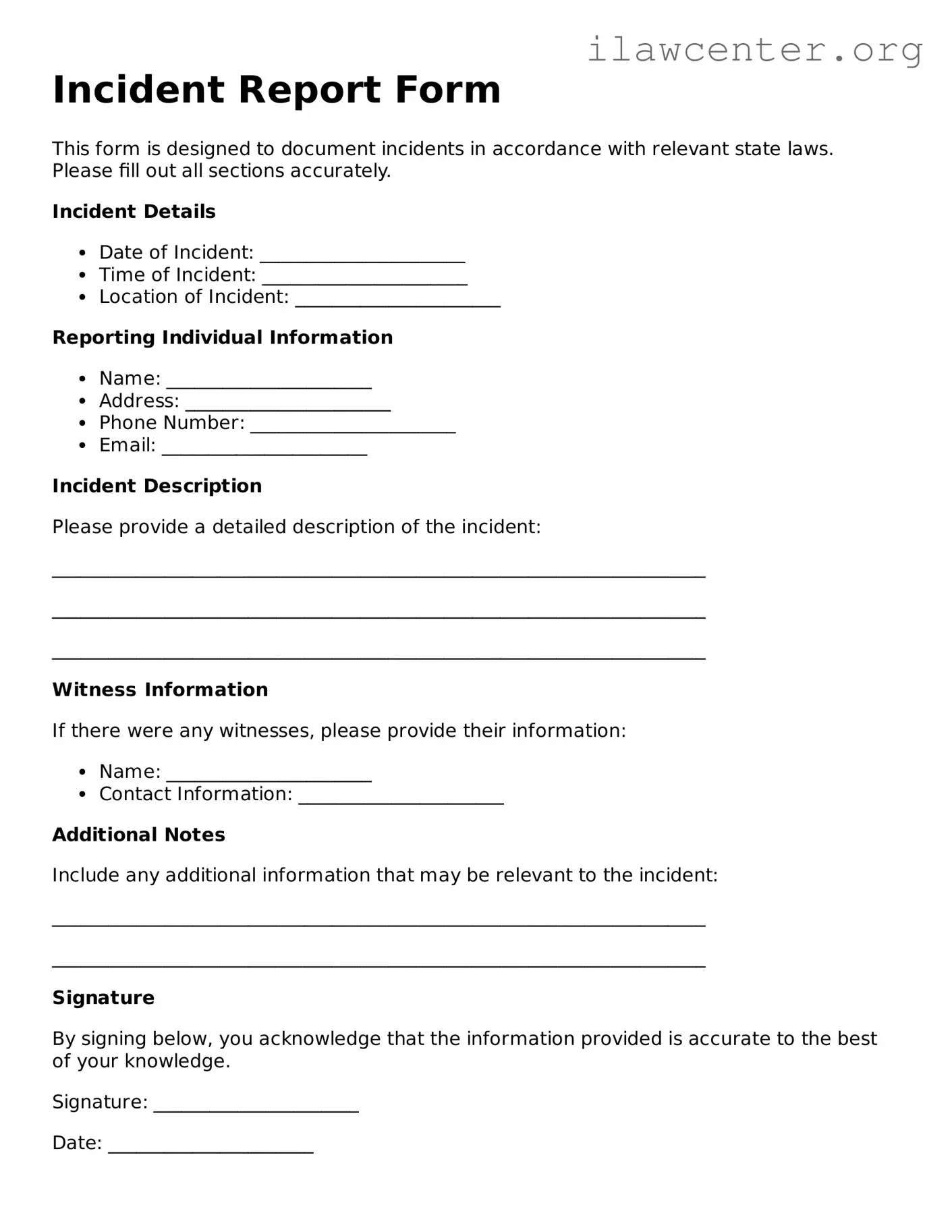
Incident Report Form Preview

Incident Report Form

This form is designed to document incidents in accordance with relevant state laws. Please fill out all sections accurately.

Incident Details

  • Date of Incident: ______________________
  • Time of Incident: ______________________
  • Location of Incident: ______________________

Reporting Individual Information

  • Name: ______________________
  • Address: ______________________
  • Phone Number: ______________________
  • Email: ______________________

Incident Description

Please provide a detailed description of the incident:

______________________________________________________________________

______________________________________________________________________

______________________________________________________________________

Witness Information

If there were any witnesses, please provide their information:

  • Name: ______________________
  • Contact Information: ______________________

Additional Notes

Include any additional information that may be relevant to the incident:

______________________________________________________________________

______________________________________________________________________

Signature

By signing below, you acknowledge that the information provided is accurate to the best of your knowledge.

Signature: ______________________

Date: ______________________

PDF Form Characteristics

Fact Name Description
Purpose The Incident Report Form is used to document details of an incident, ensuring accurate records for legal and administrative purposes.
Who Uses It This form is typically utilized by employees, supervisors, and safety officers in workplaces or organizations.
Contents It generally includes sections for date, time, location, individuals involved, and a detailed description of the incident.
State-Specific Forms Many states have their own versions of the form, tailored to comply with local regulations and reporting requirements.
Governing Laws In California, for example, the governing law is the California Code of Regulations, Title 8, Section 3204, which mandates reporting of workplace injuries.
Confidentiality Information on the form should be treated confidentially to protect the privacy of those involved.
Submission Process Typically, the completed form is submitted to a designated safety officer or human resources department for review.
Retention Period Organizations are often required to keep these reports on file for a specified period, usually three to five years, depending on state laws.

Instructions on Utilizing Incident Report Form

Completing the Incident Report Form is an important step in documenting any incident that occurs. This form will help ensure that all necessary details are recorded accurately. Follow these steps to fill it out correctly.

  1. Begin by entering the date of the incident at the top of the form.
  2. Provide your name and contact information in the designated fields.
  3. Describe the location where the incident took place. Be as specific as possible.
  4. Detail the nature of the incident. Include what happened, who was involved, and any witnesses present.
  5. Document any injuries or damages that occurred as a result of the incident.
  6. If applicable, note any actions taken immediately following the incident.
  7. Review the information you have entered to ensure accuracy and completeness.
  8. Sign and date the form at the bottom before submitting it.

After filling out the form, it will be submitted to the appropriate department for review. Make sure to keep a copy for your records.

Important Facts about Incident Report Form

What is an Incident Report Form?

An Incident Report Form is a document used to record details about an incident that occurs within an organization. This could involve accidents, injuries, or any unusual events that may affect safety or operations. The form helps ensure that all necessary information is documented for future reference, analysis, or legal purposes.

Why is it important to fill out an Incident Report Form?

Filling out an Incident Report Form is crucial for several reasons. It helps to maintain a safe environment by identifying hazards and preventing future incidents. Additionally, it provides a clear record of what happened, which can be vital for investigations or insurance claims. Having accurate documentation can protect both the organization and individuals involved.

Who should complete the Incident Report Form?

The person who witnessed the incident or was directly involved should complete the form. However, if that individual is unable to do so, a supervisor or another responsible person can fill it out. It’s essential that the report is as accurate and detailed as possible, regardless of who completes it.

How soon should an Incident Report Form be submitted?

It is best to submit the Incident Report Form as soon as possible after the incident occurs. Delaying the submission can lead to forgotten details or inaccuracies. Many organizations have specific timelines for reporting incidents, so it’s important to be aware of those requirements to ensure compliance.

What happens after the Incident Report Form is submitted?

After submission, the report will typically be reviewed by management or a designated safety officer. They will investigate the incident further, if necessary, and may take steps to address any issues identified. The report may also be used for training purposes or to improve safety protocols within the organization.

Common mistakes

Filling out an Incident Report Form is an important task, yet many people make common mistakes that can lead to confusion or delays. One frequent error is failing to provide complete information. When individuals skip sections or leave out crucial details, it can hinder the investigation process. Always ensure that every section is filled out thoroughly.

Another mistake is not being clear and concise. Using vague language or technical jargon can create misunderstandings. It’s essential to write in a straightforward manner, focusing on the facts of the incident. This helps everyone involved to understand the situation better.

People also often forget to include the date and time of the incident. These details are vital for an accurate timeline. Without them, it can be challenging to piece together the events surrounding the incident. Always double-check that these specifics are included.

Additionally, some individuals neglect to gather witness statements. If others were present during the incident, their perspectives can provide valuable insights. Make sure to record their names and contact information to support your report.

Another common mistake is not reviewing the form before submission. Errors in spelling or grammar can detract from the professionalism of the report. Taking a moment to proofread can make a significant difference in how the report is perceived.

Lastly, failing to keep a copy of the completed form is a mistake many people make. Having a record of what was submitted can be helpful for future reference or if questions arise later. Always keep a copy for your own records.

Documents used along the form

When an incident occurs, it is essential to document the details accurately. The Incident Report Form is just one part of the broader documentation process. Several other forms and documents often accompany it to provide a comprehensive view of the situation and its aftermath. Below is a list of these important documents.

  • Witness Statement Form: This form collects firsthand accounts from individuals who witnessed the incident. Their perspectives can offer valuable insights into what transpired.
  • Injury Report Form: Used to document any injuries sustained during the incident, this form details the nature of the injuries and the medical treatment provided.
  • Accident Scene Diagram: A visual representation of the incident location, this diagram helps clarify the circumstances and layout of the scene.
  • Follow-Up Report: After the initial incident report, this document outlines any subsequent actions taken, investigations conducted, or resolutions achieved.
  • Corrective Action Plan: This plan details steps that will be taken to prevent similar incidents in the future. It focuses on addressing the root causes identified during the investigation.
  • Insurance Claim Form: If applicable, this form is submitted to an insurance company to seek compensation for damages or injuries resulting from the incident.
  • Employee Training Records: These records show any training that employees received related to safety protocols and procedures, which can be relevant in understanding the context of the incident.

Each of these documents plays a crucial role in the incident documentation process. Together, they help ensure that all aspects of the incident are thoroughly examined and addressed, contributing to a safer environment moving forward.

Similar forms

The Incident Report Form serves a crucial role in documenting events and incidents within various settings. Its structure and purpose share similarities with several other documents. Below are ten documents that resemble the Incident Report Form, each with unique characteristics:

  • Accident Report Form: This document specifically details accidents that occur in the workplace, focusing on the circumstances, injuries, and immediate responses.
  • Near Miss Report: Similar to the Incident Report Form, this document captures events that could have led to an accident but did not, helping organizations improve safety protocols.
  • Safety Incident Report: This report is used to document any safety-related incidents, emphasizing the potential hazards and preventive measures taken.
  • Property Damage Report: This form records incidents that result in damage to property, detailing the extent of the damage and the context in which it occurred.
  • Witness Statement Form: This document gathers firsthand accounts from witnesses of an incident, providing additional perspectives that complement the Incident Report Form.
  • Employee Complaint Form: While focused on grievances, this form can document incidents involving employee interactions, similar to how the Incident Report Form addresses events.
  • Insurance Claim Form: This document is used to report incidents to insurance companies, detailing the event and the damages incurred, akin to the Incident Report Form's purpose.
  • Incident Log: A more informal record, the Incident Log tracks various incidents over time, offering a broader view of trends and issues within an organization.
  • Event Report: This document summarizes events, including any incidents that occurred, similar to how the Incident Report Form captures specific details about an event.
  • Risk Assessment Form: This form evaluates potential risks associated with specific activities or environments, which can be informed by incidents documented in the Incident Report Form.

Each of these documents plays a vital role in promoting safety, accountability, and awareness within organizations. Understanding their similarities can enhance the effectiveness of incident documentation and response strategies.

Dos and Don'ts

When filling out the Incident Report Form, it's crucial to follow certain guidelines to ensure clarity and accuracy. Here are nine things you should and shouldn't do:

  • Do provide a clear and concise description of the incident.
  • Do include all relevant details, such as date, time, and location.
  • Do use factual language; avoid assumptions or opinions.
  • Do ensure all parties involved are identified correctly.
  • Do submit the report promptly to maintain accuracy.
  • Don't leave out important information; omissions can lead to misunderstandings.
  • Don't use vague language; be specific in your descriptions.
  • Don't alter facts to make the incident appear less severe.
  • Don't forget to proofread for clarity and grammatical accuracy.

Following these guidelines will help ensure that the Incident Report Form is completed effectively and serves its intended purpose.

Misconceptions

When it comes to the Incident Report Form, many people have misunderstandings. Here are ten common misconceptions:

  1. Incident Reports are only for accidents.

    Many believe that these forms are only necessary for accidents. However, they can also be used for near misses, safety concerns, and other incidents that may not result in physical harm.

  2. Only management can fill out the form.

    Anyone who witnesses an incident can complete the report. This ensures that all perspectives are captured.

  3. Incident Reports are only needed for workplace injuries.

    These forms are useful for documenting any event that could impact safety, not just injuries. This includes property damage and unsafe conditions.

  4. Filing an Incident Report will get someone in trouble.

    The purpose of the report is to improve safety, not to assign blame. It helps identify areas for improvement.

  5. Incident Reports are only for legal purposes.

    While they can serve legal needs, their primary purpose is to enhance safety and prevent future incidents.

  6. Once submitted, the report is forgotten.

    Reports are typically reviewed by management to address issues and implement changes based on the findings.

  7. Incident Reports are complicated to fill out.

    Most forms are straightforward and designed to be user-friendly. They usually require basic information about the incident.

  8. Only serious incidents require a report.

    Even minor incidents should be reported. They can reveal patterns that lead to more serious issues if ignored.

  9. Reports are only for internal use.

    In some cases, reports may be shared with external agencies or regulators, especially if they involve safety violations.

  10. Filling out the form is a waste of time.

    In reality, taking the time to report incidents can lead to safer environments for everyone.

Key takeaways

Filling out and using an Incident Report Form is crucial for documenting events that require attention. Here are some key takeaways to consider:

  • Accuracy is essential: Ensure that all information provided is correct and detailed. Inaccuracies can lead to misunderstandings or mismanagement of the incident.
  • Timeliness matters: Complete the form as soon as possible after the incident occurs. Delayed reporting can result in lost details and diminished credibility.
  • Be objective: Stick to the facts when describing the incident. Avoid personal opinions or assumptions about what happened.
  • Include all relevant details: Document the date, time, location, and individuals involved. This information is critical for a comprehensive understanding of the incident.
  • Use clear language: Write in a straightforward manner. Avoid jargon or overly complex terms that may confuse the reader.
  • Follow established protocols: Adhere to any specific guidelines your organization has for completing the form. This ensures consistency and compliance.
  • Keep a copy: Retain a copy of the completed form for your records. This can be useful for future reference or follow-up actions.
  • Review and revise: Before submitting, review the form for any errors or omissions. A thorough review can prevent potential issues down the line.

Utilizing the Incident Report Form effectively can enhance safety and accountability within an organization.