Fillable Independent Contractor Agreement Document

Fillable Independent Contractor Agreement Document

An Independent Contractor Agreement is a legal document that outlines the terms and conditions between a business and an independent contractor. This agreement clarifies the expectations, responsibilities, and payment details, ensuring both parties are on the same page. To create a solid foundation for your working relationship, consider filling out the form by clicking the button below.

Article Guide

The Independent Contractor Agreement form serves as a crucial document in establishing the terms and conditions between a business and an independent contractor. This form outlines the scope of work, payment terms, and deadlines, ensuring that both parties have a clear understanding of their obligations. It typically includes sections detailing the nature of the services to be performed, the duration of the contract, and any confidentiality or non-compete clauses that may apply. Additionally, it addresses issues such as liability, ownership of work product, and the status of the contractor as an independent entity rather than an employee. By clearly defining these elements, the Independent Contractor Agreement helps prevent misunderstandings and disputes, fostering a professional relationship built on mutual respect and clarity.

Independent Contractor Agreement Preview

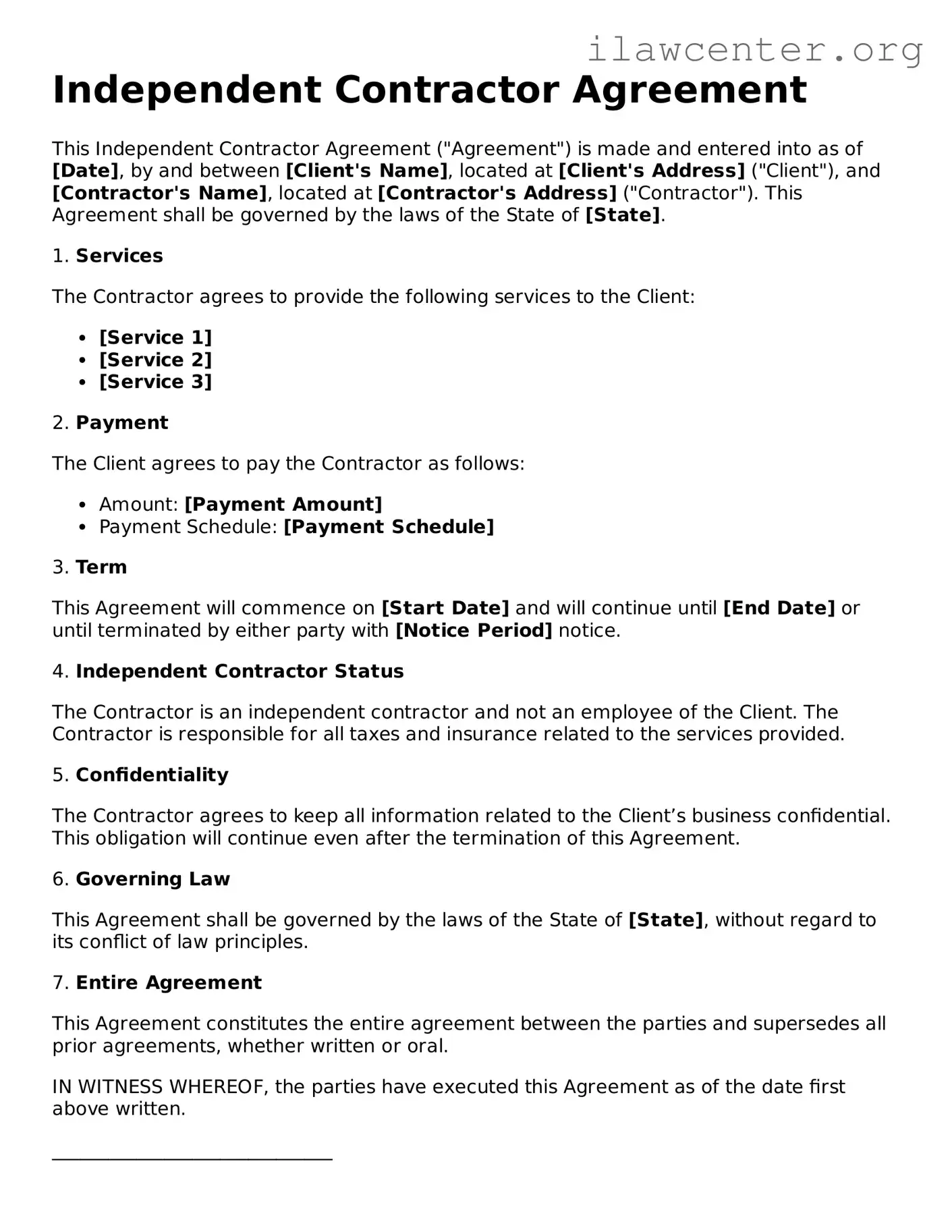
Independent Contractor Agreement

This Independent Contractor Agreement ("Agreement") is made and entered into as of [Date], by and between [Client's Name], located at [Client's Address] ("Client"), and [Contractor's Name], located at [Contractor's Address] ("Contractor"). This Agreement shall be governed by the laws of the State of [State].

1. Services

The Contractor agrees to provide the following services to the Client:

  • [Service 1]
  • [Service 2]
  • [Service 3]

2. Payment

The Client agrees to pay the Contractor as follows:

  • Amount: [Payment Amount]
  • Payment Schedule: [Payment Schedule]

3. Term

This Agreement will commence on [Start Date] and will continue until [End Date] or until terminated by either party with [Notice Period] notice.

4. Independent Contractor Status

The Contractor is an independent contractor and not an employee of the Client. The Contractor is responsible for all taxes and insurance related to the services provided.

5. Confidentiality

The Contractor agrees to keep all information related to the Client’s business confidential. This obligation will continue even after the termination of this Agreement.

6. Governing Law

This Agreement shall be governed by the laws of the State of [State], without regard to its conflict of law principles.

7. Entire Agreement

This Agreement constitutes the entire agreement between the parties and supersedes all prior agreements, whether written or oral.

IN WITNESS WHEREOF, the parties have executed this Agreement as of the date first above written.

______________________________

[Client's Name]

______________________________

[Contractor's Name]

PDF Form Characteristics

Fact Name Description
Definition An Independent Contractor Agreement outlines the terms of the working relationship between a contractor and a client.
Purpose This agreement clarifies the scope of work, payment terms, and responsibilities of both parties.
Governing Law The agreement is subject to state-specific laws, which can vary significantly. For example, California law governs contracts made in California.
Tax Implications Independent contractors are responsible for their own taxes, unlike employees who have taxes withheld by their employer.
Termination Clause Most agreements include a termination clause, allowing either party to end the contract under specified conditions.
Intellectual Property The agreement should address ownership of any intellectual property created during the contract period.

Instructions on Utilizing Independent Contractor Agreement

Filling out the Independent Contractor Agreement form is a straightforward process. This document outlines the terms of the working relationship between a contractor and a client. Completing it accurately ensures that both parties understand their rights and responsibilities.

  1. Begin with the date at the top of the form. Write the date when the agreement is being completed.
  2. Enter the name of the contractor in the designated space. Ensure the name is spelled correctly.
  3. Provide the contractor's address, including street, city, state, and ZIP code.
  4. Next, fill in the client's name. This should be the name of the business or individual hiring the contractor.
  5. Include the client's address, similar to the contractor's address format.
  6. Clearly state the services the contractor will provide. Be specific about the tasks and expectations.
  7. Specify the payment terms. Include the amount, frequency, and method of payment.
  8. Indicate the duration of the agreement. Mention start and end dates, if applicable.
  9. Review any additional clauses or terms that may need to be included, such as confidentiality or termination conditions.
  10. Both parties should sign and date the agreement at the bottom of the form. Make sure all signatures are legible.

Once you have completed the form, keep a copy for your records. Provide a signed copy to the other party involved. This ensures that both sides have a clear understanding of the agreement.

Important Facts about Independent Contractor Agreement

What is an Independent Contractor Agreement?

An Independent Contractor Agreement is a legal document that outlines the relationship between a business and a contractor hired to perform specific tasks or services. This agreement clarifies the expectations, responsibilities, and rights of both parties. It typically includes details such as the scope of work, payment terms, deadlines, and confidentiality obligations. By having this agreement in place, both the contractor and the business can ensure that they are on the same page, reducing the risk of misunderstandings and disputes.

Why is it important to have an Independent Contractor Agreement?

Having an Independent Contractor Agreement is crucial for several reasons. First, it establishes clear expectations regarding the work to be performed. This clarity helps prevent disputes and misunderstandings down the line. Second, it protects the interests of both parties by detailing payment terms and deadlines. Additionally, the agreement can include clauses that protect sensitive information and intellectual property. In essence, this document serves as a safeguard for both the contractor and the business, ensuring a professional and mutually beneficial relationship.

What should be included in an Independent Contractor Agreement?

An effective Independent Contractor Agreement should include several key elements. Start with the names and contact information of both parties. Next, outline the specific services the contractor will provide, along with deadlines for completion. Payment terms are also essential; specify how much the contractor will be paid and when. Additionally, include clauses about confidentiality, ownership of work products, and any applicable termination conditions. These components create a comprehensive framework that protects both parties and clarifies their obligations.

Can an Independent Contractor Agreement be modified after it is signed?

Yes, an Independent Contractor Agreement can be modified after it is signed, but both parties must agree to the changes. It is advisable to document any modifications in writing to avoid confusion later. This can be done through an amendment to the original agreement or by drafting a new agreement altogether. Open communication between the contractor and the business is key to ensuring that any changes reflect the current needs and expectations of both parties.

Common mistakes

Filling out the Independent Contractor Agreement form can be straightforward, but many people make common mistakes that can lead to confusion or legal issues. One frequent error is failing to provide accurate contact information. It is essential to include the correct names, addresses, and phone numbers. Inaccurate details can delay communication and create problems in the future.

Another mistake is not clearly defining the scope of work. The agreement should outline the specific tasks and responsibilities of the contractor. Without this clarity, misunderstandings can arise, leading to disputes over what was expected. It is important to be as detailed as possible to avoid ambiguity.

Many individuals overlook the importance of payment terms. Stating how much and when the contractor will be paid is crucial. Vague terms can lead to disagreements later on. It’s advisable to specify the payment method and schedule to ensure both parties are on the same page.

People often forget to include the duration of the agreement. It is vital to specify the start and end dates of the contract. This helps both parties understand the timeline of the work and when obligations will conclude. Not having a clear timeline can lead to ongoing commitments that neither party intended.

Another common error is neglecting to address confidentiality. If the contractor will have access to sensitive information, it is important to include a confidentiality clause. This protects the interests of the business and ensures that proprietary information remains secure.

Some individuals fail to include a termination clause. This clause outlines how either party can end the agreement if necessary. Without this provision, it may be difficult to exit the contract if circumstances change. Clarity in this area can prevent potential legal complications.

Lastly, many people do not seek legal advice before signing the agreement. While it may seem unnecessary, consulting with a legal professional can help identify potential issues and ensure that the agreement is fair and comprehensive. Taking this step can save time and resources in the long run.

Documents used along the form

When working with independent contractors, several forms and documents may be necessary to ensure clarity and legal compliance. Below is a list of commonly used documents that complement the Independent Contractor Agreement.

  • W-9 Form: This form is used to provide the contractor's Taxpayer Identification Number (TIN) to the hiring party. It helps the hiring entity report payments to the IRS.
  • Invoice: Contractors typically submit invoices to request payment for their services. An invoice outlines the work completed, payment terms, and total amount due.
  • Non-Disclosure Agreement (NDA): This document protects confidential information shared between the contractor and the hiring party. It ensures that sensitive information remains private.
  • Scope of Work (SOW): A detailed description of the specific tasks and responsibilities the contractor will undertake. It provides clarity on deliverables and timelines.
  • Payment Schedule: This document outlines when payments will be made to the contractor. It can specify milestones or regular intervals for payment.
  • Termination Letter: If either party decides to end the contract, a termination letter formally documents the decision. It may outline the reasons for termination and any final obligations.
  • Work Product Agreement: This agreement clarifies ownership of any work produced by the contractor. It ensures that the hiring party retains rights to the work created during the contract period.
  • Insurance Certificate: Contractors may need to provide proof of insurance coverage. This document demonstrates that they have the necessary liability insurance to protect against potential claims.

Utilizing these forms and documents can help streamline the contracting process and protect the interests of both parties involved. Clear communication and proper documentation are essential for a successful working relationship.

Similar forms

  • Employment Agreement: This document outlines the terms of employment between an employer and an employee. It covers job responsibilities, compensation, and benefits, similar to how an Independent Contractor Agreement details the scope of work and payment for independent contractors.
  • Service Agreement: A service agreement is used when one party agrees to provide services to another. Like the Independent Contractor Agreement, it specifies the services to be provided, timelines, and payment terms.
  • Consulting Agreement: This document is specifically for consultants who provide expert advice. It shares similarities with the Independent Contractor Agreement in defining the consultant's role, deliverables, and compensation.
  • Freelance Agreement: Freelance agreements are tailored for freelancers who work on a project basis. They outline project scope, deadlines, and payment, akin to the structure of an Independent Contractor Agreement.
  • Non-Disclosure Agreement (NDA): An NDA protects confidential information shared between parties. While it serves a different purpose, it is often used alongside an Independent Contractor Agreement to safeguard sensitive information.
  • Joint Venture Agreement: This document outlines the terms of collaboration between two or more parties for a specific project. Similar to the Independent Contractor Agreement, it defines roles, responsibilities, and profit-sharing arrangements.
  • Partnership Agreement: A partnership agreement governs the relationship between business partners. Like an Independent Contractor Agreement, it specifies each party's contributions and responsibilities, though it typically involves a deeper commitment.
  • License Agreement: This document grants permission to use intellectual property. While its focus is different, it often includes terms and conditions that resemble those found in an Independent Contractor Agreement regarding the use of services or products.
  • Memorandum of Understanding (MOU): An MOU outlines the intentions and expectations of parties entering a partnership. It shares the clarity of purpose found in an Independent Contractor Agreement but is generally less formal and binding.

Dos and Don'ts

When filling out the Independent Contractor Agreement form, consider the following guidelines:

  • Do read the entire agreement carefully before signing.
  • Do provide accurate and complete information about your business.
  • Do clarify any terms or conditions you do not understand.
  • Do ensure that payment terms are clearly outlined.
  • Don't leave any sections blank unless specified.
  • Don't sign the agreement without reviewing it thoroughly.
  • Don't ignore deadlines for submission or revisions.

Misconceptions

There are several misconceptions about the Independent Contractor Agreement form that can lead to confusion. Understanding these can help you navigate your contractual relationships more effectively.

  • Independent contractors are not employees. Many people mistakenly believe that independent contractors have the same rights and benefits as employees. In reality, independent contractors operate as separate entities and do not receive employee benefits.
  • All independent contractors need a written agreement. Some assume that a verbal agreement is sufficient. However, having a written Independent Contractor Agreement is crucial for clarity and legal protection.
  • Independent contractors can work for multiple clients simultaneously. While this is often true, some agreements may include exclusivity clauses that prevent contractors from working with others during the contract period.
  • Independent contractors are responsible for their own taxes. This is true, but many people overlook that clients may still need to report payments made to contractors, typically using a 1099 form.
  • Once signed, the agreement cannot be changed. Some think that an Independent Contractor Agreement is set in stone. In fact, both parties can negotiate changes as long as they are documented in writing.
  • Independent contractors have complete control over how they work. While they do have flexibility, many contracts outline specific deliverables and deadlines that must be met.

Clearing up these misconceptions can lead to better understanding and smoother working relationships. Always review your agreements carefully and consult with a professional if needed.

Key takeaways

When working with independent contractors, having a solid agreement is crucial. Here are some key takeaways to consider when filling out and using the Independent Contractor Agreement form:

  • Clearly Define the Scope of Work: Outline the specific tasks and responsibilities expected from the contractor. This clarity helps avoid misunderstandings later on.
  • Specify Payment Terms: Detail how much the contractor will be paid, the payment schedule, and the method of payment. This ensures both parties are on the same page regarding compensation.
  • Include a Timeline: Establish deadlines for project milestones or completion. This helps keep the project on track and holds both parties accountable.
  • Address Confidentiality: If the contractor will have access to sensitive information, include a confidentiality clause to protect your business interests.
  • Clarify Ownership of Work: Specify who owns the work produced by the contractor. This prevents disputes over intellectual property rights down the line.
  • Outline Termination Conditions: Define the circumstances under which either party can terminate the agreement. This provides a clear exit strategy if needed.
  • Consult Legal Counsel: Before finalizing the agreement, consider having a legal professional review it. This ensures that your interests are adequately protected.

Using an Independent Contractor Agreement not only protects your business but also fosters a professional relationship with your contractor. By following these takeaways, you can create a solid foundation for your working arrangement.