Attorney-Verified  Affidavit of Residency Document for Indiana

Attorney-Verified Affidavit of Residency Document for Indiana

The Indiana Affidavit of Residency form serves as a legal document that verifies an individual's residence within the state of Indiana. This form is often required for various purposes, including enrolling in schools or applying for certain benefits. For those needing to complete this form, take the next step by clicking the button below.

Article Guide

The Indiana Affidavit of Residency form serves as an important legal document for individuals needing to establish their residency in the state of Indiana. This form is commonly used for various purposes, including voter registration, obtaining a driver’s license, or enrolling in schools. It requires the individual to provide personal information, such as their name, address, and the duration of their residency. Additionally, the affidavit must be signed in the presence of a notary public, ensuring that the information provided is truthful and accurate. Understanding the requirements and implications of this form is crucial for residents, as it plays a significant role in confirming one’s legal status within the state. Properly completing the Affidavit of Residency can facilitate access to essential services and rights, making it a vital step for many individuals and families in Indiana.

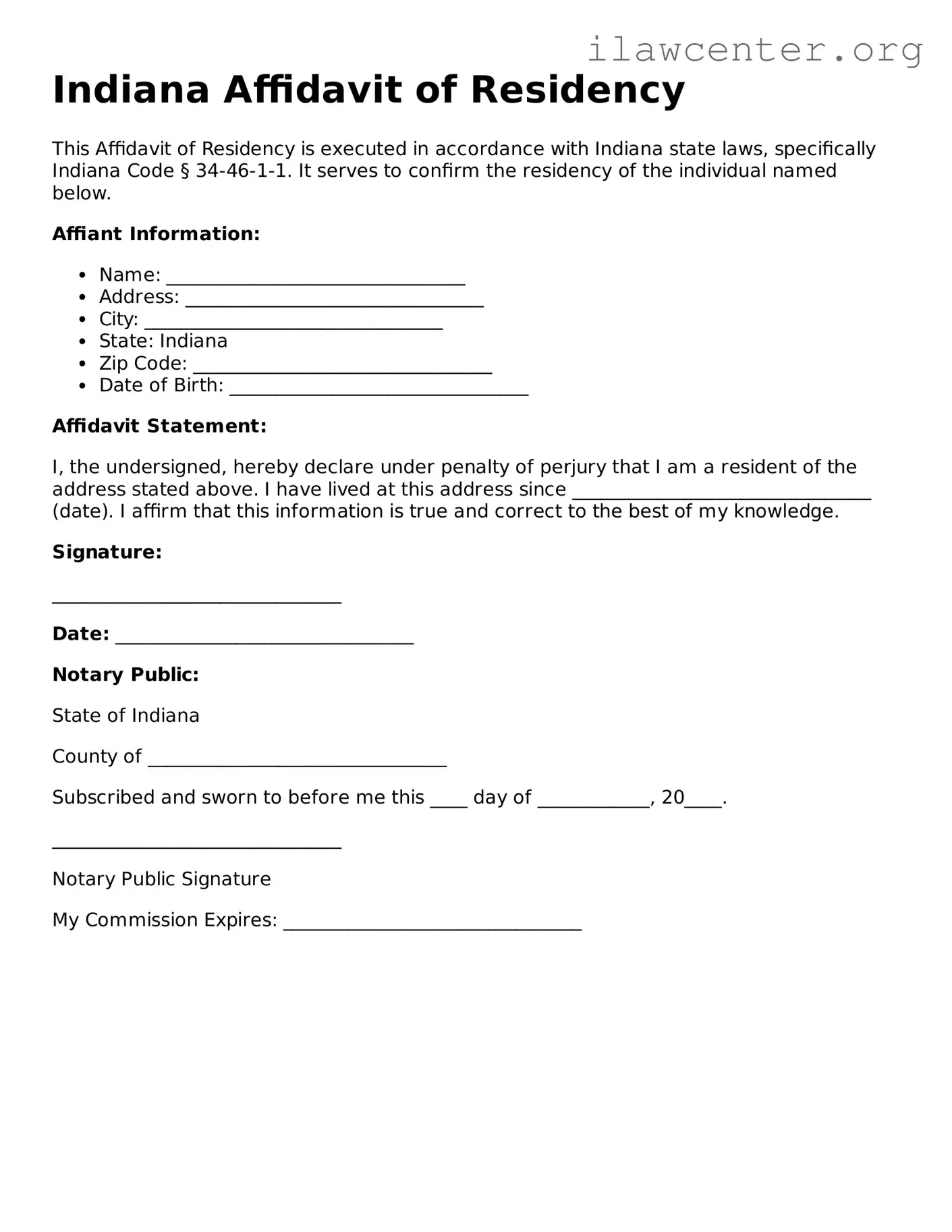
Indiana Affidavit of Residency Preview

Indiana Affidavit of Residency

This Affidavit of Residency is executed in accordance with Indiana state laws, specifically Indiana Code § 34-46-1-1. It serves to confirm the residency of the individual named below.

Affiant Information:

  • Name: ________________________________
  • Address: ________________________________
  • City: ________________________________
  • State: Indiana
  • Zip Code: ________________________________
  • Date of Birth: ________________________________

Affidavit Statement:

I, the undersigned, hereby declare under penalty of perjury that I am a resident of the address stated above. I have lived at this address since ________________________________ (date). I affirm that this information is true and correct to the best of my knowledge.

Signature:

_______________________________

Date: ________________________________

Notary Public:

State of Indiana

County of ________________________________

Subscribed and sworn to before me this ____ day of ____________, 20____.

_______________________________

Notary Public Signature

My Commission Expires: ________________________________

PDF Form Characteristics

Fact Name Details
Purpose The Indiana Affidavit of Residency form is used to verify an individual's residency in Indiana.
Governing Law This form is governed by Indiana Code § 3-7-13-1, which outlines residency requirements for voters.
Who Can Use It Any individual seeking to establish or confirm their residency in Indiana can use this form.
Required Information The form requires the individual's name, address, and a declaration of residency.
Signature Requirement The form must be signed by the individual affirming the truthfulness of the information provided.
Submission The completed affidavit should be submitted to the appropriate local election office or authority.

Instructions on Utilizing Indiana Affidavit of Residency

Completing the Indiana Affidavit of Residency form is a straightforward process that requires careful attention to detail. After filling out the form, it will need to be submitted to the appropriate authority, which may include a local school district or other designated office.

  1. Obtain the Indiana Affidavit of Residency form from the relevant source, such as a school or government website.
  2. Read the instructions carefully to understand the requirements for filling out the form.
  3. Begin with the first section by entering your full name as the affiant.
  4. Provide your current residential address, including street, city, state, and ZIP code.
  5. Fill in the date when you completed the form.
  6. Identify the person with whom you reside, providing their full name and relationship to you.
  7. Complete any additional sections as required, which may include information about your residency history.
  8. Review the form for accuracy and completeness before signing.
  9. Sign the form in the designated area to affirm the truthfulness of the information provided.
  10. Have the form notarized, if required, by a licensed notary public.
  11. Submit the completed form to the appropriate office or authority as instructed.

Important Facts about Indiana Affidavit of Residency

What is the Indiana Affidavit of Residency form?

The Indiana Affidavit of Residency form is a legal document used to confirm an individual's residency in the state of Indiana. This form is often required for various purposes, such as enrolling in schools or obtaining certain government benefits. It serves as proof that a person resides at a specified address within Indiana.

Who needs to complete the Affidavit of Residency form?

This form is typically completed by individuals who need to verify their residency status. Common situations include parents enrolling their children in local schools, individuals applying for state assistance, or those needing to establish residency for legal purposes. If you are unsure whether you need to fill out this form, it’s best to consult with the relevant authority or institution.

How do I obtain the Indiana Affidavit of Residency form?

You can obtain the Indiana Affidavit of Residency form from various sources. Many schools and government agencies provide the form directly on their websites. Alternatively, you may also find it at local county offices or public libraries. Ensure you are using the most current version of the form to avoid any issues.

What information is required on the form?

The form generally requires basic personal information, including your name, address, and the length of time you have lived at that address. You may also need to provide additional details, such as the names of any dependents living with you. Be sure to read the form carefully to ensure all necessary information is included.

Do I need to have the Affidavit of Residency notarized?

In most cases, yes, the Affidavit of Residency must be notarized. This means that you will need to sign the form in front of a notary public, who will then verify your identity and witness your signature. Notarization adds an extra layer of authenticity to the document, which is often required by schools and government agencies.

What happens if I provide false information on the form?

Providing false information on the Affidavit of Residency form can have serious consequences. It may lead to legal penalties, including fines or even criminal charges. Additionally, if the misinformation is discovered, it could result in the denial of services or benefits you were seeking. Always ensure that the information you provide is accurate and truthful.

Can I use the same Affidavit of Residency form for multiple purposes?

Generally, you can use the same Affidavit of Residency form for multiple purposes, as long as it meets the requirements of each institution or agency. However, some organizations may have specific forms or additional requirements. It’s advisable to check with each entity to ensure compliance.

How long is the Affidavit of Residency form valid?

The validity of the Affidavit of Residency form can vary depending on the institution or agency requesting it. Some may accept it for a specific period, while others may require a new affidavit if your residency status changes. Always check with the requesting party to understand their specific requirements.

Where do I submit the completed Affidavit of Residency form?

You should submit the completed Affidavit of Residency form to the organization or agency that requested it. This could be a school, government office, or other relevant authority. Ensure you keep a copy of the completed form for your records before submitting it.
Common mistakes

Filling out the Indiana Affidavit of Residency form can be a straightforward process, but several common mistakes can lead to delays or complications. One of the most frequent errors occurs when individuals fail to provide accurate personal information. This includes missing or incorrect names, addresses, or dates. It is crucial to double-check all details to ensure they match official documents.

Another common mistake is neglecting to sign and date the affidavit. This form requires your signature to validate the information provided. Without a signature, the affidavit may be considered incomplete, which can result in rejection or additional requests for information.

Some people also overlook the importance of having the affidavit notarized. Notarization is a necessary step that verifies your identity and the authenticity of your signature. Submitting an unsigned or unnotarized affidavit can lead to significant delays in processing.

Additionally, individuals often misinterpret the residency requirements. It is essential to understand what constitutes residency in Indiana. Providing documentation that does not support your claim can lead to confusion and further complications. Always include relevant proof, such as utility bills or lease agreements, that clearly demonstrate your residency.

Failure to follow the specific instructions outlined on the form can also lead to errors. Each section of the affidavit has its requirements, and skipping any part can result in an incomplete submission. Carefully read the instructions to ensure that all necessary information is included.

Lastly, some individuals underestimate the importance of timely submission. Delays in filing the affidavit can affect various aspects of residency verification and may have consequences for other processes, such as enrolling in school or obtaining a driver's license. It is advisable to submit the form as soon as possible to avoid any potential issues.

Documents used along the form

When completing the Indiana Affidavit of Residency form, you may need to gather additional documents to support your claim. These forms can help clarify your residency status and provide necessary proof. Below is a list of commonly used documents that may accompany the affidavit.

  • Proof of Identity: A government-issued ID, such as a driver's license or passport, verifies your identity and supports your residency claim.
  • Utility Bill: A recent utility bill in your name can serve as evidence of your residence at a specific address.
  • Lease Agreement: If you rent your home, a signed lease agreement can demonstrate your residency and the terms of your living arrangement.
  • Bank Statement: A bank statement showing your name and address can further confirm your residency and financial ties to the location.

Gathering these documents will strengthen your application and help ensure a smoother process. Make sure each document is up to date and clearly shows your name and address to avoid any delays.

Similar forms

The Affidavit of Residency form serves as a declaration of an individual's residence and is often used in various legal and administrative contexts. Several other documents share similarities with this form, primarily in their purpose of confirming residency or identity. Below is a list of ten documents that are comparable to the Affidavit of Residency, along with an explanation of how they are similar.

  • Lease Agreement: A lease agreement outlines the terms under which a tenant rents property from a landlord. Like the Affidavit of Residency, it confirms the tenant's residence at a specific address.
  • Utility Bill: Utility bills, such as those for electricity or water, often display the name and address of the account holder. This document serves as proof of residency, similar to the Affidavit of Residency.
  • Bank Statement: A bank statement typically includes the account holder's name and address. It can be used to verify residency, much like the Affidavit of Residency.
  • Government-Issued ID: A government-issued identification card, such as a driver's license, contains the holder's address. This document can confirm residency in a manner akin to the Affidavit of Residency.
  • Voter Registration Card: A voter registration card lists the voter's name and address. It serves as a form of residency verification, paralleling the Affidavit of Residency.
  • Employment Records: Employment records may include the employee's address. These records can serve as proof of residency, similar to the Affidavit of Residency.
  • Tax Returns: Tax returns often include the taxpayer's address. They can be used to confirm residency, much like the Affidavit of Residency.
  • School Enrollment Records: Documents from educational institutions often contain the student's address. These records provide residency verification, akin to the Affidavit of Residency.
  • Insurance Documents: Insurance policies typically state the insured's address. They can serve as proof of residency, similar to the Affidavit of Residency.
  • Affidavit of Support: This document is often used in immigration contexts and confirms that an individual can financially support another person. It may include details about the sponsor's residency, paralleling the Affidavit of Residency.

Dos and Don'ts

When filling out the Indiana Affidavit of Residency form, it's important to follow specific guidelines to ensure accuracy and compliance. Here are some key do's and don'ts to keep in mind:

  • Do provide accurate and complete information. Double-check all entries for correctness.
  • Do sign and date the form in the appropriate sections. An unsigned form may be considered invalid.
  • Do include any required supporting documents. This may help verify your residency status.
  • Do keep a copy of the completed form for your records. This can be useful for future reference.
  • Don't leave any required fields blank. Incomplete forms can lead to delays or rejections.
  • Don't use incorrect or outdated information. Always use your current address and contact details.

Misconceptions

Understanding the Indiana Affidavit of Residency form is essential for various legal and administrative purposes. However, several misconceptions can lead to confusion. Here are seven common misunderstandings:

  1. The form is only for students.

    Many people believe that the Affidavit of Residency is exclusively for students attending school in Indiana. In reality, it can be used by anyone who needs to establish residency for various reasons, including voting, obtaining a driver's license, or accessing in-state tuition rates.

  2. It must be notarized.

    Some individuals think that notarization is a requirement for the affidavit to be valid. While notarization can add an extra layer of authenticity, it is not always necessary. Check specific requirements based on the purpose for which the affidavit is being used.

  3. Anyone can fill it out.

    This form is often assumed to be fillable by any individual. However, it should be completed by the person who is claiming residency, and they must provide accurate and truthful information to avoid legal issues.

  4. It is a permanent document.

    Many believe that once the affidavit is filed, it remains valid indefinitely. In truth, residency can change, and individuals may need to update or refile the affidavit if their living situation changes.

  5. It can be submitted online.

    Some people think they can easily submit the affidavit online. However, the submission process may vary depending on the agency or institution requiring the document, and in many cases, a physical copy is necessary.

  6. Only one affidavit is needed.

    There is a misconception that a single affidavit suffices for all purposes. In reality, different entities may require their own version of the affidavit, tailored to their specific requirements.

  7. It does not need to be updated.

    Lastly, some individuals believe that once the affidavit is completed, there is no need for updates. However, if circumstances change—such as moving to a new address—the affidavit should be revised to reflect the current residency status.

By clearing up these misconceptions, individuals can better navigate the requirements surrounding the Indiana Affidavit of Residency form and ensure they meet all necessary criteria.

Key takeaways

When filling out and using the Indiana Affidavit of Residency form, it is important to keep several key points in mind. This document serves as a declaration of where you live and may be required for various legal purposes.

  • Accuracy is Essential: Ensure that all information provided on the form is correct. Mistakes can lead to complications or delays.
  • Signature Requirement: The form must be signed in the presence of a notary public. This step is crucial for the affidavit to be legally valid.
  • Purpose of the Affidavit: Understand why you are filling out this form. It may be needed for school enrollment, voting registration, or other legal matters.
  • Keep Copies: After completing the form, make copies for your records. This can be helpful if you need to refer back to it in the future.

By following these guidelines, you can navigate the process more smoothly and ensure that your affidavit serves its intended purpose effectively.