Attorney-Verified  Articles of Incorporation Document for Indiana

Attorney-Verified Articles of Incorporation Document for Indiana

The Indiana Articles of Incorporation form is a legal document required to establish a corporation in the state of Indiana. This form outlines essential details about the corporation, including its name, purpose, and registered agent. Completing this form is a crucial step in the process of forming a business entity in Indiana.

To get started, fill out the form by clicking the button below.

Article Guide

When starting a business in Indiana, one of the essential steps involves filing the Articles of Incorporation. This form serves as the foundational document for establishing a corporation in the state. It outlines key information such as the corporation's name, which must be unique and comply with state naming requirements. Additionally, the form requires details about the corporation's purpose, which can range from specific business activities to a general statement of intent. Incorporators, the individuals responsible for filing the form, must also be identified, along with the registered agent who will receive legal documents on behalf of the corporation. The Articles of Incorporation also include provisions regarding the number of shares the corporation is authorized to issue, which is crucial for determining ownership and investment opportunities. By carefully completing this form, entrepreneurs lay the groundwork for their business, ensuring compliance with Indiana law and facilitating future growth.

Indiana Articles of Incorporation Preview

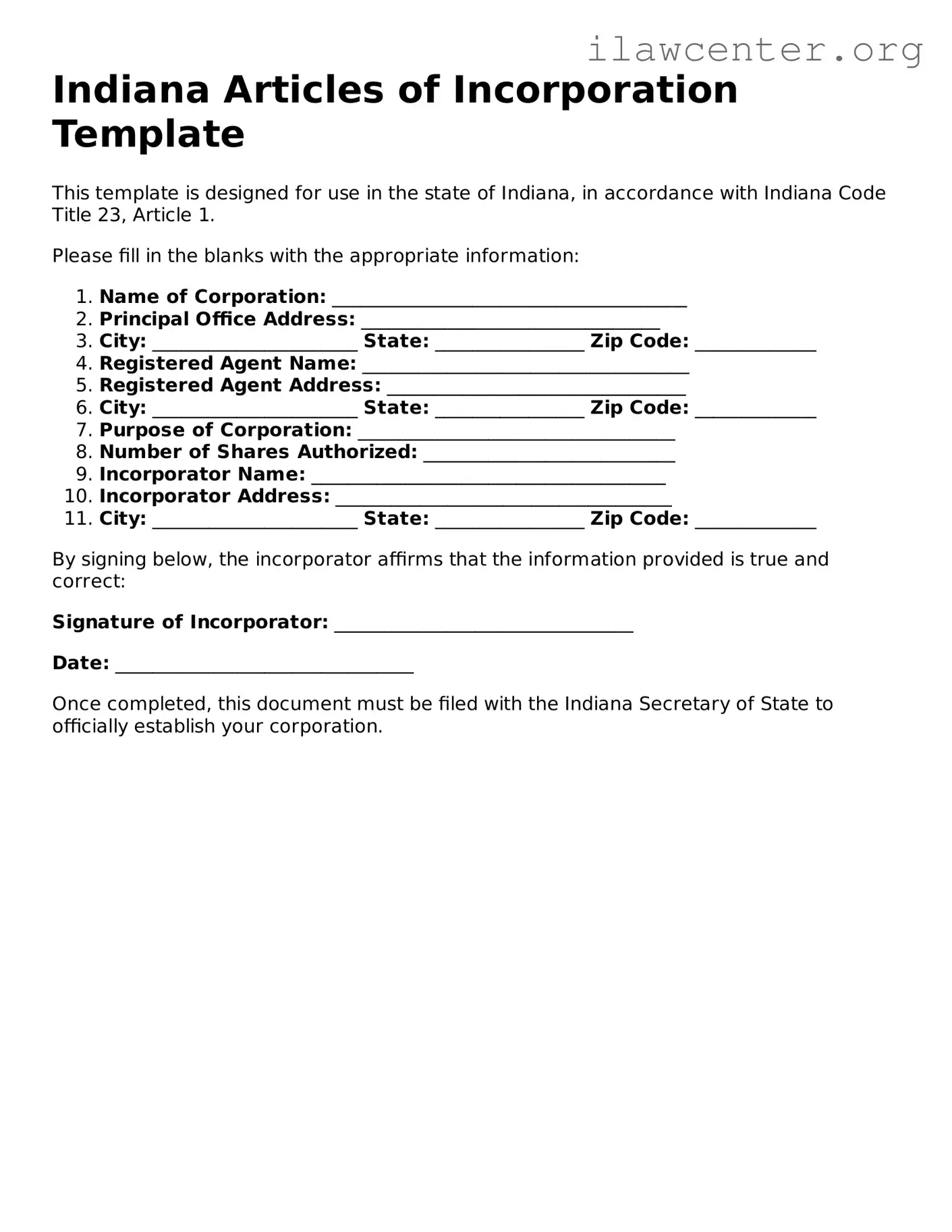
Indiana Articles of Incorporation Template

This template is designed for use in the state of Indiana, in accordance with Indiana Code Title 23, Article 1.

Please fill in the blanks with the appropriate information:

  1. Name of Corporation: ______________________________________
  2. Principal Office Address: ________________________________
  3. City: ______________________ State: ________________ Zip Code: _____________
  4. Registered Agent Name: ___________________________________
  5. Registered Agent Address: ________________________________
  6. City: ______________________ State: ________________ Zip Code: _____________
  7. Purpose of Corporation: __________________________________
  8. Number of Shares Authorized: ___________________________
  9. Incorporator Name: ______________________________________
  10. Incorporator Address: ____________________________________
  11. City: ______________________ State: ________________ Zip Code: _____________

By signing below, the incorporator affirms that the information provided is true and correct:

Signature of Incorporator: ________________________________

Date: ________________________________

Once completed, this document must be filed with the Indiana Secretary of State to officially establish your corporation.

PDF Form Characteristics

Fact Name Details
Purpose The Indiana Articles of Incorporation form is used to legally establish a corporation in the state of Indiana.
Governing Law This form is governed by the Indiana Business Corporation Law, specifically Indiana Code Title 23, Article 1.
Filing Requirements To file the Articles of Incorporation, you must submit the form to the Indiana Secretary of State along with the required filing fee.
Information Needed The form requires basic information such as the corporation's name, registered agent, and the purpose of the business.
Benefits of Incorporation Incorporating provides limited liability protection to the owners, separating personal assets from business debts.
Amendments If changes are needed after filing, amendments can be made to the Articles of Incorporation by submitting a separate form.

Instructions on Utilizing Indiana Articles of Incorporation

Once you have gathered the necessary information and documents, you can proceed to fill out the Indiana Articles of Incorporation form. This form is essential for establishing a new corporation in Indiana. Follow the steps below to ensure that you complete the form accurately.

  1. Begin by entering the name of your corporation. Ensure that the name complies with Indiana naming requirements and is distinguishable from other registered entities.
  2. Provide the duration of the corporation. Most corporations are established to exist perpetually unless stated otherwise.
  3. Indicate the purpose of your corporation. A brief description of your business activities will suffice.
  4. List the address of the corporation's registered office in Indiana. This must be a physical address, not a P.O. Box.
  5. Identify the registered agent. This person or business must have a physical address in Indiana and agree to accept legal documents on behalf of the corporation.
  6. Include the names and addresses of the incorporators. At least one incorporator is required, and they must be individuals or entities authorized to conduct business in Indiana.
  7. Provide the number of shares the corporation is authorized to issue. If there are different classes of shares, specify the details for each class.
  8. Sign and date the form. The incorporators must sign to affirm the accuracy of the information provided.
  9. Review the completed form for any errors or omissions. It is crucial to ensure all information is accurate before submission.
  10. Submit the form along with the required filing fee to the Indiana Secretary of State's office. Ensure you keep a copy for your records.

Important Facts about Indiana Articles of Incorporation

What is the Indiana Articles of Incorporation form?

The Indiana Articles of Incorporation form is a legal document that establishes a corporation in the state of Indiana. It outlines essential details about the corporation, such as its name, purpose, and registered agent. Filing this form is the first step in forming a corporation in Indiana.

Who needs to file the Articles of Incorporation?

Any individual or group looking to start a corporation in Indiana must file the Articles of Incorporation. This includes businesses of all sizes, whether for-profit or nonprofit. It’s a crucial step to gain legal recognition and limited liability protection for the owners.

What information is required on the form?

The form requires several key pieces of information. This includes the corporation's name, the purpose of the corporation, the address of the principal office, the name and address of the registered agent, and the number of shares the corporation is authorized to issue. Additional details may be necessary depending on the type of corporation being formed.

How do I file the Articles of Incorporation?

You can file the Articles of Incorporation online through the Indiana Secretary of State's website, or you can submit a paper form by mail. If you choose to file online, you’ll need to create an account. For paper filings, ensure that you send the completed form to the appropriate address along with the required filing fee.

Is there a fee to file the Articles of Incorporation?

Yes, there is a filing fee associated with submitting the Articles of Incorporation. As of the latest information, the fee for filing online is typically lower than for paper submissions. It’s important to check the Indiana Secretary of State’s website for the most current fee schedule.

How long does it take for the Articles of Incorporation to be processed?

Processing times can vary. Generally, online filings are processed faster than paper submissions. You can usually expect a turnaround time of a few business days for online filings, while paper filings may take longer. For the most accurate estimate, check the Indiana Secretary of State’s website or contact their office directly.

Can I change the Articles of Incorporation after filing?

Yes, changes can be made to the Articles of Incorporation after they have been filed. If you need to amend the articles, you will need to file an amendment form with the Indiana Secretary of State. This process may involve additional fees and documentation, so be sure to follow the guidelines provided on their website.

What is a registered agent, and why do I need one?

A registered agent is a person or business designated to receive legal documents on behalf of your corporation. Having a registered agent is a requirement in Indiana. They ensure that important documents, such as lawsuits or official government correspondence, are properly received and handled in a timely manner.

Do I need a lawyer to file the Articles of Incorporation?

While it’s not legally required to hire a lawyer to file the Articles of Incorporation, it can be beneficial. A legal professional can help ensure that all information is accurate and compliant with state laws. This can save you time and prevent potential issues down the road.

What happens after I file the Articles of Incorporation?

Once your Articles of Incorporation are filed and approved, your corporation is officially formed. You will receive a certificate of incorporation, which serves as proof of your corporation’s existence. After that, you can proceed with other steps, such as obtaining an Employer Identification Number (EIN) and setting up your business operations.
Common mistakes

Filing the Indiana Articles of Incorporation is an important step for anyone looking to establish a corporation in the state. However, many individuals make common mistakes that can lead to delays or even rejection of their application. Understanding these pitfalls can help ensure a smoother filing process.

One frequent error is failing to provide a clear and accurate name for the corporation. The name must be unique and distinguishable from existing entities registered in Indiana. If someone submits a name that is too similar to another business, it can result in a denial. Always conduct a thorough name search before submitting the form.

Another mistake is neglecting to include the correct registered agent information. A registered agent must have a physical address in Indiana and be available during business hours to receive legal documents. If the agent's details are incorrect or incomplete, it can complicate legal matters down the line.

People often overlook the requirement for specifying the corporation's purpose. While it may seem straightforward, the purpose should be clearly defined to avoid ambiguity. A vague purpose can lead to questions from the state and may delay the approval process.

Additionally, many applicants forget to include the number of shares the corporation is authorized to issue. This detail is crucial as it defines the ownership structure of the corporation. Omitting this information can result in the form being returned for correction.

Some individuals mistakenly assume that all incorporators need to be residents of Indiana. In fact, while it is beneficial, it is not a requirement. However, the incorporators must be at least 18 years old. Misunderstanding this requirement can lead to unnecessary complications.

Another common issue arises from improperly completing the signature section. The Articles of Incorporation must be signed by the incorporators, and missing or incorrect signatures can lead to rejection. Ensure that all required parties sign the document before submission.

People also tend to underestimate the importance of reviewing the completed form for errors. Simple typos or inaccuracies can derail the filing process. Taking the time to double-check the information can save time and prevent frustration.

Lastly, failing to pay the correct filing fee is a mistake that can halt the incorporation process. Each filing comes with a specific fee that must be submitted along with the form. Be sure to check the current fee schedule and include the appropriate payment to avoid delays.

By being aware of these common mistakes, individuals can navigate the process of filling out the Indiana Articles of Incorporation more effectively. Taking the time to ensure accuracy and completeness will pave the way for a successful incorporation experience.

Documents used along the form

When forming a corporation in Indiana, the Articles of Incorporation is a crucial first step. However, several other documents may also be necessary to ensure your corporation is set up correctly and compliant with state regulations. Below is a list of forms and documents often used alongside the Indiana Articles of Incorporation.

  • Bylaws: Bylaws outline the internal rules and procedures for managing the corporation. They cover important aspects such as the roles of officers, how meetings are conducted, and the process for making decisions. Having well-defined bylaws helps maintain order and clarity within the organization.
  • Initial Report: This document is typically required shortly after filing the Articles of Incorporation. It provides the state with updated information about your corporation, including the names of directors and officers, as well as the corporation's registered agent.
  • Employer Identification Number (EIN) Application: An EIN is necessary for tax purposes and is required if your corporation plans to hire employees. This unique number, issued by the IRS, helps identify your business for tax filings and other financial transactions.
  • Operating Agreement: While not always mandatory, an operating agreement is beneficial for outlining the management structure and operating procedures of the corporation. It can help prevent disputes among owners by clearly defining roles and responsibilities.

Gathering these documents will help you establish a solid foundation for your corporation in Indiana. Taking the time to prepare and understand each form will lead to smoother operations and compliance down the line.

Similar forms

The Articles of Incorporation form is a foundational document for establishing a corporation. It shares similarities with several other legal documents. Here is a list of nine documents that are comparable to the Articles of Incorporation:

  • Bylaws: Bylaws outline the internal rules and procedures for a corporation. They govern the management structure and decision-making processes, similar to how Articles of Incorporation set up the corporation's framework.
  • Operating Agreement: For LLCs, an operating agreement serves a similar purpose as the Articles of Incorporation. It details the management and operational procedures of the LLC.
  • Certificate of Formation: This document is often used interchangeably with Articles of Incorporation in certain states. It establishes the existence of a corporation or LLC.
  • Partnership Agreement: This document governs the relationship between partners in a business partnership. Like Articles of Incorporation, it lays out the structure and responsibilities of each partner.
  • Business License: A business license is required to operate legally. While it does not establish the entity itself, it is necessary for compliance, just as Articles of Incorporation are essential for incorporation.
  • Shareholder Agreement: This document outlines the rights and obligations of shareholders in a corporation. It complements the Articles of Incorporation by addressing governance and shareholder relations.
  • Certificate of Good Standing: This document verifies that a corporation is compliant with state regulations. It is related to the Articles of Incorporation as it reflects the corporation's legal status.
  • Registration Statement: For public companies, a registration statement is filed with the SEC. It contains information about the company, similar to how Articles of Incorporation provide essential details about the corporation.
  • Annual Report: Corporations are often required to file annual reports with the state. These reports provide updated information about the corporation, following the initial details provided in the Articles of Incorporation.

Dos and Don'ts

When filling out the Indiana Articles of Incorporation form, it's important to follow certain guidelines to ensure a smooth process. Here are seven things you should and shouldn't do:

  • Do provide accurate and complete information.
  • Don't leave any required fields blank.
  • Do double-check your business name for uniqueness.
  • Don't use prohibited words that could mislead the public.
  • Do include the registered agent's name and address.
  • Don't forget to sign and date the form.
  • Do keep a copy of the submitted form for your records.

Following these guidelines can help prevent delays and ensure that your incorporation process goes as smoothly as possible.

Misconceptions

When it comes to the Indiana Articles of Incorporation form, several misconceptions can lead to confusion for those looking to establish a business. Understanding these misconceptions is crucial for a smooth incorporation process.

  • Misconception 1: The Articles of Incorporation are the only requirement to start a business in Indiana.
  • While the Articles of Incorporation are essential for formally establishing a corporation, additional steps are necessary. These may include obtaining licenses, permits, and registering for taxes.

  • Misconception 2: The form can be filed without any prior planning.
  • Filing the Articles of Incorporation without a clear business plan can lead to future complications. It is important to define your business structure, purpose, and operational plans before submitting the form.

  • Misconception 3: You must hire a lawyer to file the Articles of Incorporation.
  • While legal assistance can be beneficial, it is not mandatory. Many individuals successfully file the form on their own, provided they understand the requirements and procedures.

  • Misconception 4: The Articles of Incorporation are a permanent document.
  • These documents are not permanent. Changes in business structure, name, or purpose may require amendments to the Articles of Incorporation, which must be filed with the state.

  • Misconception 5: Once filed, the corporation is automatically protected from liability.
  • Incorporating does provide some liability protection, but it is not absolute. Proper business practices and compliance with regulations are necessary to maintain that protection.

Key takeaways

When filling out and using the Indiana Articles of Incorporation form, there are several important points to consider. Below are key takeaways that can guide the process.

  • The form must be completed accurately to ensure the incorporation process proceeds smoothly.
  • Include the name of the corporation, which must be unique and distinguishable from existing entities in Indiana.
  • Specify the purpose of the corporation clearly; this should align with state requirements.
  • Provide the registered agent's name and address, as this individual or entity will receive legal documents on behalf of the corporation.
  • Indicate the number of shares the corporation is authorized to issue, along with their par value if applicable.
  • Ensure the form is signed by the incorporator(s), who are responsible for filing the document.
  • Filing fees must be paid at the time of submission; check the current fee schedule for accurate amounts.
  • Once filed, the Articles of Incorporation establish the corporation as a legal entity in Indiana.

Review all information carefully before submission to avoid delays or rejections.