Attorney-Verified  Boat Bill of Sale Document for Indiana

Attorney-Verified Boat Bill of Sale Document for Indiana

A Boat Bill of Sale form is a legal document that records the transfer of ownership of a boat from one party to another in Indiana. This form serves as proof of sale and includes important details such as the boat's description, sale price, and the names of both the buyer and seller. For those looking to finalize a boat transaction, filling out this form is an essential step; click the button below to get started.

Article Guide

When purchasing or selling a boat in Indiana, having a Boat Bill of Sale form is essential for both parties involved in the transaction. This document serves as a legal record that outlines the details of the sale, including the names and addresses of the buyer and seller, the boat's identification information, and the sale price. Additionally, it often includes a statement regarding the condition of the boat and any warranties or guarantees provided by the seller. Properly completing this form not only helps to protect the interests of both parties but also facilitates the transfer of ownership, which is crucial for registration and titling purposes. Understanding the components and significance of the Indiana Boat Bill of Sale form ensures a smoother transaction and provides peace of mind, making it a vital step in the boating experience.

Indiana Boat Bill of Sale Preview

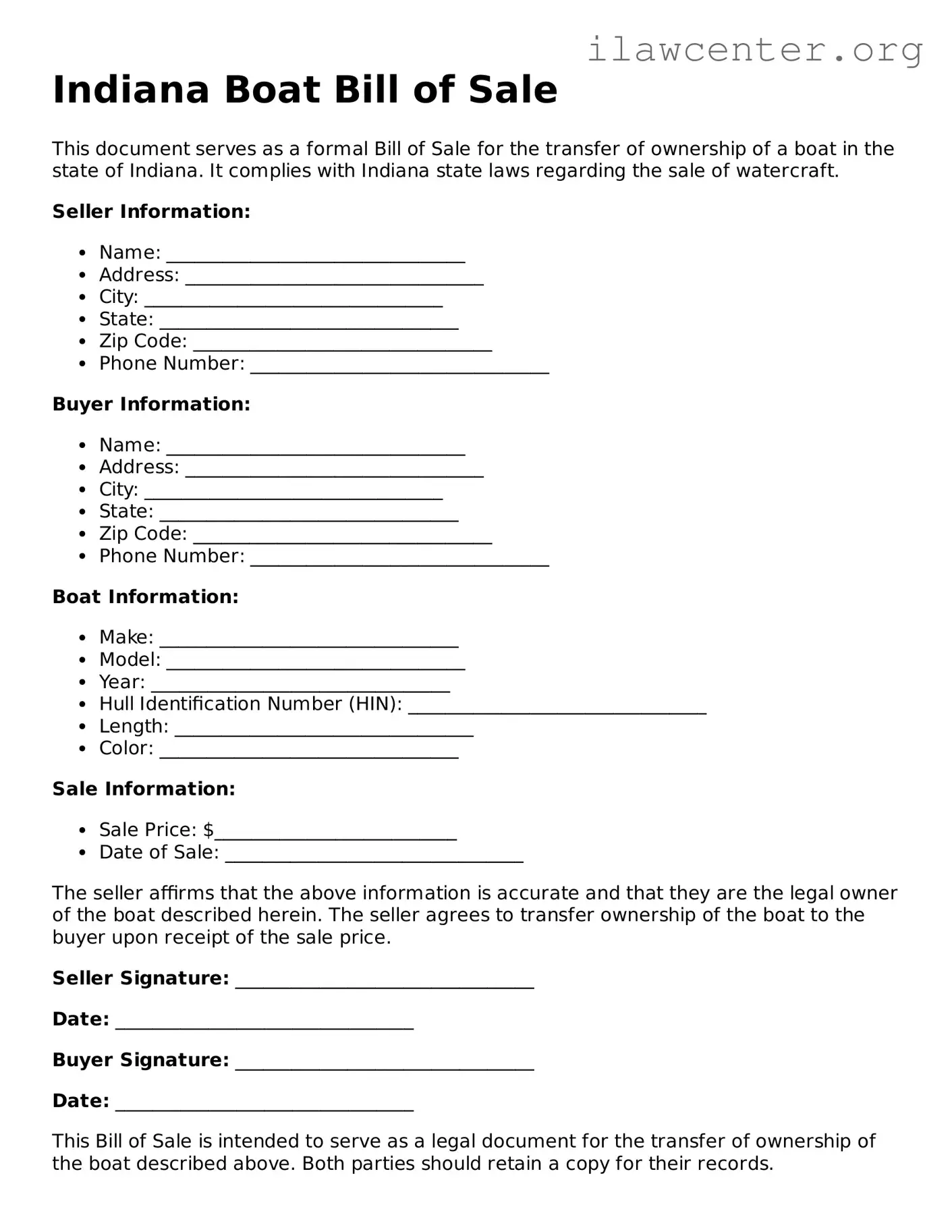
Indiana Boat Bill of Sale

This document serves as a formal Bill of Sale for the transfer of ownership of a boat in the state of Indiana. It complies with Indiana state laws regarding the sale of watercraft.

Seller Information:

  • Name: ________________________________
  • Address: ________________________________
  • City: ________________________________
  • State: ________________________________
  • Zip Code: ________________________________
  • Phone Number: ________________________________

Buyer Information:

  • Name: ________________________________
  • Address: ________________________________
  • City: ________________________________
  • State: ________________________________
  • Zip Code: ________________________________
  • Phone Number: ________________________________

Boat Information:

  • Make: ________________________________
  • Model: ________________________________
  • Year: ________________________________
  • Hull Identification Number (HIN): ________________________________
  • Length: ________________________________
  • Color: ________________________________

Sale Information:

  • Sale Price: $__________________________
  • Date of Sale: ________________________________

The seller affirms that the above information is accurate and that they are the legal owner of the boat described herein. The seller agrees to transfer ownership of the boat to the buyer upon receipt of the sale price.

Seller Signature: ________________________________

Date: ________________________________

Buyer Signature: ________________________________

Date: ________________________________

This Bill of Sale is intended to serve as a legal document for the transfer of ownership of the boat described above. Both parties should retain a copy for their records.

PDF Form Characteristics

Fact Name Description
Purpose The Indiana Boat Bill of Sale form serves as a legal document to record the sale of a boat, ensuring that both the buyer and seller have a clear understanding of the transaction.
Governing Laws This form is governed by Indiana state laws, specifically the Indiana Code Title 9, Article 32, which covers the regulations surrounding the sale and transfer of watercraft.
Required Information To complete the form, essential details such as the boat's make, model, year, hull identification number, and the names and addresses of both the buyer and seller must be included.
Signatures Both parties must sign the form to validate the sale. This signature requirement ensures that both the buyer and seller agree to the terms of the transaction.

Instructions on Utilizing Indiana Boat Bill of Sale

Once you have the Indiana Boat Bill of Sale form in front of you, it’s time to fill it out accurately to ensure a smooth transaction. This document serves as proof of sale and is essential for both the buyer and seller. Follow these steps to complete the form correctly.

  1. Obtain the form: Make sure you have the Indiana Boat Bill of Sale form, which can typically be found online or at a local boating office.
  2. Fill in seller information: Enter the full name and address of the seller. This identifies who is transferring ownership.
  3. Fill in buyer information: Provide the full name and address of the buyer. This shows who will be receiving ownership.
  4. Describe the boat: Include details such as the make, model, year, and hull identification number (HIN) of the boat. This information is crucial for identification.
  5. State the sale price: Clearly write the amount for which the boat is being sold. This is important for both parties’ records.
  6. Indicate the date of sale: Write the date when the transaction is taking place. This helps establish the timeline of ownership transfer.
  7. Sign the form: Both the seller and buyer must sign the document. This signature confirms that both parties agree to the terms of the sale.
  8. Make copies: After filling out the form, create copies for both the buyer and seller. Keeping records is essential for future reference.

After completing the form, both parties should keep their copies for personal records. This document will be important for registering the boat and may be required by local authorities. Be sure to store it safely as you move forward with the ownership transfer process.

Important Facts about Indiana Boat Bill of Sale

What is a Boat Bill of Sale in Indiana?

A Boat Bill of Sale is a legal document that records the transfer of ownership of a boat from one person to another in Indiana. This form serves as proof of the transaction and includes important details about the boat, such as its make, model, year, and identification number. It also includes the names and signatures of both the seller and the buyer. Having this document is essential for registering the boat and ensuring that the new owner has clear title to the vessel.

Why is a Boat Bill of Sale important?

The Boat Bill of Sale is crucial for several reasons. Firstly, it provides a written record of the sale, which can help prevent disputes between the buyer and seller regarding ownership. Secondly, it is often required by the Indiana Department of Natural Resources when registering the boat in the new owner's name. Lastly, it protects both parties by documenting the terms of the sale, including the purchase price and any conditions that may apply.

What information is typically included in the Indiana Boat Bill of Sale?

The Indiana Boat Bill of Sale generally includes the following information: the names and addresses of the buyer and seller, the date of the sale, a description of the boat (including its make, model, year, and hull identification number), the purchase price, and any terms or conditions of the sale. Both parties must sign and date the document to make it valid.

Do I need to have the Boat Bill of Sale notarized?

No, it is not required to have the Boat Bill of Sale notarized in Indiana. However, having it notarized can add an extra layer of security and authenticity to the document. It may also be beneficial if there are any future disputes regarding the sale. If both parties agree, they may choose to have the document notarized to provide additional assurance.

Can I create my own Boat Bill of Sale?

What should I do with the Boat Bill of Sale after the sale?

After the sale is complete, both the buyer and seller should keep a copy of the Boat Bill of Sale for their records. The buyer will need to present this document when registering the boat with the Indiana Department of Natural Resources. It is wise to store the document in a safe place, as it may be needed for future reference or if any issues arise regarding the sale.

Is there a specific form I need to use for the Boat Bill of Sale in Indiana?

While there is no official state form for the Boat Bill of Sale in Indiana, it is important that the document includes all necessary information to be legally binding. Many individuals choose to use a standard template that covers all essential details. Ensuring that the form is clear and comprehensive will help protect both the buyer and seller in the transaction.

Common mistakes

When filling out the Indiana Boat Bill of Sale form, individuals often overlook critical details that can lead to complications down the line. One common mistake is failing to include all required information about the boat itself. Essential details such as the boat's make, model, year, and hull identification number are crucial for establishing ownership. Omitting any of these can create confusion or disputes regarding the boat's identity.

Another frequent error is neglecting to provide accurate information about the buyer and seller. Both parties must ensure that their names, addresses, and contact details are correctly entered. If any of this information is incorrect, it can complicate future transactions or legal matters. It is vital to double-check that all personal information is current and precise.

Many individuals also forget to date the bill of sale. A date is not just a formality; it serves as a record of when the transaction occurred. Without a date, it may be challenging to establish the timeline of ownership or resolve any disputes that arise later. This simple step can save time and trouble in the future.

Another mistake is not signing the document. Both the buyer and seller must sign the Boat Bill of Sale to validate the transaction. Without signatures, the document may not hold up as proof of sale, leaving both parties vulnerable to claims or misunderstandings. It is important to ensure that both parties sign in the appropriate sections.

Additionally, people sometimes fail to keep a copy of the completed bill of sale. After the transaction is finalized, it is advisable for both parties to retain a copy for their records. This document serves as proof of the sale and can be useful for registration purposes or future transactions. Not having a copy can lead to difficulties if questions about the sale arise later.

In some cases, individuals do not fully understand the implications of the bill of sale. It is essential to recognize that this document transfers ownership of the boat from the seller to the buyer. Therefore, both parties should be aware of their rights and responsibilities following the sale. Ignoring this aspect can lead to misunderstandings about who is liable for any issues that may arise post-sale.

Another oversight involves the payment details. The form should clearly indicate how payment was made, whether it was cash, check, or another method. This information is important for both parties to protect themselves and ensure that the transaction is legitimate. Without this clarity, disputes over payment can easily arise.

Lastly, individuals may not realize the importance of checking local regulations regarding boat sales. Each state has its own rules, and Indiana is no exception. Failing to comply with these regulations can result in legal issues or complications with boat registration. It is wise to familiarize oneself with the local laws before completing the bill of sale to ensure a smooth transaction.

Documents used along the form

When completing a transaction involving a boat in Indiana, it's crucial to have the right documentation. The Indiana Boat Bill of Sale form serves as a vital record of the sale, but several other forms and documents may also be necessary to ensure a smooth transfer of ownership and compliance with state regulations. Below is a list of essential documents that are often used alongside the Boat Bill of Sale.

  • Title Certificate: This document proves ownership of the boat. It must be transferred from the seller to the buyer during the sale, and it includes important information such as the boat's hull identification number (HIN) and registration details.
  • Registration Application: After purchasing a boat, the new owner must register it with the state. This application typically includes details about the boat and proof of ownership, often requiring the Boat Bill of Sale and the Title Certificate.
  • Affidavit of Ownership: In cases where the title is lost or unavailable, this document can serve as a sworn statement confirming the buyer's ownership of the boat. It may help facilitate the registration process.
  • Notice of Transfer: This form informs the state that the ownership of the boat has changed. It's essential for updating the state’s records and can help prevent any future legal issues related to the boat.
  • Sales Tax Form: Depending on the purchase price and local regulations, the buyer may need to complete a sales tax form. This ensures that the appropriate taxes are paid and documented, which is important for legal compliance.

Having these documents ready can streamline the buying and selling process, making it easier for both parties involved. Proper documentation not only protects your interests but also ensures that you comply with state laws regarding boat ownership. Always consider consulting with a professional if you have questions about these forms or the overall process.

Similar forms

  • Vehicle Bill of Sale: This document transfers ownership of a vehicle. Like the Boat Bill of Sale, it includes details about the seller, buyer, and the vehicle itself.
  • Motorcycle Bill of Sale: Similar to the Boat Bill of Sale, this form is used to document the sale of a motorcycle, ensuring both parties agree on the terms.
  • ATV Bill of Sale: This document serves to transfer ownership of an all-terrain vehicle. It contains essential details about the ATV and the parties involved, just like the Boat Bill of Sale.
  • Trailer Bill of Sale: When selling a trailer, this document is crucial. It outlines the terms of sale and identifies the trailer, similar to how a Boat Bill of Sale functions.
  • Real Estate Purchase Agreement: This document outlines the terms of buying or selling property. Both agreements require details about the parties and the item being sold.
  • Personal Property Bill of Sale: This form is used for various personal items. It shares similarities with the Boat Bill of Sale by documenting the transaction and identifying the item.
  • Business Asset Bill of Sale: When selling business assets, this document is essential. It details the assets and the parties involved, akin to the Boat Bill of Sale.
  • Equipment Bill of Sale: This document transfers ownership of equipment. It includes seller and buyer information, just like the Boat Bill of Sale.
  • Gun Bill of Sale: This form is used to document the sale of firearms. It requires details about the buyer and seller, similar to the Boat Bill of Sale.
  • Pet Bill of Sale: When selling or adopting a pet, this document outlines the transaction. It serves a similar purpose to the Boat Bill of Sale by documenting the transfer of ownership.

Dos and Don'ts

When completing the Indiana Boat Bill of Sale form, it is important to be thorough and accurate. Below is a list of things to do and avoid during this process.

Things You Should Do:

  • Provide accurate and complete information about the boat, including the make, model, year, and hull identification number.
  • Include the full names and addresses of both the buyer and the seller.
  • Clearly state the sale price of the boat.
  • Sign and date the form to validate the transaction.
  • Keep a copy of the completed Bill of Sale for your records.

Things You Shouldn't Do:

  • Do not leave any blank spaces on the form; incomplete information can lead to complications.
  • Avoid using vague language when describing the boat; specificity is key.
  • Do not forget to check for any local or state regulations that may apply to the sale.
  • Never sign the form without reviewing all the details thoroughly.
  • Do not underestimate the importance of having the document notarized, if required.

Misconceptions

When it comes to the Indiana Boat Bill of Sale form, several misconceptions can lead to confusion for buyers and sellers alike. Here are some common misunderstandings:

  1. The form is not necessary for boat transactions.

    Some people believe that a Bill of Sale is optional. In Indiana, while not always legally required, having a Bill of Sale is highly recommended for documenting the transfer of ownership and protecting both parties.

  2. Only the seller needs to sign the form.

    Many assume that only the seller's signature is required. In reality, both the buyer and seller should sign the Bill of Sale to validate the transaction and confirm agreement on the terms.

  3. All boats require a notarized Bill of Sale.

    It is a common belief that notarization is mandatory for all boat sales. However, notarization is not a requirement for the Bill of Sale in Indiana unless specified by the parties involved.

  4. The form can be completed after the sale.

    Some individuals think they can fill out the Bill of Sale after the transaction has taken place. It is best practice to complete the form at the time of sale to ensure accuracy and clarity.

  5. Any format is acceptable for the Bill of Sale.

    While a Bill of Sale can be in various formats, using a standardized form ensures that all necessary information is included and reduces the risk of disputes later on.

  6. The Bill of Sale is only for motorized boats.

    This misconception suggests that only motorized boats require a Bill of Sale. In fact, any type of boat, including non-motorized ones, should have a Bill of Sale to document the transfer of ownership.

  7. The Bill of Sale is not needed if the boat is registered.

    Some believe that registration alone eliminates the need for a Bill of Sale. However, the Bill of Sale serves as proof of purchase and is important for transferring ownership, regardless of registration status.

  8. Once the Bill of Sale is signed, it cannot be changed.

    People often think that a signed Bill of Sale is final and unchangeable. However, if both parties agree, modifications can be made to the document before finalizing the sale.

  9. The Bill of Sale does not need to include the purchase price.

    Some individuals overlook the importance of including the purchase price in the Bill of Sale. Documenting the price helps establish the value of the transaction and can be useful for tax purposes.

Understanding these misconceptions can help ensure a smoother transaction when buying or selling a boat in Indiana. Proper documentation is key to protecting both parties involved.

Key takeaways

When filling out and using the Indiana Boat Bill of Sale form, consider the following key takeaways:

  1. Complete All Sections: Ensure every section of the form is filled out accurately. This includes the seller's and buyer's information, boat details, and sale price.
  2. Provide Accurate Boat Information: Include the boat's make, model, year, and hull identification number (HIN). This information is crucial for registration purposes.
  3. Signatures Required: Both the seller and buyer must sign the document. This indicates mutual agreement on the sale terms.
  4. Consider Notarization: While not mandatory, having the bill of sale notarized can provide an extra layer of security and legitimacy to the transaction.
  5. Keep Copies: Both parties should retain a copy of the signed bill of sale for their records. This can be important for future reference or disputes.
  6. Use for Registration: The completed bill of sale is often required when registering the boat with the Indiana Department of Natural Resources. Ensure it is submitted promptly.