Attorney-Verified  Do Not Resuscitate Order Document for Indiana

Attorney-Verified Do Not Resuscitate Order Document for Indiana

A Do Not Resuscitate Order (DNR) form in Indiana is a legal document that allows individuals to refuse resuscitation efforts in the event of a medical emergency. This form is designed to ensure that a person's wishes regarding life-sustaining treatment are respected. Understanding and completing this form can provide peace of mind for both individuals and their families.

To fill out the Indiana Do Not Resuscitate Order form, please click the button below.

Article Guide

In Indiana, the Do Not Resuscitate (DNR) Order form serves as a crucial document for individuals who wish to express their preferences regarding medical interventions in the event of a life-threatening situation. This form allows patients to make clear decisions about their care, ensuring that their wishes are respected during critical moments. It is essential for patients to understand that the DNR Order specifically instructs healthcare providers not to perform cardiopulmonary resuscitation (CPR) if the patient's heart stops beating or if they stop breathing. The form must be completed and signed by the patient or their legal representative, and it requires the signature of a physician to be valid. Furthermore, the DNR Order is designed to be easily accessible, allowing emergency personnel to recognize and honor the patient's wishes promptly. Understanding the implications of this form can provide peace of mind to individuals and their families, knowing that their choices regarding end-of-life care will be upheld. Engaging in discussions with healthcare providers about the DNR Order can further clarify any questions and ensure that the document aligns with the patient’s values and desires.

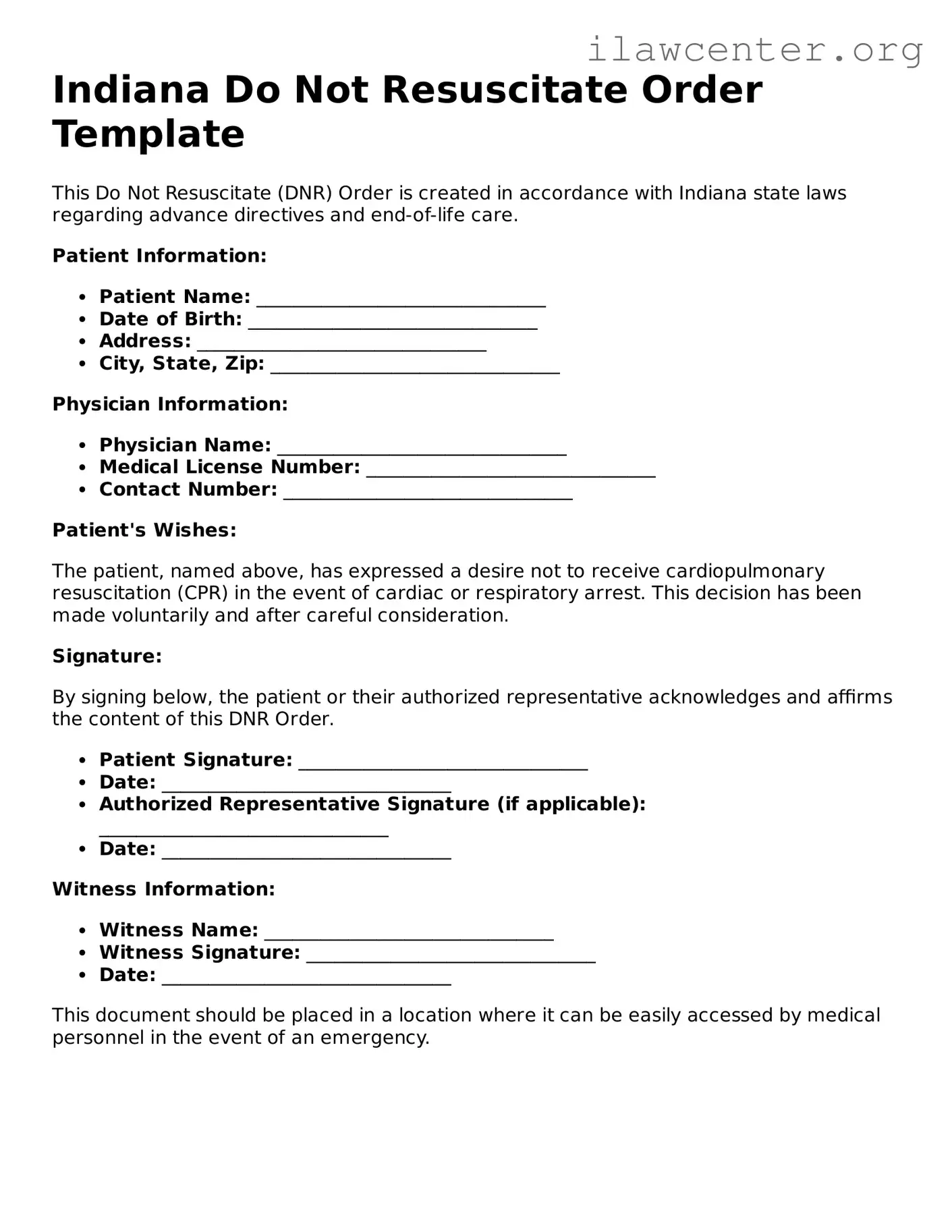
Indiana Do Not Resuscitate Order Preview

Indiana Do Not Resuscitate Order Template

This Do Not Resuscitate (DNR) Order is created in accordance with Indiana state laws regarding advance directives and end-of-life care.

Patient Information:

  • Patient Name: _______________________________
  • Date of Birth: _______________________________
  • Address: _______________________________
  • City, State, Zip: _______________________________

Physician Information:

  • Physician Name: _______________________________
  • Medical License Number: _______________________________
  • Contact Number: _______________________________

Patient's Wishes:

The patient, named above, has expressed a desire not to receive cardiopulmonary resuscitation (CPR) in the event of cardiac or respiratory arrest. This decision has been made voluntarily and after careful consideration.

Signature:

By signing below, the patient or their authorized representative acknowledges and affirms the content of this DNR Order.

  • Patient Signature: _______________________________
  • Date: _______________________________
  • Authorized Representative Signature (if applicable): _______________________________
  • Date: _______________________________

Witness Information:

  • Witness Name: _______________________________
  • Witness Signature: _______________________________
  • Date: _______________________________

This document should be placed in a location where it can be easily accessed by medical personnel in the event of an emergency.

PDF Form Characteristics

Fact Name Description
Governing Law The Indiana Do Not Resuscitate Order form is governed by Indiana Code § 16-36-6.
Eligibility This form is intended for individuals who are adults or emancipated minors and wish to refuse resuscitation.
Signature Requirements The form must be signed by the patient or their legal representative, along with a physician's signature.
Validity The order remains valid until revoked by the patient or their representative, or if the patient is no longer in a healthcare facility.
Distribution Copies of the signed form should be provided to healthcare providers and kept in the patient's medical records.
Emergency Medical Services Emergency medical personnel are required to honor a valid Do Not Resuscitate Order in Indiana.

Instructions on Utilizing Indiana Do Not Resuscitate Order

Filling out the Indiana Do Not Resuscitate Order form is a crucial step in ensuring that your healthcare preferences are respected in emergency situations. Once you have completed the form, it is important to keep it in a safe place and share copies with your healthcare providers, family members, and anyone else who may need to know your wishes.

  1. Obtain the Indiana Do Not Resuscitate Order form. This can be found online or through your healthcare provider.
  2. Begin by entering your full name at the top of the form.
  3. Provide your date of birth. This helps to confirm your identity.
  4. Fill in your address, including city, state, and ZIP code.
  5. Designate a healthcare representative if you wish. This person will make decisions on your behalf if you are unable to do so.
  6. Clearly state your wishes regarding resuscitation. You may need to check a box or sign a line indicating your preference.
  7. Sign and date the form. Your signature confirms that you understand and agree with the contents of the form.
  8. Have the form witnessed by two individuals who are not related to you and who do not stand to benefit from your estate.
  9. Make copies of the completed form for your records and for your healthcare providers.

Important Facts about Indiana Do Not Resuscitate Order

What is a Do Not Resuscitate (DNR) Order in Indiana?

A Do Not Resuscitate Order is a legal document that allows a person to refuse resuscitation efforts in the event of a cardiac arrest or respiratory failure. In Indiana, this order must be signed by a physician and is intended to communicate a patient's wishes regarding resuscitation to healthcare providers.

Who can request a DNR Order in Indiana?

In Indiana, a DNR Order can be requested by an adult patient who is capable of making their own medical decisions. Additionally, a legal representative, such as a healthcare proxy or power of attorney, can request a DNR on behalf of an incapacitated individual.

How is a DNR Order created in Indiana?

To create a DNR Order, a patient must discuss their wishes with their physician. The physician will then complete the official Indiana DNR form, which includes the patient's name, date of birth, and signature, along with the physician's signature. This form must be properly filled out and filed to be considered valid.

Is a DNR Order valid in all healthcare settings?

Yes, a properly executed DNR Order is valid in all healthcare settings in Indiana, including hospitals, nursing homes, and home care. However, it is important to ensure that the DNR form is readily accessible to healthcare providers at the time of an emergency.

Can a DNR Order be revoked?

A DNR Order can be revoked at any time by the patient or their legal representative. This can be done verbally or in writing. It is essential to inform healthcare providers of the revocation to ensure that the patient's current wishes are respected.

What happens if a DNR Order is not available during a medical emergency?

If a DNR Order is not available during a medical emergency, healthcare providers are obligated to perform resuscitation efforts. It is crucial for individuals with a DNR Order to keep the document accessible and inform family members and caregivers of its existence.

Are there any specific requirements for the DNR Order form in Indiana?

The Indiana DNR Order form must include specific information, such as the patient's name, date of birth, and the physician's signature. The form must also be printed and signed, as electronic signatures are not accepted for this document.

Can a DNR Order affect other medical treatments?

A DNR Order specifically addresses resuscitation efforts. It does not impact other medical treatments or interventions. Patients can still receive pain management, comfort care, and other necessary medical treatments even with a DNR in place.

Where can I obtain a DNR Order form in Indiana?

The DNR Order form can be obtained from healthcare providers, hospitals, or online through the Indiana State Department of Health website. It is advisable to consult with a physician to ensure that the form is completed correctly and reflects the patient's wishes accurately.
Common mistakes

Filling out the Indiana Do Not Resuscitate (DNR) Order form can be a crucial step in ensuring your healthcare wishes are respected. However, many individuals make mistakes that can lead to confusion or unintended consequences. Here are five common errors to avoid.

One frequent mistake is not discussing the decision with family members or healthcare providers beforehand. This can lead to misunderstandings or disagreements about your wishes. It's important to have open conversations with loved ones and your medical team to ensure everyone is on the same page.

Another common error is failing to sign and date the form properly. Without a signature, the DNR Order may not be considered valid. Make sure to sign the document and include the date to ensure it is legally recognized. Also, remember that a witness signature is often required, so don’t overlook that detail.

People also sometimes forget to provide copies of the completed form to their healthcare providers. A DNR Order is only effective if medical personnel are aware of it. Distributing copies to your primary care doctor, hospital, and any other relevant medical facilities can help ensure your wishes are honored in an emergency.

In addition, some individuals neglect to review and update their DNR Order as their health status changes. Life circumstances can shift, and so can your preferences regarding medical treatment. Regularly revisiting the document ensures that it reflects your current wishes.

Finally, using incorrect or unclear language on the form can lead to misinterpretation. Be specific and clear about your wishes. Avoid vague terms that could create confusion for healthcare providers. The goal is to communicate your desires as clearly as possible.

Documents used along the form

In Indiana, the Do Not Resuscitate (DNR) Order form is an important document for individuals who wish to refuse resuscitation in the event of a medical emergency. Along with the DNR form, several other forms and documents may be relevant for ensuring that a person's healthcare preferences are respected. Here is a list of some commonly used documents that may accompany a DNR Order.

  • Advance Directive: This legal document outlines a person's preferences for medical treatment in situations where they cannot communicate their wishes. It can include instructions on life-sustaining treatments and appoint a healthcare proxy.
  • Healthcare Power of Attorney: This document designates an individual to make healthcare decisions on behalf of someone else if they become incapacitated. It is crucial for ensuring that a person's medical preferences are honored.
  • Living Will: A living will specifies a person's wishes regarding medical treatment in end-of-life situations. It typically addresses the use of life support and other life-prolonging measures.
  • Physician Orders for Life-Sustaining Treatment (POLST): This form translates a patient's wishes about life-sustaining treatment into actionable medical orders. It is intended for individuals with serious illnesses or those nearing the end of life.
  • Do Not Intubate (DNI) Order: Similar to a DNR, a DNI order specifically instructs healthcare providers not to insert a breathing tube if the patient stops breathing or their airway becomes obstructed.
  • Medical Record Release Authorization: This document allows individuals to grant permission for healthcare providers to share their medical records with designated persons or entities, facilitating communication regarding their care.
  • Emergency Medical Services (EMS) Protocols: These protocols guide EMS personnel on how to respond to patients with a DNR order or other advance directives during emergencies.
  • Patient's Bill of Rights: This document outlines the rights of patients in healthcare settings, including the right to make informed decisions about their care and to refuse treatment.
  • Do Not Hospitalize (DNH) Order: This order indicates that a patient should not be admitted to a hospital for treatment, often used in conjunction with DNR orders for patients who prefer to receive care at home.
  • Comfort Care Order: This document specifies that a patient should receive comfort measures rather than aggressive treatment, focusing on quality of life rather than prolonging life.

Understanding these documents can help individuals and their families navigate complex healthcare decisions. Each document serves a specific purpose in expressing and honoring a person's medical preferences, particularly in critical situations.

Similar forms

The Do Not Resuscitate (DNR) Order form is an important document in healthcare, particularly concerning end-of-life care. Several other documents serve similar purposes, providing guidance on medical treatment preferences. Here’s a list of ten documents that share similarities with the DNR Order:

  • Living Will: This document outlines a person's wishes regarding medical treatment in situations where they cannot communicate their preferences, similar to how a DNR specifies resuscitation wishes.
  • Healthcare Power of Attorney: This allows an individual to appoint someone to make healthcare decisions on their behalf, much like how a DNR communicates specific treatment preferences.
  • Advance Healthcare Directive: Combining elements of a living will and healthcare power of attorney, this document provides comprehensive instructions on medical care, including resuscitation wishes.
  • Physician Orders for Life-Sustaining Treatment (POLST): POLST forms translate patient preferences into actionable medical orders, similar to how a DNR directs healthcare providers in emergencies.
  • Do Not Intubate (DNI) Order: This specific order indicates that a patient should not be placed on a ventilator, paralleling the DNR's focus on avoiding resuscitation efforts.
  • Comfort Care Order: This document emphasizes palliative care and comfort measures, aligning with the intent behind a DNR to prioritize quality of life over aggressive treatment.
  • End-of-Life Care Plan: This comprehensive plan outlines a patient’s wishes for their final days, including preferences for resuscitation and other medical interventions.
  • Do Not Hospitalize Order: This directive indicates that a patient should not be admitted to a hospital, similar to how a DNR limits certain medical interventions.
  • Patient Wishes Statement: This informal document can express a patient’s desires regarding their care, including resuscitation preferences, much like a DNR form.
  • Medical Order for Scope of Treatment (MOST): This document is used in some states to outline a patient's treatment preferences, including resuscitation, similar to a DNR order.

Dos and Don'ts

When filling out the Indiana Do Not Resuscitate Order form, it is crucial to approach the task with care and consideration. Below is a list of things you should and shouldn't do to ensure that your wishes are clearly articulated and respected.

  • Do consult with your healthcare provider. Discuss your wishes and the implications of a Do Not Resuscitate order with a medical professional to ensure you fully understand the consequences.
  • Do ensure the form is completed in its entirety. All required sections must be filled out to avoid any ambiguity regarding your wishes.
  • Do sign and date the form. Your signature is essential to validate the document and indicate your consent.
  • Do keep copies of the completed form. Distribute copies to your healthcare provider, family members, and anyone else involved in your care.
  • Do review the form periodically. Your preferences may change over time, so it is wise to revisit the document regularly.
  • Don't overlook state-specific requirements. Each state may have unique regulations regarding DNR orders, so ensure compliance with Indiana’s specific guidelines.
  • Don't assume verbal agreements suffice. A written order is necessary; verbal wishes may not be honored in a medical emergency.
  • Don't leave the form in an inaccessible place. Keep it in a location where it can be easily found by healthcare providers and family members during an emergency.
  • Don't forget to inform your loved ones. Communication is key; ensure that your family understands your wishes and the existence of the DNR order.
  • Don't fill out the form under pressure. Take your time to reflect on your decisions, ensuring they are made freely and thoughtfully.

Misconceptions

Understanding the Indiana Do Not Resuscitate (DNR) Order form is essential for individuals and families making healthcare decisions. Unfortunately, several misconceptions can lead to confusion. Below are six common misconceptions about the Indiana DNR Order form, along with clarifications to help you navigate this important topic.

  • A DNR order means no medical treatment at all. Many believe that a DNR order prohibits all medical interventions. In reality, it only indicates that a person does not wish to receive cardiopulmonary resuscitation (CPR) in the event of cardiac arrest. Other medical treatments and interventions can still be provided.
  • A DNR order is only for terminally ill patients. This is a common misconception. While many individuals with terminal illnesses may choose to have a DNR order, it is not limited to them. Anyone can request a DNR order based on their personal healthcare preferences.
  • A DNR order is permanent and cannot be changed. Some people think that once a DNR order is in place, it cannot be altered. However, individuals can revoke or modify their DNR orders at any time, as long as they are competent to make such decisions.
  • Emergency medical personnel will ignore a DNR order. There is a belief that first responders may not honor a DNR order. In Indiana, emergency medical personnel are trained to recognize and respect valid DNR orders, ensuring that a person's wishes are followed.
  • A DNR order is the same as a living will. While both documents relate to end-of-life care, they serve different purposes. A living will outlines a person's wishes regarding medical treatment in various situations, whereas a DNR specifically addresses resuscitation efforts during cardiac arrest.
  • Having a DNR order means giving up on life. Many individuals fear that requesting a DNR order signifies a desire to end their life. This is not true. A DNR order is a personal choice that reflects a person's values and preferences regarding their medical care, allowing them to maintain control over their treatment.

Clarifying these misconceptions can empower individuals and families to make informed decisions about their healthcare preferences. It is essential to have open conversations with healthcare providers to ensure that your wishes are understood and respected.

Key takeaways

Filling out and using the Indiana Do Not Resuscitate (DNR) Order form is an important step for individuals who wish to express their preferences regarding medical treatment in emergencies. Here are some key takeaways to consider:

  • The DNR Order form allows individuals to communicate their wishes about resuscitation efforts in case of a medical emergency.
  • It is essential for the form to be signed by a qualified healthcare provider, such as a physician, to be valid.
  • Patients must also sign the form to indicate their consent and understanding of the order.
  • The DNR Order should be prominently displayed in the patient’s medical records and easily accessible in emergency situations.
  • Individuals can revoke the DNR Order at any time by notifying their healthcare provider or destroying the document.
  • Family members should be informed of the DNR Order to ensure everyone understands the patient’s wishes.
  • It is advisable to review the DNR Order periodically, especially when there are changes in health status or treatment preferences.

By following these guidelines, individuals can ensure that their healthcare preferences are respected and understood in critical situations.