Attorney-Verified  Durable Power of Attorney Document for Indiana

Attorney-Verified Durable Power of Attorney Document for Indiana

A Durable Power of Attorney in Indiana is a legal document that allows an individual to appoint someone else to make decisions on their behalf, even if they become incapacitated. This form empowers a trusted person to handle financial matters, medical decisions, or both, ensuring that your wishes are respected when you are unable to communicate them. For those considering this important step, filling out the form can provide peace of mind; click the button below to get started.

Article Guide

The Indiana Durable Power of Attorney form serves as a crucial legal document that empowers individuals to designate a trusted person, known as an agent, to make decisions on their behalf in the event they become incapacitated. This form is essential for ensuring that personal, financial, and healthcare matters are managed according to the individual's wishes when they are unable to communicate or make decisions themselves. It allows for a wide range of responsibilities, including managing bank accounts, paying bills, and making medical decisions, thus providing peace of mind to both the principal and their loved ones. The form must be executed with specific requirements to ensure its validity, including the necessity for the principal to be of sound mind at the time of signing and the requirement for witnesses or notarization. By clearly outlining the powers granted to the agent, the Indiana Durable Power of Attorney form helps prevent potential disputes among family members and ensures that the principal’s preferences are respected during challenging times.

Indiana Durable Power of Attorney Preview

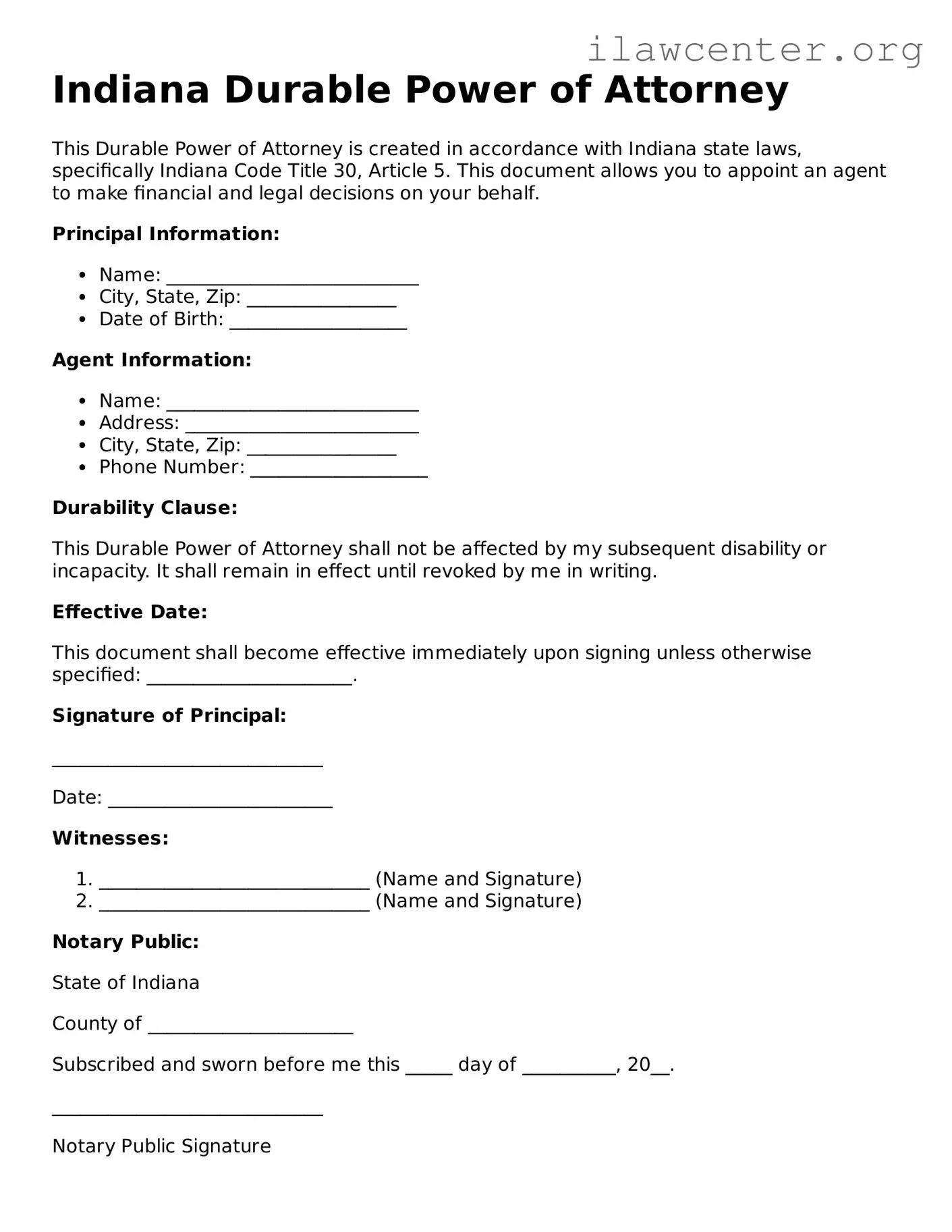
Indiana Durable Power of Attorney

This Durable Power of Attorney is created in accordance with Indiana state laws, specifically Indiana Code Title 30, Article 5. This document allows you to appoint an agent to make financial and legal decisions on your behalf.

Principal Information:

  • Name: ___________________________
  • City, State, Zip: ________________
  • Date of Birth: ___________________

Agent Information:

  • Name: ___________________________
  • Address: _________________________
  • City, State, Zip: ________________
  • Phone Number: ___________________

Durability Clause:

This Durable Power of Attorney shall not be affected by my subsequent disability or incapacity. It shall remain in effect until revoked by me in writing.

Effective Date:

This document shall become effective immediately upon signing unless otherwise specified: ______________________.

Signature of Principal:

_____________________________

Date: ________________________

Witnesses:

  1. _____________________________ (Name and Signature)
  2. _____________________________ (Name and Signature)

Notary Public:

State of Indiana

County of ______________________

Subscribed and sworn before me this _____ day of __________, 20__.

_____________________________

Notary Public Signature

My Commission Expires: ________________

PDF Form Characteristics

Fact Name Description
Definition An Indiana Durable Power of Attorney allows an individual to designate someone else to make financial or legal decisions on their behalf.
Durability This type of power of attorney remains effective even if the principal becomes incapacitated.
Governing Law The Indiana Durable Power of Attorney is governed by Indiana Code Title 30, Article 5.
Principal The person who creates the power of attorney is referred to as the principal.
Agent The individual designated to act on behalf of the principal is called the agent or attorney-in-fact.
Signing Requirements The form must be signed by the principal in the presence of a notary public to be valid.
Revocation The principal can revoke the power of attorney at any time, as long as they are competent.
Limitations Some actions, like making a will or changing beneficiaries, cannot be delegated through this form.
Use Cases This document is often used for managing finances, real estate transactions, and healthcare decisions.

Instructions on Utilizing Indiana Durable Power of Attorney

Filling out the Indiana Durable Power of Attorney form is a straightforward process that requires careful attention to detail. Once the form is completed, it will need to be signed and witnessed to ensure its validity.

  1. Obtain the Indiana Durable Power of Attorney form. This can be found online or through legal offices.
  2. Begin by entering the name and address of the person granting the power (the "Principal").
  3. Provide the name and address of the person receiving the power (the "Agent").
  4. Specify the powers being granted to the Agent. This may include financial decisions, health care decisions, or other specific powers.
  5. Indicate the effective date of the power of attorney. You may choose for it to be effective immediately or upon a specific event.
  6. Include any limitations or conditions regarding the Agent's authority, if applicable.
  7. Sign and date the form in the presence of a notary public or witnesses, as required by Indiana law.

After completing these steps, ensure that copies of the signed form are distributed to relevant parties, including the Agent and any institutions that may need to recognize the power of attorney.

Important Facts about Indiana Durable Power of Attorney

What is a Durable Power of Attorney in Indiana?

A Durable Power of Attorney is a legal document that allows you to appoint someone to make decisions on your behalf if you become unable to do so. This can include financial decisions, medical decisions, or both. The document remains effective even if you become incapacitated, hence the term "durable." It is important to choose a trusted individual for this role.

How do I create a Durable Power of Attorney in Indiana?

To create a Durable Power of Attorney in Indiana, you need to complete a form that meets state requirements. You can find templates online or consult with an attorney to ensure it is valid. After filling out the form, you must sign it in front of a notary public. It is advisable to provide copies to the person you appointed and any institutions that may need it, such as banks or healthcare providers.

Who can be appointed as an agent under a Durable Power of Attorney?

In Indiana, you can appoint any competent adult as your agent. This can be a family member, friend, or a professional, such as an attorney. It is crucial to choose someone you trust, as they will have significant authority over your financial or medical decisions.

What powers does my agent have under a Durable Power of Attorney?

The powers granted to your agent can vary based on what you specify in the document. Generally, your agent can handle financial matters, such as paying bills, managing investments, and filing taxes. If you include medical decisions, they can also make healthcare choices on your behalf. Be clear about the extent of the powers you wish to grant.

Can I revoke a Durable Power of Attorney in Indiana?

Yes, you can revoke a Durable Power of Attorney at any time as long as you are still competent. To do this, you should create a written revocation document, sign it, and notify your agent and any institutions that had a copy of the original document. This ensures that your wishes are clear and legally recognized.

What happens if I do not have a Durable Power of Attorney?

If you do not have a Durable Power of Attorney and become incapacitated, a court may need to appoint a guardian to make decisions for you. This process can be lengthy and costly. Having a Durable Power of Attorney in place allows you to choose your own agent and avoid this situation.

Can I set limits on my agent's authority?

Yes, you can set limits on your agent's authority in the Durable Power of Attorney document. You can specify which powers they do or do not have. Clearly outlining these limits can help prevent any misuse of authority and ensure your wishes are respected.

Is a Durable Power of Attorney valid if I move to another state?

A Durable Power of Attorney created in Indiana may still be valid in another state, but it is wise to check the laws of that state. Some states have specific requirements for these documents. If you move, consider consulting with an attorney in your new state to ensure your Durable Power of Attorney remains effective.

Do I need to file my Durable Power of Attorney with the court?

No, you do not need to file your Durable Power of Attorney with the court in Indiana. However, it is essential to keep the document in a safe place and provide copies to your agent and relevant institutions. This ensures that your agent can act on your behalf when necessary.
Common mistakes

When completing the Indiana Durable Power of Attorney form, individuals often overlook crucial details that can lead to significant complications down the line. One common mistake is failing to specify the powers granted to the agent. Without clear definitions, the agent may not have the authority to act in the best interest of the principal, potentially causing confusion and disputes.

Another frequent error involves neglecting to date the document. A Durable Power of Attorney must be dated to ensure its validity. If the form lacks a date, questions may arise about when the powers were intended to take effect, which can complicate matters when the agent needs to act.

Many people also forget to sign the form in the presence of a notary public. In Indiana, notarization is a critical step in making the document legally binding. Without this, the form may not hold up in legal situations, leaving the agent without the necessary authority to act.

Additionally, individuals sometimes fail to consider the selection of their agent carefully. Choosing someone who is not trustworthy or lacks the ability to manage financial or medical decisions can lead to serious issues. It is essential to appoint someone who understands the responsibilities and can act in the principal's best interest.

Another mistake occurs when individuals do not discuss their wishes with the appointed agent. Open communication is vital. If the agent is unaware of the principal's preferences or values, they may make decisions that do not align with what the principal would have wanted.

Some people overlook the importance of having successor agents. If the primary agent is unable or unwilling to fulfill their duties, having a backup in place ensures that there is always someone ready to step in. This can prevent delays and complications in critical situations.

Lastly, individuals often neglect to review and update the Durable Power of Attorney as life circumstances change. Major life events, such as marriage, divorce, or the birth of a child, may necessitate changes to the document. Regular reviews ensure that the powers granted remain relevant and reflect the principal’s current wishes.

Documents used along the form

When preparing a Durable Power of Attorney (DPOA) in Indiana, it's essential to consider additional forms and documents that can complement this legal instrument. Each of these documents serves a specific purpose, ensuring that an individual's wishes are respected and that their affairs are managed effectively in various situations.

  • Health Care Power of Attorney: This document allows an individual to designate someone to make medical decisions on their behalf if they become unable to do so. It focuses specifically on health care matters.
  • Living Will: A living will outlines an individual’s preferences regarding medical treatment in end-of-life situations. It provides guidance to healthcare providers and loved ones about the person’s wishes.
  • Financial Power of Attorney: Similar to a DPOA, this document grants authority to an agent to manage financial matters. However, it may be more limited in scope compared to a durable power of attorney.
  • Advance Directive: This is a broader term that encompasses both the Health Care Power of Attorney and the Living Will. It serves as a comprehensive guide for medical decisions and end-of-life care.
  • Will: A will outlines how an individual's assets should be distributed upon their death. While not directly related to a DPOA, it is crucial for overall estate planning.
  • Trust Document: A trust can be established to manage assets during a person’s lifetime and after their death. It provides a structured way to handle estate matters and can work alongside a DPOA.
  • Guardian Designation: This document allows an individual to appoint a guardian for their minor children or dependents in the event of their incapacitation or death, ensuring that their loved ones are cared for according to their wishes.

Understanding these documents can empower individuals to make informed decisions about their personal and financial affairs. By utilizing a Durable Power of Attorney alongside these forms, one can create a comprehensive plan that reflects their intentions and provides clarity for their loved ones.

Similar forms

A Durable Power of Attorney (DPOA) is an important legal document that allows someone to act on your behalf when you are unable to do so. Here are six other documents that are similar to a Durable Power of Attorney:

  • General Power of Attorney: This document also allows someone to make decisions for you, but it becomes invalid if you become incapacitated. In contrast, a DPOA remains effective even if you can no longer make decisions yourself.
  • Health Care Proxy: This document specifically designates someone to make medical decisions for you if you cannot. While a DPOA can include health care decisions, a Health Care Proxy focuses solely on medical matters.
  • Living Will: A Living Will outlines your wishes regarding medical treatment in situations where you cannot communicate. It differs from a DPOA, which appoints someone to make decisions on your behalf.
  • Financial Power of Attorney: This document gives someone the authority to manage your financial affairs. While similar to a DPOA, it may be limited to financial matters rather than encompassing a broader range of decisions.
  • Revocable Trust: A Revocable Trust allows you to manage your assets during your lifetime and can specify what happens to them after your death. While it provides control over your assets, it does not appoint someone to make decisions on your behalf like a DPOA does.
  • Will: A Will outlines how your assets should be distributed after your death. Unlike a DPOA, which is effective during your lifetime, a Will only takes effect after you pass away.

Dos and Don'ts

When filling out the Indiana Durable Power of Attorney form, it is essential to approach the process with care and attention. Here are some important dos and don'ts to consider.

  • Do choose a trusted individual to act as your agent. This person will make decisions on your behalf, so select someone responsible and reliable.
  • Do clearly outline the powers you are granting. Specify what decisions your agent can make to avoid confusion in the future.
  • Do sign the document in the presence of a notary public. This step adds an extra layer of validity to your form.
  • Do review the form thoroughly before signing. Ensure all information is accurate and complete to prevent any issues later.
  • Do keep a copy of the completed form for your records. Having a copy can be helpful for both you and your agent.
  • Don't rush through the process. Take your time to understand each section of the form.
  • Don't select an agent who may have conflicting interests. Ensure that your agent's goals align with your own.
  • Don't forget to discuss your wishes with your chosen agent. Open communication can help ensure your preferences are honored.
  • Don't neglect to update the form if your circumstances change. Life events may necessitate adjustments to your Durable Power of Attorney.

By following these guidelines, you can create a Durable Power of Attorney that reflects your wishes and protects your interests. Take the time to make informed decisions for your future.

Misconceptions

Many people have misunderstandings about the Indiana Durable Power of Attorney (DPOA) form. Here are some common misconceptions:

  1. It only applies to financial decisions.

    While the DPOA is often used for financial matters, it can also cover health care decisions if specified. This means you can give someone authority to make medical choices on your behalf.

  2. It is only for the elderly or ill.

    Anyone over the age of 18 can create a DPOA. It’s a useful tool for anyone who wants to plan for the future, regardless of their current health.

  3. Once I sign it, I lose control.

    That’s not true. You can continue to make decisions for yourself as long as you are capable. The DPOA only takes effect if you become incapacitated.

  4. It must be notarized to be valid.

    In Indiana, while notarization is recommended, it is not strictly required. However, having it notarized can help avoid disputes in the future.

  5. My agent can do anything they want.

    Your agent must act in your best interest. They have a legal duty to follow your wishes and act responsibly.

  6. It is permanent and cannot be revoked.

    You can revoke a DPOA at any time, as long as you are still competent. Just inform your agent and any relevant institutions.

  7. It is only valid in Indiana.

    While it is designed for use in Indiana, some states will honor it if it meets their requirements. However, it’s best to check local laws if you move.

  8. There is a standard form that everyone must use.

    Indiana provides a statutory form, but you can create a custom DPOA. Just ensure it meets legal requirements.

  9. Only lawyers can create a Durable Power of Attorney.

    While it’s wise to consult a lawyer, you can fill out the form yourself. Just make sure you understand what you’re signing.

Understanding these misconceptions can help you make informed decisions about your Durable Power of Attorney in Indiana.

Key takeaways

Filling out and using the Indiana Durable Power of Attorney form is an important step in ensuring that your financial and medical decisions are managed according to your wishes. Here are some key takeaways to keep in mind:

  • Choose Your Agent Wisely: Select someone you trust completely to act on your behalf. This person will have significant authority over your financial and healthcare decisions.
  • Be Specific: Clearly outline the powers you are granting. The form allows you to specify which decisions your agent can make, so be detailed to avoid confusion later.
  • Consider Legal Advice: Although the form is designed for ease of use, consulting with a legal expert can provide clarity and ensure that your document meets all necessary requirements.
  • Keep It Accessible: Once completed, store the document in a safe yet accessible place. Inform your agent and family members where it is located to ensure it can be easily found when needed.

By following these guidelines, you can create a Durable Power of Attorney that effectively meets your needs and protects your interests.