Attorney-Verified  Employee Handbook Document for Indiana

Attorney-Verified Employee Handbook Document for Indiana

The Indiana Employee Handbook form serves as a crucial document that outlines workplace policies, employee rights, and company expectations. This form helps ensure that both employers and employees understand their roles and responsibilities within the organization. To get started on filling out the form, click the button below.

Article Guide

Creating an employee handbook is an essential step for any business in Indiana, serving as a comprehensive guide for both employers and employees. This document outlines workplace policies, employee rights, and responsibilities, ensuring that everyone is on the same page. It typically includes sections on company culture, code of conduct, attendance policies, and procedures for reporting grievances. Additionally, the handbook addresses topics such as workplace safety, anti-discrimination policies, and benefits information. By providing clear guidelines, the Indiana Employee Handbook form helps to foster a positive work environment and can assist in mitigating potential legal issues. Ultimately, a well-structured handbook not only informs employees but also reinforces the company's commitment to a fair and respectful workplace.

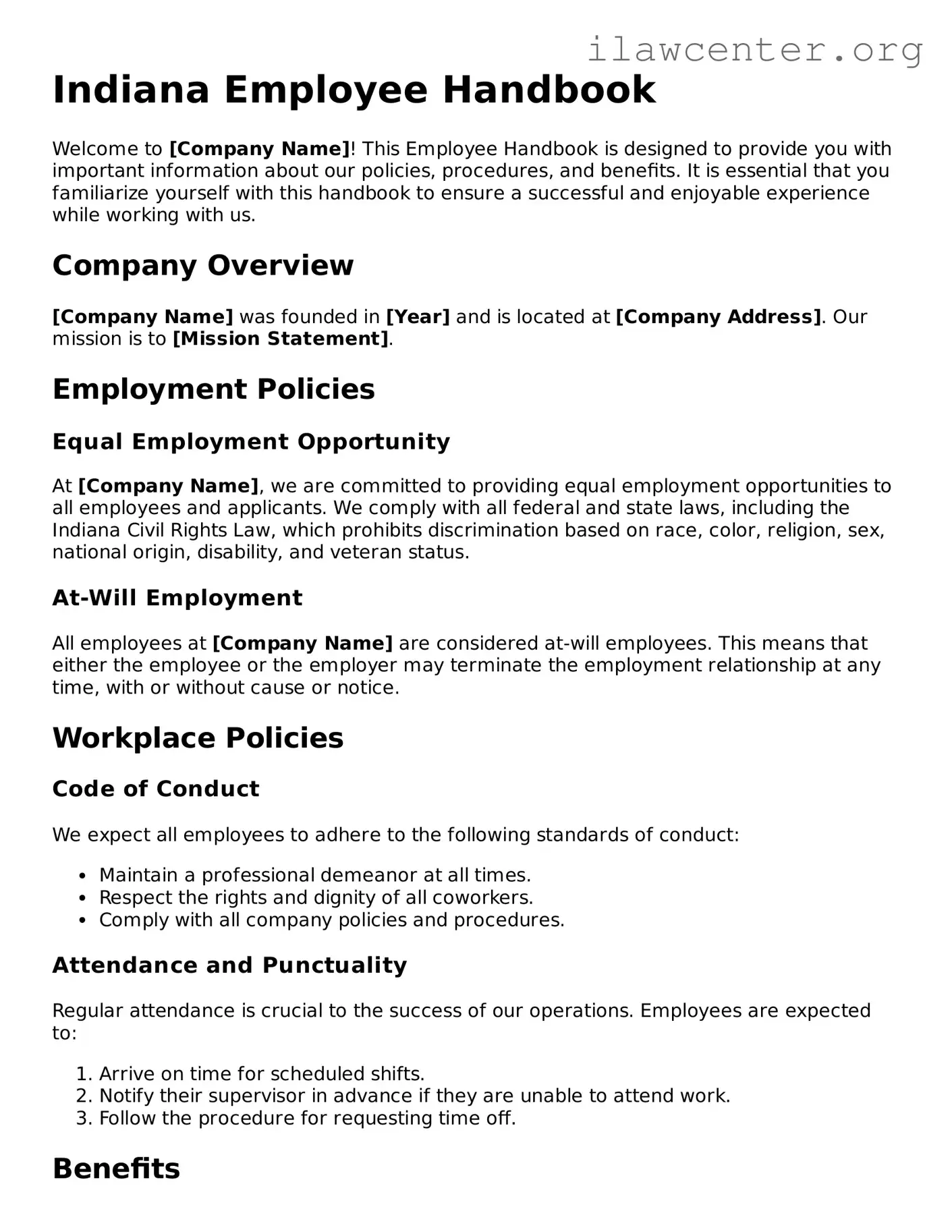
Indiana Employee Handbook Preview

Indiana Employee Handbook

Welcome to [Company Name]! This Employee Handbook is designed to provide you with important information about our policies, procedures, and benefits. It is essential that you familiarize yourself with this handbook to ensure a successful and enjoyable experience while working with us.

Company Overview

[Company Name] was founded in [Year] and is located at [Company Address]. Our mission is to [Mission Statement].

Employment Policies

Equal Employment Opportunity

At [Company Name], we are committed to providing equal employment opportunities to all employees and applicants. We comply with all federal and state laws, including the Indiana Civil Rights Law, which prohibits discrimination based on race, color, religion, sex, national origin, disability, and veteran status.

At-Will Employment

All employees at [Company Name] are considered at-will employees. This means that either the employee or the employer may terminate the employment relationship at any time, with or without cause or notice.

Workplace Policies

Code of Conduct

We expect all employees to adhere to the following standards of conduct:

  • Maintain a professional demeanor at all times.
  • Respect the rights and dignity of all coworkers.
  • Comply with all company policies and procedures.

Attendance and Punctuality

Regular attendance is crucial to the success of our operations. Employees are expected to:

  1. Arrive on time for scheduled shifts.
  2. Notify their supervisor in advance if they are unable to attend work.
  3. Follow the procedure for requesting time off.

Benefits

Health Insurance

Eligible employees may enroll in our health insurance plan after [Waiting Period]. More details can be found in the Benefits Overview section of this handbook.

Paid Time Off

We offer paid time off (PTO) to eligible employees. The accrual rate is based on your length of service:

  • [0-1 Year]: [X] hours per month
  • [1-5 Years]: [Y] hours per month
  • [5+ Years]: [Z] hours per month

Safety and Health

Your safety is our priority. [Company Name] adheres to all applicable workplace safety laws, including those set forth by the Indiana Occupational Safety and Health Administration (IOSHA). Employees are encouraged to:

  • Report any unsafe conditions immediately.
  • Participate in safety training sessions.
  • Use protective equipment as required.

Conclusion

This handbook is a guide to help you understand your role at [Company Name]. We encourage you to ask questions and seek clarification on any policies or procedures. Welcome aboard!

For further information, please contact [HR Contact Name] at [HR Contact Email] or [HR Contact Phone Number].

PDF Form Characteristics

Fact Name Details
Purpose The Indiana Employee Handbook serves as a guide for employees regarding company policies and procedures.
Legal Requirement While not legally required, having an employee handbook is highly recommended for clarity and compliance.
Governing Laws Indiana labor laws govern the contents and practices outlined in the handbook.
Contents The handbook typically includes sections on workplace conduct, benefits, and disciplinary procedures.
Updates Employers should regularly update the handbook to reflect changes in laws and company policies.
Distribution Employees should receive a copy of the handbook upon hiring and whenever significant updates occur.
Acknowledgment Employees are often required to sign an acknowledgment form to confirm they have received and understood the handbook.
Confidentiality Handbooks should include a confidentiality clause to protect sensitive company information.
Legal Review It's advisable for employers to have the handbook reviewed by a legal professional to ensure compliance.

Instructions on Utilizing Indiana Employee Handbook

Completing the Indiana Employee Handbook form is an important step in ensuring that all employees understand their rights and responsibilities. Follow these steps carefully to fill out the form accurately.

  1. Begin by gathering all necessary personal information, including your full name, address, and contact details.
  2. Locate the section for employment details. Fill in your job title, department, and the date you started working.
  3. Review the policies outlined in the handbook. Take note of any specific sections that require your acknowledgment.
  4. Sign and date the form at the designated area to confirm your understanding and agreement with the handbook policies.
  5. Make a copy of the completed form for your records before submitting it to your HR department.

Important Facts about Indiana Employee Handbook

What is the Indiana Employee Handbook form?

The Indiana Employee Handbook form is a document that outlines the policies, procedures, and expectations of an employer regarding their employees. It serves as a guide to help employees understand their rights and responsibilities within the workplace, promoting a positive and productive work environment.

Why is it important to have an Employee Handbook?

An Employee Handbook is crucial for setting clear expectations. It helps to prevent misunderstandings by providing employees with information about company policies, benefits, and procedures. Furthermore, it can protect the employer by ensuring compliance with state and federal laws, reducing the risk of disputes and legal issues.

What should be included in the Indiana Employee Handbook?

Key elements of an Indiana Employee Handbook should include company policies on attendance, conduct, harassment, discrimination, and leave policies. Additionally, it should cover compensation, benefits, and the process for resolving workplace issues. Tailoring the handbook to reflect the company culture and values is also essential.

How often should the Employee Handbook be updated?

Regular updates to the Employee Handbook are necessary to reflect changes in laws, regulations, or company policies. It is advisable to review the handbook at least annually. This ensures that the information remains current and relevant, helping to maintain compliance and clarity for all employees.

Who is responsible for distributing the Employee Handbook?

The responsibility for distributing the Employee Handbook typically falls on the Human Resources department or the management team. It is important that all employees receive a copy, whether in print or electronically, and that they acknowledge receipt to ensure they understand the policies outlined within.

What should employees do if they have questions about the handbook?

If employees have questions about the Employee Handbook, they should feel encouraged to reach out to their supervisor or the Human Resources department. Open communication is key. Employees should seek clarification on any policy or procedure that is unclear to them.

Can an Employee Handbook be legally binding?

While an Employee Handbook can outline policies and procedures, it is not typically considered a legally binding contract. However, it can create expectations for both the employer and the employee. Therefore, it’s important for employers to ensure that the language used in the handbook is clear and not misleading.

What steps should be taken if an employee violates a policy in the handbook?

If an employee violates a policy outlined in the Employee Handbook, the employer should follow the disciplinary procedures specified within the handbook. This often involves documenting the violation, conducting an investigation, and applying appropriate disciplinary measures. Consistency in enforcement is crucial to maintain fairness and integrity in the workplace.
Common mistakes

Filling out the Indiana Employee Handbook form can seem straightforward, but many individuals make common mistakes that can lead to confusion or issues later on. One prevalent error is failing to read the entire handbook before signing. Understanding the policies and procedures outlined in the handbook is crucial for employees. Without this knowledge, they may inadvertently violate company policies.

Another frequent mistake is neglecting to provide accurate personal information. This includes names, addresses, and contact details. Inaccurate information can hinder communication and create complications in payroll or benefits administration. Always double-check the details before submission.

Some employees overlook the importance of signing and dating the form. A signature indicates acknowledgment of the handbook's contents, while a date provides a record of when the employee received and reviewed the handbook. Omitting either can result in misunderstandings regarding policy acceptance.

Additionally, individuals often fail to ask questions about unclear policies. The handbook may contain complex language or concepts that are not immediately understood. Seeking clarification from a supervisor or HR representative can prevent misinterpretations and ensure compliance with company standards.

In some cases, employees do not keep a copy of the signed form for their records. Retaining a copy can serve as a reference point for future questions or concerns regarding policies. This practice is essential for maintaining clarity in employment terms.

Another mistake is ignoring the updates or revisions to the handbook. Employers may periodically update their policies, and employees should stay informed about these changes. Failing to do so can lead to unintentional violations of new rules.

Some individuals may also skip the section regarding acknowledgment of specific policies, such as harassment or safety protocols. These sections are critical for ensuring that employees understand their rights and responsibilities within the workplace. Missing this acknowledgment can create gaps in understanding.

Lastly, employees sometimes fill out the form in a rushed manner, leading to careless errors. Taking the time to carefully review and complete the form can prevent these mistakes. Attention to detail is key in ensuring that the form accurately reflects the employee's understanding and agreement with the handbook.

Documents used along the form

When creating an Indiana Employee Handbook, several other documents can complement it to ensure a comprehensive understanding of workplace policies and employee rights. These documents can help clarify expectations and provide essential information to employees. Here’s a list of forms and documents that are often used alongside the Employee Handbook in Indiana.

  • Employment Application: This form collects essential information from job applicants, including their work history, education, and references. It serves as the first step in the hiring process.
  • Offer Letter: Once a candidate is selected, an offer letter outlines the job title, salary, benefits, and other terms of employment. It formalizes the job offer and sets clear expectations.
  • Non-Disclosure Agreement (NDA): This legal document protects sensitive company information by preventing employees from sharing proprietary data with outsiders during and after their employment.
  • Employee Acknowledgment Form: Employees sign this form to confirm they have received, read, and understood the Employee Handbook. It serves as proof of communication regarding company policies.
  • Performance Evaluation Form: This document is used to assess employee performance periodically. It helps managers provide feedback and identify areas for improvement.
  • Time-Off Request Form: Employees use this form to formally request time off, whether for vacation, illness, or personal reasons. It helps maintain proper records and ensures adequate staffing.
  • Exit Interview Form: Conducted when an employee leaves the company, this form gathers feedback about the employee’s experience. It can provide valuable insights for improving workplace culture and retention.

Utilizing these documents alongside the Indiana Employee Handbook creates a well-rounded framework for managing employee relations and expectations. Together, they help foster a transparent and supportive workplace environment.

Similar forms

  • Company Policies Manual: Similar to the Employee Handbook, this document outlines the rules and guidelines that employees are expected to follow within the workplace.

  • Code of Conduct: This document details the ethical standards and behaviors expected from employees, paralleling the expectations set in the Employee Handbook.

  • Onboarding Guide: This guide assists new hires in understanding their roles and responsibilities, much like the introductory information found in the Employee Handbook.

  • Safety Manual: This document provides safety protocols and procedures, similar to how the Employee Handbook addresses workplace safety policies.

  • Employee Benefits Guide: It outlines the benefits available to employees, echoing the sections in the Employee Handbook that cover compensation and benefits.

  • Performance Review Guidelines: This document explains the performance evaluation process, akin to the performance expectations mentioned in the Employee Handbook.

  • Leave of Absence Policy: It details the procedures for requesting time off, similar to how the Employee Handbook addresses leave policies.

  • Disciplinary Procedures Document: This outlines the steps taken when addressing employee misconduct, paralleling the disciplinary actions mentioned in the Employee Handbook.

  • Grievance Procedure Manual: This document explains how employees can report issues or complaints, much like the grievance process outlined in the Employee Handbook.

Dos and Don'ts

When filling out the Indiana Employee Handbook form, it is important to follow certain guidelines to ensure accuracy and compliance. Below are nine things to consider.

  • Do read the entire handbook before filling out the form to understand the policies and procedures.
  • Do provide accurate personal information, including your name, address, and contact details.
  • Do ask questions if you do not understand any part of the form or the handbook.
  • Do keep a copy of the completed form for your records.
  • Do submit the form by the specified deadline to avoid any delays in processing.
  • Don't leave any required fields blank; this may lead to processing delays.
  • Don't provide false information, as this could result in disciplinary action.
  • Don't rush through the form; take your time to ensure everything is filled out correctly.
  • Don't forget to sign and date the form where indicated.

Misconceptions

There are several misconceptions regarding the Indiana Employee Handbook form that can lead to confusion among employers and employees. Understanding these misconceptions is important for ensuring compliance and clarity in the workplace.

  • Misconception 1: The Employee Handbook is optional for all businesses.
  • While not all businesses are legally required to have an Employee Handbook, it is highly recommended. A well-drafted handbook can help clarify policies and expectations, reducing misunderstandings.

  • Misconception 2: The Employee Handbook must include every possible policy.
  • It is not necessary to include every policy or procedure in the handbook. Employers should focus on the most important policies that govern the workplace, such as anti-discrimination and harassment policies.

  • Misconception 3: Once created, the Employee Handbook does not need to be updated.
  • Employee Handbooks should be reviewed and updated regularly. Changes in laws, company policies, or workplace practices may necessitate revisions to ensure the handbook remains relevant and compliant.

  • Misconception 4: Employees must sign the Employee Handbook to acknowledge receipt.
  • While it is beneficial to have employees acknowledge receipt of the handbook, it is not a legal requirement. However, obtaining a signed acknowledgment can help protect the employer in case of disputes.

  • Misconception 5: The Employee Handbook can override state and federal laws.
  • Handbooks cannot supersede existing laws. They should be designed to comply with all applicable laws. If a policy in the handbook conflicts with the law, the law prevails.

  • Misconception 6: All employees must be treated the same according to the Employee Handbook.
  • While the handbook outlines general policies, employers may need to make exceptions based on individual circumstances. Flexibility can be important in addressing specific employee needs.

Key takeaways

When filling out and using the Indiana Employee Handbook form, there are several important points to keep in mind. Understanding these key takeaways can help ensure that your handbook is effective and compliant.

  • Customization is Essential: Each employee handbook should reflect the specific policies and culture of your organization. Generic templates may not address your unique needs.
  • Clarity is Key: Use clear and straightforward language. Employees should easily understand the policies and procedures outlined in the handbook.
  • Regular Updates are Necessary: Laws and regulations change frequently. Review and update your handbook regularly to ensure it remains compliant with current laws.
  • Include Acknowledgment Forms: Incorporate a section for employees to sign, acknowledging that they have received and understood the handbook. This can be important for legal purposes.
  • Encourage Feedback: Create an open channel for employees to provide feedback on the handbook. This can help identify areas for improvement and foster a positive workplace culture.

By keeping these takeaways in mind, you can create a comprehensive and effective employee handbook that serves both your organization and its employees well.